China's weekly invocation volume of large models ranks top across the globe, Kimi K3 ignites the price war
For a long time, overseas closed-source models have dominated the high-price market and monopolized high-end evaluation rankings, but this situation was completely broken when Moonshot AI open-sourced the full weights of its flagship model K3 on July 27.
Recently, in the latest Frontend Code Arena ranking of the internationally authoritative evaluation platform Arena.ai, Kimi K3 took the top spot strongly, achieving a lead in three key tracks: ultra-long text processing, complex task planning and code generation, with its overall performance ranking among the world's first tier.
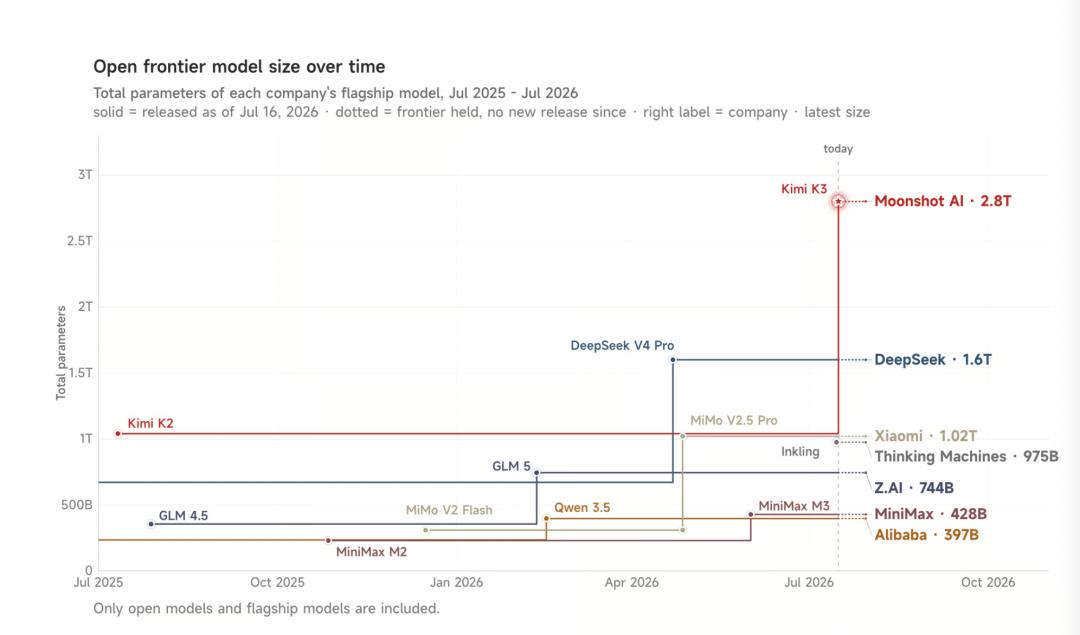
Source: Kimi official website
The strong breakout of Kimi K3 is not an isolated case, as domestic large models are continuously dominating global rankings with a collective rising momentum.
According to the latest data from OpenRouter, in the global large model Token call ranking of last week (July 27 to August 2), the top five positions were all taken by local Chinese AI products for the first time, marking that the weekly call volume of Chinese large models has surpassed that of the United States for 14 consecutive weeks, ranking firmly first in the world. Among them, DeepSeek-V4-Flash topped the list with a weekly call volume of 7.22 trillion Tokens.
Time Finance interviewed a number of industry insiders including venture capitalists, AI practitioners and market researchers, and found that the "dimensionality reduction strike" capability demonstrated by Kimi K3 — that is, lower price under the same performance, and better performance at a lower price — not only breaks the long-term dominance of overseas closed-source models in the high-price market, but also directly triggers the restructuring of the global large model pricing logic.
Kimi K3 prompts overseas giants to cut prices overnight and enter passive defense mode
In the latest Frontend Code Arena ranking of the internationally authoritative evaluation platform Arena.ai, Kimi K3 scored 1679 points, surpassing Claude Fable 5 under Anthropic to take the top spot strongly, achieving a full lead in the three key tracks of ultra-long text processing, complex task planning and code generation, with its overall performance ranking among the world's first tier, and even won praise from Elon Musk.
On Friday of that week, the Moonshot AI team held a celebration banquet in Sanlitun, Beijing, which was called "Rush to the Moon" by the industry. The eye-catching slogans such as "Push K4 to the extreme" and "Rush to the Moon" on site are not only a carnival of technological breakthroughs, but also mark that domestic large models have officially launched a full-scale impact on the global market.
On the other side of the ocean, the shock wave brought by Kimi quickly spread to Silicon Valley. Faced with the "dimensionality reduction strike" capability demonstrated by Kimi K3 — that is, extremely low price under the same performance, and even better performance at a lower price, the US closed-source model company Anthropic felt a chill.
On July 24, Anthropic urgently launched its new flagship model Claude Opus 5, and sharply reduced the call pricing: only $5 per million input Tokens and $25 per million output Tokens, the price was directly cut to half of Fable 5, the model that once ranked first in the evaluation.
Anthropic explicitly emphasized externally that this price cut does not sacrifice the model's intelligence level, and Opus 5 can achieve the comprehensive capability close to Fable 5 at half the cost.
Anthropic's active price cut has affected the nerves of the entire US AI industry. Time Finance found that OpenAI announced on its official website on July 30 that the price of GPT-5.6 was reduced by 20% to 80%. The platform will also launch a Fast mode to replace the original priority processing service, with a speed up to 2.5 times that of standard processing, but the price is only 2 times higher.
Technological breakthroughs have brought a series of chain reactions, and the performance of the capital market is particularly fierce.
After the release of Kimi K3, the US stock AI sector as a whole fluctuated in the second half of July, with the total market value of the sector evaporating by about 470 billion US dollars, equivalent to 3.2 trillion RMB; 17 Wall Street investment banks lowered the target valuation of AI chip companies overnight. Goldman Sachs partners released an industry research report warning that if China's high-performance, low-cost open-source models maintain the current iteration pace, the long-term high capital investment of US AI enterprises will be unsustainable, and the global disorderly computing power expansion cycle may usher in an inflection point.
Farewell to high premium: the cost advantage of domestic open-source large models emerges
On the one hand, the shock wave of Kimi K3 shook Silicon Valley across the ocean, and on the other hand, it also caused a huge shock in the domestic large model circle. When a company demonstrates the capability of "dimensionality reduction strike", the original balanced pattern of the "Four Dragons" is instantly broken.
After the release of Kimi K3, two independent large model listed companies on the Hong Kong Stock Exchange, Zhipu AI (02513.HK) and MiniMax (00100.HK), showed obvious stock price fluctuations.
For Zhipu AI, in the two trading days after the release of Kimi K3, the maximum pullback of Zhipu AI's stock price was about 42.47%, and the market value evaporated by more than HK$200 billion in the short term. JPMorgan Chase released an artificial intelligence industry research report on July 21, adjusting Zhipu AI's narrative from "the continuous leader of domestic models" to "one of China's cutting-edge AI laboratories", lowering the expected price-earnings ratio in 2030 from 30 times to 20 times, lowering the target price from HK$2400 to HK$1600, and maintaining the overweight rating, on the grounds that the fundamentals of Zhipu's B-end MaaS and privatization revenue have not deteriorated significantly.
CLSA also reiterated its "outperform" rating on Zhipu AI with a target price of HK$2061. CLSA believes that K3 accelerates the global API (Application Programming Interface) price discovery, and the pricing pressure on GPT-5.6 Sol/Fable 5 may be greater than that on domestic peers, but the overall pricing direction is reasonable, with intelligence level and underlying cost as the main driving factors.
JPMorgan Chase judges that the iteration speed of domestic large models continues to accelerate, and a single manufacturer cannot occupy a leading technical position for a long time, but the current industry computing power supply is limited, and the market is not a zero-sum competition. Zhipu's GLM series is still in the domestic top tier, and subsequent new models are expected to continuously drive revenue. For MiniMax, JPMorgan Chase judges that its multi-modal product line has long-term value, but the model performance is still in the catching-up range, and the industry also has downside risks such as geopolitics and high R&D expenditure.
A large model engineer from a US AI unicorn company pointed out to Time Finance that the recent passive price reduction and defense of overseas giants is not a short-term emotional "stress" response, but a real realization that Chinese domestic large models are building a cost-performance advantage that is difficult to replicate.
Calculation data from third-party institutions shows that the comprehensive cost of a single task of Kimi K3 is about $0.94, slightly better than $1.04 of GPT-5.6 Sol, and only half of Claude Opus 4.8 ($1.80); there is a significant gap in underlying cache optimization, with the unit price of domestic model cache hits as low as $0.3, which is only one-thirtieth of similar overseas products.
A venture capitalist focusing on the AI track told Time Finance that the cost advantage of domestic large models is reflected in two aspects: in terms of computing power acquisition, China has significantly reduced the high power cost relying on the "East Data, West Computing" project and green power direct supply, and got rid of the dilemma of overseas dependence on high-price on-demand computing power leasing through domestic chip adaptation and long-term annual package discounts from cloud vendors; in terms of engineering optimization, domestic manufacturers have increased GPU utilization to over 70% through innovative technologies such as Mixture of Experts (MoE), KV Cache compression and dynamic batching, making every calculation "make the most of its value".
The solid cost base gives domestic manufacturers led by Kimi the confidence in pricing, and all enterprises have also arranged prices in layers according to their own technical characteristics.
Time Finance learned that taking the cost-effective route as an example, DeepSeek has greatly reduced the reasoning cost through self-developed Mixture of Experts (MoE) and sparse attention technology, the overall price of its flagship model has been reduced by 75%, and the unit price of cache hits is as low as 0.025 RMB per million Tokens. In sharp contrast, Zhipu's GLM-5 series, with its good performance in complex system engineering and long-range Agent tasks, has raised prices by 83% cumulatively in the first half of 2026, but the market call volume still soared by 400%, successfully verifying the commercial logic of "performance premium".
At the same time, manufacturers led by Kimi have taken another sustainable commercialization path. Zhong Xinlong, associate researcher of the Future Industry Research Center of China Electronics Information Industry Development Research Institute, interpreted to Time Finance that Kimi K3 has now built a complete commercialization system, covering four basic sectors: member subscription, API call, programming development tools and enterprise customization services; at the same time, it expands diversified revenue channels relying on cloud reasoning, exclusive model fine-tuning, agent development platform, vertical industry solutions and one-on-one technical supporting services, taking a sustainable commercialization path for domestic large models.
Yuan Shu, co-founder of the New Quality Productivity Salon of Xinzhi Pai, believes that the transformation of domestic open-source large models from free "land grab" to tiered charging is exactly a sign of the industry's maturity. Only by finding a balance between commercial sustainability and technology inclusiveness, can they truly move from a simple "technology competition" to thousands of industries, and become a productivity tool that can create practical value.
The second half of China-US AI competition: from technical barriers to a comprehensive game of pricing power and ecosystem
Large models are shedding the attribute of "high-end technical luxury goods" and transforming into the infrastructure of the digital industry. The market pricing logic has also been restructured accordingly: model pricing is no longer simply determined by technical leadership, and cost performance, Agent adaptation capability, multi-tool collaboration compatibility and the perfection of supporting ecosystems have become the core criteria for enterprise selection.
Justin Summerville, a data analysis expert at OpenRouter, predicts that the open-source Chinese models have performance close to the top level, but the cost is 60% to 90% lower than the leading US models from Anthropic and OpenAI. This highly competitive cost advantage has prompted some large US companies to turn to Chinese large models.
Brian Chesky, CEO of Airbnb, said recently that Airbnb is currently very dependent on using Alibaba's Tongyi Qianwen model, and praised it as "fast and cheap". Behind this transformation is the calm review of the input-output ratio of AI by enterprises.
Cindy Rose, CEO of advertising giant WPP, also said that the number of Agents owned by the company is more than the number of employees, and many Token expenses are not included in the original budget at all; Praveen Nipally Naga, CTO of US company Uber, also said that the company burned through the whole year's AI budget in just four months.
It is precisely this anxiety about cost runaway that forces enterprises to return to rationality.
A technical manager of a multinational enterprise confessed to Time Finance that enterprises do pursue stronger basic capabilities when purchasing large models, but in the actual business implementation, the weight of two factors is continuously increasing: one is the comprehensive cost performance, and the other is the native capability of the model to adapt to Agent, tool call and MCP collaborative architecture.
Faced with the strong breakout of Chinese AI, the attitudes within the United States are divided.
On July 22, Michael Kratsios, Director of the White House Office of Science and Technology Policy, claimed that Moonshot AI developed Kimi K3 by "distilling" the technology of US company Anthropic; US Treasury Secretary Bessant even threatened to use sanctions and the "Entity List" to deal with such behaviors of Chinese enterprises. Jensen Huang, CEO of NVIDIA, publicly expressed different opinions, pointing out that the United States should not ban such large models, and emphasizing that Chinese large models are very excellent, and artificial intelligence technology will penetrate into more industries.
All signs indicate that the high premium barriers established by overseas large model manufacturers relying on their first-mover technical advantages are being continuously broken through by domestic large models with both low cost and high performance. Guo Tao, an angel investor in the artificial intelligence field, told Time Finance that domestic large models are ushering in a historical opportunity to accelerate their going global with their significant cost advantages. In the future, enterprises should focus on building unique technical barriers and ecosystem stickiness, and create a world-class AI application paradigm.
(Intern Wang Yuqian also contributed to this article)
This article is from the WeChat official account "Time Finance APP" (ID: tf-app), written by Zhao Shuchan and Pang Yu, authorized for release by 36Kr.