AI is finally able to spend money on its own. The company that once crashed half of the internet has built an Alipay for Agents.
Even though the development of Agent is in full swing at the moment, these AI agents that claim to outperform humans in intelligence are essentially unregistered "outlaws" in the internet payment ecosystem.
They lack stable identities and native payment capabilities. When faced with login pages, verification codes and credit card forms, AI often has to interrupt tasks due to security factors, and hand over registration, payment and key generation back to humans.
To enable Agent to truly enter a closed commercial loop, the thresholds of identity and payment must be crossed.
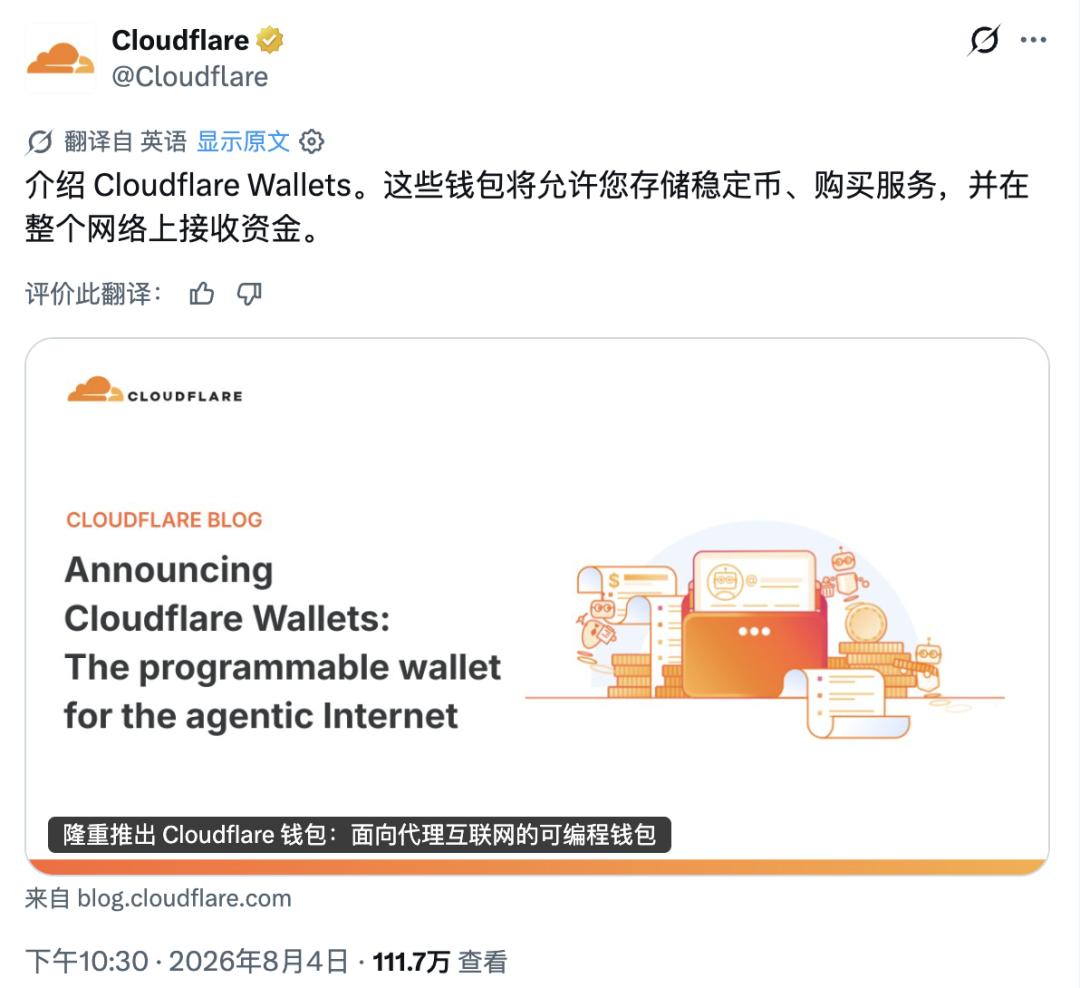
Official blog address: https://blog.cloudflare.com/wallets/?utm_campaign=cf_blog&utm_content=20260804&utm_medium=organic_social&utm_source=twitter
And at this very point, I found that Cloudflare, known as the "No.1 security guard of the internet", officially launched Cloudflare Wallets, a programmable wallet for AI agents, today.
Users can already claim a Wallet Handle for their own Cloudflare account to get a unique readable username. Full features including wallet top-up, collection, payment and virtual wallet will be opened one after another in subsequent updates.
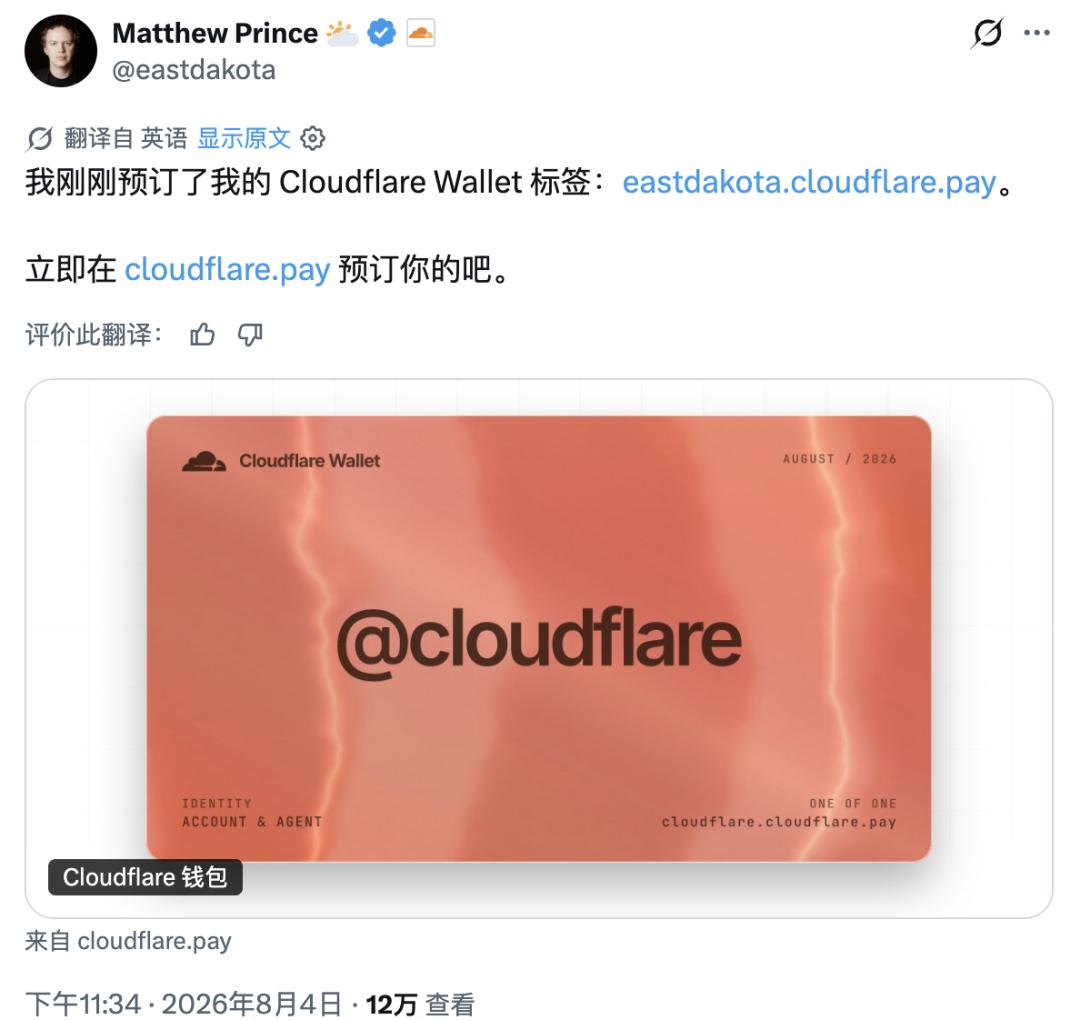
Cloudflare CEO Matthew Prince
Combined with the Monetization Gateway released earlier, what Cloudflare intends to build is a set of payment, identity and commercial infrastructure for Agents, trying to take charge of all transaction businesses of AI on the internet.
Issue a "pocket money" secondary card for AI
To understand what problems Cloudflare Wallets solves, you can first look at how many steps AI currently needs to go through to call a paid API.
Find the registration page -> Call for human help -> Human fills in information -> Bind credit card -> Pass verification code -> Get API Key -> AI can finally work. This process is simply a nightmare for AI that needs to compare hundreds of data sources.
Cloudflare's solution is to embed the payment logic directly into the network protocol.

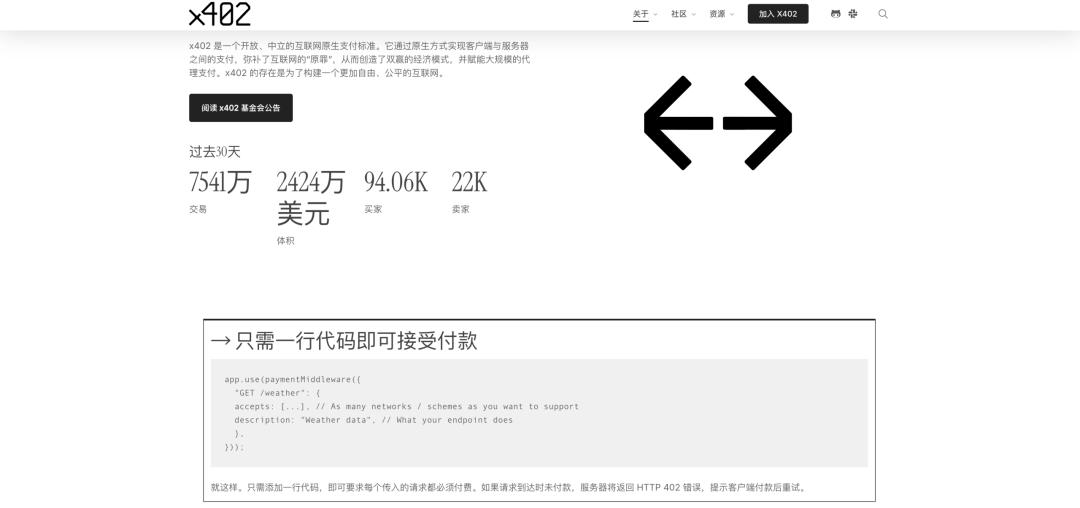
They adopted an extremely hardcore technology called the x402 protocol. You can simply understand it as a protocol that directly attaches payment requirements to HTTP requests.
When AI requests a paid service, the server can return the price and payment conditions. After AI completes the payment, it can immediately continue to obtain content or call the interface. The whole process does not require opening a web page or filling in a credit card form.
To prevent AI from maxing out its owner's card, Cloudflare has also designed a two-tier wallet system.
The first is the Account Wallet, which is controlled by the human administrator.
The other is the Virtual Wallet, which is exclusively issued to AI agents.
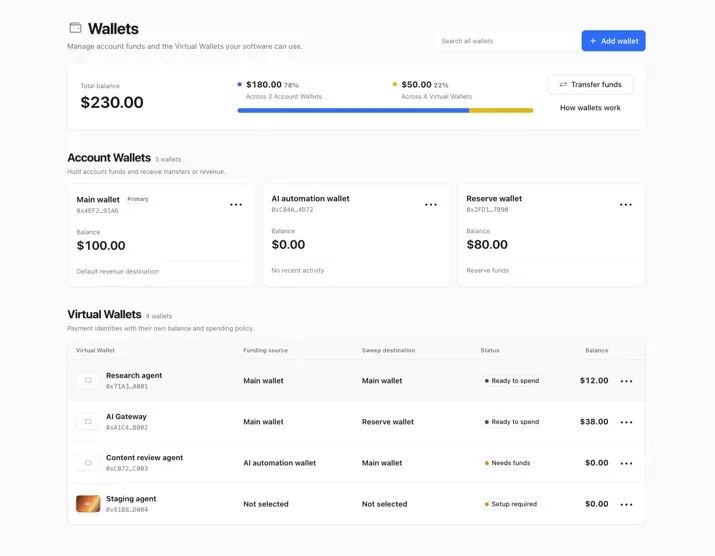
This virtual wallet is the real "masterstroke".
In essence, it sets an insurmountable "loss cap" for AI.
Let's take an example.
If your AI housekeeper holds a credit card with a $10,000 credit limit bound to your account, would you dare let it wander around the internet on its own? You would definitely not be able to sleep at night, fearing that it would go haywire and buy a bunch of useless API services.
But what if you only put $10 in its virtual wallet? You would say: "Go ahead, spend as you like, I'll cover all the costs after you use them up!" (just kidding)
When AI can lose at most $10, humans can completely delegate authority. $10 is enough for AI to test hundreds of different API services in the world of micro-payments, comparing which one has the most accurate data, the fastest response, and the highest cost-effectiveness.
The autonomy of AI does not depend at all on how smart it is, but on human psychological expectation for the "worst possible outcome". Using magic to defeat magic, exchanging extremely small credit limits for extremely large freedom, this is the real first principle.
As long as the budget is strictly locked, AI can run freely on the internet, make mistakes on its own, and complete natural selection on its own. Humans only need to check the bill at the end of the month.
Similar ideas have begun to enter domestic consumption scenarios.
WeChat Pay released the "AI Exclusive Card" not long ago, and WorkBuddy became one of the first batch of agent platforms to access it.
Users can directly tell WorkBuddy what they want to eat, and let AI complete the process of finding restaurants, getting discounts, filtering set meals and initiating payments.

However, the payment method of the AI Exclusive Card is relatively cautious.
The AI Exclusive Card has an independent credit limit, and users can decide how much money to transfer into it. Each payment still requires the user to personally confirm on the mobile phone before the funds are actually deducted.
Special funds for special use, and confirmation for every transaction. AI is responsible for finding products and executing processes, while humans retain the final payment right.
Cloudflare Virtual Wallet and WeChat Pay AI Exclusive Card represent two paths for Agent payment. Cloudflare is more inclined to preset budgets and permissions, allowing Agents to consume independently within the credit limit; WeChat Pay lets AI complete the pre-process, and the user confirms the final step.
The two are applicable to different scenarios, but they are moving in the same direction.
AI is evolving from a Q&A assistant to a transactional agent that can search, compare prices, place orders and make payments. The wallet is no longer just a payment tool, but an entry for humans to control the budget and permissions of Agents.
Agents have become internet VIPs in the AI era
The money problem is solved, but this is not the end of the story.
AI goes to knock on the door with money, why should the merchants on the other side trust it?
You know, in the past two decades, the underlying security logic of the entire internet is to "keep all robots out". All verification codes, device fingerprints and risk control models are designed to identify those non-human "cyber phantoms".
When website administrators see non-human traffic, their first reaction is to block the IP and add it to the blacklist.

Why? Because they are afraid of being exploited for benefits.
For example, new users get $10 as a sign-up bonus. If it is a real human, it is acceptable to claim the bonus once. But if it is a robot? It can generate thousands of clones in one second, instantly crashing both the merchant's server and budget.
AI without identity is like a stranger wearing a mask and holding cash, no one dares to do business with it.
At this time, Cloudflare took out another trump card: cloudflare.pay.
This is an exclusive Wallet Handle, which you can understand as issuing a stamped "electronic ID card" for AI. In the future, when AI browses the internet, it can choose to show its identity.
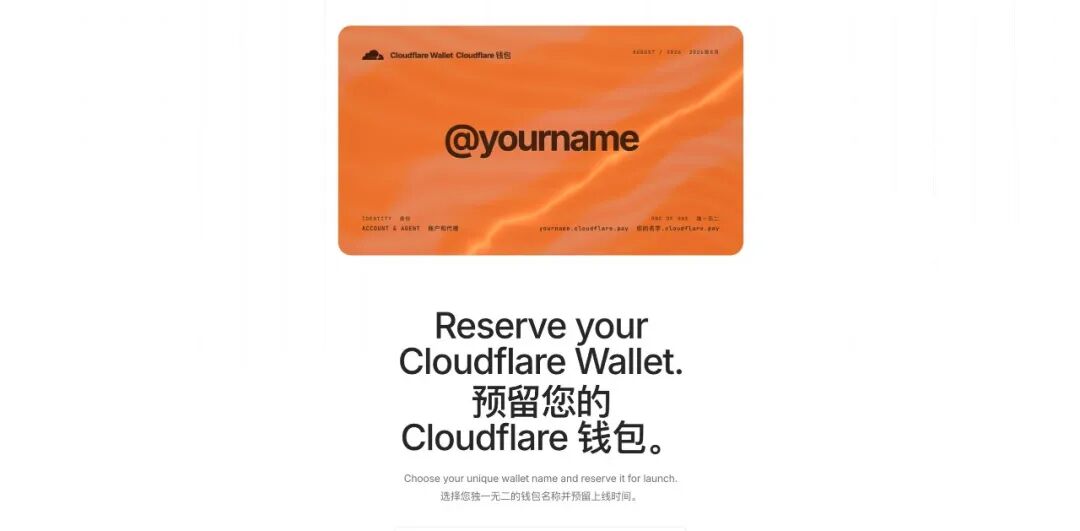
For example, it knocks on the door with the identity tag research.example.cloudflare.pay. The merchant checks the server log and says: "Oh, this is the regular army sent by a large well-known company, with budget, good credit and no malicious records, come in quickly!"
This transformation of identity verification can be said to be a major reshuffle in the history of the internet.
In the past, everyone's question was: "Are you a human or a machine?" Now everyone's question has become: "Which company sent you as a machine? Do you have money? What's your credit like?"
Cloudflare does not force everyone to use its own system, they claim that they only provide a simple and readable identifier, and will support more Agent identity standards in the future.
But the ambition behind this is obvious to all.
After all, this is a huge moat. When all machine transactions recognize this identity identifier, Wallet Handle will become the domain name in the AI era.
Under this system, high-quality robots with real budgets and clear affiliations will become the most distinguished VIP customers of the next generation internet.
Machines pay, humans enjoy
If you think this is the end, you are underestimating the power of this set of infrastructure. When AI has wallets and identities, a brand new commercial era is about to begin.
Cloudflare named this new world: Headless Marketplace.
What does "headless" mean? It means there is no "head" (front-end web page), only the "body" (underlying interface).
Let's recall the current e-commerce and internet. In essence, all web page designs are "catering" to human senses, or in other words, "manipulating" human dopamine.
Gaudy carousel images, attractive promotion copy, extremely eye-catching "Buy Now" buttons, and even deliberately created sense of scarcity. All of these are designed to make you, as a human, stay two more seconds and make impulsive purchases.
But will AI pay for a product just because the model on the web page looks good? Will it feel anxious because you write "Last day for limited-time offer"? (just kidding)

Absolutely not!
Machines have no emotions, nor brand loyalty. In the eyes of AI, the world is just a pile of cold structured data in JSON format. When AI buys things, it only focuses on indicators such as data accuracy, interface latency, and single-call cost.
You can imagine such a scenario. One day in the future, you say to your mobile phone: "Help me arrange the entire business trip to Shanghai next week, with a budget of 10,000 dollars, and the accommodation should be close to the subway station."
Your AI agent gets this 10,000-dollar budget, instantly turns into a ruthless price bargaining machine, and simultaneously calls the API interfaces of more than a dozen airlines and hotels in the background at millisecond speed.
All price comparison, identity verification, and micro-payments are completed instantly in the "HTTP request base" that humans cannot see. A few seconds later, there is only a perfect itinerary and a deduction bill left on your mobile phone screen.

This is the real headless e-commerce.
Humans are only responsible for issuing instructions and enjoying the results, while machines complete all requirements in the background. For existing API suppliers and SaaS software companies, this is almost a brutal reshuffle.
In front of machine buyers, the gold content of brand premium will be quickly compressed. Infrastructure stability, computing power scheduling capability and price efficiency are the core competitiveness of the headless marketplace.
However, Cloudflare also pointed out that the internet will not shift to the Agent economy overnight, and an open market does not necessarily weaken the power of infrastructure platforms.
When identity, payment, traffic, merchant access and risk control are all concentrated on Cloudflare, it will also master the purchase records, call frequency and transaction relationships of agents.

Login pages are disappearing, but intermediaries have not disappeared, they have only moved from front-end web pages to more underlying network infrastructure.
The