AI has sparked a huge craze for excavators, are civil engineering practitioners finally saved?
As tech companies continue to expand their investment in AI infrastructure, AI-driven orders are flowing to an enterprise that seemingly has no connection with large models — an industrial firm that manufactures excavators, bulldozers and power generation equipment.
On August 4, Caterpillar (CAT), the global construction machinery giant, released its financial report featuring strong growth performance.
In the second quarter, the company's revenue reached 20.54 billion US dollars, a year-on-year increase of 24%; new orders hit 9.4 billion US dollars, and the order backlog rose to a record high of 72.1 billion US dollars. The company also raised its full-year revenue growth forecast at the same time.
Behind this impressive performance are AI data centers that are expanding across the globe.
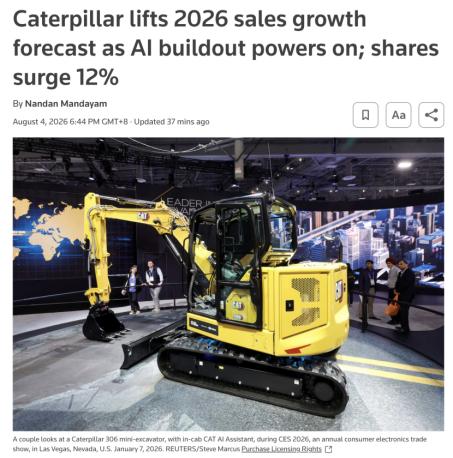
The AI gold rush is now extending into the real economy.
The demand it brings is not only reflected in GPUs, servers and cloud computing platforms, but also starts to spread along the infrastructure chain to civil engineering, power supply, equipment manufacturing and engineering services.
AI Data Centers First Spark a Massive Infrastructure Boom
To figure out whether AI infrastructure investment has really landed, Caterpillar's financial report may be a more direct observation window than the vision speeches delivered by tech companies.
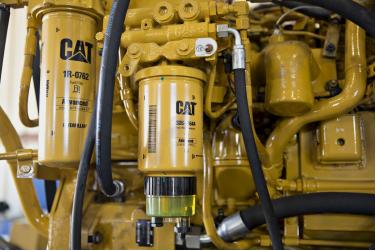
As one of the world's largest construction machinery manufacturers, Caterpillar has long been regarded as the "thermometer" of the global industrial economy. Its excavators, bulldozers, diesel engines and power generation equipment are widely used in construction, mining, energy and infrastructure projects, and changes in its order volume often reflect shifts in enterprise investment and infrastructure activities.
On August 4, Caterpillar released its second-quarter financial results.
The company's quarterly revenue reached 20.54 billion US dollars, up 24% year on year; new orders hit 9.4 billion US dollars, and the order backlog rose to a record 72.1 billion US dollars.
Driven by strong market demand, the company also raised its full-year revenue growth forecast.
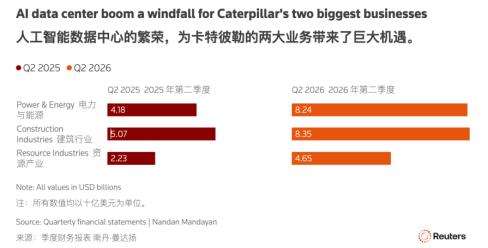
Among them, the revenue of the construction industries segment in the second quarter increased by 35% year on year to 8.35 billion US dollars; the revenue of the energy & power segment rose 17% year on year to 8.24 billion US dollars.
Caterpillar stated that data center construction is becoming a key factor driving demand growth.
As technology companies including Microsoft, Google and Amazon continue to expand their AI infrastructure investment, large-scale data centers are being built across the world. But before GPUs and servers are moved into computer rooms, these projects need to complete more fundamental works first: land leveling, building construction, power access, backup power generation and energy system construction.
The two segments that saw the most prominent growth of Caterpillar this time exactly correspond to two key links in AI data center construction.
On one hand, a large-scale data center is a massive infrastructure project rather than a simple server installation task. A large number of construction machinery units are required for links from land development, site leveling to plant construction and construction equipment input, which drives the development of the construction industries business.
On the other hand, as the demand for AI model training and inference grows, data centers' demand for electricity keeps rising. In regions where grid supply is insufficient or the construction cycle is relatively long, backup power generation equipment has become a critical facility for data centers to ensure stable operation, which pushes the growth of the energy & power business.
AI infrastructure investment is spreading along a path that has received little public attention before:
Nvidia's GPUs are the most eye-catching "shovels" in the AI era.
But to complete the actual construction of a data center, another type of more traditional "shovels" are also needed — excavators, bulldozers and power generation equipment.
As AI infrastructure construction enters the practical implementation stage, investment is spreading from chips and servers to the construction, power and industrial equipment chains.
Over the past year, Caterpillar's stock price has significantly outperformed the S&P 500 index, as investors are betting that AI infrastructure construction will bring a new growth cycle to traditional industrial enterprises.
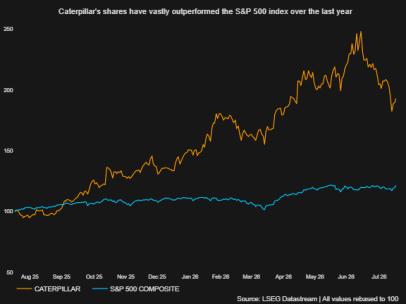
After the financial report was released, the market gave a direct feedback. Caterpillar's share price rose by about 12%, marking its largest single-day gain in 17 years.
From Selling Excavators to Transforming Excavators with AI
The impact brought by AI is not only creating new orders for traditional industrial enterprises. For these manufacturers, AI is also changing their own production methods and product forms.
Over the past decades, construction machinery enterprises mainly competed in mechanical design, manufacturing capabilities and global supply chains: excavators, cranes and mining trucks are, in the final analysis, all large mechanical equipment.
But with the development of AI, sensors and industrial data, equipment is evolving from pure hardware to intelligent systems that can perceive the environment, analyze data and assist decision-making.
The construction machinery industry is also standing at the same inflection point.
Caterpillar has begun to explore embedding AI capabilities into construction machinery.
In 2026, the company launched the AI-based AI Assistant, to help operators query equipment information, obtain maintenance suggestions and lower the threshold for equipment use.
At the same time, Caterpillar is also pushing forward the R&D of automated equipment, extending the autonomous driving technology previously applied in the mining sector to more construction scenarios.
In China, Sany Group is also promoting similar transformation.
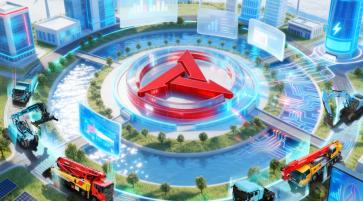
When promoting AI implementation, Sany chooses to start from its internal business scenarios, combining industry knowledge, production processes and business data with AI.
In June 2026, Xu Guoqiang, CIO of Sany Group, disclosed that the company has accumulated more than 1.3 million pieces of industry-specific knowledge, iteratively trained more than 10 vertical industry models, with AI applications covering more than 700 business scenarios across the group, generating an annual economic benefit of over 200 million yuan.
These applications cover links including R&D, manufacturing, supply chain and after-sales service.
For example, in after-sales service, Sany has precipitated the maintenance experience accumulated by a large number of engineers for years into an enterprise knowledge base, and uses AI to assist equipment fault diagnosis.
In the past, equipment maintenance relied heavily on the empirical judgment of senior engineers; with AI, Sany can combine equipment data, historical cases and maintenance knowledge to help engineers locate problems faster.
In the supply chain link, AI also helps Sany Group carry out material identification, procurement analysis and process optimization, reduce repetitive work and improve operational efficiency.
Similar changes are taking place in more traditional manufacturing enterprises.
John Deere, the American agricultural machinery manufacturer, is using computer vision and AI models to transform agricultural equipment.
Its See & Spray intelligent spraying system can identify weeds in farmland through cameras, and spray pesticides only on target areas, so as to reduce pesticide use; its self-driving tractors use AI to perceive the environment and achieve a higher degree of automated operation.
Komatsu, the Japanese manufacturing enterprise, is also promoting intelligent mines, and improving mine operation efficiency through unmanned mining trucks, automatic transportation systems and construction data platforms.
For these manufacturing enterprises, AI is becoming an important tool to drive the next stage of industrial intelligence.
AI Gold Rush is Expanding Industrial Infrastructure
The most direct beneficiaries of AI infrastructure investment are usually the enterprises that are closest to the models.
Nvidia provides GPU computing platforms; SK Hynix and Micron supply HBM and storage products required by AI; TSMC undertakes advanced process manufacturing and advanced packaging; Broadcom provides data center network chips and connection solutions. Domestic storage manufacturers such as ChangXin Memory Technologies are also expanding production layouts around the storage demand brought by AI.
But AI infrastructure is not only made up of GPUs, servers and cloud computing. It also includes the engineering equipment required for data center construction, the power systems needed to ensure the operation of data centers, and the industrial capabilities that support the operation of the entire industrial chain.
As the scale of AI data centers expands, dividends continue to spread along the infrastructure chain.
Enterprises including Vertiv, Schneider Electric, Eaton and Delta Electronics benefit from the power supply, power management and heat dissipation demands inside data centers; energy equipment enterprises such as GE Vernova benefit from the new power generation and grid investment demand brought by AI.
And Caterpillar's financial report shows that this chain is continuing to extend to more traditional industrial manufacturing links.
What AI infrastructure construction ultimately needs is not only chips and servers, but also land development, building construction, power guarantee and a large number of industrial equipment.
The market is therefore re-evaluating the value of these companies.
When Caterpillar's share price rises, investors are not only paying attention to equipment sales volume, but also watching whether the expansion of AI infrastructure can become a new source of demand in the future.
At the same time, AI is also transforming these industrial enterprises themselves.
Large models provide general capabilities, but to truly land in industrial sites, it is also necessary to understand specific equipment, specific processes and specific environments. In the AI era, the long-accumulated data, industry knowledge and real application scenarios of these enterprises have also become important resources for AI implementation.
Companies like Nvidia provide the computing power for the AI era.
But the beneficiaries of the AI gold rush are not only chip manufacturers. As AI infrastructure continues to expand, energy, equipment and industrial manufacturing enterprises are also entering this new industrial chain.
This article is from the WeChat official account "Letter AI", written by Yuan Xinyue, and authorized for release by 36Kr.