36Kr Exclusive | Two "Triple-Tsinghua" PhDs co-founded a space situational awareness service provider and completed tens of millions of yuan in Angel+ round financing.
Author | Qiao Yujie
Editor | Yuan Silai
36Kr has learned that space situational awareness firm "Qingbo Aerospace" has recently completed tens of millions of yuan in Angel+ round financing. This round of financing is led by Minghui Investment, with participation from Xingxiang Investment and Taiya Investment. Maple Pledge Capital acts as the private equity financing advisor. The funds from this round will be mainly used for the construction of the space target monitoring network, the iteration of the space situational awareness algorithm platform, the expansion of the core technical team and the development of key customers.
With the rapid growth of the number of low-orbit satellites and space debris, near-Earth orbit is becoming more crowded, and the risk of satellite collisions is rising accordingly. Space Situational Awareness (SSA) has gradually become an important basic capability for satellite operation.
In the past, domestic tasks such as space target monitoring and orbit early warning were mainly undertaken by national-level scientific research and engineering systems. However, as commercial aerospace enters the stage of large-scale development, a large number of commercial satellites are put into orbit, and satellite operators' demand for services such as collision early warning and orbit safety management continues to increase, making the market urgently need commercial space situational awareness solutions.
Founded in August 2025, Qingbo Aerospace is a technology service company focusing on the space security field. It mainly serves customers such as satellite operators and constellation builders, providing in-orbit satellites with space situational awareness, space debris monitoring and collision early warning services.
Space situational awareness solves the problem of "seeing space clearly and predicting risks". It can be analogized to the map navigation system in ground transportation: Gaode Map focuses on the flow of vehicles in urban roads, while SSA focuses on the "satellite flow" in near-Earth orbit; the Skynet system identifies risk targets through massive data, while SSA needs to predict possible collision risks between satellites in the orbital environment.
(Source: The enterprise)
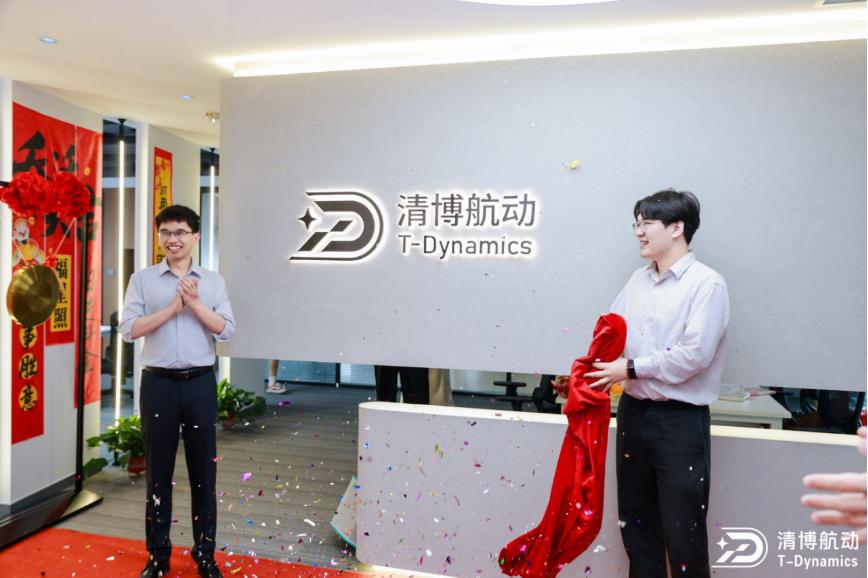
The two co-founders of the company, Zeng Yiqiang and Ban Caohuo, are both "three Tsinghua" doctors from Tsinghua University (they all studied at Tsinghua University for their bachelor's, master's and doctoral degrees), and have long been engaged in research related to aerospace dynamics and space situational awareness. Among them, Ban Caohuo once participated in the work related to the precise orbit determination and prediction of the space station. Professor Ba Yin from the School of Aerospace Engineering of Tsinghua University, who is the common doctoral supervisor of the two, currently serves as the chief strategic scientist of Qingbo Aerospace, providing strategic and technical guidance for the company in the direction of aerospace dynamics and space security.
(Source: The enterprise)
Dr. Zeng Yiqiang, the founder of the company, focused his doctoral research on space situational awareness, solved the core space security problem of a key satellite in China, and the related achievements have been industrially implemented and deployed in batches, winning the Science and Technology Progress Award of a relevant ministry.
Ban Caohuo, co-founder of the company, once participated in the precise orbit determination and prediction of the space station. By integrating historical data, measured atmospheric density data and existing atmospheric density models, he constructed a new modified model, which improved the one-day accuracy of space station orbit determination and prediction to 500 meters, reducing the average annual number of collision avoidance operations from more than 30 to 3 to 5, greatly reducing operating costs and operational risks. His work contributions have obtained paid orders and written commendations from the Chinese Academy of Sciences.
According to Zeng Yiqiang, the company has now built a space situational awareness data service platform and realized commercial services for downstream key customers. To further improve the service capability and service quality of the platform, the company is building a space-ground integrated monitoring system, which integrates multiple data collection methods including optical telescopes, radio monitoring equipment and phased array radars.
In the field of space situational awareness, data collection is only the first step. Qualified raw observation data can be converted into practically usable decision-making information after processing through multiple links such as orbit calculation, target identification and risk analysis. The Qingbo Aerospace team has world-leading core advantages in data processing, analysis and application links.
In terms of commercialization, Qingbo Aerospace has currently carried out business cooperation with a giant constellation operation enterprise in China around software systems and data services, providing interface construction and standardized collision early warning information services. The relevant systems are currently under testing, and will provide long-term collision early warning information services for customers in the follow-up.
Excerpts from the founder Q&A:
36Kr: Compared with rocket manufacturing and satellite communication, space situational awareness and early warning is still in an earlier stage in China. What advantages do commercial companies have in this field?
Zeng Yiqiang: The core tasks of the national team are more focused on serving national security and military needs. Against the background of the rapid development of commercial aerospace, it is difficult to devote a large amount of resources specifically to meet the growing collision avoidance and security assurance demands of commercial satellites. There are also many problems related to the division of powers and responsibilities. In contrast, commercial companies can be more flexible, more focused on providing better services, and adjust services and cooperation modes at any time to provide continuous space traffic safety assurance services for satellite operators.
Although at the level of infrastructure, such as the construction and use of monitoring equipment like radars, there is still a certain gap between commercial companies and the national team, commercial companies can apply new technologies more boldly in data processing, analysis and application links to reprocess and analyze the raw observation data for multiple times, and convert it into decision-making information that users really need. In the future, we hope to standardize these capabilities and serve downstream customers through the space situational data analysis platform we build, for example, allowing satellite operators to quickly access and use our collision early warning information services via API calls. In general, promoting the application and implementation of new technologies rather than carrying out redundant construction is the promise and advantage of commercial companies.
36Kr: In terms of data collection and capability building, what specific plans does the company have this year?
Zeng Yiqiang: In the second half of this year, we mainly focus on two directions, one is data collection, and the other is AI.
In terms of data collection, we are simultaneously promoting different types of monitoring solutions, including optics, radio and radar. At present, the optical solution is advancing relatively faster due to its relatively shorter construction cycle and lower implementation difficulty. The goal for the second half of the year is to build several optical and radio monitoring arrays, and open up the complete chain from data collection, data processing to data application.
On the other hand, we are also laying out AI capabilities. The development direction of the national team's situational awareness system is gradually moving from digitalization and informatization to automation and intelligence. In the past few years, more efforts were focused on completing the construction of digital infrastructure, while in the next few years, intelligent capabilities will become an important direction.
For the space situational awareness industry, in the future, not only algorithm capabilities are needed, but also the system needs to be more user-friendly and intelligent. On the one hand, our own platform needs to have intelligent capabilities; on the other hand, when providing standardized products or customized solutions to customers, we also need to reduce the threshold of use through models and intelligent tools. In fact, most users are more concerned about whether the final delivered product is easy to use, and whether a non-professional can master and use it in a short time. This is also an important direction of our product design.