This minor update from DeepSeek actually hides two major killer features.
Today, an AI researcher messaged me and said this is the best summer she has ever had since she entered the industry.
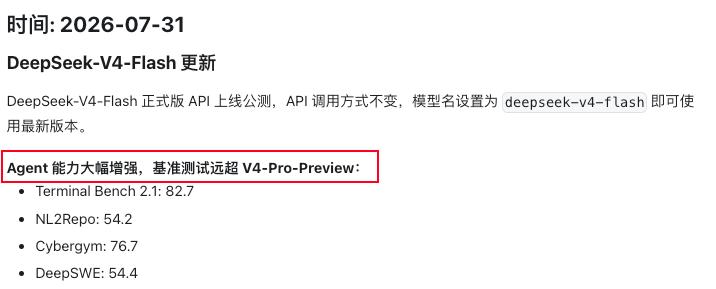
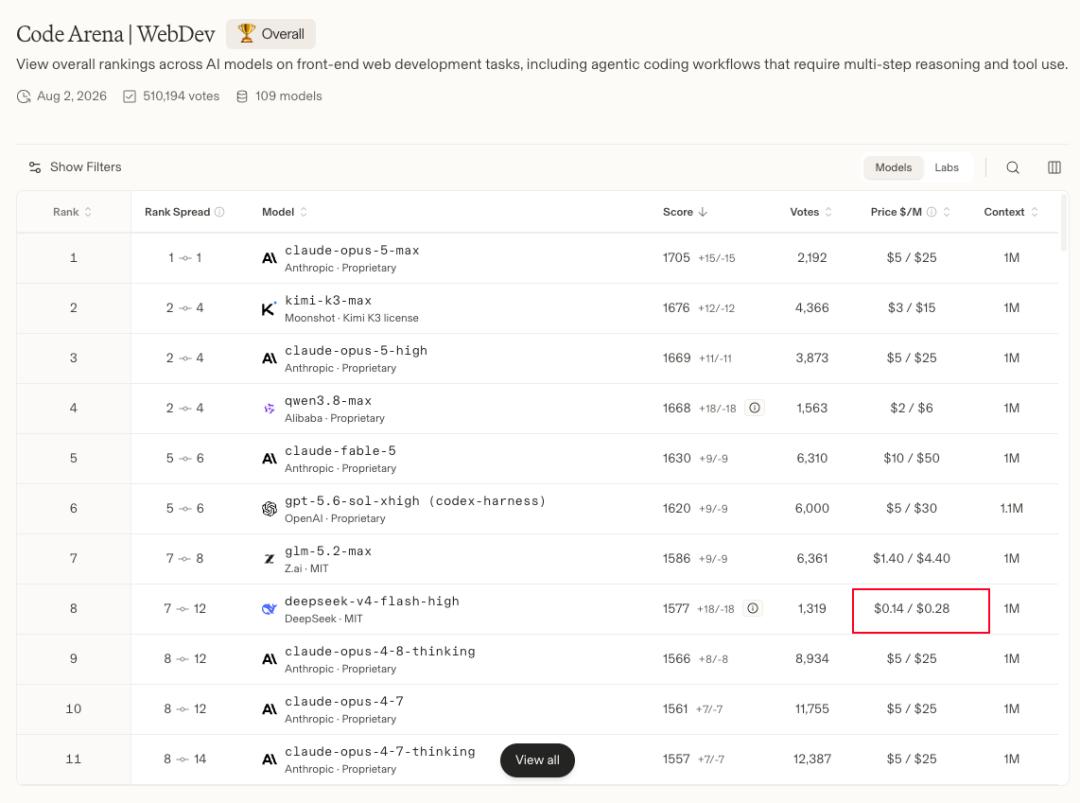
The official version of DeepSeek-V4-Flash has been released, with performance surpassing the previous V4-Pro-Preview.
Its benchmark scores can even be compared side by side with Claude Fable 5 in the same table.
A "lightweight" model with a total parameter count of 284B and only 13B activated parameters has matched the once unattainable Opus 4.8 across multiple tasks.
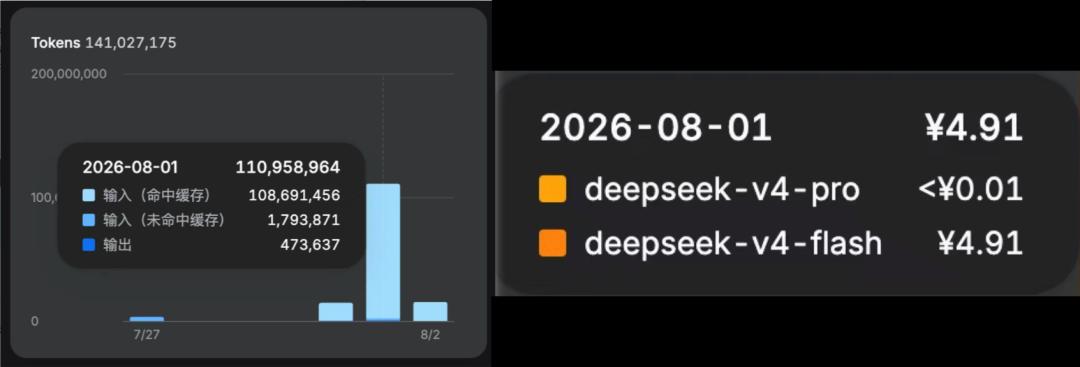
What's even more outrageous is the price: the Flash version is unbelievably cheap, as low as 2 yuan for 1 million output tokens. She optimized all her ongoing projects, and the total cost didn't even cover a cup of milk tea.
Yesterday in the developer group, everyone suddenly stopped what they were doing,
and started forwarding evaluation screenshots. She said she was extremely happy,
and felt like she was living in a golden age for humanity.
No one expected that DeepSeek would drop another bombshell this time, releasing the official version of DeepSeek V4 Flash right at the tail end of July.
To be honest, at first, Shi Chao didn't pay much attention to this update...
After all, it was just a model update under the Flash name, and the mainstay Pro series didn't get touched at all.
The last large language model vendor that only updated Flash without updating the Pro model was Google, and that move has now become a running joke among everyone.

No matter how much you update a Flash model, its capabilities can't outperform the Pro version, right...
?
??

Wait a minute, how come this Flash model has better benchmark scores than the Pro model???
Is this even a Flash model anymore?
Hey DeepSeek, that's not how large language models work. You're supposed to release a Flash model first and claim it's just a bit faster, not make the Flash model catch up with your own Pro model, sell it for only 2 yuan per million tokens, and even offer a 90% discount for cache hits from time to time. I used 100 million tokens over the weekend and only spent 5 yuan.
Shi Chao sorted out the scores released for this V4 Flash, and found that the capabilities of this Flash model are incredibly impressive.
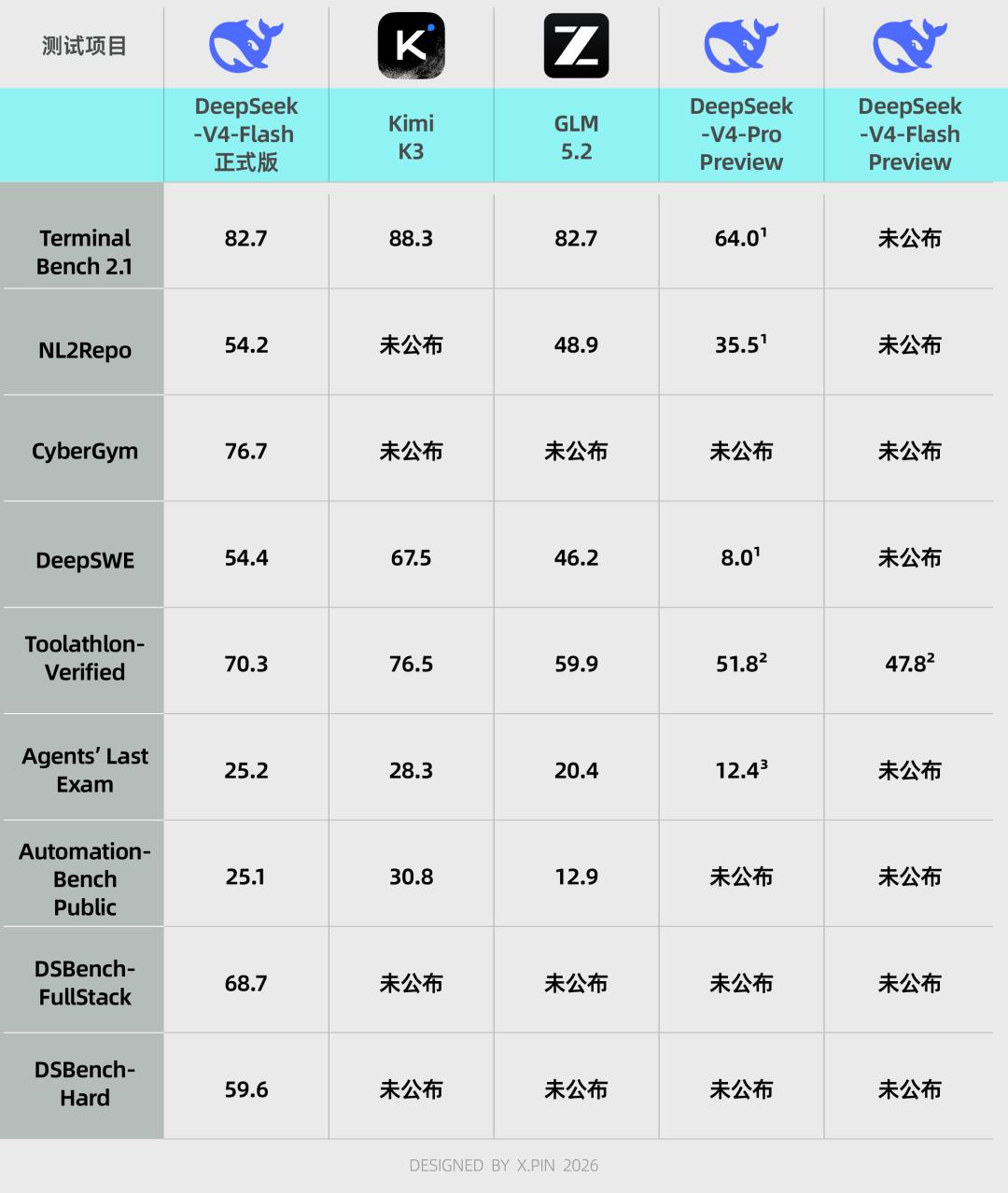
Not only does it outperform its big brother Pro, but even though it can't beat top-tier models like Claude Opus 5, GPT-5.6 Sol, and Kimi K3,
the official V4 Flash is basically only outperformed by these few models.
Some netizens collected the capabilities and prices of various large models and organized them into a table:
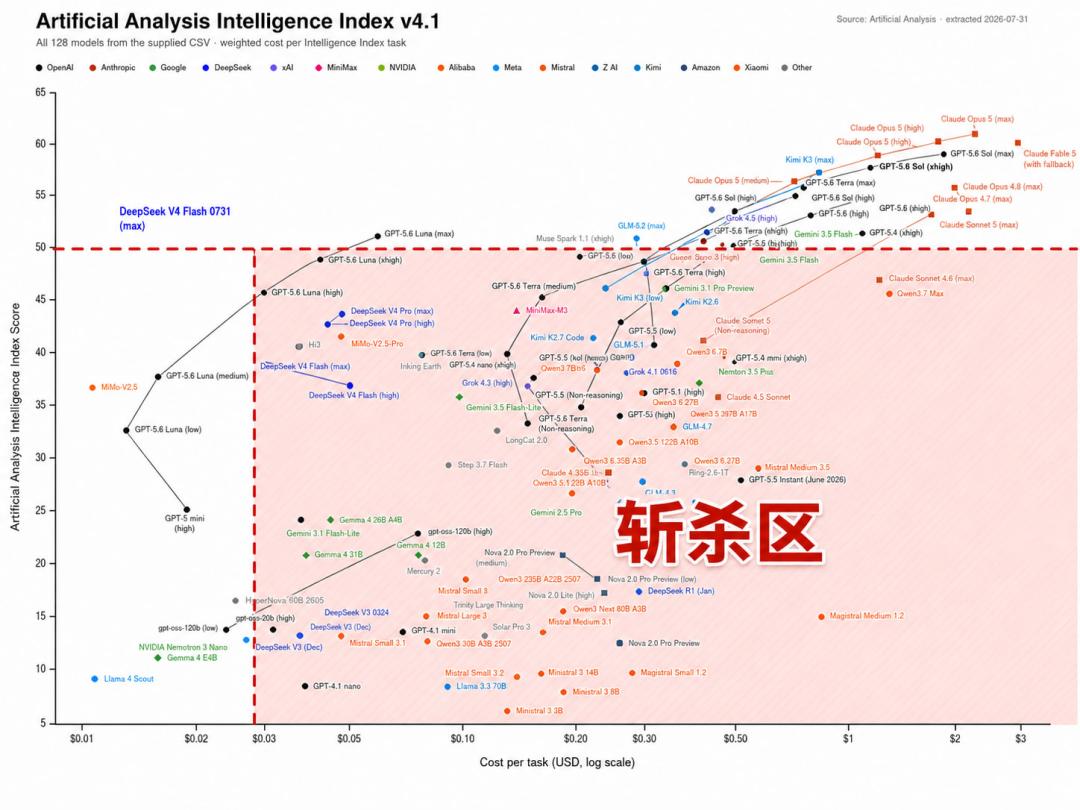
Each large model is represented as a dot on the table. The further to the left the dot is, the cheaper the model is; the higher up the dot is, the better the model's performance.
This makes it very intuitive to see that the vast majority of models on the market are in an awkward position.
They are not as performant as DeepSeek models, and they are even more expensive than DeepSeek.
And those models that do outperform DeepSeek are not in a much better situation either.
Because their prices are far too high.
Many of you may not have noticed that the horizontal axis of the above chart is not a linear axis, but a logarithmic axis.
But that's not how we calculate costs when we pay for model usage.
So Shi Chao pulled out the PS skills he hadn't used in ages, converted the chart to a linear axis, and found that the actual proportional relationship looks like this...

That means in terms of performance, models like Claude Fable 5 and GPT-5.6 Sol only have a roughly 20% improvement over V4 Flash.
But the price of these models is about 100 times higher than V4 Flash.
To put it more dramatically, it can be said that DeepSeek has redefined the cost-effectiveness threshold for AI models once again.

So how did DeepSeek pull this off this time? The architecture and parameter count of the model barely changed, so why did the model's capabilities suddenly see such a huge leap?
Shi Chao looked back through DeepSeek's papers and public materials, and found the two most likely explanations.
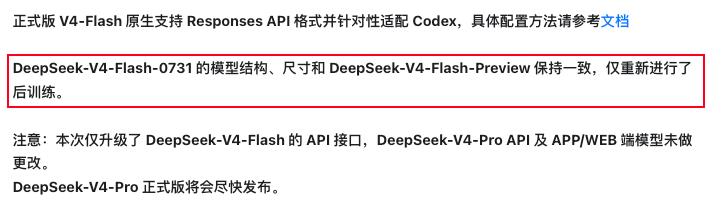
The first and most important point is post-training.
This is also acknowledged by the official team as the biggest difference between the preview version and the official release.
For those of you who are not very familiar with large language models, generally the training process of a large model is divided into two stages.
The first stage is pre-training.
In this stage, we feed massive amounts of text, code and other data into the model to help it learn the basic ability to answer questions.
The whole process is a bit like cultivating a high school student: you need to expose them to knowledge from all fields including language, math, foreign languages, physics, chemistry, biology, politics, history, geography, music, art, PE and computer science, to improve the model's foundational capabilities.
The second stage, post-training, is where the model trains its practical problem-solving abilities.
The main work in this stage is doing practice problems: by repeatedly working through large volumes of tasks, the model improves its test-taking ability and learns how to solve problems.
Researchers use supervised fine-tuning, reinforcement learning and large volumes of task data to help the model learn to understand instructions, break down problems, use tools, and generate answers that align with human preferences.
The exact same model that comes out of pre-training can easily show completely different performance after going through different post-training practice sessions.
As mentioned in DeepSeek's previous R1 paper, after they applied GRPO (Group Relative Policy Optimization) reinforcement learning to the V3 model, the model's mathematical abilities got a huge boost, and its accuracy on the AIME 2024 test set directly surged from the initial 15.6% to 71%.
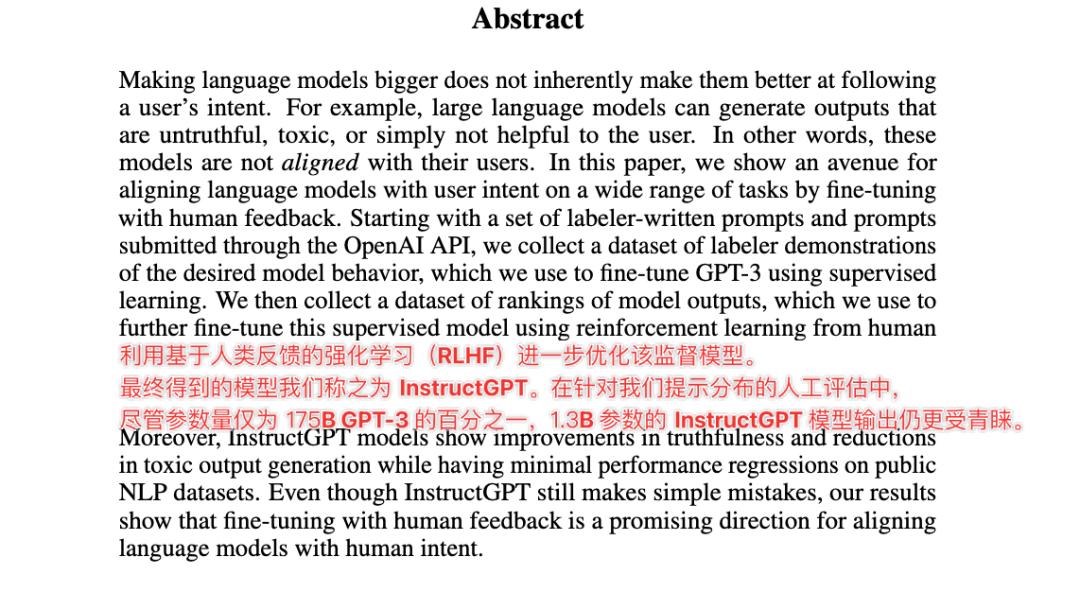
The same thing happened with OpenAI's InstructGPT back in the day.
After supervised fine-tuning and RLHF, a model with only 1.3 billion parameters could even outperform GPT-3, which has over 100 times more parameters, in blind human evaluations.
If pre-training determines whether the model has the relevant knowledge stored in its "brain", then post-training determines whether the model has mastered the ability to retrieve and apply that knowledge.
Of course, post-training alone may not fully explain the incredible scores of this V4 Flash release.
If you look closely at DeepSeek's release notes, you will find another detail:
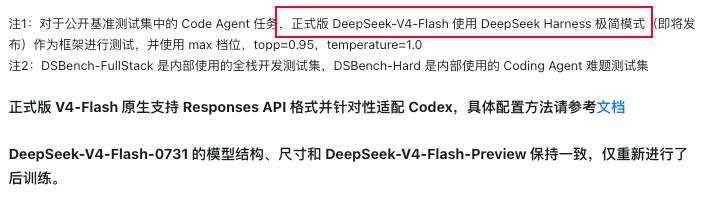
Part of the benchmark scores released this time were not obtained by running the model on its own.
They were generated using an unreleased tool called DeepSeek Harness.
You have probably heard the word "Harness" a lot in the past six months. The currently popular Claude Code, Codex and OpenClaw can all be classified as Harness, or a type of Agent tool.
Even the widely discussed Workbuddy, Qoder and Trae fall into this category.
Now DeepSeek is joining this competition by launching its own Agent tool.
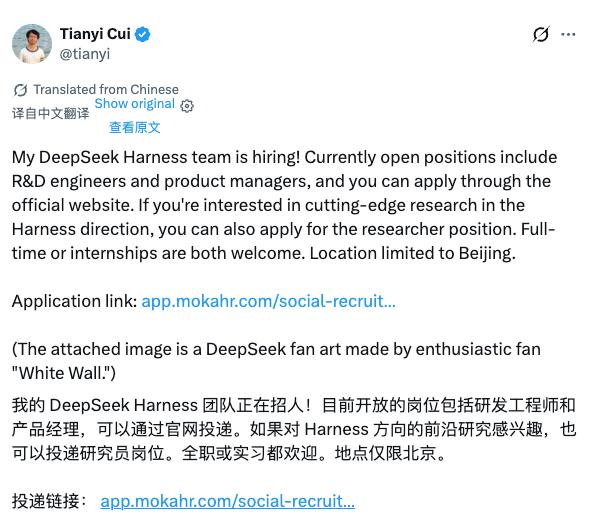
This move may be far more significant than a standalone model update.
Because in this current Agent era, the final performance of a model no longer only depends on how smart the model itself is, but also on what kind of toolset is paired with it.
A bare model is like a student sitting in an exam room who can only rely on their own brain to work through complex problems.
But an Agent can equip the model with a search engine, a code runtime environment, help it manage project context, check project execution results, and even restart the process directly if it runs into errors.
By giving the model these external boosts, the actual practical capabilities of AI can be greatly enhanced.
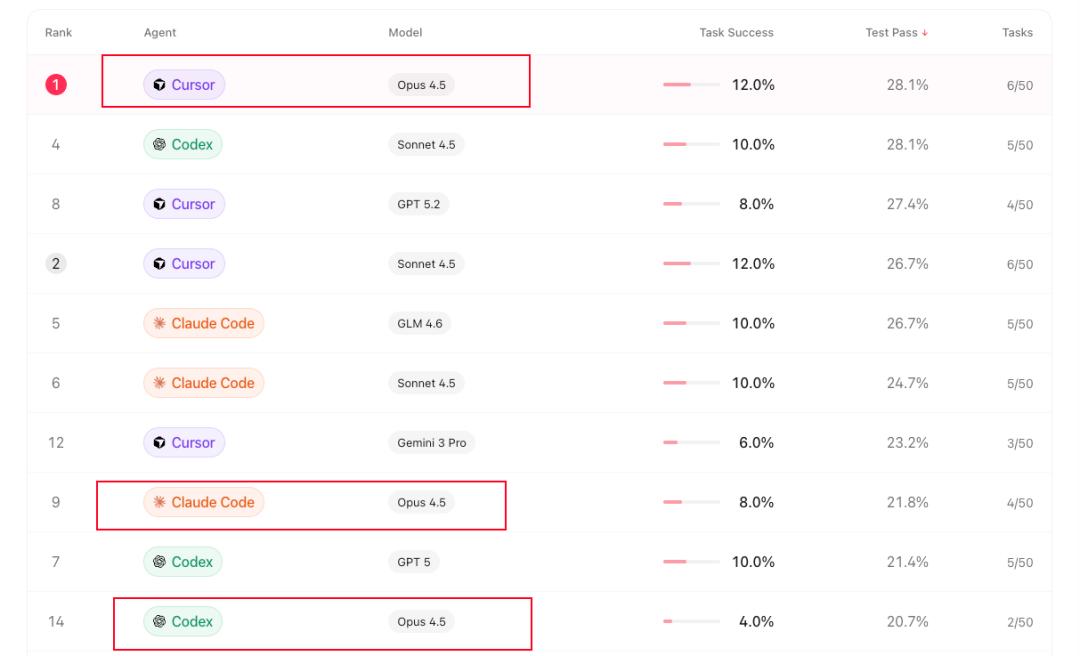
Earlier this year, a team from the University of Toronto conducted a study where they tested the exact same large model in different Agent tools.
They found that the same model showed completely different performance across different tools, with the maximum difference in problem-solving probability reaching several times.
Not long ago someone said that the development of AI is like climbing a ladder step by step.
The ladder last year was Chain of Thought: through Chain of Thought prompting, we could help models learn to think step by step, enabling AI to accomplish far more tasks.
And this year, the most important ladder for AI development is Agent.
Now, DeepSeek has presented its own solution for Agent.
Through high-quality post