The maximum price increase for iPhones could reach 1,350 yuan, and the starting price of Apple's new foldable smartphone will exceed 13,500 yuan.
On August 2 local time, well-known tech journalist Mark Gurman published an article stating that iPhone prices are expected to rise by $100 to $200 (equivalent to about 675 yuan to 1,350 yuan).
When responding to questions from netizens, Gurman emphasized that Apple will definitely raise prices this year. The reasons include the company's current shortage of memory chips and main device processors, the higher cost of the brand-new camera system on iPhone 18 Pro and Pro Max, not to mention the more expensive design adopted by the first foldable iPhone.
In Gurman's view, the recent price hikes of iPad and Mac in recent weeks have already provided the public with some reference directions.
On June 25, Apple announced a global price increase for all Mac and iPad hardware products, covering the full MacBook line, full iPad line, Mac desktop devices, Vision Pro and HomePod. The iPhone did not see a price hike at that time.
In terms of domestic price adjustments, the price increase of Apple's products in this round generally falls in the range of 15% to 20%. The entry-level MacBook Neo was raised from 4,599 yuan to 5,499 yuan, with a price increase of 900 yuan; the mass-market main model MacBook Air saw a 1,500 yuan price hike to 9,999 yuan; the 14-inch MacBook Pro increased by 2,500 yuan, with its price exceeding 15,999 yuan; the high-end version of Mac Studio was raised by 3,500 yuan at one go.
The iPad product line also saw a general price increase simultaneously. The basic iPad was raised by 800 yuan to 3,799 yuan, the iPad Air got a 1,200 yuan price hike, and the iPad Pro was directly adjusted from 8,999 yuan to 10,799 yuan.
As for the foldable iPhone, Gurman advised users to prepare mentally that its starting price will reach at least $2,000 (about 13,507 yuan), or even higher.
Gurman previously stated that according to historical records, the most likely release date for Apple's iPhone 18 Pro and iPhone Ultra is September 8 or September 9. However, US Labor Day falls on September 7, so Apple may prefer to choose a travel gap day, which is September 9.
It is reported that the iPhone 18 Pro series includes two models: 6.3-inch Pro and 6.9-inch Pro Max, which are equipped with the A20 Pro chip (2nm process) at the core with significantly improved performance and energy efficiency, supplemented by a self-developed C2 baseband that supports 5G satellite communication.
In terms of the screen, the Dynamic Island is narrowed by 35% for a higher screen-to-body ratio, with a peak brightness of 2600 nits. In terms of imaging, the main camera is equipped with a physical variable aperture (f/1.4-f/4.0) for the first time, both the ultra-wide-angle and telephoto lenses are 48 megapixels, and the Pro Max is equipped with a 6x optical periscope telephoto lens. In addition, the iPhone 18 Pro series adds new color options such as Deep Cherry Red, and the Pro Max has a battery capacity of over 5000mAh for improved battery life.
According to the latest analyst report from JPMorgan Chase, Apple's first foldable iPhone planned to launch in 2026 will be equipped with under-display front camera technology, combined with a side-mounted Touch ID solution, completely saying goodbye to the notch and Dynamic Island forms that have been used for many years, and realizing a true full-screen design with no cutouts for the first time.
Ming-Chi Kuo, a well-known analyst at Tianfeng International, stated in his latest research that Apple has recently significantly raised the shipment forecast for the foldable iPhone, to 8-10 million units in 2026 and 20-25 million units in 2027 respectively. The previous estimates were 6-8 million units and 10-15 million units respectively.
In late June, sources from the supply chain revealed that Apple has finalized the key specifications of the foldable iPhone, including the display, casing and mechanical components, and will start mass production of its first foldable iPhone in late July.
Just last week, Apple released its financial results for the third fiscal quarter of fiscal 2026, with total revenue, net profit and earnings per share all hitting record highs for the same period, and the revenue of multiple hardware businesses also refreshed the June quarter records simultaneously.
The financial report shows that Apple's total revenue in the third fiscal quarter was $109.42 billion, up 16% year on year, exceeding the LSEG-consensus analyst expectation of $108.65 billion; net profit was $29.789 billion, up 27% year on year, and operating cash flow hit an all-time peak for the June quarter.
The hardware sector is the core pillar driving Apple's overall revenue, among which iPhone contributes nearly half of the revenue, with quarterly revenue reaching $54.25 billion, up 21.7% year on year, hitting the highest sales scale in any June quarter in history, and the high-end Pro models continue to push up the overall average selling price.
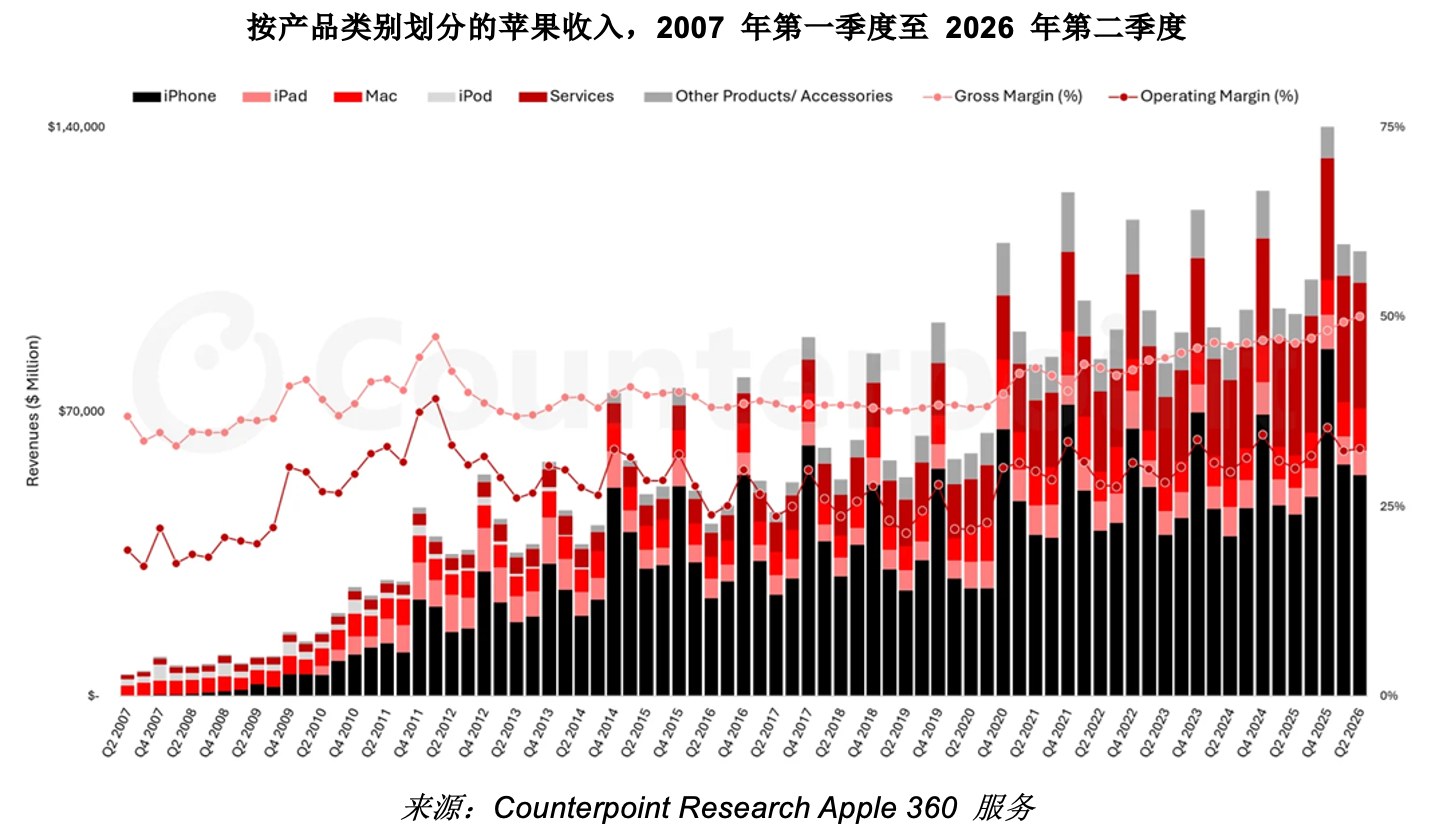
In response to the iPhone business performance, Varun Mishra, Chief Analyst at Counterpoint Research, said that the growth of iPhone business mainly benefits from the strong performance of the iPhone 17 series. Apple maintained stable iPhone prices throughout the quarter, while the prices of competitors' products generally rose by 15%-20%, which further enhanced Apple's market competitiveness. Apple also actively increased shipments, especially in the Chinese market, to seize market share while competitors raised prices. At the same time, market expectations of possible future iPhone price hikes have also prompted some consumers to make purchases in advance.
However, Apple also has to face the huge cost pressure brought by the storage chip shortage. Tim Cook, CEO of Apple, said on the earnings call that as storage chip prices continue to rise, the company is evaluating all response options. He described the current memory price environment as a "once-in-a-century flood" and said that prices have seen an exponential rise. When talking about Apple's recent price hikes for Mac and iPad, he said the company made the decision "reluctantly".
Cook revealed that Apple's storage procurement expenditure continued to increase in the March and June fiscal quarters, and the cost is expected to continue climbing in the September fiscal quarter, but part of the pressure will be offset by beginning-of-period inventory gains and cost reductions of non-storage components. He emphasized that the current dynamic random access memory (DRAM) market is mainly controlled by three suppliers. Having more suppliers will help improve supply and have a positive impact on product pricing.
When analysts pressed for the logic behind the price adjustment decision, Cook said that Apple does not solely pursue revenue or profit margins, and will make business judgments by comprehensively considering sales volume and long-term market share.
Speaking of future market outlook, Tarun Pathak, Research Director at Counterpoint Research, said: "With storage prices expected to continue rising for some time in the future, the smartphone industry will face a more severe market environment in the second half of the year."
However, leveraging the advantage of its huge installed base of active devices and the positive initial market feedback for Siri AI, Counterpoint Research predicts that Apple is expected to continue outperforming the overall industry in its core hardware product categories.
This article is from Jiemian News, reported by SONG Jianan, and published with authorization by 36Kr.