MiniMax H3, Seedance 2.5 and DeepSeek V4 are all here, domestic large models are having a pretty busy day today
What a special day today! MiniMax H3, Seedance 2.5, and DeepSeek V4-Flash have all been released!
First, MiniMax launched its first open-source multimodal generation model H3, which directly integrates video generation, editing, and multimodal understanding into a single model. Then ByteDance rolled out its new-generation video creation model Seedance 2.5, extending the maximum duration of single video generation to 30 seconds. On the other side, DeepSeek was also active, announcing the official public beta launch of the V4-Flash official version API, with key upgrades in Agent and coding capabilities.
Three models made their concentrated debut within one day. Two of them target video creation, and the other one is tailored for developers' code terminals. Domestic large model manufacturers seem to have made a prior agreement, collectively submitting their "homework" on the last day of July.
MiniMax H3: Video models are starting to pursue "all-round capabilities"
Traditional video models usually have clear divisions of labor. Some are responsible for text-to-video generation, some are good at image-to-video generation, and others are dedicated to video editing or motion transfer. Users need to switch back and forth between multiple models and workflows to complete a finished video.
H3 tries to break down these boundaries.
It supports input in different forms such as text, images, audio and video, understands users' creative intentions in the same set of multimodal context, and then completes generation, editing and presentation. The model can directly output 2K resolution content, generate up to 15-second audio-visual videos in a single run, and has been significantly optimized in instruction following, text and brand information presentation, as well as V2V Motion Transfer, namely the video-to-video motion transfer capability.
For example, advertisers can ask the model to refer to a segment of real-person actions, and replace the characters, costumes, products and scenes at the same time; e-commerce brands can also input product images, brand fonts, reference videos and music to directly generate advertising materials containing product displays, character performances and brand information.
In terms of ranking results, H3 currently ranks first in the Artificial Analysis video editing leaderboard with audio, and is also at the forefront in text-to-video and image-to-video categories.
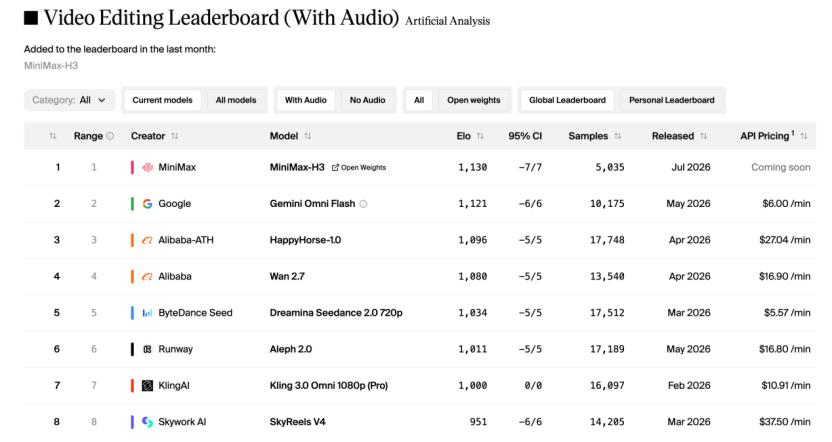
In terms of pricing, H3 is also very competitive: the price for generating 2K videos is 0.8 yuan per second, which is about one-third of that of similar flagship models in the industry. To reduce costs, MiniMax uses a highly compressed Tokenizer to cut down the number of Tokens consumed for video generation, and optimizes heterogeneous training, task load balancing and GPU utilization efficiency.
At the same time, H3 will open model weights in the near future, becoming the first open-source multimodal generation model launched by MiniMax. Enterprises can perform local deployment and make adaptations combined with their own data and business scenarios; domestic chip manufacturers also get the opportunity to carry out software and hardware optimizations around the model.
Seedance 2.5: Don't just give me a piece of material, finish the whole story directly
In the past, generating videos with AI was often like drawing random cards.
After inputting a prompt, the model may generate a nice shot, but the character will look like a completely different person when the angle changes, and when the scene switches, the costumes, lighting and art style may also "lose memory". To make a one-minute video, creators often need to generate more than a dozen pieces of material, then manually select, splice and process transitions.
What Seedance 2.5 first wants to solve is the problem that AI videos are "generated segment by segment".
This model inherits Seedance 2.0's unified multimodal audio and video joint generation architecture, which can generate videos of up to 30 seconds in a single run, doubling the 15-second maximum duration of the previous generation. The upgrade here is not just stretching a single shot, but organizing multiple logically related frames within 30 seconds, making the story have setup, progression, turning point and ending.
If 30 seconds is not enough, users can continue generating after the existing video. The model will try its best to keep the characters, scenes, styles, sounds and narrative rhythm consistent, and finally form content of several minutes with relatively unified audiovisual language. The previous process that required splitting shots, repeated random generation and manual splicing is thus further streamlined.
Seedance 2.5 is also working hard to get rid of the lingering "greasy texture" of AI videos. Characters' skin no longer looks like it has three layers of wax applied, the eyes, materials, lighting and picture saturation are closer to real shooting, and the situation where the model adds subtitles and background music on its own initiative is also reduced.
Another upgrade is the "reference capability". Users can input up to 30 images, 10 videos and 10 audio clips at a time, allowing the model to refer to the characters, sounds, compositions, scenes, props and camera movements in different materials at the same time. In short, in the past you could only send one reference image to the AI, now you can throw the character profile, scene map, action sample video and background music to it all at once.
The editing capability of Seedance 2.5 is also further enhanced. Users can specify what plot happens, what action is executed and what perspective is adopted at which second through timestamps, or only modify the characters, sounds or camera movements in local clips. For example, keep the actor's movements and only replace the green screen with another scene; or keep the characters and frames unchanged, and only redesign the camera movements from the 5th second to the 10th second.
This means that Seedance is gradually evolving from a "video material generator" to a creation tool with the capabilities of a director, cinematographer and editor.
DeepSeek V4-Flash: The model architecture remains unchanged, post-training has "re-educated" it thoroughly
On July 31, the official version API of DeepSeek-V4-Flash launched public beta. Users can use the latest version by keeping their original API calling method and setting the model name to deepseek-v4-flash.
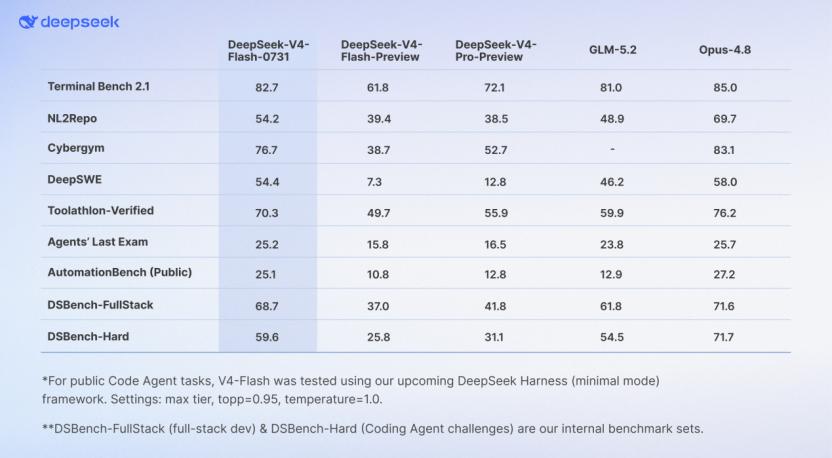
DeepSeek-V4-Flash-0731 shares the same model architecture and size with the previous preview version, and the performance improvement mainly comes from re-conducted post-training. In other words, DeepSeek did not equip the model with a larger "brain", but sent the same "brain" back to the training camp, focusing on reinforcing tool calling, task planning, code development and Agent execution capabilities.
According to the data released by DeepSeek, V4-Flash has achieved significant performance improvements in Terminal Bench 2.1, NL2Repo, DeepSWE, Toolathlon and multiple Agent tests, among which the Terminal Bench 2.1 score reaches 82.7. It should be noted that DSBench-FullStack and DSBench-Hard are DeepSeek's internal test sets, and the relevant results still need to be verified by more external usage results.
The official V4-Flash natively supports Responses API and is adapted for Codex. Developers can call the DeepSeek model in Agent development environments such as Codex, allowing the model to complete code reading, task decomposition, file modification, tool calling and result checking, instead of only answering an isolated programming question. The Harness framework developed by DeepSeek for code Agent tasks will also be released later.
To some extent, this upgrade of V4-Flash also re-emphasizes the value of post-training. As basic models get larger and pre-training costs get higher, how to use high-quality data, reinforcement learning and task environments to "fine-tune" existing models into more reliable Agents is becoming another main competitive track.
However, only the V4-Flash API is upgraded today, DeepSeek's App, web client and V4-Pro have not been updated synchronously. The official version of V4-Pro will be released later. Therefore, it is too early to describe today as "Flash has fully surpassed Pro". A more accurate statement is: the capability gap between lightweight models and flagship models is being rapidly narrowed by post-training.