Bezos uses AI to search for the next silicon
Jeff Bezos, the founder of Amazon, has made another investment in an AI company.
This time, his bet is: Can AI help humanity find the next "silicon"?
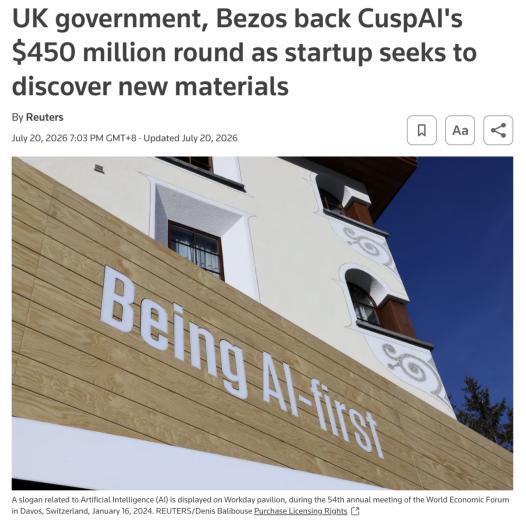
On July 20, UK-based AI materials firm CuspAI announced the completion of a $450 million Series B financing, valuing the company at $2.6 billion.
This round of financing was led by Kleiner Perkins and New Enterprise Associates (NEA). The investors include Bezos Expeditions, the investment arm of Jeff Bezos, the UK government-backed sovereign AI fund, as well as institutions such as AMD Ventures and Samsung Ventures.
A $2.6 billion valuation is not unprecedented among AI-native companies, but it is very prominent for companies in the vertical scientific field, and CuspAI was founded less than two years ago.
If the mainstream AI competition revolves around large models and Agents, CuspAI represents another route:
Can AI move from processing existing information to helping humans discover the unknown?
Humanity has been searching for the next material
If the development of industrial civilization is condensed into one sentence, it is like a history of constantly searching for new materials.
Bronze ushered in the Bronze Age, steel supported the Industrial Revolution, silicon created computers, and lithium promoted the development of new energy vehicles.
Almost every major industrial transformation is supported by a key material behind it.
Today, humanity is still searching for the next "silicon".
Over the past few decades, the semiconductor industry has continuously reduced transistor sizes relying on silicon, which has continuously improved computer performance. However, as the manufacturing process gradually approaches the physical limit, the industry is increasingly turning its attention to new semiconductor materials, interconnection materials and advanced packaging, hoping to find the next breakthrough.
The new energy industry is also facing similar problems. Compared with the widely used liquid lithium batteries today, solid-state batteries are considered to be expected to simultaneously improve safety, energy density and cruising range. But from Toyota, QuantumScape to CATL, the industry has not yet achieved large-scale commercialization.
This year, focusing only on solid electrolyte discovery, the academic community has successively published multiple review papers such as Breaking Bottlenecks in Solid Electrolyte Discovery with Large Artificial Intelligence Models and Machine Learning Pipelines for the Design of Solid-State Electrolytes.
The fields of catalysts, aerospace, advanced manufacturing and environmental protection are also equally unavoidable.
In order to remove "permanent pollutants" such as PFAS (per- and polyfluoroalkyl substances) that are almost impossible to degrade naturally, researchers are still continuously searching for new adsorption materials with higher efficiency and lower cost; the growing computing power demand of data centers has also made heat dissipation materials an important variable affecting energy consumption.
More and more industries are finding that engineering capabilities are advancing rapidly, but material breakthroughs are getting slower and slower.
The reason is not difficult to understand: finding a new material is not like searching for an answer in a database. Scientists usually need to put forward hypotheses first, then design the material structure, carry out computational simulation and experimental verification, and then continuously adjust the plan according to the results. One failure means starting all over again.
Moreover, the possibilities in the material world are almost infinite.
The performance of a material depends not only on its elemental composition, but also on the combined effects of atomic arrangement, crystal structure, defect state and manufacturing process. Even tiny changes may lead to completely different results.
Facing such a huge search space, it is increasingly difficult for humans to rely on experience and experiments to find truly valuable new materials bit by bit.
Thus, a new idea began to emerge:
What really takes time and effort in material R&D is not only experiments, but also finding the few candidate solutions worth experimenting among countless possibilities.
And this is exactly the problem that AI is best at solving.
It is against this background that a number of new companies focusing on AI material discovery have begun to attract capital attention.
CuspAI's this round of financing is exactly the latest representative case. Capital is starting to bet on a new possibility: the next "silicon" may be born in an AI-driven material R&D system.
Why did Bezos bet on this company?
CuspAI is a UK-based AI materials company founded in 2024, headquartered in Cambridge.
The company was co-founded by two founders with complementary backgrounds. CEO Chad Edwards once participated in the founding of quantum computing company Cambridge Quantum Computing (CQC), and promoted its merger with Honeywell's quantum business to establish today's Quantinuum; co-founder Max Welling is an important scholar in the field of machine learning, who once served as a distinguished scientist at Microsoft Research, and is also one of the authors of the classic paper Auto-Encoding Variational Bayes, with important influence in the field of generative models.

In the past, material R&D usually started from an existing material. Scientists first design a new structure, then test its performance through computational simulation and experiments; if the effect is not ideal, adjust the structure and start over.
MIRA developed by CuspAI attempts to change this process.
It adopts the idea of "Inverse Design": researchers do not need to think about "what material should be designed" first, but define the goal first — such as higher conductivity, stronger high temperature resistance or lower manufacturing cost — then AI reversely generates possible material structures that meet these requirements, predicts their properties, and helps scientists screen the most promising candidate solutions for verification.
In other words, it does not do experiments for scientists, but hopes to allow scientists to spend more time on verifying the most promising materials instead of looking for a needle in a haystack among countless possibilities.
However, up to now, CuspAI has not handed over a report card enough to shock the industry.
It has not announced representative new materials like Google DeepMind's GNoME, nor has it announced that any new material designed by AI has achieved industrialization.
At present, one of CuspAI's cases closest to commercial verification is to help Finnish chemical company Kemira find new materials to remove PFAS pollutants. The company said that MIRA once screened candidate solutions from about 300 trillion potential material structures, and finally narrowed it down to 20 for further development, but the relevant candidate materials are still in the subsequent verification stage, and no commercialized results have been announced yet.
So here comes the question: Why can an AI company that has not yet delivered decisive results get a $2.6 billion valuation?
One detail may be worth noting.
On July 20, CuspAI not only announced the $450 million Series B financing, but also announced the establishment of AI Materials Foundry.
This round of financing is led by Kleiner Perkins and NEA, with participation from Bezos Expeditions under Bezos, AMD Ventures, Samsung Ventures and other institutions; at the same time, AI Materials Foundry has gathered more than 45 partners, including NVIDIA, Meta, Applied Materials, Hyundai Motor Group and other enterprises.
This list spans the AI, semiconductor, advanced manufacturing, automotive and materials industries.
Some provide computing power and chips, some master manufacturing capabilities, some have real industrial demands, and some can undertake subsequent experiments and industrial verification.
The significance of this list is not only how many partners CuspAI has brought in, more importantly, it shows capital a market far larger than a single material R&D project.
The value of a traditional material company usually depends on whether it can produce a certain material and how many orders it can get; what CuspAI tries to cover is the entire R&D chain from putting forward material demands, generating candidates, predicting performance, completing verification, to entering industrial applications.
Once this model is established, all industries that rely on material progress, such as chips, automobiles, batteries, chemical industry, aerospace, etc., may become its service targets.
This is exactly the imagination behind the $2.6 billion valuation: CuspAI has the opportunity to grow from a company that searches for new materials into a R&D platform used by multiple industries.
The participation of AI Materials Foundry, as well as enterprises such as NVIDIA, Meta, Applied Materials and Hyundai Motor, provides a realistic fulcrum for this imagination. It shows that CuspAI is organizing models, computing power, industrial demands and experimental capabilities into a collaborative network, and also makes investors believe that they have the opportunity to participate in the construction of this infrastructure.
If in the future material R&D gradually evolves into a new collaboration mode — AI is responsible for generating candidate materials, the industry puts forward demands, computing power completes simulation calculations, and the laboratory is responsible for verifying results, then what determines competitiveness will no longer be just the R&D capability of a single company, but who can enter this system and jointly complete material R&D with more participants.
The $2.6 billion prices the possibility of CuspAI becoming a material R&D platform.
This valuation is of course still based on the unfulfilled future. But in the field of AI materials, what capital is willing to pay in advance is exactly the huge market that may be covered once this chain is put into operation.
Has AI already found new materials?
CuspAI is not the first company that tries to reconstruct material R&D with AI. Before it, Google DeepMind has proved that AI can expand material search to a scale that was unimaginable in the past; MatNex began to design materials around specific industrial demands; Orbital further pushed material models to real industrial scenarios.
These players have chosen different paths, and together they have answered a question: Where exactly has AI material discovery gone?
Google DeepMind is the most watched representative among them.
If AlphaFold brought AI into the field of life sciences, then GNoME (Graph Networks for Materials Exploration) is an important attempt by DeepMind to explore materials science.
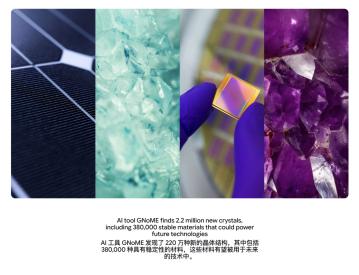
In 2023, Google DeepMind launched the GNoME project. The system uses graph neural networks to predict the stability of crystal structures, and has discovered more than 2.2 million potential crystal structures in total, of which about 380,000 are predicted to be stable materials, which nearly ten times expands the number of known stable materials for humans.
Among them, there are 528 potential lithium ion conductors, about 25 times the number of previous similar research results, providing more candidate solutions for next-generation batteries.
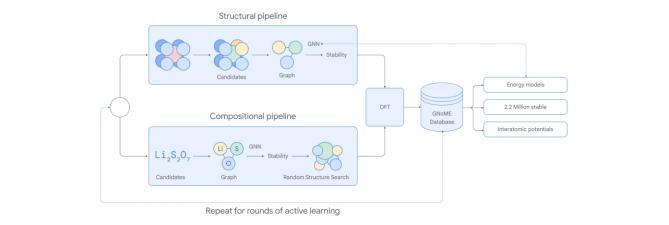
Traditional material databases mainly come from past calculations and experimental accumulations, and researchers usually search for rules within the range that has been recorded by humans, while GNoME shows another possibility: AI can actively explore crystal structures that have not yet entered the database according to the learned material rules.
But the fact that a computer predicts a material is stable does not mean that this material can be manufactured in reality.
In order to verify that these predictions are not limited to computers, DeepMind later cooperated with Lawrence Berkeley National Laboratory. The A-Lab system built by the latter can use algorithms to generate experimental schemes, control robots to complete material proportioning, heating and testing, and finally successfully synthesized more than 40 new materials.
However, what GNoME mainly solves is still "which crystal structures may be stable". Stability does not equal practicality, and being able to be synthesized does not mean having better conductivity, magnetism, heat resistance or lower manufacturing cost. There are still performance verification, process development and large-scale manufacturing between it and actual industrial production.
If DeepMind answers the question of "Can AI find new materials", then MatNex cares more about another question: Can AI design materials according to industrial demands?
MatNex, formerly known as Materials Nexus, founded in 2020, is a deep tech company incubated from the University of Cambridge.

Similar to CuspAI, Materials Nexus also adopts the "Inverse Design" route: according to the target performance requirements, use AI to search for new materials that may meet the requirements, instead of relying on traditional experimental methods to try error one by one.
One of the first directions the company cut into was rare-earth-free permanent magnet materials.
Rare earth permanent magnets are widely used in new energy vehicles, motors and wind power generation, but they are highly dependent on specific rare earth resources and supply chains. In 2024, MatNex announced that its AI platform screened and designed the rare-earth-free permanent magnet material MagNex from more than 100 million candidate combinations.
The material only took 3 months from design, synthesis to testing, which greatly shortened the R&D cycle compared with traditional industrial materials. The company expects that the cost of MagNex can reach about 20% of traditional rare earth magnets, while reducing material carbon emissions by 70%.
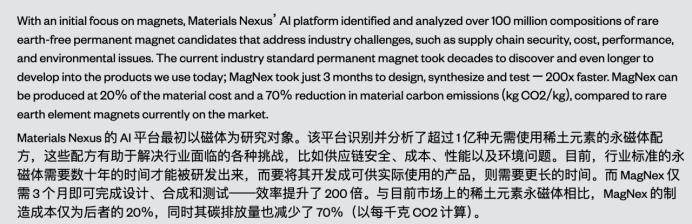
This case goes a step further than simply predicting a material — it completes the process from setting goals, algorithm screening, to experimental synthesis and performance testing around a clear industrial demand.
Therefore, the value of AI is no longer just "discovering more possibilities", but also helping R&D teams find a set of answers worth manufacturing faster.
But the successful synthesis of MagNex cannot be directly equated with the completion of commercialization. It proves that AI can shorten the early R&D cycle, but whether it can extend this speed to large-scale production remains to be seen.
Another typical player in the AI material track also comes from the UK.
Orbital Materials was founded in 2022, headquartered in London, and later renamed Orbital Industries.
