Google's robotics team has pulled off a major feat, aiming to tackle the long-standing industry challenge of the "last few centimeters".
A while ago, the Lei Technology WAIC2026 reporting team traveled to the site in person, observed this global AI exhibition at close range, and witnessed an unprecedented coming-of-age ceremony for humanoid robots.
More than 200 robot-related enterprises and over 300 real machines competed on the same stage — from Unitree's 3-meter-tall manned transformable mech switching forms back and forth, to Agibot's robot picking up a 2mm resistor with tweezers and welding it onto a circuit board. The backflips and mechanical dances that used to easily draw crowds of audiences are still there, but manufacturers are increasingly eager to prove another thing:
Robots can not only move, but also work, and even handle more diverse tasks.
However, building a "body" that can run, jump and stretch out its arms is no longer the most scarce capability at present. The real bottleneck lies in the "brain": how to make robots perceive chaotic environments, decide what to do next, and then stably transmit the decisions to dozens of joints.
Just over a week after WAIC concluded, Google DeepMind launched Gemini Robotics 2, a general-purpose robot model focused on "whole-body intelligence" that is applicable to robots of various different forms.
But the most critical keyword is still "whole-body intelligence". When a human bends down to pick up a kettle on the ground, they will naturally lean forward, bend their knees, stretch out their hands, and adjust their center of gravity at the same time. When sealing a ziplock bag, they will naturally align the seals on both sides, then pinch from one end to the other with their fingers, and adjust the force at any time according to the deformation of the plastic. Robots, however, need to continuously calculate a series of interlinked actions correctly.
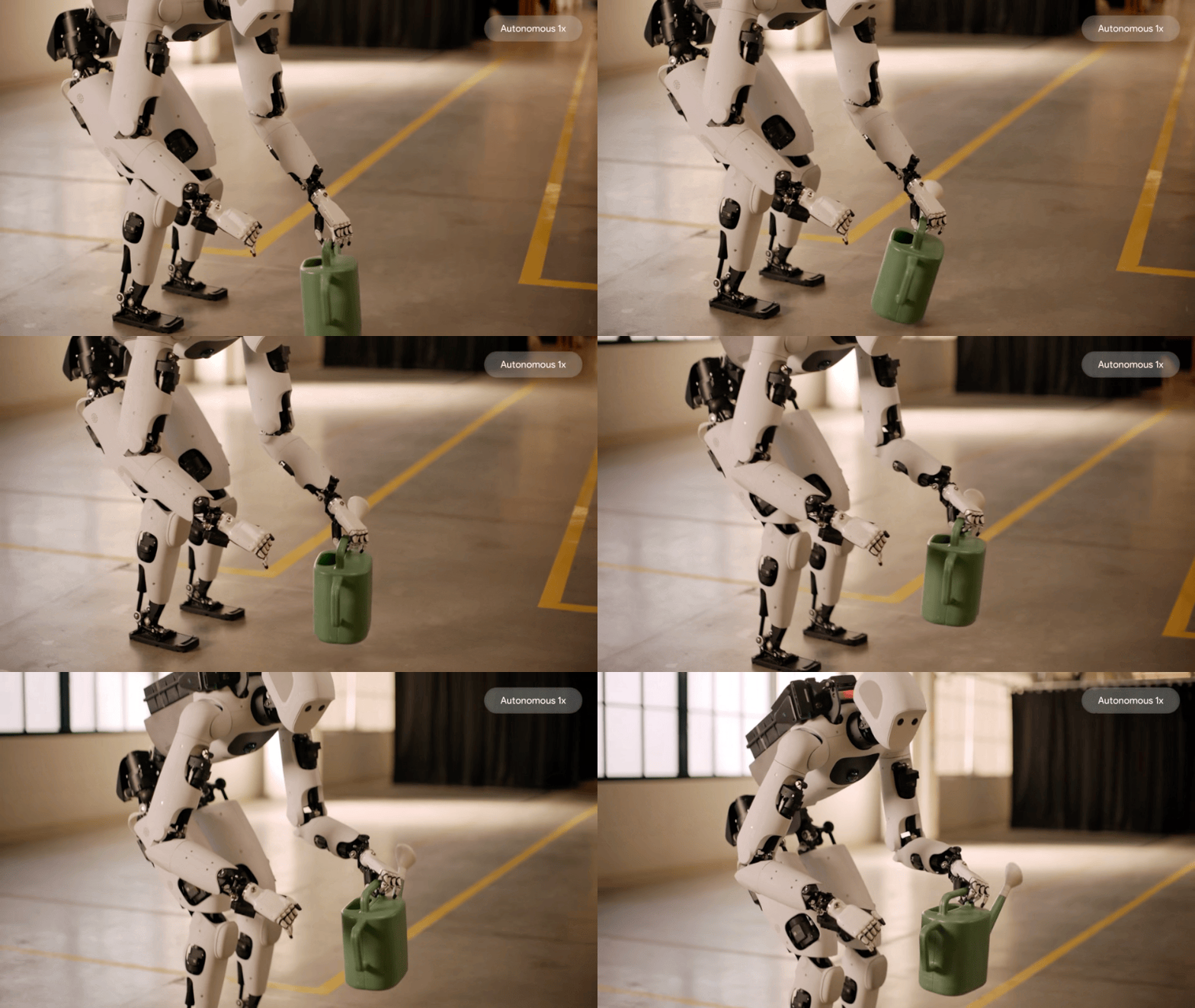
Image source: Google Deepmind
The more complete the body components are, the more the control difficulty snowballs.
The release from Google this time includes three models. Gemini Robotics ER 2 is responsible for understanding the environment, planning long tasks and communicating with humans. Gemini Robotics 2, this VLA model, directly converts vision and language into actions, while On-Device 2 compresses the action model to the local side, and can adapt to new robot entities with less than 200 samples and several hours of data.
But the core is that Google starts to use a set of models to coordinate the legs, torso, arms and fingers of a humanoid robot, allowing it to think and reason while moving and operating.
Robots finally don't have to "stand still first, then reach out"
In the past, many robot demonstrations had a strong sense of turn-based games. The robot first walked to the table, stopped, stood firm, and then called the robotic arm to grab the object. After grabbing, it switched to the walking controller again and moved to the next position. Each segment of action could be performed very smoothly, but as long as the table was slightly offset, the object slipped a little, or it had to maintain the grip while walking, the seams between several independent modules would be exposed.
The previous generation of Gemini Robotics also mainly controlled the upper body of the robot to handle desktop tasks. For Gemini Robotics 2, the Apptronik Apollo 2 in the official video will walk to the green kettle placed on the ground and bend down to lift it up. In another scene, Apollo 2 walks to the shelf, takes out a baseball glove, and then turns around and leaves.
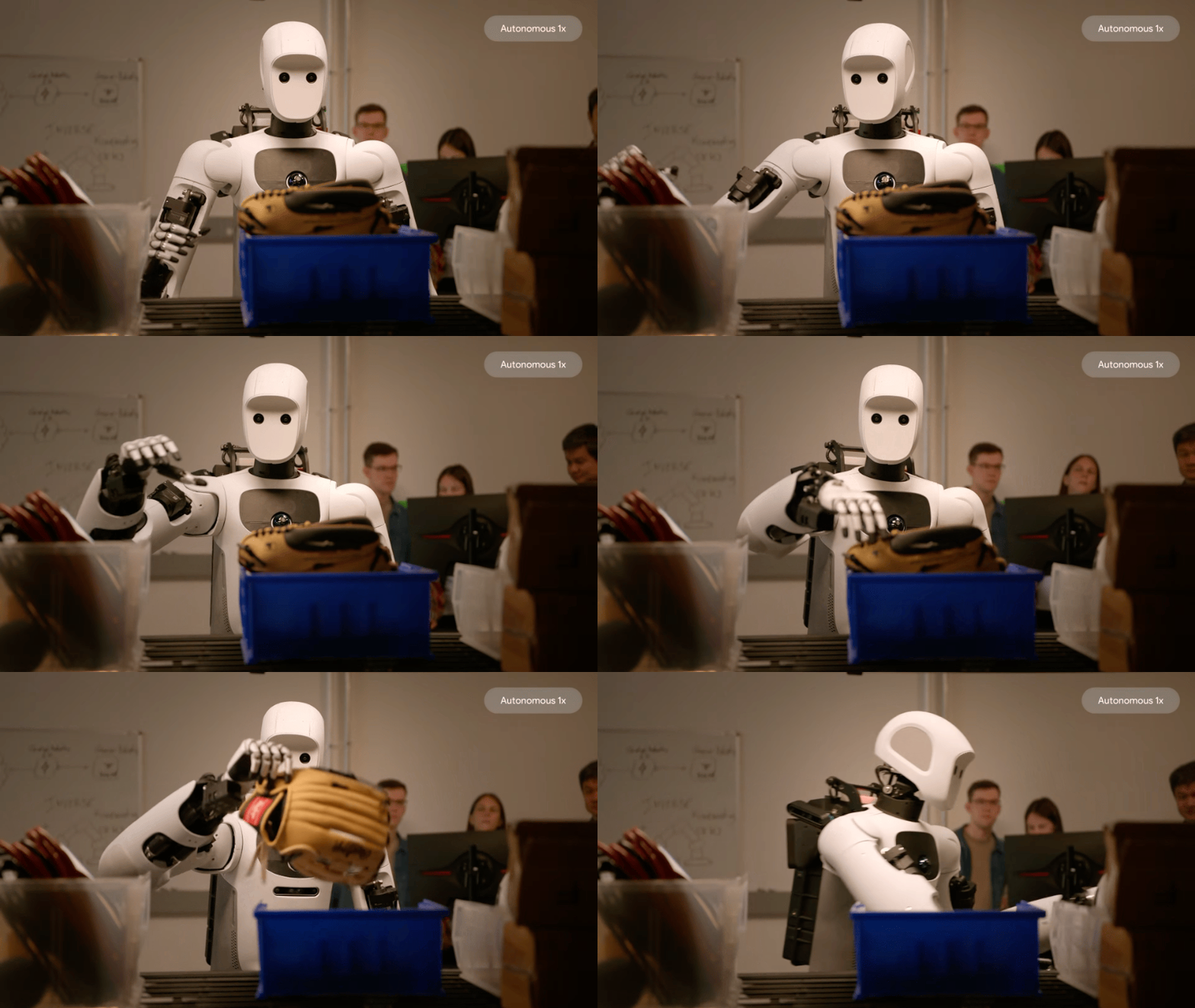
Image source: Google Deepmind
These actions seem unremarkable, but behind them they rely on vision, reachable range, gait and center of gravity at the same time. If the arm stretches further, the body has to lean forward accordingly. When the body leans forward, the legs must compensate in time.
The video also specifically marks that all robots in the footage operate autonomously, and the actions are played at real speed.
This is also the practical meaning of "whole body": the model no longer treats legs as transportation tools and hands as operation tools, but regards the entire body as a mutually coupled action space. Google says the same model has been used on Apollo 2 equipped with different dexterous hands, as well as Franka Duo using two-finger grippers. At least in terms of technical direction, what it wants to build is not just a dedicated brain adapted to a specific humanoid robot.
Of course, the demonstrations are not fast enough to create illusions. Apollo walks, squats and places objects very slowly, and Google itself admits that the movement speed still needs to be improved. In official tests, the average success rates of Apollo picking up objects from the desktop, ground and shelf are 68.4%, 45.7% and 76.3% respectively. The ground object picking task, which best reflects whole-body control, is exactly the one with the lowest success rate.
The direction is correct, but the movements are not yet agile enough.
From screwing light bulbs to tying garbage bags, the hardest part for robots lies in the "last few centimeters"
Whole-body control solves the problem of how robots move to targets and keep balance. What really determines whether they can enter homes and factories is often the last few centimeters of operation.
In the official video, Apollo 2 uses a five-finger SharpaWave dexterous hand with 22 degrees of freedom to try screwing light bulbs, sealing ziplock bags, and tying knots on garbage bags. On the other side, the two grippers of Franka Duo are responsible for tightly packing tools of different shapes into the toolbox.
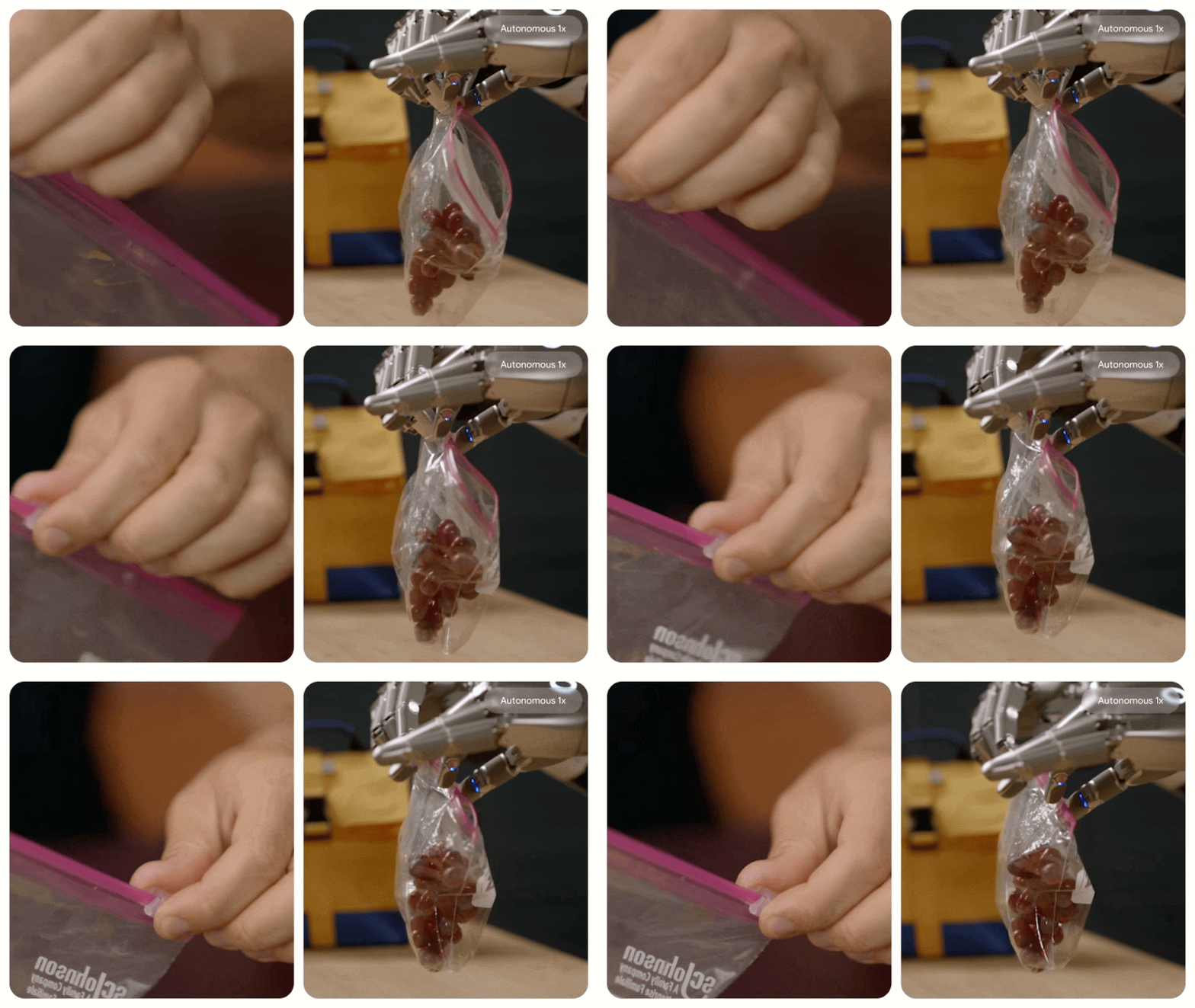
Image source: Google Deepmind
In the past, the most common grabbing demonstrations of robots often only moved a hard object from point A to point B. These new tasks involve continuous contact, two-hand cooperation and deformation: plastic bags will collapse, knots will slip, and the light bulb needs to be aligned with the thread without being squeezed too hard.
When humans do these things, they don't calculate how many degrees each of the 22 joints should rotate in advance. What Gemini Robotics 2 does is exactly to generate these high-frequency, continuous actions directly from vision and instructions.
However, the results released by Google are very realistic. The average success rates of the two-finger gripper in general pick-and-place, tool matching and precise insertion reach 74.2%, 78.9% and 89.6% respectively, but the gap widens rapidly when it comes to multi-finger dexterous hands: unscrewing the light bulb reaches 92%, screwing on the light bulb is only 36%, tying garbage bags is 44%, and using dustpans and sealing ziplock bags are only 32% and 40% respectively.
This set of figures also shows that large models can already handle quite complex hand movements, while multi-finger dexterous operation is far from reaching the "human-level" as stated on the official model page. At least for now, robots may still fail six times out of ten when screwing light bulbs.
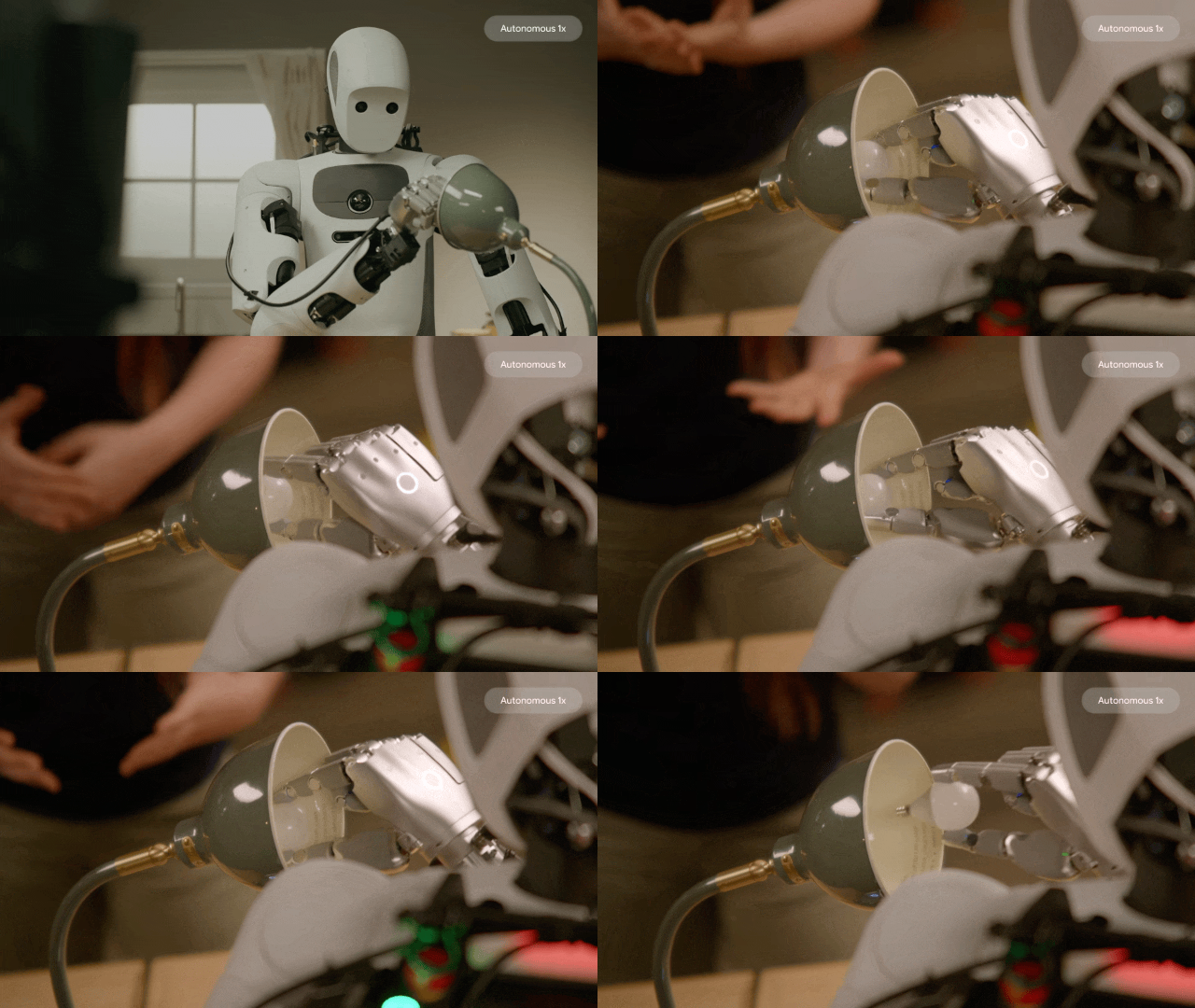
Image source: Google Deepmind
The third change is collaboration. In the video, Apollo and Franka Duo sort out the toolbox together. Apollo assigns the task, Duo loads the tools into the box, and the two robots run a set of models respectively, distributing and connecting work through high-level reasoning, instead of being manipulated by a central neural network at the same time. ER 2 will also continuously view the video, judge the task progress, find failures and decide whether to retry.
This is quite different from two robots mechanically executing preset procedures. Google wants robots of different forms to first understand what each is good at, and then hand over tasks to each other like a team. But the official video shows a designed tool storage scene with a total length of several minutes, which is still far away from the stability verification of multiple robots working continuously in a real factory for several months.
Google has not abandoned the "cerebrum and cerebellum" architecture, it just breaks the boundary of the body
The embodied intelligence industry currently generally summarizes the robot architecture as "cerebrum" and "cerebellum". The large model is responsible for understanding instructions and decomposing tasks, while small models and traditional controllers are responsible for navigation, balance and grasping. This approach is very pragmatic: high-level reasoning does not need to run hundreds of times per second, and low-level control cannot wait for a large model to think slowly. Separating modules makes deployment, debugging and safety protection easier.
The problem is that the physical world does not like neat module boundaries.
Lifting a heavy object will change the balance, stepping forward will change the reachable range of the arm, and once the cup in your hand slips, the original path planning will be invalid immediately. As long as there is inconsistency in understanding between high-level plans and low-level actions, errors will accumulate in long tasks. Every time you switch from walking to grabbing, or from grabbing back to navigation, it may also cause a pause. The robot clearly plans correctly, but the body does not follow the plan.
But strictly speaking, Google has not given up the "cerebrum and cerebellum" architecture. ER 2 is still the high-level cerebrum, responsible for perception, thinking, planning and tool calling, and then hands over action execution to the VLA. It can even treat the navigation API, robotic arm interface and VLA of other manufacturers as tools.
What Google solves is to stop splitting walking, balance, torso and arm movements into a bunch of unrelated small cerebellums at the action layer. Gemini Robotics 2 unifies whole-body movements with one VLA, while ER 2 can observe the execution while thinking about subsequent steps, reducing the sense of fragmentation that the robot has to "stop and think" every step it takes.
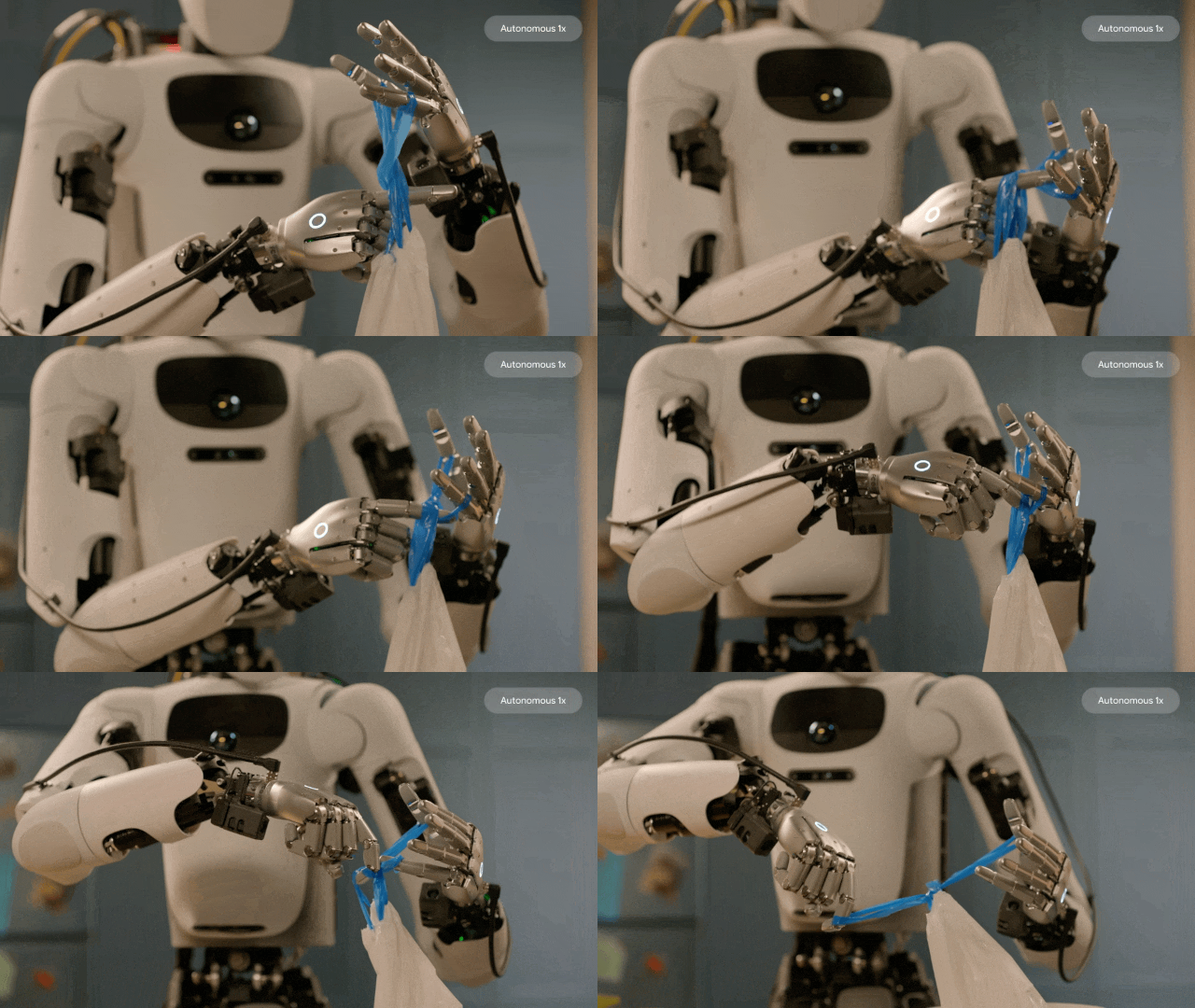
Image source: Google Deepmind
This is a more accurate dividing line: the high level is still layered, while the body operation starts to be end-to-end.
This also explains why Google does not put all links into one giant network. The low-level control of robots pursues millisecond-level response, while high-level reasoning may need to retrieve materials and understand vague human requirements. The computing power, data and operating frequency required by the two are different. If all are mixed together, the training cost will rise rapidly, and it will be difficult to judge whether the error comes from the wrong plan or the joints do not execute in place when problems occur.
More realistically, there is the safety issue. The model can decide to place the kettle on the shelf, but emergency stop, speed limit and the safety distance between humans and robots cannot be guaranteed only by probability. ER 2 introduces safety constraints, feasibility judgment and requests for human intervention, while the bottom layer still retains traditional physical safety mechanisms, which shows that Google does not intend to let end-to-end learning handle everything.
Moreover, this route is not unique to Google. Helix 02 released by Figure earlier this year also connects all sensors to a whole-body visual motion strategy, allowing System 1 to output whole-body joint targets at 200Hz, then System 0 processes balance and contact at 1kHz, and the top System 2 continues to be responsible for semantic reasoning. It looks like one model, but internally it is still a three-layer system tightly interlocked at different time scales.
The latest GO-2 from Agibot also directly refers to the problem as the "semantics-execution gap", using action chain of thought and asynchronous dual systems to connect low-frequency planning and high-frequency execution. Instead of simply choosing between "one model" and "cerebrum and cerebellum", everyone is shortening the distance of information transmission between modules.
Whole-body intelligence needs to stand the test of real life scenarios
At present, the cutting-edge exploration of embodied intelligence models is generally pursuing three things: more robot entities, longer tasks and less dedicated data. NVIDIA's open-source GR00T N1.6 has absorbed thousands of hours of teleoperation data, and has been post-trained on Agibot Genie-1, Unitree G1 and different dual-arm platforms, bringing whole-body mobile operation into the dataset.
Physical Intelligence's π0.5 mixes data from different robots, web knowledge and high-level subtasks, allowing the wheeled dual-arm robot to continuously clean the kitchen and bedroom in an unfamiliar house, with a task duration of 10 to 15 minutes. While Ant Lingbo open-sourced LingBot-VLA 2.0, using 60,000 hours of data to cover 20 robot configurations, and mapped arms, dexterous hands, waists, heads and mobile chassis into a unified action space.
These are increasingly similar to the early competition of large language models: first train a set of basic capabilities with multi-task and multi-entity data, then use a small amount of data to adapt to specific hardware and scenarios. Gemini Robotics On-Device 2 uses less than 200 samples to adapt to new entities, which is the most noteworthy point. If a new set of robotic arms or new set of sensors requires massive data collection again, the so-called general model will hardly achieve scale effect.
But robots are harder to fool than chat models. NVIDIA still admits in the description of GR00T N1.6 that multi-task language following and out-of-distribution generalization are ongoing challenges. The success rate of Google's five-finger tasks also clearly shows that the fact that the same model can control different bodies does not mean that it has stably mastered all body operations. Not to mention that real deployment has to face wear and tear, power consumption, collisions, sudden human intrusion and network interruptions.
Therefore, the most important part of Gemini Robotics 2 is not that it installs a suddenly enlightened brain for the robot, but that it makes embodied intelligence models start to go beyond desktop and upper-body tasks, and put walking, balance, fine operation, long tasks and multi-robot collaboration into the same evaluation scope. In contrast, the previous approach of one task corresponding to one set of algorithms is closer to the AI in the pre-large model era.
At the same time, the increasingly mature chips, joints and complete machines at WAIC have already prepared many bodies for AI. This time Google tries to prove that the model has also learned to use the body as a whole. As for when it can really walk into our kitchen, bend down to pick up the cup that fell on the ground, wipe up the spilled water conveniently, and tidy up the room before we get home — that requires more than just whole-body intelligence.