Do audiences need AI celebrities?
AI actors have been extremely popular recently.
Recently, the topic #Two AI Actors Are More Popular Than the Up-and-coming Stars in Chinese Entertainment Industry# topped Weibo's hot search list for more than 8 hours, even sparking a nationwide heated discussion on AI-generated star creation.
At the same time, the male and female leads of an AI comic drama have officially announced their collaboration in a new work, and the scheduled release announcement video gained 290,000 likes in half a day, with popularity comparable to top real-life celebrities.
More importantly, the entire live-action film and television industry has begun to embrace AI. Not only have veteran stars successively "sold" their facial rights to AI, but traditional satellite TV stations are also opening up to AI actors. Anhui TV has announced that starting from July 22, it will broadcast fully AI-produced TV series in its prime evening slot.
This also means that AI film and television works and AI celebrities are becoming increasingly popular, which is an established fact.
However, audiences are clearly not ready for this. A drama fan named Xiaolin admitted, "I don't buy it. Their expressions are hollow and lack a sense of reality." "Sometimes they look so much like humans, but they are not real people after all."
Audience complaints have not stopped the explosion of AI micro dramas. Public data shows that in the first half of 2026, the market size of domestic AI short dramas exceeded 220 billion yuan, and the full-year figure is expected to hit 400 billion yuan.
A producer of AI comic dramas told Tingtong Tech frankly, "Although the uncanny valley effect makes many people swipe away instinctively, the low production cost, low risk of public image collapse, and production capacity hundreds of times higher than that of live-action dramas are all objective factors that make AI dramas impossible to stop in the short term."
The Explosive Popularity of AI Celebrities
Although the market has completely divided evaluations on AI actors, it does not affect the rising popularity of AI celebrities at all.
Recently, the AI short drama The Laid-off Girl has attracted widespread attention. It tells the story of Fang Taozi, a small-town girl who comes to the city of Shangnan to pursue her dreams and finally achieves transformation through continuous learning. Although the plot is not complicated, the number of views on a single platform has exceeded 200 million.
Apart from the drama, the two leads Fang Taozi and Zhou Yiheng have opened independent social accounts respectively, updating their daily lives like real-life influencers. In less than a month of operation, the total number of fans of the two accounts has exceeded 500,000.
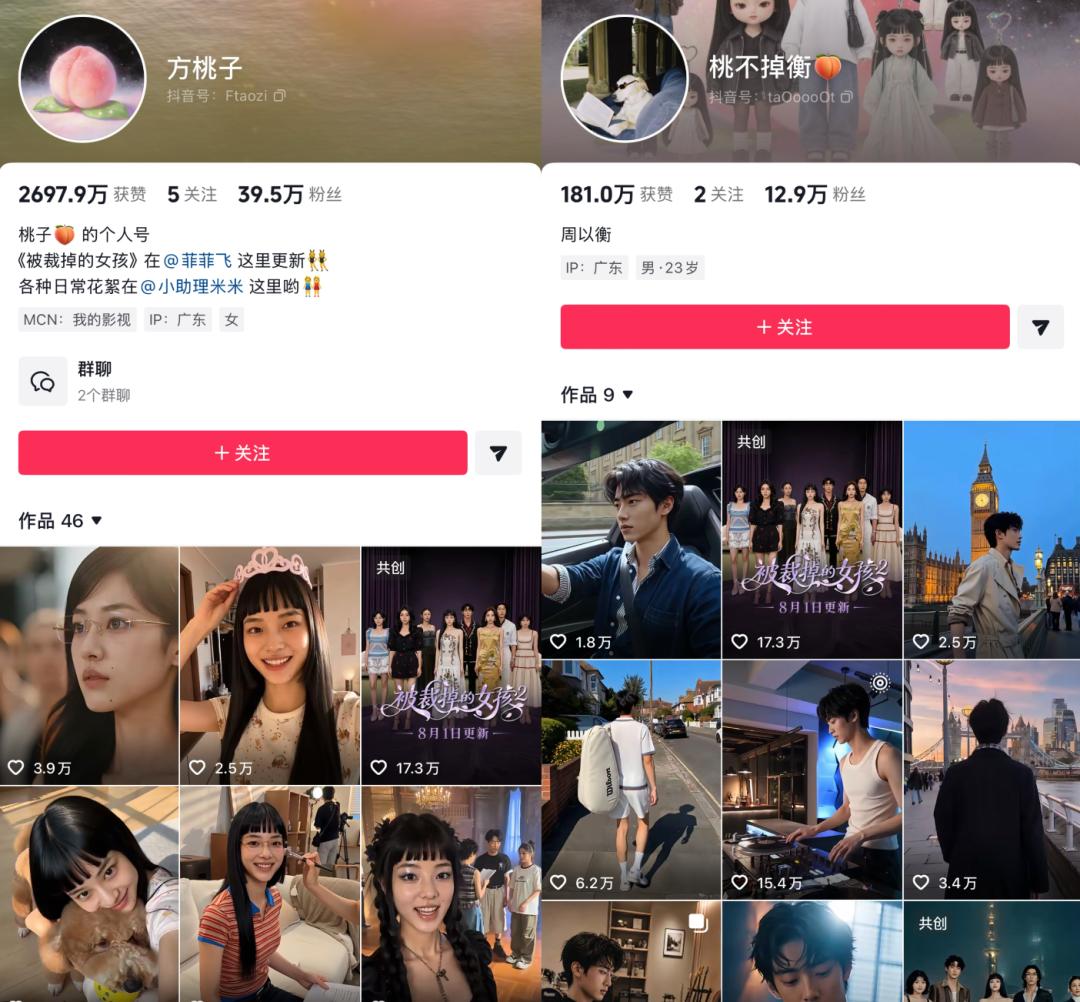
Figure: Social accounts of Fang Taozi and Zhou Yiheng. Source: Screenshot of Tingtong Tech on Douyin.
What the market did not expect is that these two leads suddenly became viral across the internet.
On July 22, the topic #Two AI Actors Are More Popular Than the Up-and-coming Stars in Chinese Entertainment Industry# topped Weibo's hot search list for more than 8 hours, with over 45 million views. The protagonists discussed in this topic are exactly Fang Taozi and Zhou Yiheng.
Even a complete CP fan ecosystem has formed around these two AI characters. Derivative topics such as "Fang Taozi's bangs makeup tutorial" and "But there are girls just like Taozi everywhere in Shangnan" have set off a boom of fan creation.
In fact, it is not only AI characters that are gaining explosive popularity, some AI actors have already arranged their second collaboration in new works.
For example, the male and female leads "Duan Yan" and "Rong Jiqiao" of the AI comic drama Deep Love Invades the Rest of My Life have officially announced their new collaborative drama Chaos of Male and Female Oriented Novels After Breaking Up, which is scheduled to be released on July 28. The release and opening ceremony videos they posted gained 290,000 likes in half a day.
Even this pair of AI characters not only show sweet interactions online, but also launch the same goods-selling model. Among them, a bracelet promoted by Duan Yan sold more than 10,000 units, with sales exceeding one million yuan.
Market analysis points out that with personalized account operation, complete set of promotion and monetization methods, and formed fan ecosystem, the operation of AI characters has completely replicated the industrial chain of real celebrities.
From the perspective of Xiaolin, a drama fan for many years, "This is exactly the treatment a professional actor would get when they suddenly become famous. No one would have thought that one day this would happen to AI actors."
Xiaolin has been a drama fan for many years and has spent money on chasing celebrities. "I have supported many top idols, popular young actors and actresses, and excellent boy groups for their commercial endorsements, and I have also bought their peripheral products."
But Xiaolin can hardly imagine herself chasing AI dramas and AI actors. Although she is resistant to AI film and television works and AI actors, she did admit that "I clearly feel that AI dramas are getting more and more popular. The main reason is that all my friends around me are watching them."
According to Xiaolin's observation, since the end of last year, some of her friends have started discussing AI micro dramas. "At first, they paid attention to some virtual 20-second short anime clips; then some AI actors began to output content of expanding themes, ranging from fantasy, urban romance to rural themes. Recently, some people even started to chase AI actors."
What surprised Xiaolin even more is the openness of traditional film and television channels to AI short dramas.
"I was a little shocked when I saw Anhui TV broadcast the fully AI-produced drama The Tale of Taohua Pond in its prime evening slot starting from July 22." Xiaolin said that this 20-episode intangible cultural heritage themed work is marked with the words "AI Production" and "AIGC Director" on its opening title for the first time.
According to data from Kuyun, the premiere of the first 4 episodes of The Tale of Taohua Pond achieved a viewership rating of 0.0349%, ranking 33rd nationwide in the post-prime time slot; three days later, when 5 episodes were broadcast consecutively, the viewership rating rose to 0.1067%, ranking 10th nationwide, even exceeding some long live-action dramas.
Prior to this, in February this year, an AI short drama Chinese Legends: The White Snake was tested in the prime time slot of Zhejiang TV, ranking second nationwide in terms of viewership rating in the same period.
Xiaolin admitted that as a drama fan who only chases real actors, although she is still resistant to AI, "I have to admit that AI actors are taking jobs away from real actors." Xiaolin joked.
"Even AI actors have started their second collaboration, who cares whether you accept them or not."
"Its Popularity Is Inevitable"
No matter whether the audience accepts it or not, the trend that AI film and television works move from the internet to large screens and enter the mainstream vision is already an irreversible general trend.
The latest data from DataEye shows that from January to May this year, the market size of domestic AI short dramas has exceeded 220 billion yuan, and the full-year figure is expected to hit 400 billion yuan. The number of domestic AI short drama users exceeded 600 million in the first half of the year. The scale of supporting services for AIGC video large models exceeds 200 billion yuan, occupying half of the industry.
The figures on the supply side are staggering. Data shows that in the first quarter of 2026, about 128,000 micro dramas were launched across the industry, of which about 122,000 were AI micro dramas, accounting for more than 95%.
Native data from Douyin also shows that from January to June, a total of 221,900 new AI short dramas were added. It can be said that AI micro dramas have completed the output growth that took live-action short dramas three or four years to achieve in less than a year.
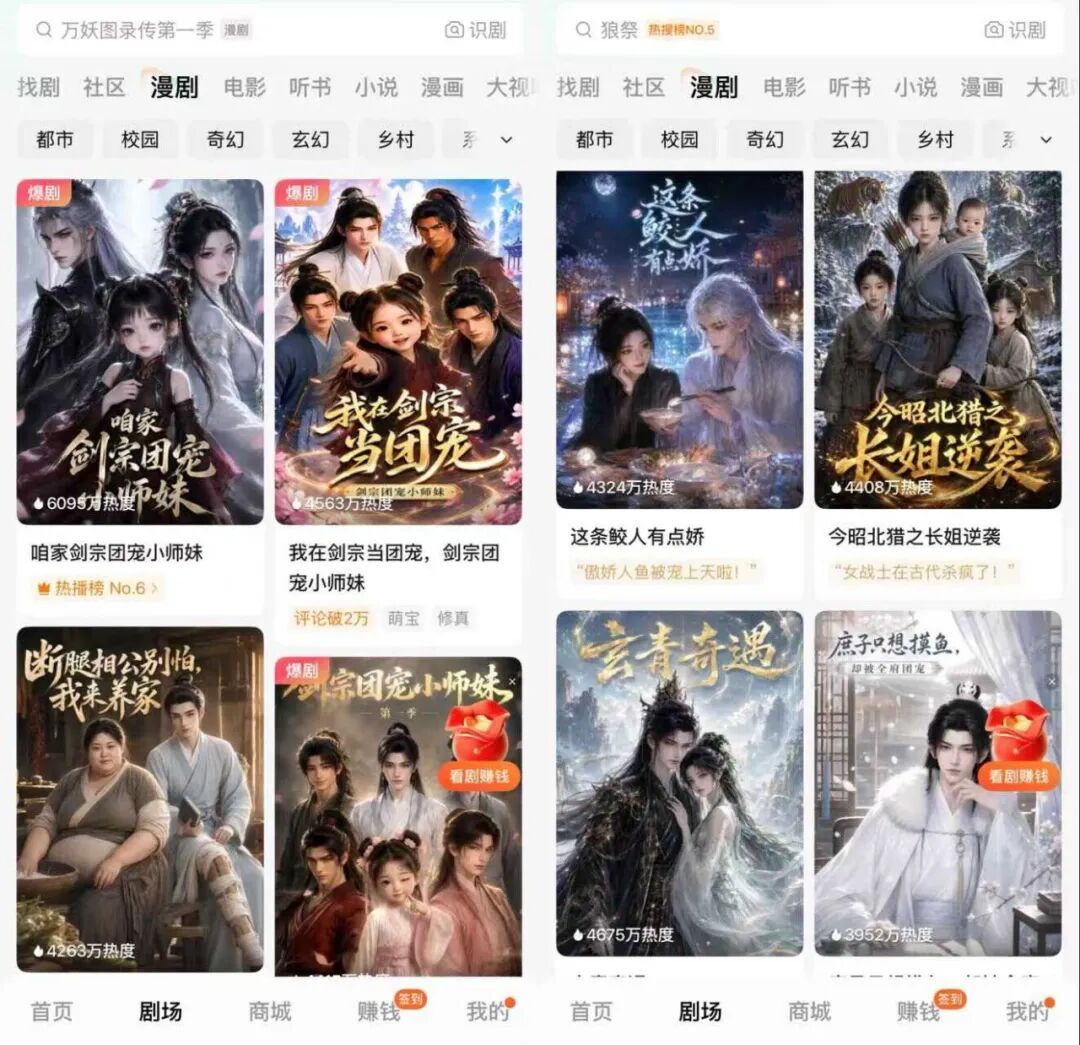
Figure: AI comic dramas on short video platforms. Source: Screenshot of Tingtong Tech on Hongguo.
Dou Ge, an AI comic drama producer, told Tingtong Tech, "The explosion of AI micro dramas and AI actors is not complicated. The technology has matured, the cost has dropped, and the output has increased."
Because of the low cost and the fierce "involution" in the industry, the popularity of AI micro dramas and AI actors has become inevitable.
Public information shows that at present, the cost of a single episode of AI short drama can be controlled at around 10,000 yuan. Dou Ge also admitted, "The production cost of AI short dramas is only one-tenth of that of live-action short dramas."
For example, the total production cost of a high-quality live-action short drama is between 1 million and 1.5 million yuan, and the shooting cycle takes 30 to 45 days; while the total cost of a high-quality AI short drama of the same length is only 200,000 to 400,000 yuan, and the production cycle can be shortened to 15 to 20 days.
At the same time, the theme boundaries of AI short dramas have also been greatly expanded.
"Types such as immortal cultivation, doomsday, and science fiction, which were rarely involved before due to the high cost of live-action special effects, can now produce very realistic special effects with little effort with the continuous iteration of AI-generated video applications." Dou Ge said.
In addition, Dou Ge also admitted, "Male users of Generation Z are also one of the core groups of AI short dramas, which complements the traditional pattern where the audience of short dramas is dominated by women. In terms of theme preferences, men like fantasy, games, doomsday, suspense and supernatural stories."
More notably, AI micro dramas are not competing for the existing market share with live-action short dramas, but reaching out to groups that were not covered by short dramas before, such as users of online novels and games, continuously expanding the overall market size of short dramas.
For example, data from Kuaishou shows that 62% of the paying users of AI short dramas are incremental users of the industry, and the overlap rate between the audience of traditional short dramas and the paying group of AI short dramas is only 38%.
This also means that AI short dramas are attracting new users, not simply replacing existing content.
Xiaolin has a deep feeling about this, "Many people around me who watch AI micro dramas are male two-dimensional anime fans who hang out on Bilibili. They often follow IP-adapted hot-blooded anime on long video platforms, and now AI micro dramas have become one of their new entertainment choices."
Industry Shuffling Is Imminent
Everything seems to be developing at a breakneck pace, but what is the market's attitude towards it?
Although the industry is growing rapidly, the vast majority of audiences do not accept it. In particular, with the continuous deep penetration of AI in the industry, topics related to AI are constantly fermenting in society.
On July 30, the topic #Can We Stop the Development of AI# became a trending search, and netizens had heated discussions. They generally said that this has become the inner voice of more and more ordinary people.
Some netizens said, "Especially the painting skills you have practiced hard through staying up late, the writing skills you have polished repeatedly, and the professional skills you have accumulated over years, now AI can quickly produce similar content with one click. The industry threshold has been infinitely lowered, and many artisans are in a passive position."
This kind of resistance is not just about rejecting "technology", but about fearing that the livelihood you have worked hard for will have no place in the tide of technological development.
In particular, in the view of more insiders, AI actors and AI micro dramas not only impact the real cultural and entertainment ecosystem, but more importantly, they bring impacts to the development of public aesthetics and business ecosystem.
Previously, the "uncanny valley" effect of AI simulated real-person dramas has been widely discussed by the society. Some audiences reported that "the more you watch, the weirder it feels, and even cause physical discomfort."
Many analyses believe that when the realism of the work reaches a certain level but is not 100% real, the audience's favorability will drop sharply.
Data from China Netcasting Services Association also shows that in the first quarter of 2026, the number of AI micro dramas accounted for more than 95%, but their core play volume only accounted for 4%. During the 2026 Spring Festival holiday, the number of live-action dramas launched was about 1/50 of that of AI dramas, but the total play volume was 25 times that of AI dramas.
Xiaolin explained, "Although AI actors will not have public image scandals, their uniformly exquisite facial features, flawless skin, standardized beauty filters, and a large number of characters sharing the same facial template make people feel false directly."
From the perspective of the industry, Dou Ge believes that AI micro dramas also have an increasingly obvious problem of inverted cost.
Dou Ge explained that the main problem is that the cost structure of AI simulated real-person dramas will have extreme differentiation. Some producers, in order to pursue S-level projects with stable characters and exquisite pictures, have seen their cost close to that of live-action dramas; while A-level high-volume dramas that only meet the compliance launch standards can compress costs, but the homogeneity and the problem of "generic AI faces" are becoming more and more serious.
In particular, the entire industry is facing tightening regulatory policies.
On June 25, the Network Audio-Visual Department of the National Radio and Television Administration issued the Management Tips (Classification and Hierarchy Standards for AI Micro Dramas), which was officially implemented on July 1. This is China's first special regulatory specification for AI-generated audio-visual content, marking that AI short dramas have entered a compliant era of licensed operation from the previous unregulated wild growth stage.
Earlier, a person in charge of an online reading platform revealed to Tingtong Tech, "Many AI-generated projects on short video platforms have been suspended, and the specific information is still being verified. However, changes are inevitable. Whether it is the top-level supervision or the fermentation of unrecorded drama incidents, the relevant supervision will not allow the opening for the whole people to make comic dramas to continue to expand."
These trends also point out the direction that the industry will usher in a deep shuffling cycle.
Some industry insiders pointed out that industry competition will shift from simply competing for production capacity and traffic investment to competing for comprehensive strength including IP reserve, high-quality content production, and global operation. That is to say, IP, script creation ability and aesthetic level are the core competitiveness.
"AI actors have already arrived. They may not replace good actors, but they will definitely reshape the production mode, business model of the industry, and even the relationship between the audience and performance." Dou Ge said frankly.
However, Xiaolin still insists that "looking back at the history of film and television art development, every technological innovation has reshaped and enriched the form of performance, but never eliminated the core value of performance."
Indeed, the story of AI creating celebrities is still going on, but whether it can further occupy the audience's viewing list still depends on the audience's inner recognition.
(All names in this article are pseudonyms.)
(The cover image is generated by AI.)
(Statement: This article is for information exchange only, and does not constitute any investment reference or suggestion.)
—END—