Why has UEFA publicly come out to oppose FIFA?
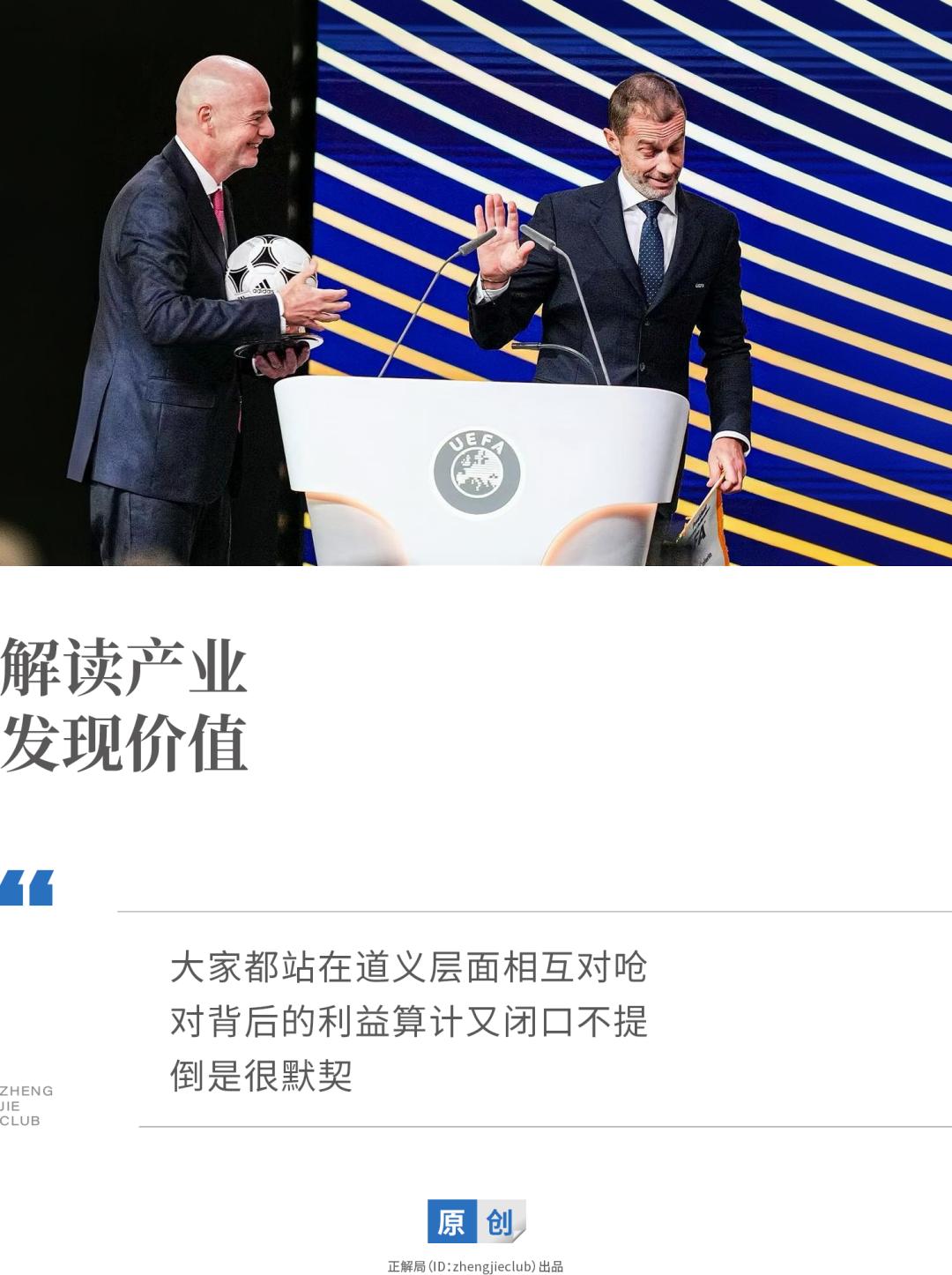
These past couple of days, football fans have almost certainly come across this piece of news:
UEFA (the Union of European Football Associations) has publicly slammed FIFA (the Fédération Internationale de Football Association).
What is going on here?
Since it's the weekend today, let's talk about this briefly.
A few days ago, FIFA announced that it would set up a subsidiary called FIFA Forward Enterprise (FFE, which is mostly referred to as "FIFA Forward Enterprise" in Chinese at present).
This subsidiary will be responsible for integrating FIFA's commercial rights including broadcasting, sponsorship, ticketing and franchising, as well as event operations.
It is reported that the initial valuation of FFE is 20 billion US dollars, and FIFA plans to sell around 20% of its equity to raise 4.2 billion US dollars in capital.
FIFA has promised that investors will only be allowed to participate in the commercial operations of FFE, and cannot interfere in core competitive affairs such as competition rules and match scheduling. All net profits will be reinvested in the global football industry.
Furthermore, as long as the proposal gets support, every country can quickly receive 20 million US dollars to support the development of football.
On the surface, this seems to be a good thing.
But at present, the Oceania Football Confederation, the Confederation of North, Central America and Caribbean Association Football, the Asian Football Confederation and the Confederation of African Football have all stated no support for the move.
UEFA, however, has taken the toughest stance: it demands that FIFA withdraw this proposal, otherwise it will withdraw from all events under the auspices of FIFA.
It should be noted that Europe is a key stronghold for global football. Without European teams, the World Cup would lose almost half of its appeal.
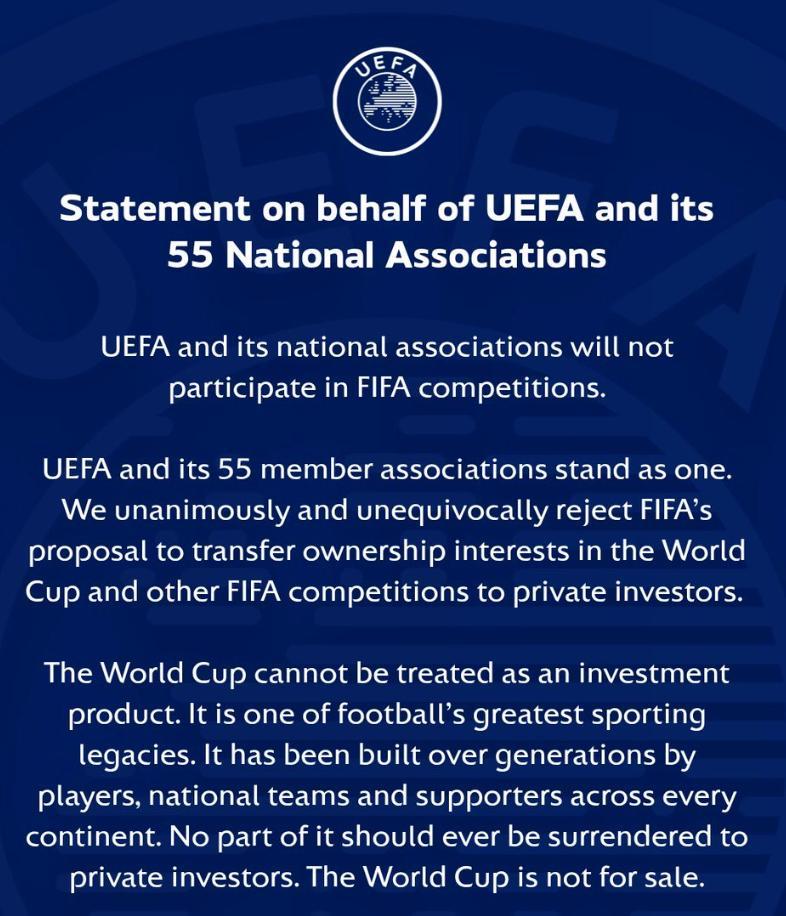
UEFA's official statement
Let's insert a bit of background knowledge first.
Many people find it confusing that regional football confederations are opposing decisions made by FIFA, as if they are overstepping their authority.
In fact, FIFA is not an intergovernmental international organization, but a voluntary association composed of national (and regional) football associations.
At the end of the day, FIFA is a commercial organization that needs to make profits just like any other entity.
Take this year's World Cup as an example: FIFA initially asked for as high as 300 million US dollars for the Chinese broadcasting rights, purely to extract more revenue from the Chinese market.
To put it simply, FIFA runs three major events: the World Cup, the U-20 World Cup, and the U-17 World Cup.
FIFA now has 211 member associations, covering countries and regions around the world.
From the most fundamental business logic perspective, FIFA, national football associations, and continental football confederations are all partners.
Therefore, UEFA's opposition to FIFA is by no means an act of insubordination.
UEFA has also put forward seemingly well-justified reasons for its opposition: FIFA is "commodifying" football and selling out "the soul of football".
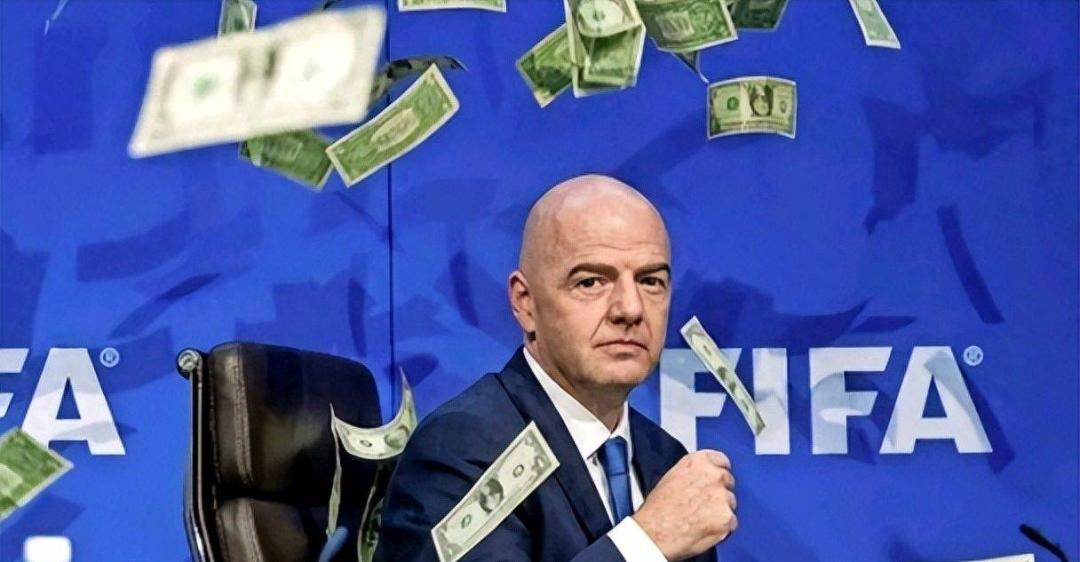
Is that really the case?
But the actual core of the issue is a fight over commercial interests.
UEFA's opposition to the "commodification" of football is, in essence, still driven by business logic.
In more plain terms, even though football is the world's most popular sport, the total number of football fans globally is relatively stable, the total amount of money sponsors are willing to spend is limited, and the pool of top-tier players is also fixed.
More importantly, there are only 365 days in a year, so the total time available for matches is limited.
FIFA's current strategy is to expand its scale, strengthen its competitiveness and achieve new glories.
This year, the World Cup has expanded from the original 32 teams to 48 teams, with the number of group stage matches increased to 72, total matches reaching 104, and the total duration of the tournament extended to 39 days.
Additionally, this is the first time that the World Cup is co-hosted by three countries: the United States, Canada and Mexico.
By comparison, the 2022 Qatar World Cup only had a tournament duration of 28 days.
In fact, this is the second expansion of the World Cup in recent years. The previous expansion was in 1998, when the number of teams was increased from 24 to 32.
Back in 1930, the first World Cup only had 13 participating teams, with a total of 18 matches played over 18 days.
Now there are even rumors that FIFA is studying the possibility of further expanding the number of participating teams from 48 to 64...
What about UEFA? It is also a commercial organization.
Once the World Cup kicks off, all other events have to make way for it.
Now that FIFA is going to set up this dedicated subsidiary, as the number of participating teams in the World Cup keeps growing and the tournament duration keeps extending, FIFA will make huge profits.
Not to mention that FIFA already runs the U-20 World Cup and the U-17 World Cup, and may even launch new events in the future.
This kind of diversion will not only split the match time, the attention of top players and global football fans, but also divert a huge amount of actual revenue.
Europe has the most mature football market in the world.
The UEFA Champions League and the UEFA European Football Championship operated by UEFA are, to put it simply, direct competitors to FIFA's events.
Now that FIFA wants to grab all the profits for itself, UEFA naturally will not agree.
However, both sides are arguing on moral grounds while keeping silent about the underlying interest calculations, which is a rather tacit understanding between them.
In fact, many things in this world work in this way.
✎
THE END

[About Zhengjie Insight]
Zhengjie Insight is a financial content institution focused on industrial economic research. For a long time, it has analyzed urban, enterprise and regional competition from an industrial perspective, and provides in-depth reports on industrial trends and urban development as well as industrial research services. Governments, enterprises and institutions are welcome to contact us for cooperation and research projects.
This article is from WeChat Official Account "Zhengjie Insight" (ID: zhengjieclub), the author is Zhengjie Insight, and 36Kr publishes this article with authorization.