GPT-5.6 sees a sharp price cut: Luna's input pricing is even lower than that of DeepSeek, and the official version of DeepSeek V4 is launched shortly afterwards.
On July 31, the AI industry witnessed two major events on the very same day.
On one hand, OpenAI suddenly announced a steep price cut, with the input price of its cheapest model directly slashed from $1 to $0.2, a whopping 80% reduction — this price is even lower than that of DeepSeek, a domestic model widely known for its cost-effectiveness. On the other hand, DeepSeek did not sit idle, and rolled out a new version the very same day, claiming that its capabilities in complex tasks such as coding and bug fixing have been greatly improved.
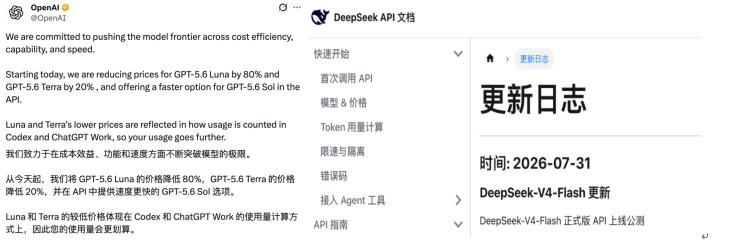
The two companies are clearly following different paths: OpenAI aims to popularize top-tier AI capabilities with low prices, while DeepSeek is capturing the market with extreme cost-effectiveness. But their moves on the exact same day are by no means a coincidence, but a head-on confrontation over "how much AI services should actually cost".
However, behind the fanfare, three questions are worth exploring in depth:
First, OpenAI rushed to cut prices by 80% just three weeks after the new model's release — who exactly forced it to do so? Second, Chinese AI models have long relied on "low pricing" as their moat, but now that competitors are offering even lower prices, will this strategy still work? Third, as the price war escalates to this level, who will be the first to be unable to hold on?
01 Luna's Price Slashed by 80%, Sol Gets Faster Performance at No Extra Cost
This price adjustment covers three GPT-5.6 models, but the magnitude of the cuts varies drastically.
Luna is the absolute star of this price reduction. Its input price dropped from $1 to $0.2, and output price from $6 to $1.2, marking an 80% cut in one go. The Terra model saw a relatively mild adjustment, with input price falling from $2.5 to $2 and output price from $15 to $12, representing a 20% reduction. The flagship Sol model kept its price completely unchanged, with input price staying at $5 and output at $30, but a new Fast mode toggle has been added to its API.
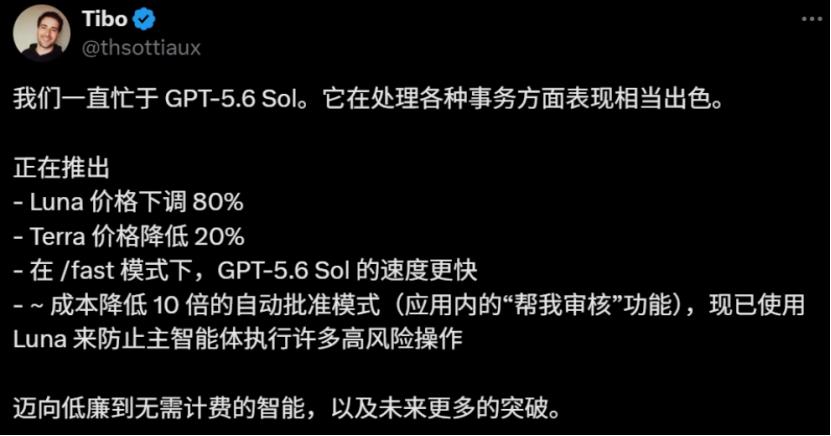
The Fast mode is cleverly designed — it boosts the processing speed to 2.5 times that of the standard version, with double the charge, but there is no compromise on intelligence level. It replaces the previous Priority Processing service, and all requests previously tagged with priority will be automatically routed to this new mode. In plain terms, OpenAI is selling "speed" as a separate service: pay more if you cannot wait, and you can choose the tier that fits your budget.
The dividend of the price cut has also been passed on to the subscription tier. The monthly fees for ChatGPT and Codex remain unchanged, and the total quota is not adjusted either, but fewer credits will be consumed when calling Luna and Terra. With the same $20 monthly fee, users can now run far more tasks than before.

OpenAI also replaced the Auto-review model in ChatGPT and Codex CLI from GPT-5.4 to Luna. This feature is responsible for checking code and modification results in the background, a typical high-frequency Agent task. The combination of model replacement and price reduction is expected to bring the cost down to roughly one-tenth of the original level, according to official estimates.
After the price cut, Luna's input price is on par with the previous-generation GPT-5.4 nano, and its output price is even $0.05 lower. But the capabilities of the two models are not in the same league at all — the nano model is mainly designed for simple routine tasks such as classification and information extraction, while Luna can call tools, process long contexts, and execute multi-step workflows. OpenAI is now selling models that power Agent operations at the price point of small models from the past.
The division of labor for the three models is now very clear: use Luna for large-scale high-frequency tasks, Terra for daily work, Sol for the most challenging complex tasks, and turn on the Fast mode to pay extra for faster speed if you are in a hurry.
02 AI Works for Itself, Sol Rewrites Its Own Running Code
Where does the confidence to cut prices by 80% come from?
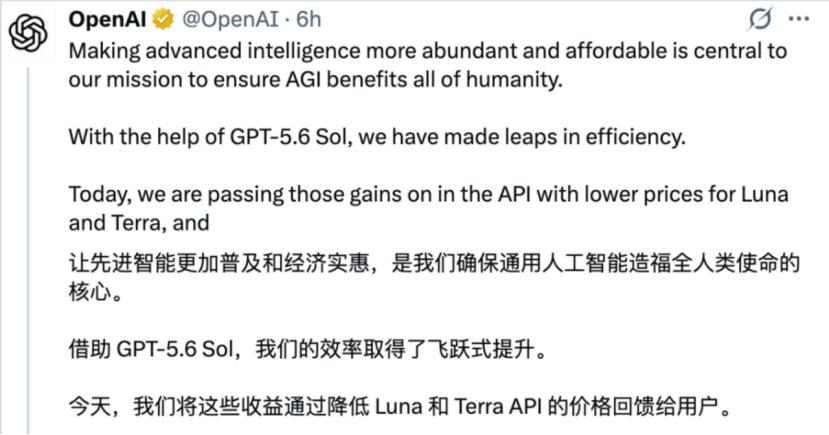
The day before the announcement, OpenAI disclosed a key piece of information — Sol was connected to the production inference stack via Codex, and optimized the entire system that runs it by itself. Specifically, under the supervision of human engineers, Sol completed four major tasks.
First, it rewrote the GPU kernel. Models need underlying programs to perform computing tasks on GPUs. The more efficient the program is written, the faster the same GPU can complete the calculation. Sol independently rewrote part of the production kernels using the Triton and Gluon languages. Combined with more extensive kernel optimizations, the end-to-end service cost was reduced by 20%.
Second, it improved speculative decoding. This technology essentially allows a small model to first "guess" what tokens might appear next, and the main model verifies the guesses in parallel. If the guess is correct, the model can output multiple tokens at once. Sol designed and ran hundreds of architectural experiments for this process, actively monitored the training process, and intervened automatically when encountering hardware failures and training instability. As a result, token generation efficiency has increased by more than 15%.
Third, it optimized load balancing. OpenAI distributes requests by region, capacity and accelerator type, and further allocates resources within the cluster based on load and context length. Sol analyzed production traffic data, identified unbalanced issues that engineers had not noticed before, and tested new routing strategies.
Fourth, it tuned KV cache configurations. The optimal configuration is highly dependent on actual workloads, and the configuration space is so vast that engineers previously relied mostly on experience for tuning. After analyzing production workloads, Sol automatically generated and evaluated candidate configurations, pushing the performance of previously untunable modules to the extreme.
Tibo, Head of Codex, summarized this approach into two steps: first train a sufficiently powerful model, then use this model to optimize every link including infrastructure and kernels. It is worth noting that the code written by Sol cannot be directly launched for production — OpenAI uses tools to verify the structure and data flow item by item, and only approves the code after confirming it is error-free. The entire process is still steered by humans, with the model responsible for execution.
But all these optimizations combined still cannot explain the 80% price cut. The 20% service cost optimization plus 15% generation efficiency improvement still leaves a significant gap with Luna's drastic price reduction.
The remaining part of the answer lies in the market pressure that forced OpenAI to make this move.
03 Price Comparison: Luna Surpasses DeepSeek V4 Pro in Cost-Effectiveness
Where does the pressure that pushed OpenAI to cut prices at this specific point in time come from?
Chinese large model vendors are an unavoidable answer.
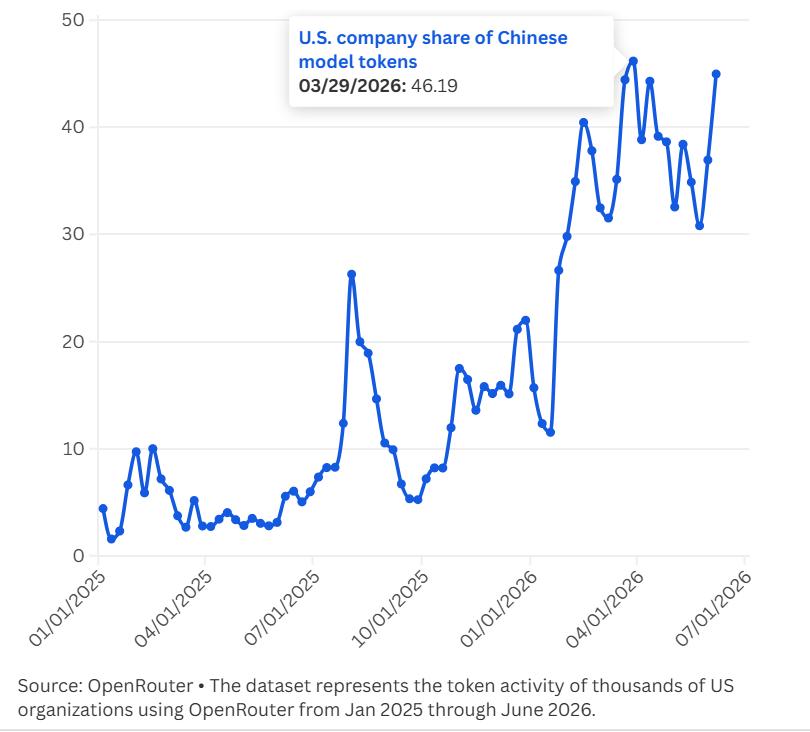
Let's look at a set of statistics. According to OpenRouter's data, since late April 2026, the token call volume of Chinese models has exceeded that of US models for 13 consecutive weeks. In the week from July 20 to July 26, Chinese models processed about 38.6 trillion tokens, accounting for 66.5% of the entire platform's total volume. According to another CNBC survey, since February 8, the proportion of tokens that US companies spend on Chinese AI models via the OpenRouter platform has exceeded 30% every week, with the highest figure reaching 46%. The usage volume is rising, and the price competition is even more fierce.
The pricing of DeepSeek V4 Pro is $0.435 per million input tokens and $0.87 per million output tokens, with a permanent 75% discount. The input price is as low as $0.003625 per million tokens when cache hits. Kimi K3 is priced at $3 for input and $15 for output. GLM-5.2 is priced at $1.4 for input and $4.4 for output.
A horizontal comparison makes the gap very intuitive:
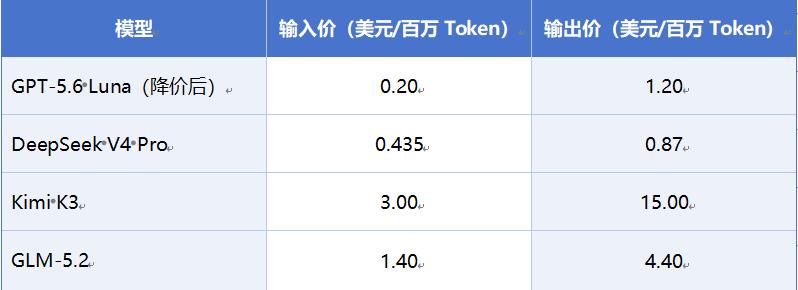
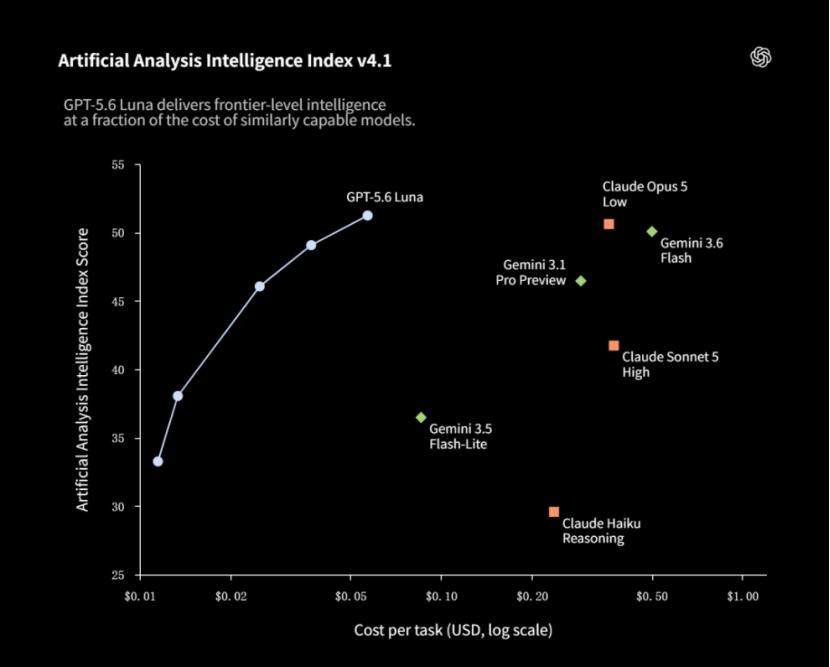
Luna has already overtaken DeepSeek V4 Pro in terms of input price. Although its output price is still slightly higher, considering the intelligence level, data from third-party institution Artificial Analysis shows that Luna's overall cost-effectiveness has already taken the lead.
In the Agents Last Exam benchmark, Luna even outperformed Anthropic's flagship Fable 5, with the cost per task being only about 1% of that of Fable 5.
Sam Altman later posted on X (Twitter) that OpenAI aims to provide the best price-to-intelligence ratio "at every model tier". In plain terms: do not compete with me on cost-effectiveness.

Enterprise customers' growing sensitivity to AI costs is also a major driving factor.
According to CNBC reports, enterprises are increasingly reluctant to deploy expensive models when they cannot clearly calculate the return on investment. Google launched three high cost-effectiveness models in this month alone, and Microsoft CEO Satya Nadella specifically emphasized cost-effectiveness during the earnings call. Facing pressure from all sides, OpenAI had to roll out a powerful countermeasure. Luna is a particularly shrewd move — with an input price of $0.2, it lowers the threshold for Agent operations to the floor, turning review, verification and monitoring tasks that were previously too costly to run frequently into regular operations in daily workflows.
04 Those Who Cannot Afford the New Standard Will Fall Behind First
But to understand the true significance of this price cut, we first need to look at a real-world scenario.
A developer uses AI to scrape, clean and label tens of thousands of news articles every day. Structuring, data cleaning, pre-filtering, labeling, entity extraction, atomic event separation, clustering, semantic merging... most of these links require AI intervention. Some workflows are so complex that the Agent needs to call tools by itself, check results, and decide on the next step. Tens of thousands of news articles multiplied by a long processing chain result in an extremely staggering call volume.
Given his call scale, the monthly API cost is only about 1000 RMB, which would be at least ten times higher if using top-tier models.
This is exactly the niche where DeepSeek V4 Flash thrives — its intelligence level is above average, but it is incredibly cheap. The same logic applies to WorkBuddy: for the most difficult tasks, users turn to K3, but for the vast majority of daily tasks, Flash is more than capable, and each task only consumes 0.06 credits.
But OpenAI's real killer feature in this price cut hits right at this very logic.
Luna is not a "small model" that can only do classification and extraction. It can call tools and execute multi-step tasks, making it a fully-fledged Agent model. And its input price is only $0.2. This means that the high-volume, high-throughput scenarios where DeepSeek V4 Flash has been thriving now have a strong new competitor — and this competitor has a much higher level of intelligence.
When Luna brings the cost of Agent operations down to the price level of small models from the past, the cost of large-scale calls becomes almost negligible. Review, verification and monitoring tasks that were previously too costly to run frequently can now become regular steps in the workflow.
The industry certainly needs top-tier models that can solve world-class problems in one go. But the vast majority of real-world demands are ordinary tasks that are repeated tens of thousands, hundreds of thousands, or millions of times every day.
When intelligence is as expensive as a luxury, people can only experience it occasionally. When intelligence is as cheap as water and electricity, it can truly flow into every company, every production line, and every ordinary person's life.
This is the true democratization of intelligence. And this competition is far from over.
At the same day the GPT-5.6 price cut news came out, the developer community was abuzz. Some people said their API quota can finally be used more freely, while others directly called out to Anthropic: "It's your turn to make a move."

It is clear that the true significance of this round of price cuts is not about saving a few dollars, but a clear signal: the commoditization of large models is accelerating. When models start to reduce their own operating costs, when efficiency gains are directly translated into price reductions, when "intelligence is so cheap that you don't need to calculate the cost" is no longer a slogan — the entire