Graph Engineering: The engineering that enables AI to truly "understand the world"
The deciding edge for industrial AI never lies in the "horsepower" of the model itself, but in the "full-vehicle system" that steers it — this is the core conclusion we drew from our discussion in the Harness Engineering article.
In that three-tier architecture, the "graph constraint" at the control layer and the "relational memory" at the memory layer all take knowledge graph as their core. However, in the deep-water zone of real industries, a more fundamental engineering question emerges: how can the graph itself be engineered?
This is exactly the core proposition of Graph Engineering. If Harness solves the problem of "how to steer the model", then Graph Engineering solves the problem of "what the model should trust" — building a credible, inferable and evolvable structured world model for the model.
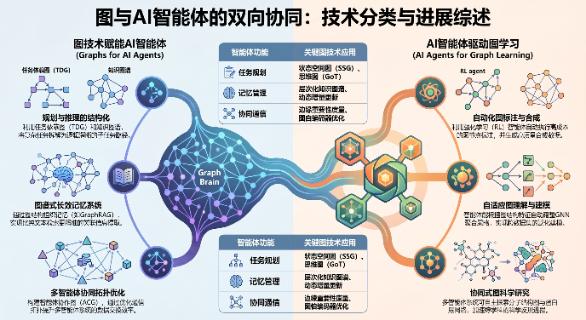
Recently, Zhejiang University and the University of Illinois Chicago (the team of Academician Philip S. Yu) jointly published the landmark review Graphs Meet AI Agents, which for the first time established a complete academic classification system for "Graph × Agent". The paper systematically demonstrates a core consensus: in the face of complex tasks, Agents must deal with intricate and disordered information, operations and interactions; data structurization is the key to enabling Agents to understand and process effectively; and graphs, with their natural advantages in organizing, managing and utilizing complex data relationships, have become a powerful data paradigm supporting structurization.
This cutting-edge judgment coincides with more than ten years of industrial practice of Hydata. We have always believed in what Academician Zheng Weimin said: "The graph is like the left brain, and the large model is like the right brain." A real industrial-grade AI is by no means a simple combination of the two, but makes structured knowledge become the inherent thinking framework of the model.
Starting from the deep logic of the engineering architecture, this article will analyze the technical core of Graph Engineering, and share how Hydata builds a truly credible knowledge base for industrial-grade AI through mature graph engineering practices.
01 Paradigm Establishment: The Rise of Graph Engineering
The Graphs Meet AI Agents review puts forward a clear judgment: Traditional Agents mainly process unstructured data, and can only "implicitly" identify potential correlations between information in the learning process; while graph-based structured modeling can convert the original complex input into a concise and well-organized form, enabling Agents to better understand and process it.
This judgment marks that AI knowledge engineering has experienced three key transitions:
Before 2022: The Era of Rules and Expert Systems (Knowledge 1.0) — relying on manually defined ontologies, rule templates and dedicated NLP pipelines. It is accurate but not scalable, and it has to be built from scratch every time it enters a new field.
2023~2024: The Era of Vector Retrieval (Knowledge 2.0) — represented by RAG, which uses vector embedding for semantic similarity matching to provide external knowledge for the model. It is scalable, but essentially it is a similarity match of "isolated points": it knows "what it looks like", but does not know "who it connects to and why".
Since 2025: The Era of Graph Engineering (Knowledge 3.0) — starting with Microsoft GraphRAG (2024), and systematized by the Graphs Meet AI Agents review in 2025, the knowledge graph is no longer just a fact base, but engineered into the inferable memory, reasoning scaffolding and verifiable knowledge layer of the Agent. The graph organizes knowledge into a network with relationships, time sequences and evolvability.
A simple analogy can illustrate the essential difference between these three transitions: A vector is an "impression" — you vaguely remember what something "looks like", but cannot clearly explain its relationship with other things; a graph is a "map" — you not only know "what a certain location is", but also know "who it connects to, how to get there, and where to pass by". The model is the driver, and what Graph Engineering builds is exactly the map that prevents the driver from getting lost.
It is worth noting that these three transitions are not a simple "substitution" relationship, but a progressive and complementary in capability dimensions: vector retrieval is irreplaceable in semantic generalization and fuzzy matching, and graph engineering adds the "second layer of capability" of relational reasoning and logical traceability on this basis. The two are like "System 1 (Intuition)" and "System 2 (Analysis)" of the human brain, working in synergy rather than in opposition.
At the same time, these three transitions are not parallel to the overall evolution of AI engineering (Prompt Engineering → Context Engineering → Harness Engineering), but vertically nested: Graph Engineering is the deepening of Context Engineering towards graphs, and it is also the technical core of the "control layer" and "memory layer" in Harness Engineering.
When the industry is hotly discussing "Harness Engineering", graph engineering has long been the substantive carrier of that set of reins and memory.
02 The "Reasoning Cliff" of Vector RAG: Why Graph Engineering Is a Must for Industrial AI
With its natural advantages in semantic generalization and fuzzy matching, vector RAG performs well in C-end scenarios with high fault tolerance. However, once it enters the core B-end business of finance, government affairs and other scenarios that require deterministic reasoning and logical traceability, simple vector similarity retrieval will expose structural shortcomings — it is good at finding isolated fragments that "look like something", but it is difficult to connect the relationship chains of "who it connects to, why, and how to get there". This is not a "failure" of vector RAG, but its capability boundary.
Just as the human brain needs "intuition" and "analysis" to work together, industrial AI also requires the deep integration of vector retrieval and graph reasoning. Graph Engineering is the engineering solution to complement this "System 2" reasoning capability. This judgment has been systematically verified in multiple top conference experiments.
1. Semantic Similarity ≠ Logical Relevance: Systematic Failure of Multi-Hop Reasoning
The essence of vector retrieval is the similarity matching of "isolated points". Each paragraph is encoded independently, and entity relationships cannot be associated across paragraphs. This leads to systematic failures in multi-hop reasoning (such as "which university did the tutor of A's spouse graduate from").
HippoRAG (NeurIPS 2024) provides the most direct evidence: after integrating knowledge graph + personalized PageRank with vector retrieval, the Recall@5 on 2WikiMultihopQA jumps from 68.2 of pure vector to 89.5 — the improvement is up to 20%, the cost is reduced by 10~30 times, and the speed is 6~13 times faster.
More convincing is the direct controlled experiment of the StructuralMemory paper: after systematically comparing four memory structures: chunks (vector), knowledge triples (graph), atomic facts, and summaries, knowledge triples are clearly superior to pure vector chunks in relational reasoning and multi-hop QA, and the mixed memory containing triples has the strongest anti-noise robustness.
Vectors can only find "what it looks like", and only graphs can answer "who it connects to" — this is a structural capability gap that cannot be bridged by parameter tuning.
However, it should be emphasized that the most robust solution is not to replace vectors with graphs, but to use graphs as the relational skeleton and vectors as the semantic entry, and the two cooperate to form a hybrid retrieval architecture.
2. Black-Box Reasoning and Audit Dilemma: From "Probabilistic Guessing" to "Traceable Path"
The core business of enterprises must pass compliance audits, but the reasoning of general large models is a "black box". Graph Engineering fundamentally rewrites this problem: The graph structure transforms the "black-box reasoning" of LLM into "white-box path reasoning" — each step of reasoning takes entities and relationships in the knowledge graph as anchors, and the process is traceable, auditable and correctable.
Think-on-Graph (ICLR 2024) allows the LLM as an Agent to perform beam search on the knowledge graph, and each step only selects from the neighbor relationships that truly exist in the graph, and the reasoning path is faithful to the graph structure. Its explicit path can backtrack and locate wrong triples, supporting manual or LLM feedback correction. Reasoning on Graphs (ICLR 2024) goes a step further, using knowledge-graph-grounded relational paths as "faithful plans" to constrain the reasoning direction.
Its ablation experiment is very convincing: the random path (35.2 F1) is worse than no path (49.7), while the knowledge-graph faithful path reaches 70.8 — which proves that it is not "just adding a graph", but a "correct and complete graph structure" that can effectively guide reasoning.
This also inversely derives the primary engineering challenge of Graph Engineering — how to continuously build, verify and complete high-quality knowledge graph ontologies. The more accurate the map is, the more reliable the driver will be; but if the map itself has omissions, the engineering system must have built-in correction and dynamic update mechanisms, which is also the core value of Hydata's investment in the ontology constraint layer.
3. Knowledge Cannot Evolve: Vectors Are Static Snapshots, Graphs Are Living Relational Networks
Enterprise knowledge is dynamic — customer relationships are changing, policies are being updated, and inventory is flowing in real time. However, the vector library is essentially a static snapshot, which cannot express "relationships evolving over time". Zep/Graphiti (2025) uses a temporal knowledge graph to maintain historical relationships, which improves the accuracy of cross-session information synthesis by 18.5% and reduces response latency by 90%; A-MEM (NeurIPS 2025) triggers self-organization and update of historical memory when new memory is added, reduces token usage by 85-93%, and the performance of multi-hop tasks is twice that of vector/cached memories such as MemGPT. A graph is not dead data to be queried, but a living network that continuously evolves through interaction with Agents.
The most counter-intuitive and most powerful evidence comes from Think-on-Graph: Llama2-70B + graph constraint exceeds GPT-4's unconstrained CoT reasoning (46.0%) on ComplexWebQuestions (53.6%). Small model + graph engineering outperforms the bare run of large models — this directly confirms the core judgment of industrial AI: the deciding edge does not lie in model parameters, but in the engineering system. The gain from Graph Engineering even exceeds the gain from model scale.
03 Core Architecture and Engineering Implementation of Graph Engineering
The above industrial dilemmas show that relying solely on vector retrieval or bare model reasoning has a capability gap when dealing with complex relational reasoning, and cannot meet the requirements of core B-end businesses. Graph Engineering is filling this gap. But this does not mean that a single graph solution applies to all scenarios, and there is no one-size-fits-all base for industrial AI.
The Graphs Meet AI Agents review divides the capabilities of graph-empowered Agents into four major functions: planning, execution, memory, and multi-agent coordination — which precisely maps to the three-tier system of "control layer — memory layer — orchestration layer" precipitated by Hydata in the Harness architecture.
Relying on more than ten years of technical accumulation in the 2B field, Hydata has deeply transformed graph engineering capabilities into the core components of Graph Engineering:
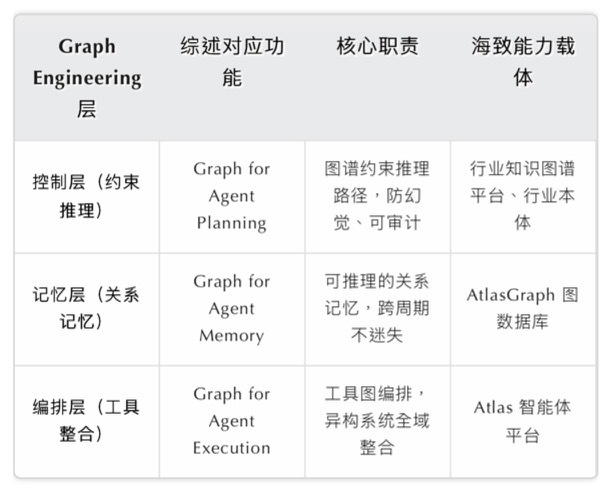
1. Control Layer (Constraint Reasoning): From "Trial and Error" to "Error Prevention"
In industrial scenarios with extremely high reliability requirements, any "trial and error" is costly. The control layer of Graph Engineering uses the knowledge graph as a standardized constraint framework to structurally precipitate enterprise-level facts, business relationships and industry rules, and builds the core "track" for Agent reasoning.
As proved by Reasoning on Graphs, the knowledge-graph-grounded faithful plan can effectively constrain the reasoning direction of LLM; the graph execution sub-step of Graph Chain-of-Thought (ACL 2024) acts as a "fact verifier" to ensure that reasoning does not deviate from the graph structure.
Hydata's industry ontology is exactly the engineering implementation of this layer: define legal associations between entities through the graph Schema to prevent Agents from generating outputs that do not conform to business logic; verify whether the relationships generated by the model conform to the existing facts of the ontology through graph query; when the model output conflicts with the ontology, trigger a feedback loop to force re-reasoning. This is not to tell the model "you are wrong", but to tell it "which edge in the ontology the correct path is on".
2. Memory Layer (Relational Memory): Relational Network Beyond Semantics
Traditional vector databases provide semantic memory ("what it looks like"), while industrial-grade Agents need inferable relational memory ("what it is, who it connects to, and why it is associated").
In the Memory chapter of the review, it details how AriGraph, GraphRAG, Zep, HippoRAG and others use graph structures to organize, retrieve and maintain Agent memories — GFM-RAG (NeurIPS 2025) uses a graph foundation model to achieve single-step multi-hop retrieval, and the average zero-shot migration on 7 domain datasets exceeds HippoRAG by 18.9%.
Hydata's AtlasGraph graph database provides exactly this kind of inferable relational memory: it can not only recall, but also perform logical deduction based on relationships; it not only records the current state, but also maintains the temporal relationship of state transitions, ensuring that the Agent does not get lost in business processes spanning a long time, and can deduce based on historical states instead of only relying on the current context. This is the "cross-cycle memory" that vector databases are not competent for.
3. Orchestration Layer (Tool Integration): Relational Skeleton of Heterogeneous Systems
The IT environment of B-end enterprises is a "museum of technical debt" accumulated over decades. When an Agent has a huge number of tools, there are complex dependencies and invocation relationships between the tools.
In the Execution chapter, the review points out that graph organization can orchestrate tools into a "tool graph": ToolNet organizes tools into a directed graph, so that the tool scale can be expanded to thousands with only a moderate increase in token consumption; GPTSwarm (ICML 2024) abstracts the Agent itself as an optimizable DAG to automatically optimize nodes and edges; ControlLLM uses a resource-tool bipartite graph + parallel search to avoid tool usage hallucinations.
On the industrial side, LangGraph has productized "graph as Agent orchestration" (adopted by Klarna, Uber, J.P. Morgan); Anthropic's MCP protocol is becoming the de facto standard for tool connection, while Google-led A2A protocol complements inter-Agent collaboration — MCP (Agent↔Tool) + A2A (Agent↔Agent) form a complete integration stack, and graphs play the role of "relational skeleton" in it.
Hydata's Atlas intelligent agent platform is exactly the engineering carrier of this layer: encapsulate enterprise APIs, databases, and business systems into tools that Agents can call, realize state machine management of complex tasks, support dynamic routing of more than 100 large models, and retain the final decision-making power of humans at key decision points — enabling general models to transform into "industrial Agents that can continuously execute tasks".
Conclusion
In 2025, when the Graphs Meet AI Agents review systematizes "how graphs empower Agents" into a complete taxonomy, it actually points out a long-underestimated truth for industrial AI: Large models determine the upper limit of intelligence, but the knowledge base determines the bottom line of reliable operation of the system.
This does not deny the agility of vector retrieval, nor does it exaggerate the omnipotence of a single graph, but emphasizes a pragmatic engineering balance. Just like a map to a driver — without a map, no matter how fast the car can only run around based on impressions; with an accurate and inferable map, you can plan routes, avoid wrong paths, and reach the destination. What Graph Engineering builds is exactly this knowledge base that allows AI Agents to move from "guessing based on impressions" to "reasoning according to the map", a "high-precision map" that keeps them from getting