Linear Capital's Dialogue with Ding Wenchao of Tashi Zhihang: Embodied Intelligence May Usher in Its Real Emergence Moment in 24 Months
During WAIC, the linear video podcast "Between the Lines" launched a special live broadcast. Wang Huai, Founder and CEO of Linear Capital, was officially invited by Bilibili to have a conversation with Ding Wenchao, Co-founder and Chief Scientist of TaShi Intelligence.
At this year's WAIC, TaShi Intelligence officially released AWE 3.5, a new-generation native foundation model for embodied intelligence, and was selected as one of the only six SAIL Stars at the conference. As the earliest round investor of TaShi Intelligence, Linear Capital has supported the company through three consecutive rounds of financing.
Ding Wenchao's resume perfectly spans both engineering implementation and cutting-edge research. He is a core technical expert of the first-generation autonomous driving system; he returned to academia in 2023 and served as a researcher and doctoral supervisor at Fudan University; he started his new journey in 2025, co-founded TaShi Intelligence with Chen Yilun, Li Zhenyu and other partners, and served as the chief scientist of this fast-growing star embodied intelligence company.
In this conversation, Ding Wenchao put forward a number of judgments pointing to the same question: when embodied intelligence moves out of demos and into real scenarios, where is the final watershed? His answer is — "trustworthiness" may be the final watershed for embodied intelligence.
The following is the transcript of the conversation, edited and organized by Linear Capital. You are welcome to search for "Linear Capital" on Bilibili to watch the full version of the conversation video.
01 The Embodied 3.0 Era May Arrive in 24 Months
▍Wang Huai: From autonomous driving to academia and then to entrepreneurship, you are one of the few people who have experienced both engineering implementation and cutting-edge research. More than 1 million vehicles have used your end-to-end algorithm, and later you returned to Fudan University to do model research. Along this journey, what do you think is the hardest thing you are really solving?
▍Ding Wenchao: Although there were several transitions and switches from autonomous driving to embodied intelligence in the middle, I think the core thing I have been doing is: using AI, or data-driven methods, to build an agent that you can trust in the physical world.
What is the essential problem that autonomous driving is solving? We collect a large amount of data of humans driving cars, and train a network: the input is images, the output is actions, and the car can fully trust the output of the network. This seems very incredible to most people.
When we chat with large language models, their answers are sometimes accurate and sometimes not so good, and you can iterate with them repeatedly. But autonomous driving cannot iterate repeatedly, because the trajectory it outputs directly controls your car.
▍Wang Huai: If it goes wrong, it may lead to car crash and fatalities.
▍Ding Wenchao: Yes, the consequences are very serious, which is a very distinctive feature of physical AI. Embodied intelligence is doing similar things, but with a larger scope. It is not limited to driving, and it may need to work in factories, carry goods in logistics, and do cleaning at home.
For all these things, you must be able to trust that the robot can complete them safely and stably. Moreover, the method cannot rely on handwritten rules. Generally, data-driven methods should be used to iterate like training large models, so that it has a "brain" to adaptively complete tasks in various environments.
So although I have worked on autonomous driving products, done research, and founded a company, all of these converge to one point: how to build a trusted agent in the physical world through data-driven AI methods.
▍Wang Huai: Then let's compare with the history of autonomous driving. Based on my superficial understanding, autonomous driving has gone through three major stages: the earliest was ADAS for prompts, with collision prompts, lane change prompts and other functions; then came rule-based, scenario-based autonomous driving which followed a rigid process; later came end-to-end autonomous driving.
What do you think of the current technology of embodied intelligence, and what stage of development history it is in? Some people say it is "autonomous driving in 2019", is this metaphor correct?
▍Ding Wenchao: Autonomous driving started very early. People began to work on it in the early 2010s, and the available toolkits were scarce at that time. When I was doing product R&D before, a question that everyone would repeatedly ask was: if you use neural networks to do this, is it explainable at all? When I promoted end-to-end R&D in the early days, many people would ask, why can you trust the neural network to drive the car for you? This awareness actually hindered the rapid progress of autonomous driving towards the final solution. There was a process of educating engineers and educating users in between.
Compared with autonomous driving, I think embodied intelligence has definitely surpassed the level of 2019, and is more likely close to the level of 2021 to 2022. My analysis is as follows:
First of all, embodied intelligence has a higher starting point. From the very first day of embodied intelligence, no one has ever thought of using rule-based methods to develop it, because the scenarios are too diverse. In fact, autonomous driving is only a sub-scenario of embodied intelligence, and it is the simplest form of four-wheeled robot.
Secondly, the problems that embodied intelligence needs to solve are objectively more difficult. People's expectations are not just that "it can work in this scenario". Since it is a general form, people definitely want it to do many things.
So from the perspective of methodology, embodied intelligence has a very high starting point, and it is directly benchmarked against the most advanced large models and end-to-end systems; but the problems it faces are more difficult. Combining these two points, I position it at the level of autonomous driving around 2021 to 2022.
If we divide embodied intelligence into generations, I roughly divide it into several eras: In the 1.0 era, there were some relatively small models that could complete specific tasks of "from sensor to action". This era has passed. Its upper limit is to make very good demos, but it is difficult to enter scenarios and work in batches.
Now we have probably entered the 2.0 era, and you can feel this atmosphere at WAIC: building a relatively general foundation model to do multiple things, and doing them all quite well. Although there is still a distance from AGI in the physical world and the capability of large language models, it can already reliably complete multiple tasks in physical space. I predict that in about 24 months, we will probably usher in the real 3.0 era.
▍Wang Huai: What are the characteristics of the 3.0 era?
▍Ding Wenchao: Large language models have a very important capability called in-context learning. For many tasks you ask it to do, there is no training data, or only data with very low similarity. In the 3.0 era, embodied intelligence will also enter the era of in-context learning. To make it do a task, you don't need to collect demonstration data first as you do now. You teach it, and it can do it. This may be the real emergence time point for embodied intelligence.
▍Wang Huai: It is equivalent to having a one-shot learning capability. And this one-shot may not need to be deliberately shown to it, it will emerge naturally in its usual observation.
Back to TaShi, the model you recently released is called AWE, AI World Engine, which is now version 3.5. What is the difference between 3.5 and the previous 3.0? What is the correspondence with the "entering the 3.0 era in 24 months" mentioned earlier?
▍Ding Wenchao: AWE, we call it the world engine of AI. From version 3.0 to now, there are several obvious changes:
The first is a substantial increase in the amount of data. Under the human-centric data paradigm, we can obtain a lot of data. The expanded data is not repeated data, but data of multiple scenarios and multiple tasks — basically almost all the things that humans can do are covered by us.
The second is the change of model architecture. The models of the same period in the 3.0 era were often borrowed from other fields. In the early days, when people developed VLA models, they actually borrowed from VLM and added the output of the action end; later, many world action models and world models also evolved from video models.
Regarding version 3.5, one of our core thoughts is: As such a large field, embodied intelligence should have its own foundation model. It was hard to imagine this before, but with sufficient and diverse data, we can start to do it now. Therefore, the most important improvement of 3.5 compared to 3.0 at the model level is to move towards native development. Language models are native models, video models are native models, but the previous spliced models are not. Embodied intelligence should have its own native model.
▍Wang Huai: So data is very critical here. I see that you are carrying your data collection device in your hand, as well as this hand for operation. What is the relationship between this and your data source?
▍Ding Wenchao: This device is very light, just like a glove worn daily. It has tactile feedback capture at the fingertips and magnetic sensor signal capture at the back.
The data of embodied intelligence needs to know "what exactly humans feel", and tactile sense is the core to solve this point. For example, when you grab a bottle of water, it looks like "grabbed" visually, but the state of the world in the future will be completely different if you hold it tighter or looser — if you hold it tight, you catch it, if you hold it loose, it will fall.
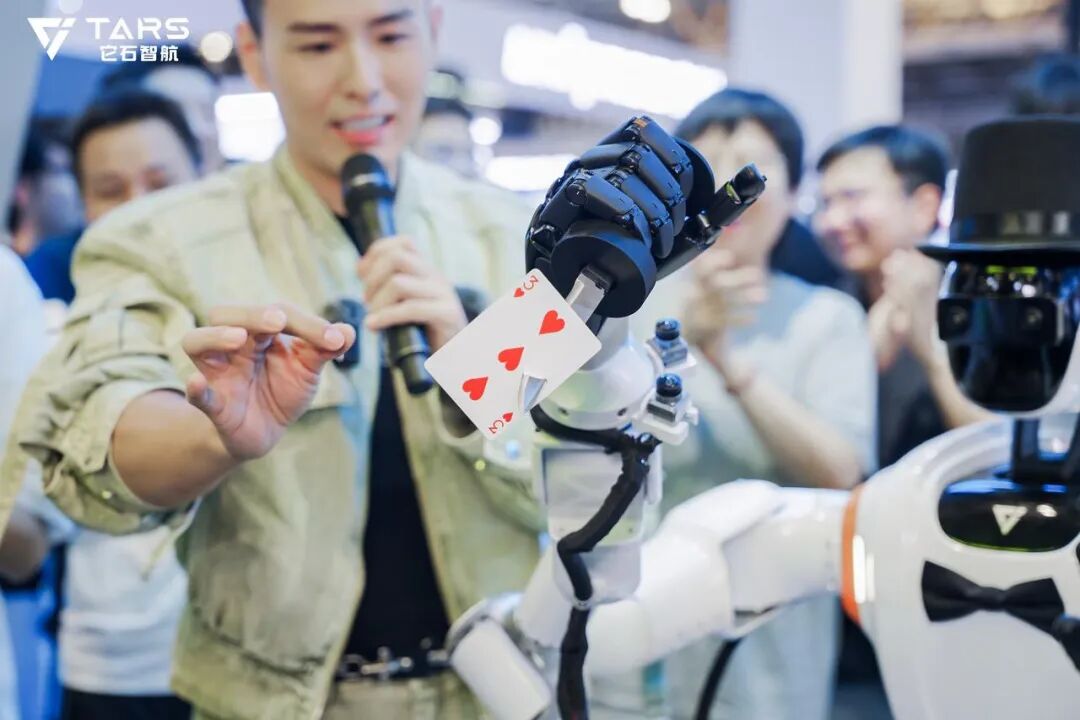
Even if our hand reaches into the quilt, the small sensor behind this device can accurately capture the posture. It is a motion capture system that can be applied all day long and in all scenarios. It has cameras on both the top and bottom, which can capture the environment where people are doing things. FPV (first-person view) cameras can be strapped to the chest and head to form a complete set of kits, which is equivalent to recording in daily life.
After we have the data to train the model, it establishes the connection between the two: first, feel what humans feel — what humans see and feel at this moment; second, do what humans do — predict the future trajectories and actions of humans through the model.
▍Wang Huai: With vision added, it can "see what humans see".
▍Ding Wenchao: Yes, see what humans see. TaShi is a company with a strong "obsessive-compulsive" trait. After we had the data glove, we wanted to have a robotic hand. This is a dexterous hand with 21 degrees of freedom, which is almost equivalent to the degrees of freedom of the human hand. It adopts direct-drive motors, and all 21 micro motors and reducers are integrated in such a small space. Basically, it can do almost all the work that human hands can do.
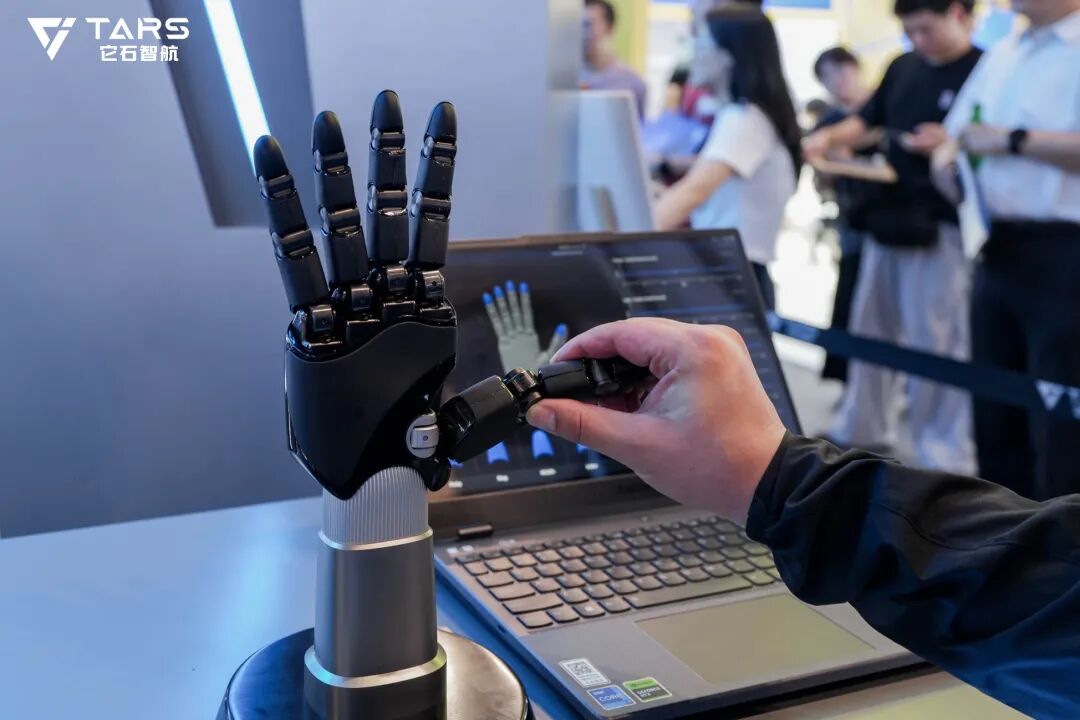
So this is the end effector for dexterous operation. The glove generates data, and returns to the intelligent end effector to complete the task.
▍Wang Huai: The collected data is finally precipitated into the capability of the model, which is connected to form a closed loop.
02 Human-centric, Return to First Principles
▍Wang Huai: TaShi is a very unique company. When I first met you, everyone was vigorously promoting VLA, and you should be the first company to talk about world models. At that time, how did you determine that the future belongs to world models rather than VLA?
▍Ding Wenchao: The idea at that time was not referring to peers, but more thinking from the first principle, top-down.
The first dilemma faced by embodied intelligence at that time was data: it was often obtained through teleoperation, which means capturing my actions and directly mapping them to the robot, and completing the actions with the robot as the main body.
This is very difficult. First, it depends on the number of robots; second, the efficiency of teleoperation is basically only 1/3 of human efficiency, and less than 1/10 for unskilled operators.
▍Wang Huai: I tried it once, it was so hard that I had to practice a lot.
▍Ding Wenchao: The second dilemma is that the VLA model is a little "top-heavy". The visual and language reasoning capabilities of the VLM part are indeed very good, but it is difficult to break the "dimensional wall" — today we are on Bilibili, and everyone should have a deep feeling about the dimensional wall. It still stays in the information space of vision and language, and the only way to penetrate the dimensional wall is to splice a head on it, which we call the "action expert".
▍Wang Huai: Forced combination.
▍Ding Wenchao: Yes, forced combination, which is obviously not the way to truly break the dimensional wall. From the first principle, data acquisition cannot stay at teleoperation, and there must be a better, lighter acquisition method. There is only one agent in this world that has this capability, and that is human beings. So we have to return to human beings, which we call "human-centric". Let human beings replace robots and become the data collection subject for general physical intelligence. This is the first major judgment.
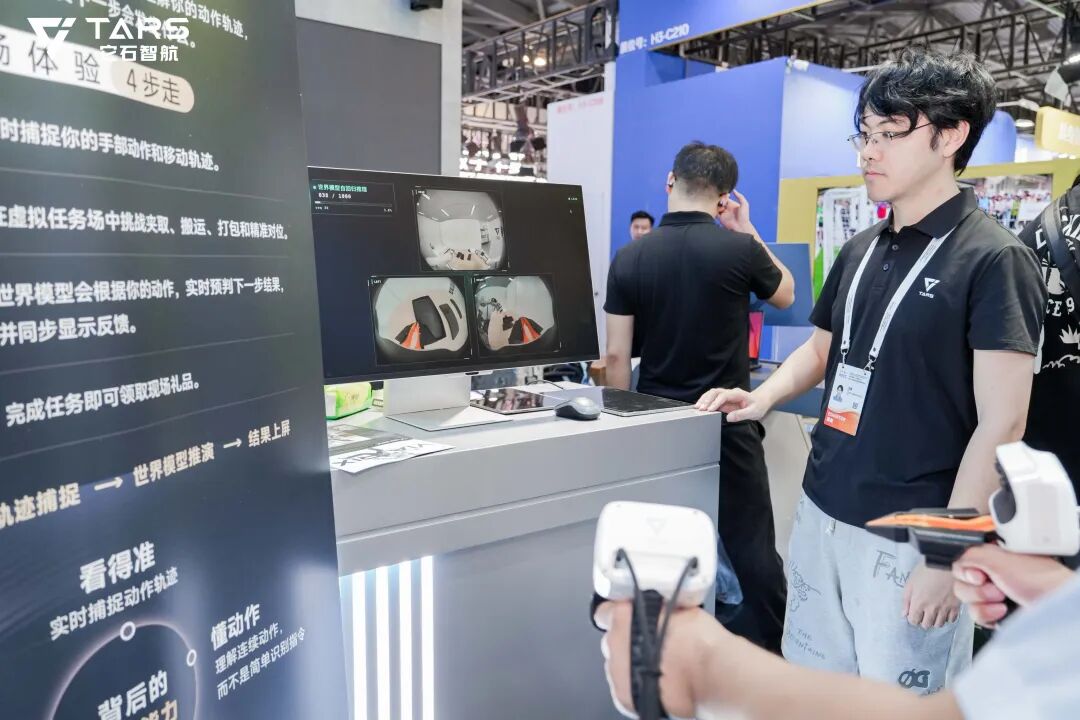
The second judgment is about the model. When all data comes from humans, there will be a problem: humans and robots are different "species" after all. How to share knowledge and capabilities? Simple action fitting is definitely not enough. It needs to learn the laws of human interaction with the real physical world, and implicitly learn "how you do it, the physical world will change accordingly". When you grab a bottle of water, it will fall down in the way of Newton's laws.
This learning paradigm must be a paradigm driven by the world model, which can digest "no ontology" or "cross-ontology" data with great efficiency. The biggest advantage of the world model is to obtain cross-ontology capability, because humans and robots share the knowledge of the world, as well as kinematics and physical laws. So at that time, many people didn't understand us, but in our opinion, this is the only solution.
▍Wang Huai: But a year and a half later, everyone not only understood it, but also came up with five or six different paths to define world models. Some are focused on generating videos, some are done in Latent Space. Your understanding and insight into the future trend at that time were really amazing.
03 Find Real Demands, Do Things That Humans Are Unwilling to Do
▍Wang Huai: When you chose the application, you picked the hardest one — wire harness. What is the