Amazon has made staggering profits, with AWS hitting a new all-time high in growth rate.
Amazon delivered an earnings report that beat expectations in Q2, driven by the growth of AWS and its AI business.
On July 30 local time in the United States, Amazon released its financial results for the second quarter ending June 30, 2026. The earnings report shows that its net sales hit $200.6 billion, a 20% year-on-year increase, which is higher than the average expectation of $196.47 billion from analysts at London Stock Exchange Group (LSEG).
In terms of profits, Amazon's net profit in the second quarter jumped directly to $62.6 billion from $18.2 billion in the same period last year; diluted earnings per share reached $5.75, compared with only $1.68 in the same period last year, and the average expectation of analysts surveyed by LSEG was only $1.82.
Among them, the net profit includes $53.4 billion in pre-tax non-operating other income, which mainly comes from the investment gain in Anthropic.
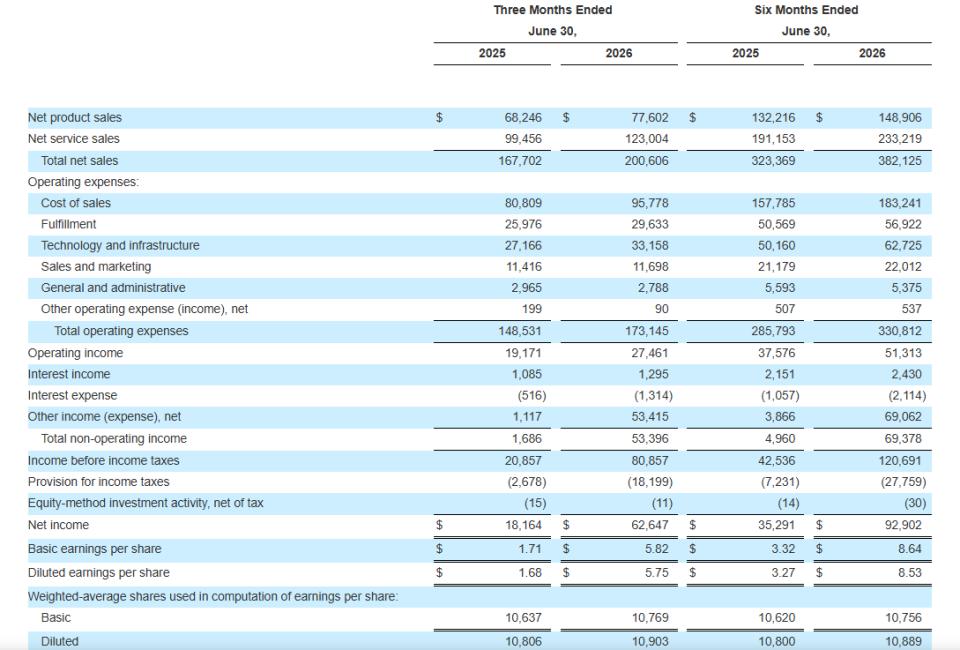
However, this investment gain is not included in the operating profit, which better reflects the performance of the main business. In the second quarter, Amazon achieved an operating profit of $27.5 billion, a 43% year-on-year increase, far exceeding the $19.2 billion in the same period last year.
Looking ahead to the third quarter, Amazon expects net sales to range from $197 billion to $202 billion, representing a 9% to 12% year-on-year growth. Considering that this year's Prime Day was moved forward from the traditional July to June, if the impact of this time difference is excluded, the growth rate in the third quarter will be nearly 400 basis points higher.
Operating profit is expected to range from $22.5 billion to $26.5 billion, compared with $17.4 billion in the third quarter of last year.
After the earnings report was released, Amazon's stock price rose by more than 9% in after-hours trading, and investors cast a vote of confidence with real money.
01 AWS posts its highest growth rate in 18 quarters
AWS recorded net sales of $42.2 billion in the second quarter, up 37% year-on-year. This growth rate hit a new high in 18 quarters, meaning AWS has never reached such a growth rate since the fourth quarter of 2021.
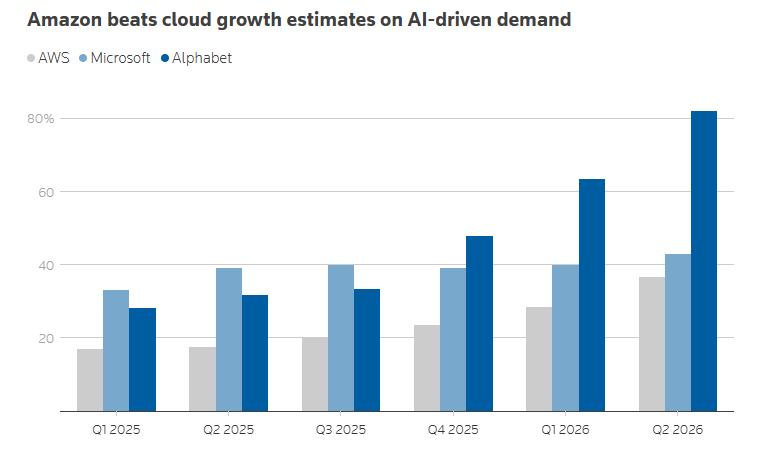
Compared with Wall Street's previous expectation of $40.54 billion, the actual performance exceeded the estimate by nearly $1.7 billion. Compared with the revenue of $30.8 billion in the second quarter of 2025, AWS's single-quarter revenue increased by $11.4 billion within one year.
In terms of operating profit, AWS reached $16.6 billion, compared with $10.2 billion in the second quarter of 2025, representing a 63% year-on-year increase. Converted to operating margin, it was about 39.3% in the second quarter, compared with about 33.1% in the same period last year.
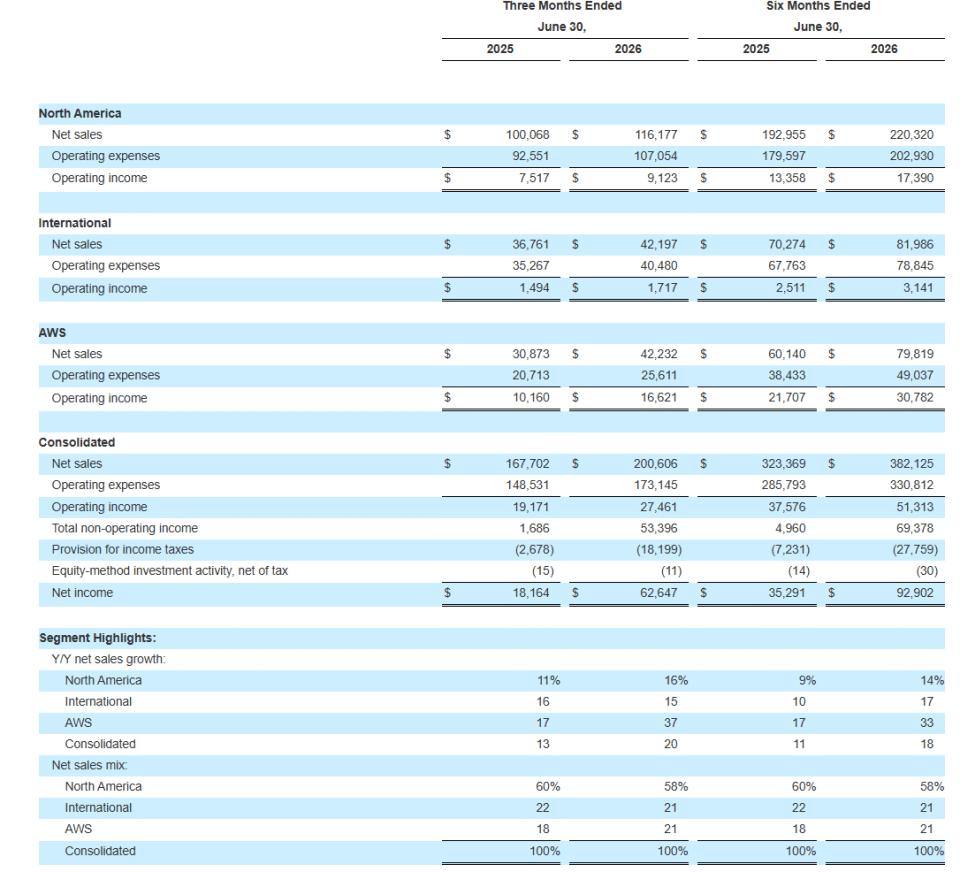
Of Amazon's total $27.5 billion operating profit, AWS contributed about 60%, while its revenue only accounts for about 21% of the company's total revenue. This structure that generates 60% of profits with 20% of revenue clearly reflects AWS's core position in Amazon's business landscape. From the perspective of annualized run rate, the overall scale of AWS has reached $1690 billion.
The scale of backlog orders is also worthy of attention. Andy Jassy, CEO of Amazon, disclosed on the investor conference call that AWS's order backlog reached $4960 billion in the second quarter. Backlog orders refer to future service commitments that have been signed with customers but not yet fulfilled and not yet recognized as revenue.
Based on the revenue of $42.2 billion in the second quarter, this is equivalent to nearly 12 quarters - that is, about three years of revenue scale has been locked in advance. The continuous growth of backlog orders indicates that the speed of customer signing continues to outpace the speed of Amazon's delivery capacity.
This situation of supply falling short of demand is in sharp contrast to previous market concerns about AWS losing market share. Dan Morgan, portfolio manager at Synovus Trust, said: "There were previous concerns that AWS was losing market share, but those concerns have now faded. This provides more evidence that AWS's leading position remains solid. The AI wave is pushing up the entire industry."
It is worth noting that Alphabet reported 82% growth for Google Cloud in its latest earnings report, and Microsoft reported 43% growth for Azure. This shows that the AI-driven increment in computing power demand is broad enough to support the rapid growth of multiple giants at the same time, rather than a zero-sum game where one rises as another falls.
Jassy said on the analyst conference call: "We have always believed that AWS could become a business with hundreds of billions of dollars in revenue. Now we think it will at least double, and will very likely become our trillion-dollar annual revenue business in due course, accompanied by very considerable free cash flow and return on invested capital."
In terms of e-commerce and advertising business, Amazon also delivered a solid performance in the second quarter. North American sales rose 16% year-on-year to $116.2 billion; the international division rose 15% year-on-year to $42.2 billion.
The advertising business rose 26% year-on-year to $19.81 billion, exceeding StreetAccount's expectation of $19.43 billion. Ads Agent, the AI-powered advertising tool, has been expanded to 11 new countries. Advertisers using this tool have seen an 8% reduction in cost per impression and a 6% reduction in cost per acquisition.
In terms of delivery speed, more than 40% of Prime products achieved same-day or next-day delivery in the first half of the year, with groceries and daily necessities growing significantly faster than the overall business.
The pharmacy business has become one of the highlights. The number of new customers of Amazon Pharmacy more than tripled in the first half of the year, and the volume of same-day prescription delivery increased nearly five times.
02 AI business sees rapid growth in annualized revenue
Jassy emphasized in the earnings statement that the annualized revenue run rate of the AI business has exceeded $25 billion, with a year-on-year growth rate reaching triple-digit percentage.
Amazon disclosed earlier in 2026 that the annualized revenue run rate of AI exceeded $15 billion. Now it has risen to more than $25 billion, with the annualized scale increasing by at least $10 billion within half a year. This means that AI-related revenue has accounted for about 15% of AWS's total annualized run revenue, and this proportion is still climbing rapidly.
Amazon's layout in the AI field covers the complete chain from foundation model access, agent toolchain to developer productivity.
At the model layer, Amazon Bedrock added more than 10 fully managed foundation models in the quarter, including OpenAI's GPT-5.6, Anthropic's Claude Opus 5, Google DeepMind's Gemma 4, and SpaceXAI's Grok 4.3. Bedrock is AWS's model marketplace platform, where enterprise customers can call various third-party large language models through a unified interface without managing the underlying infrastructure by themselves.
Amazon disclosed that hundreds of thousands of customers are currently using Bedrock. The number of new customers added in the past six months has exceeded the total of the first two years after its launch, and customer spending in the second quarter also exceeded the sum of all previous quarters. This trend shows that enterprise customers are moving from the trial phase to large-scale practical deployment.
At the agent tool layer, AWS has added multiple new features to Bedrock AgentCore: payment capability enables agents to execute transactions autonomously, web search enables the agent's knowledge base to be updated in real time within the AWS environment, and Harness helps customers speed up the integration of infrastructure required by agents.
At the developer tool layer, Kiro, the specification-driven coding agent, is now available on iOS, allowing developers to launch new projects, monitor progress and interact with Kiro from mobile phones, desktops, command lines and web pages. Amazon says Kiro is 50% more cost-effective than alternatives, and its usage has tripled month-on-month. AWS DevOps Agent adds new release management capabilities, which can conduct readiness reviews for code changes and autonomously test releases to identify potential risks before problems go online.
At the underlying infrastructure layer, AWS introduced serverless infrastructure for agents that can scale on demand. This includes Lambda MicroVMs, a new version of AWS Lambda that provides instant startup and elastic scaling, while supporting stateful sessions lasting up to 8 hours for the first time, suitable for long-running agent loops, multi-step pipelines or persistent database engines.
AWS also announced an investment of $1 billion to create the Forward Deployed Engineering team, a team of AI engineers embedded directly inside customers to jointly develop and deploy agent solutions in days rather than months. This model of assigning embedded engineers is rare in the cloud computing industry, reflecting that the real bottleneck faced by enterprises when deploying AI often lies in the ability to deeply integrate technology with specific business processes.
03 Self-developed chips gain dual endorsement
In the second quarter, Amazon's self-developed chip business also reached an annualized revenue run rate of $25 billion, with a triple-digit year-on-year growth rate.
Among them, the Trainium chip has achieved a landmark breakthrough: the world's two leading AI labs, Anthropic and OpenAI, have both made "multi-year, multi-gigawatt-hour" computing power commitments. Using the power industry term "gigawatt-hour" to describe the procurement scale means that the computing power required by these AI labs has gone beyond the concept of server quantity, and is instead measured at the level of data center energy consumption.
Anthropic and Amazon are already deeply tied, while OpenAI has long cooperated with Microsoft Azure. The two top model developers who are competitors to each other choosing Trainium at the same time is equivalent to providing a high-value dual endorsement for Amazon's self-developed chips.
The customer list of Trainium is still expanding. A number of AI startups have joined this camp, including unicorn companies NEURA Robotics and Odyssey, as well as TwelveLabs, Decart, Poolside, Karakuri and others.
In terms of large enterprises, Uber and Pinterest are also adopting Trainium. From startup unicorns to listed companies, from AI-native labs to traditional enterprises integrating AI into their business, Trainium's customer coverage is forming a clearly tiered gradient.
In the field of general-purpose computing chips, Amazon officially released Graviton 5. The Graviton series is known for its 30% to 40% higher cost-effectiveness than similar x86 instances, and Graviton 5 has a 25% improvement in computing performance compared with the previous generation Graviton 4. At present, 98% of top EC2 customers are using Graviton, with revenue commitments growing nearly 3 times month-on-month. Graviton 5 is growing almost twice as fast as Graviton 4.
Amazon's cooperation with Anthropic was further deepened in April, when Amazon announced that it would invest up to $25 billion in new capital in this AI developer. As part of the agreement, Anthropic committed to purchasing more than $1000 billion worth of AWS cloud services, roughly equivalent to seven or eight months of AWS's current revenue scale.
04 $220 billion capital expenditure may not be enough
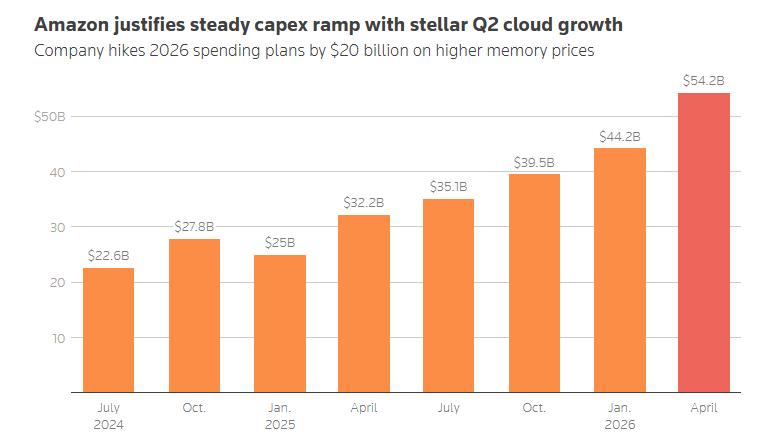
In the second quarter of 2026, Amazon's expenditure on property and equipment reached $54.2 billion, compared with $32.1 billion in the same period last year, an increase of 69%. Amazon said this growth mainly reflects continuous investment in AI infrastructure.
What is more notable is the upward adjustment of the full-year capital expenditure guidance. Jassy revealed on the conference call that Amazon now expects this year's capital expenditure to reach $2200 billion, 10% higher than the previous forecast. He specifically pointed out that the cost of purchasing memory chips is the main factor driving this growth.
Even so, Jassy still confessed that production capacity is far from keeping up with demand. "Even at this amount, we still do not have enough capacity to meet all the demand in 2026," he said on the conference call, "I believe this dynamic will also exist in 2027."
This investment rhythm is directly reflected in cash flow. Over the past twelve months, Amazon's free cash flow turned to an outflow of $7.6 billion, compared with an inflow of $18.2 billion in the same period last year. The free cash flow turning from positive to negative indicates that all the cash generated by the core business has been invested in infrastructure construction, and additional financing or cash reserve utilization is needed to fill the gap.
Jassy emphasized on the conference call that these investments are indispensable to meet the surging demand for cloud services. Operating cash flow in the past twelve months was $161.4 billion, up 33% year-on-year, indicating that the core business's cash-generating capacity remains strong, and all cash is only reinvested in capacity expansion.
Sky Canaves, an analyst at Emarketer, pointed out that Amazon's spending pace so far may push capital expenditure higher than the company's own estimate, but she also said: "Given the acceleration of AWS revenue growth and strict cost control in other areas, investors are unlikely to back down because of this."
According to analyst estimates compiled by FactSet, Amazon, Google, Meta and Microsoft are expected to invest about $1.5 trillion in data centers and related equipment this year and next.
This article is from the WeChat official account "Tencent Tech", Author: Worth Paying Attention To, 36Kr published with authorization.