Sharp price hikes on Qualcomm chips hit Android phones the hardest.
Recently, Qualcomm, the global chip giant, has officially announced a new round of product price adjustment plans, which will implement a double-digit price increase across its full range of chip products starting from September 1, with the latest flagship chip Snapdragon 8 Elite Gen 6 Pro seeing a maximum increase of up to 18%.
Following MediaTek's announcement of a price hike for its Dimensity series chips in late June, Qualcomm has also followed the pace of price adjustment, bringing a new round of cost shocks to the mobile terminal industry that is already under pressure.
It is reported that Qualcomm has issued a price increase notice to global customers on July 24 local time. The new price will be uniformly applied to all chip products shipped after September 1, covering multiple product lines such as mobile phones, tablets, smart wearables, and automotive chips. Qualcomm CEO Cristiano Amon confirmed the price adjustment plan during the earnings call, stating that the core of this price increase is to hedge against the upward cost pressure across the entire industrial chain, restore the company's declining gross profit margin, and push the profit margin back to the normal historical level.
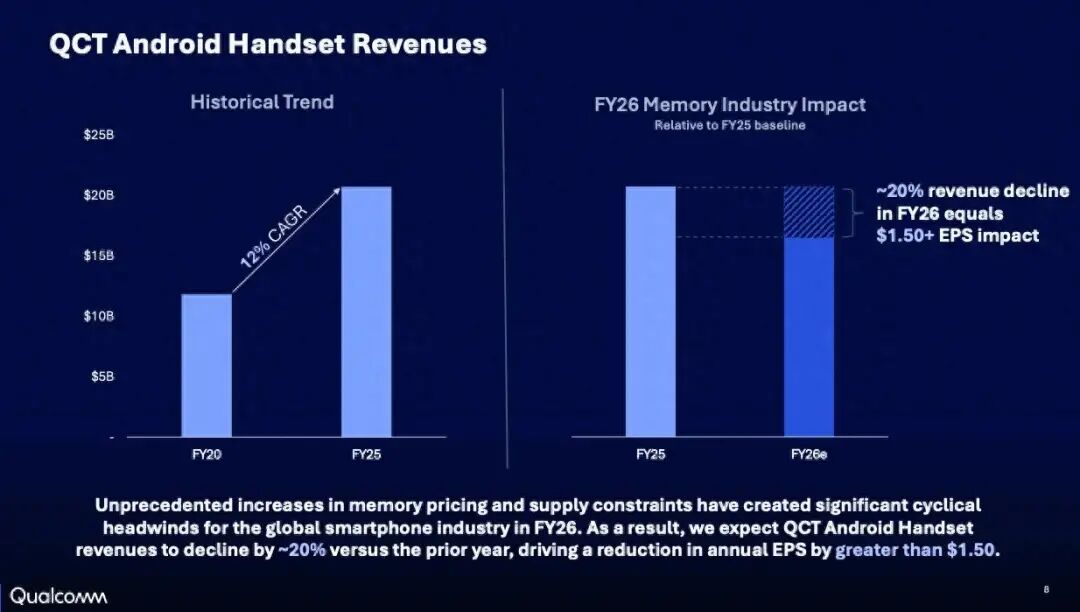
Data shows that Qualcomm's revenue in the third fiscal quarter of fiscal 2026 was 9.947 billion US dollars, a year-on-year increase of 4%, but its net profit dropped sharply by 25% year-on-year, and the revenue of its mobile phone business plummeted by 20% year-on-year, hitting the lowest record since 2021. The main reason is the industry-wide price surge triggered by the explosion of the AI industry.
With the surge in demand for AI computing power, memory manufacturers such as Samsung and SK Hynix have significantly increased the production capacity of HBM memory, leading to an imbalance between supply and demand for general-purpose memory chips.
According to data from TrendForce, the contract price of general-purpose DRAM in the first quarter of 2026 increased by 93%-98% quarter-on-quarter, and the contract price of NAND Flash increased by 55%-60% quarter-on-quarter. The proportion of memory in the material cost of mobile phones has soared from 10%-15% to more than 30%. At the same time, the wafer cost of TSMC's 2nm advanced process has exceeded 30,000 US dollars, plus the advanced packaging has a price increase of more than 20%, making the chip cost reach a historically high level.
The cost pressure of chip giants has finally been passed on to downstream mobile phone manufacturers, and the industry has fallen into a vicious cycle.
Previously, the continuous price increase of memory chips has compressed the profit margin of terminal manufacturers. In order to control costs, brands such as Xiaomi, OPPO, and vivo have cut orders for mid-to-low-end models in 2026, with the maximum reduction reaching 20%. Some manufacturers also reduce costs by streamlining hardware configurations, and even use older generation chips.
It is reported that the 5th Generation Snapdragon 8 Ultimate Edition (Snapdragon 8E5) "has been forced to" become a long-lasting popular chip. Qualcomm will release a downclocked version in the second half of this year exclusively for its sub-series of new models, whose performance is no less than the standard Snapdragon 8E5, and the price is much lower than the Snapdragon 8E6 released in the same period.
Under the heavy cost pressure, the Android mobile phone market continues to be sluggish. IDC data shows that the domestic smartphone shipment in the second quarter of 2026 declined by 4.3% year-on-year, marking five consecutive quarters of year-on-year decline. The market share of mainstream Android brands such as OPPO, vivo, Xiaomi and Honor has dropped significantly. In contrast, Huawei and Apple, which do not rely on external high-end SoC chips, have achieved significant growth in market share by virtue of their self-developed chip advantages and stable pricing.
Compared with mobile phone manufacturers, Qualcomm can actually pass on cost pressure even without raising prices.
At present, Qualcomm is accelerating the transformation of business diversification, focusing on new tracks such as automotive, Internet of Things and data centers. Among them, the automotive business has achieved double-digit year-on-year growth for 23 consecutive quarters, and recently reached a ten-year chip supply agreement with BMW. However, the volume of new businesses is currently limited, and it is difficult to fully fill the gap in the mobile phone business.
Industry insiders predict that as the cost of chip and memory price increases is concentrated in the second half of the year, the price increase of new Android flagship phones may exceed market expectations, and the decline in domestic mobile phone market shipments in 2026 may further expand.
This article is from the WeChat official account "Meku", author: Meku, published with authorization from 36Kr.