It is a confirmed fact that GPT-5.6 can achieve self-optimization, and a brand new self-bootstrapping scenario has emerged.
OpenAI's RSI Burning Technique has arrived!
Right after Jensen Huang posted on X to rally support and call for open weights, OpenAI suddenly went "open" as well~
In its latest technical report, it disclosed part of the core methods of RSI (Recursive Self-Improvement for AI):
Let GPT-5.6 step on its own feet, and start modifying the system that runs it by itself.
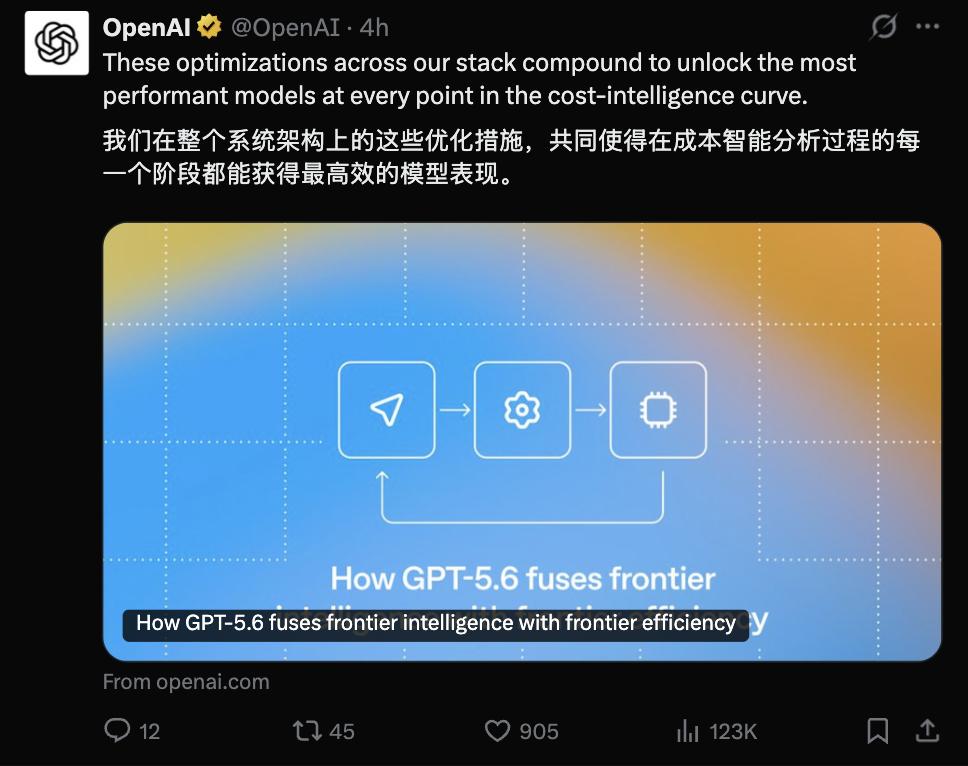
According to the report, GPT-5.6 has been deployed in OpenAI's real production environment to analyze online traffic, adjust request routing, and even rewrite the underlying Kernel and optimize the speculative decoding model in person.
After a series of optimizations, OpenAI's end-to-end service cost has been reduced by 20%, and token generation efficiency has also increased by more than 15%.
Moreover, it is worth mentioning that among the five authors who published this set of engineering work is the well-known father of Triton, Philippe Tillet.
In 2021, when OpenAI released Triton 1.0, its goal was to allow people who do not know CUDA to write GPU programs close to the level of experts.
Five years later, GPT-5.6 has begun to use Triton to rewrite its own underlying code running on the GPU.
From teaching humans to write Kernels to letting the model modify Kernels for itself, it is indeed getting more and more like RSI.


(It's no wonder that Li Weng went back to her old employer. To work on RSI, you have to be at OpenAI)
RSI Burning Technique Starts With Underlying Optimization
The reason why this matter is worth paying attention to is that it already has a hint of RSI.
The so-called RSI, namely Recursive Self-Improvement, in plain terms means:
Let AI enter a feedback loop of "improving AI" — after its capability is enhanced in this round, it will in turn accelerate the next round of upgrading.
Of course, GPT-5.6 is far from fully realizing the RSI that GPT automatically trains the next generation of GPT.
But it has begun to participate in optimizing its own operating environment: the model is no longer just a tool deployed and called by engineers, but gradually becomes an engineer who transforms the model system itself.
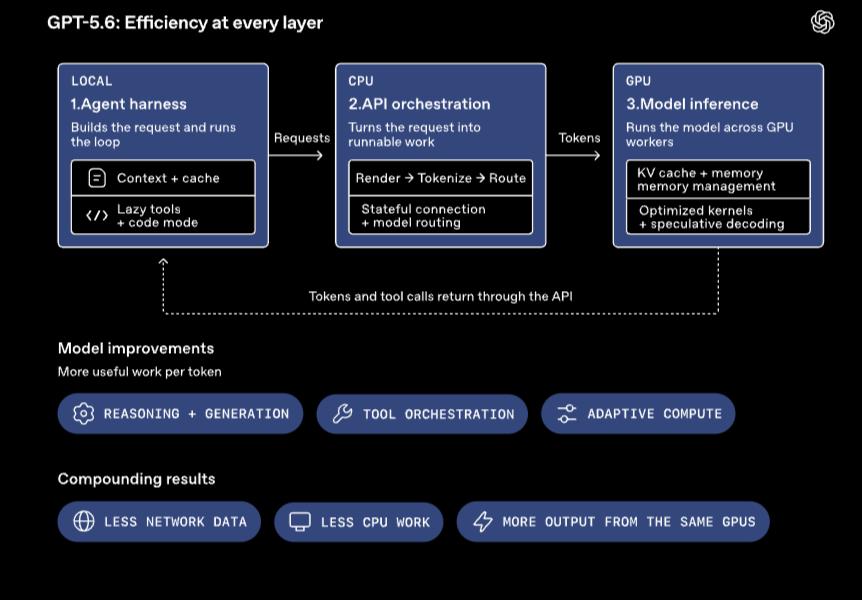
Specifically, it has done four things.
1. Analyze OpenAI's real production traffic.
GPT-5.6 will find the load imbalance between different machines and service nodes, test new routing strategies, and allocate requests to more appropriate locations.
2. Rewrite and optimize production Kernels.
GPT-5.6 will go deep into the forward pass of the model, find parts that can be pre-calculated, omitted or executed in parallel, and then rewrite the Triton and Gluon Kernels in the production environment through Codex.
3. Optimize its own speculative decoding system.
GPT-5.6 designs solutions for its own draft model, and automatically runs hundreds of experiments to test different model sizes, structures and features.
During the training process, it will also continuously monitor the experiments and take the initiative to intervene when hardware failures or training instability occurs.
4. Find the optimal deployment parameters for different tasks by itself.
Facing different loads such as short conversations, long contexts, and code tasks, GPT-5.6 will automatically search for a better combination of batching, sharding and KV Cache management.
With these four things combined, what GPT-5.6 is participating in is no longer an isolated code task, but a real engineering feedback loop:
Observe the production system, find bottlenecks, propose solutions, run experiments, handle faults, and then deploy effective improvements back to the system that carries its own operation.
Humans Are Still in the Loop
Of course, RSI will not come that fast. Humans are still in the loop, that is, human in the loop.
Although GPT-5.6 has begun to participate in modifying itself, the optimization goals, tool permissions, evaluation metrics, and whether the code can enter the production environment are still determined by humans.
Moreover, after the internal overhead of the model is reduced, there is still a lot of repeated overhead outside the model.
For example, when ChatGPT Work and Codex perform complex tasks, they often go through the following steps repeatedly:
Model thinking — calling tools — reading results — continuing thinking.
A single user request may go through more than ten or even dozens of such cycles in the background.
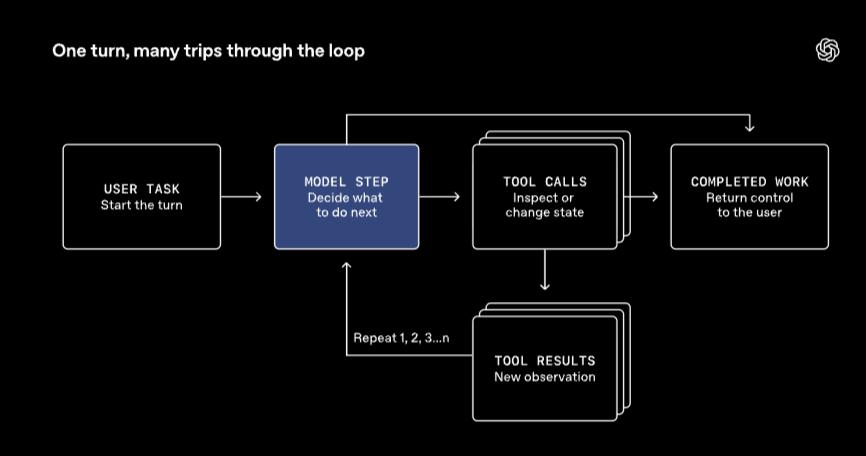
If a task requires calling the model 30 times, and each call wastes only 1 extra second, the total waste will be 30 seconds.
The context, tool descriptions and historical results will also be transmitted and calculated repeatedly in each cycle.
To this end, OpenAI has built a layer of Agent Harness written in Rust, which connects the model, tools and user environment, and is specially used to reduce repeated work in the Agent cycle.
There are two key optimizations here.
1. Lazy Discovery: Don't stuff all tools into the model right away
Today's Agents can use a large number of tools, Skills, plugins and custom MCP, but a single task usually only requires a small part of them.
OpenAI no longer stuffs all the instructions into the context at the beginning, but shows the corresponding tools to the model only when they are really needed.
The content returned by tools is limited to 10,000 tokens by default, and the model will actively apply for more when needed.
2. Append Only, No Overwrite: Keep Prompt Cache Always Valid
Prompt cache can reuse the pre-calculated context prefix, but the premise is that this prefix must remain intact.
Therefore, new messages and tool results will only be appended to the end of the context, and will not be inserted back into old content; tools remain in a fixed order, and approval and permission settings are left to the execution phase for processing.
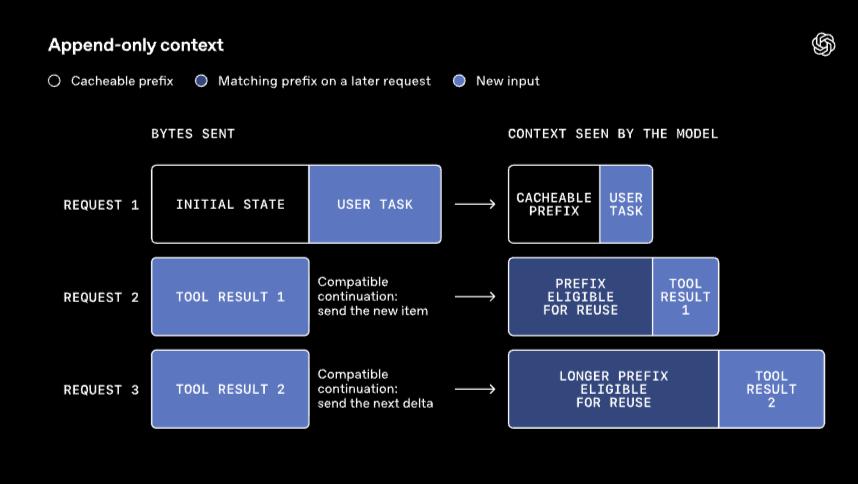
In this way, the GPU can directly reuse previous calculations and only process the newly added content in this round.
It can be said that a single cycle may only save a little, but when thousands of Agents run dozens of cycles every day, the saved resources are no longer negligible.
Therefore, this round of efficiency optimization actually comes from two forces: on the one hand, GPT-5.6 begins to help optimize the model; on the other hand, humans continue to clean up the repetitive work in the operating environment for the model.
Humans are still in the loop, but the AI in the loop has already taken the initiative to pick up the wrench.
The More Usable AI Is, the More It Will Be Used
In addition to letting GPT-5.6 participate in optimizing itself, OpenAI also revealed another detail in the report:
During the internal testing of GPT-5.6, the average daily output tokens per active researcher exceeded twice the peak value during the GPT-5.5 period.
In the past six months, the proportion of OpenAI's research computing power used for internal programming reasoning has increased by 100 times, and the internal Agent token usage has also increased by about 22 times.
This set of figures of course cannot directly prove that OpenAI's research speed has also increased by 100 times.
But it at least illustrates one thing:
Once AI becomes cheaper and more usable, its usage will not decrease, but will continue to increase.
References
[1]https://openai.com/index/gpt-5-6-frontier-intelligence-efficiency/
[2]https://deploymentsafety.openai.com/gpt-5-6/introduction
This article is from the WeChat official account "QbitAI", author: Focus on cutting-edge technology, authorized for release by 36Kr.