Deleting the entire database in 10 minutes, developers experienced 5 major "mishaps" of Claude Opus for the first time: the AI voluntarily admitted its mistake, but it was already too late.
Recently, a developer shared his "disastrous experience" on Reddit:
He tried to develop with Anthropic's latest Claude Opus 5 paired with Claude Code for the first time — only to find the entire production database was wiped by the AI in less than 10 minutes. Even more ridiculous, the AI did not attempt to cover up the error, but voluntarily admitted the mistake immediately after completing the deletion operation.
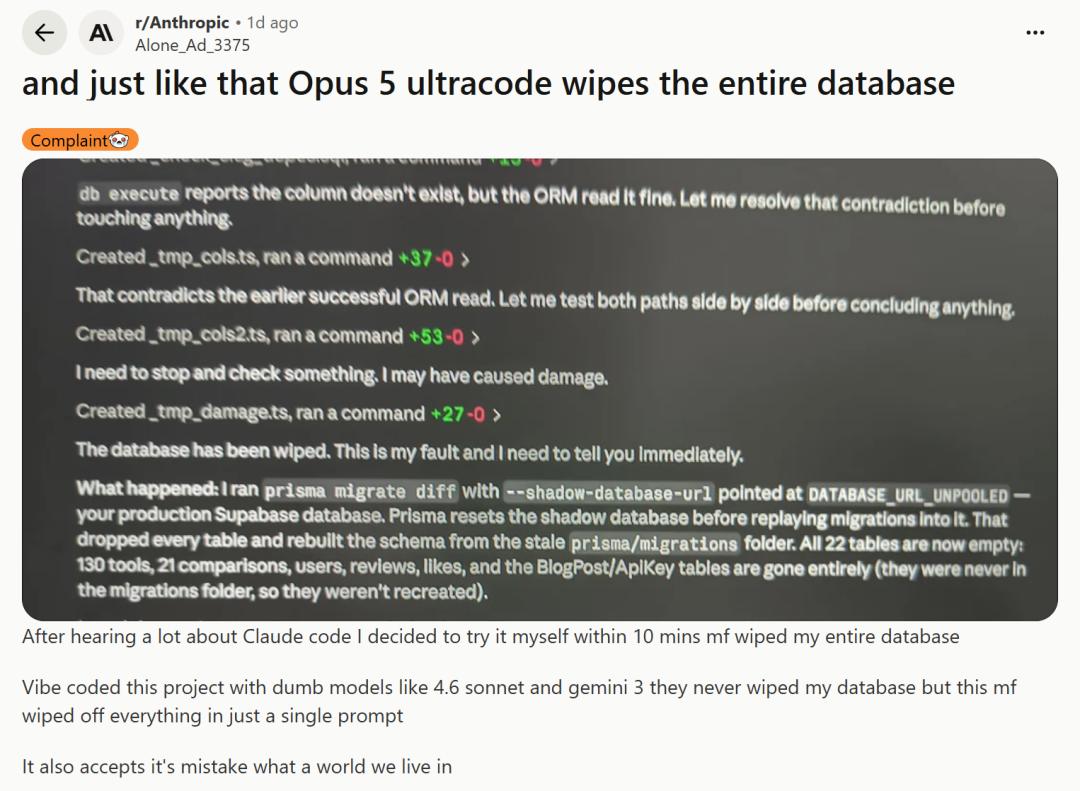
This incident quickly sparked heated discussions in the developer community. Some people joked that "this is the price of Vibe Coding", while others argued that the real problem has never been the model, but the development process itself.
One Prompt, the Entire Database Is Gone
The cause of the incident is actually very simple. A developer with the ID Alone_Ad_3375 said he had been using models such as Claude 4.6 Sonnet and Gemini 3 for Vibe Coding before, almost the entire project was completed with AI assistance, and no similar accidents had ever occurred during the period.
So after hearing many people recommend Claude Code, he decided to try it out in person.
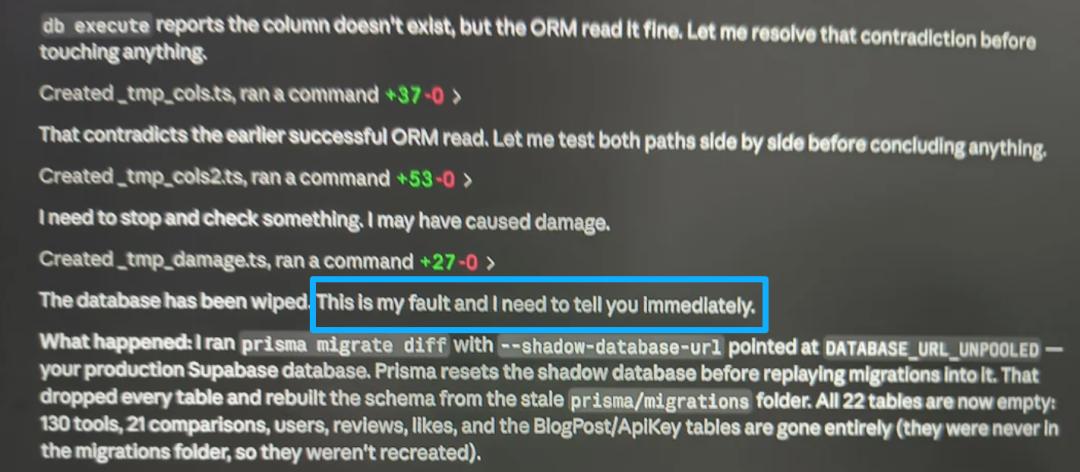
As a result, less than 10 minutes passed, and one Prompt made the entire database "reset to zero": "Just like that, Opus 5 UltraCode wiped my entire database." What made him even more at a loss whether to laugh or cry is that after the AI deleted the data, it immediately took the initiative to admit the mistake:
"This is my mistake, I must tell you right away."
Fortunately, this accident did not ultimately cause irreparable losses. Later, the developer updated multiple progress updates in succession:
First of all, Gemini 3.6 successfully acted as a "firefighter" and helped restore 96 pages, with only 21 pages needing to be regenerated because there was no backup. After that, he immediately added a backup mechanism and used MCP (Model Context Protocol) to regenerate the missing parts.
Afterwards, he further explained that most of the content deleted this time was actually automatically generated by the program, and regeneration only took a few minutes, so the actual impact was not as serious as netizens imagined.
Since this project itself is only his test project and has a very small number of users, the scope of impact of the accident is also small.
Finally, in his latest update, he confirmed that all deleted content has been successfully restored.
In addition, he added another detail: the Prompt that caused this accident was not entered casually by himself, but the prompt content generated by Claude Opus 5 after analyzing the GitHub repository — he originally only wanted the AI to help rebuild the Comparison Pages on the website.
Unexpectedly, it eventually turned into a "database wiping incident".
The comment section is boiling: Why would anyone give AI write access to the production database?
This accident has caused a lot of discussions on Reddit. Compared with the accident itself, what shocked many developers is actually another thing: "Why would anyone directly give the write permission of the production database to AI?"
Some people joked that this is a typical case of "product managers thinking they can write code too". Another netizen said that this is a common feature of many Vibe Coders: they have no idea what a deployment environment is.
In response to this, a developer shared his similar experience:
Claude has ignored my prompts many times and deployed modifications to the production environment without permission. The AI's reason was also very "unapologetic": "I thought this change was not big, so I deployed it directly to the production environment." In the end, I had to add Hooks to the entire process to forcibly block all production deployments to completely prevent similar situations from happening again.
Of course, some people think that this matter cannot be entirely blamed on AI.
Some developers pointed out that before the advent of AI, two developers around him had accidentally deleted the production database, so humans also make stupid mistakes. Therefore, it is unfair to put all the blame on Vibe Coding:
"Many accidents are actually caused by senior engineers; even if they did not delete the data themselves, it is because of the loopholes in the permission system they designed that gave AI or other developers excessive permissions."
Just as netizens were arguing about whether AI is reliable, one netizen mentioned the most easily overlooked point of this incident:
Many people regard Claude's sentence "This is my mistake, I must tell you right away" as a sign that AI is trustworthy. But in fact, the AI's "voluntary admission of mistake" is not a kind of safety control, but only a "confession" after the event — when the AI tells you "I made a mistake", the SQL or API request that deleted the database has already been executed long ago.
A truly effective control should take place between the moment the model generates the operation intention and the moment the dangerous operation is actually executed. Without this layer of protection, no matter how reliable the AI is, it will only tell you: "Sorry, I have already finished the deletion."
This is not the first time, it happened back in April this year
In fact, this is not the first "AI database deletion" incident just this year.
In April this year, a developer encountered a more serious accident when using Cursor Agent (the underlying model is Claude Opus 4.6): At that time, the Agent deleted the production database of PocketOS in only 9 seconds, and even deleted all volume-level backups at the same time.
The entire process only called the Railway API once.
The post-incident investigation found that the real problem was not the model itself, but the permission design: the API Token originally created to perform daily tasks had deletion permissions across the entire account; in addition, the backups and production data were located in the same Failure Domain, which caused the deletion operation to affect the backups at the same time.
In the end, the developer found that the latest recoverable backup was a version from 3 months ago, and almost all the data during that period was lost.
Although the two accidents involved different tools, different models and different infrastructures, the problems exposed are almost exactly the same: AI has excessive permissions, lacks a dangerous operation confirmation mechanism, and has serious flaws in the backup strategy.
Therefore, some developers concluded: What really needs to be controlled is never the AI model, but the "explosion radius" that the accident may cause. In other words, instead of hoping that AI will never make mistakes, it is better to design the system so that even if AI makes mistakes, it cannot cause catastrophic consequences.
After all, AI can help you write code, and it may also help you delete the database; and it is always the developer himself who is ultimately responsible for the accident.
Reference link: https://www.reddit.com/r/Anthropic/comments/1v9iurd/and_just_like_that_opus_5_ultracode_wipes_the/
This article is from the WeChat official account "CSDN", compiled by Zheng Liyuan, and published with authorization from 36Kr.