AI has begun writing code for itself, GPT-5.6 rewrites the kernel, resulting in a direct 20% reduction in service costs.
This time, AI has started writing code for itself!
Right after GPT-5.6 was launched, the first major task it took on was a full "overhaul" of its own operating environment.
It autonomously rewrote and optimized the underlying code of OpenAI's online system, which is the production GPU kernel that actually runs the models.
On July 29, OpenAI officially released a set of data:
The kernel optimization with the participation of GPT-5.6 Sol reduced OpenAI's external service cost by 20%; the improvement of speculative decoding increased the efficiency of model token generation by more than 15%.
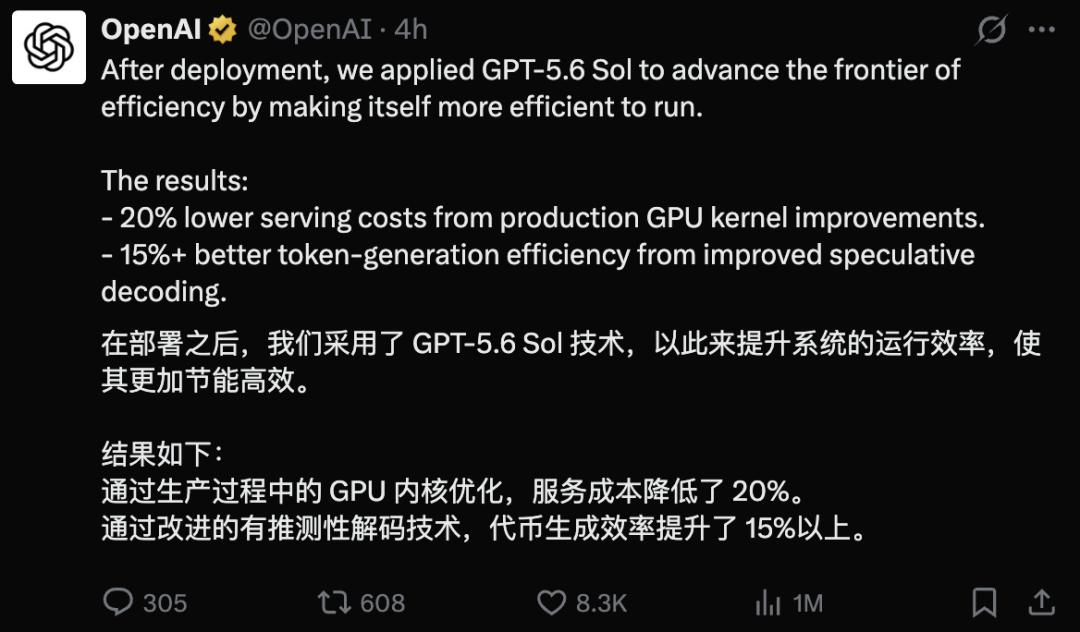
What GPT-5.6 modified this time is not a demo running in a demonstration environment, but the production system that OpenAI is running online, which handles billions of user requests every day.
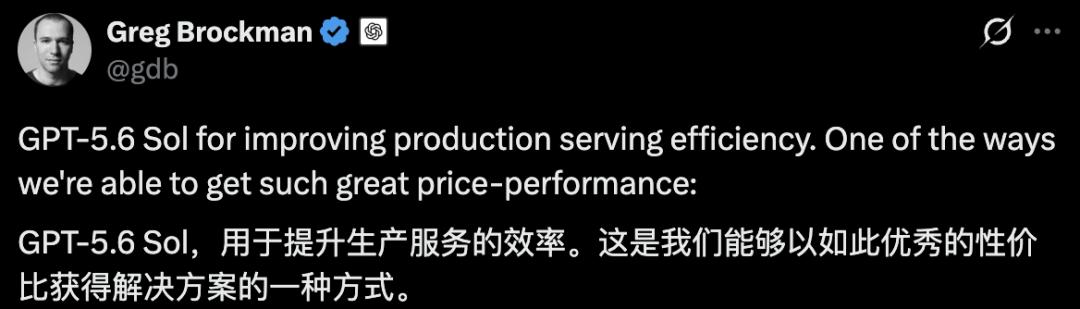
In the words of Greg Brockman, President of OpenAI: Letting GPT-5.6 Sol improve the efficiency of production services is exactly one of the reasons why it is both more powerful and lower-cost.
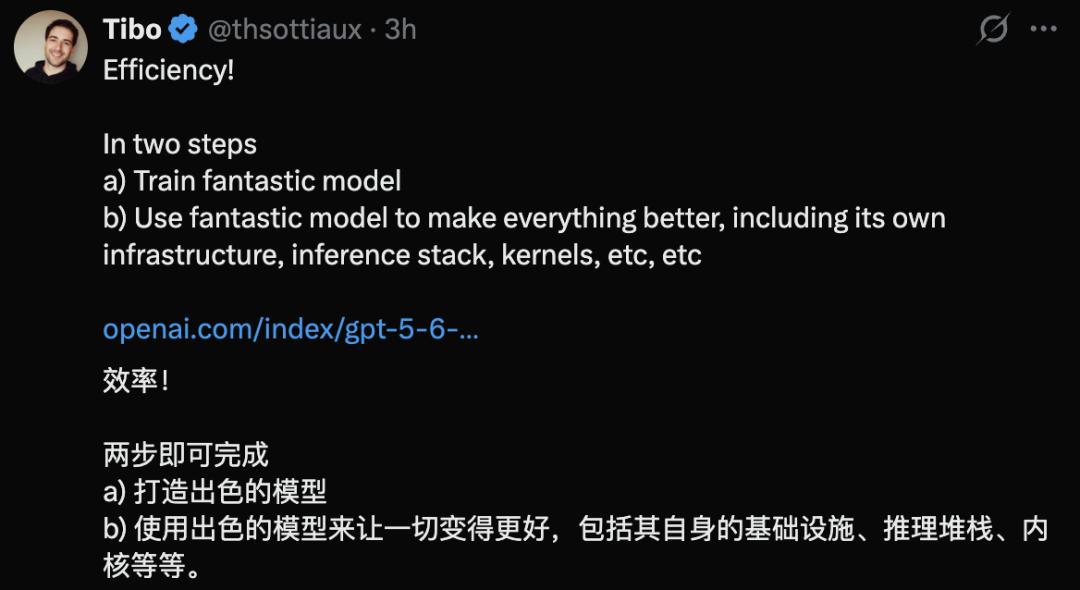
Inside OpenAI, a complete set of methodologies has long been formed, which Tibo (Thibault Sottiaux), head of Codex, summed up into two steps:
The first step is to train a sufficiently powerful model;
The second step is to use this model to improve everything, including the infrastructure, inference stack and kernel that runs itself.
How was the 20% cost saving achieved?
How on earth was this 20% of service cost saved?
Through Codex, GPT-5.6 Sol connected to OpenAI's production inference stack, and modified the most core modules in the inference stack: GPU kernel, load balancing, speculative decoding, and KV cache.
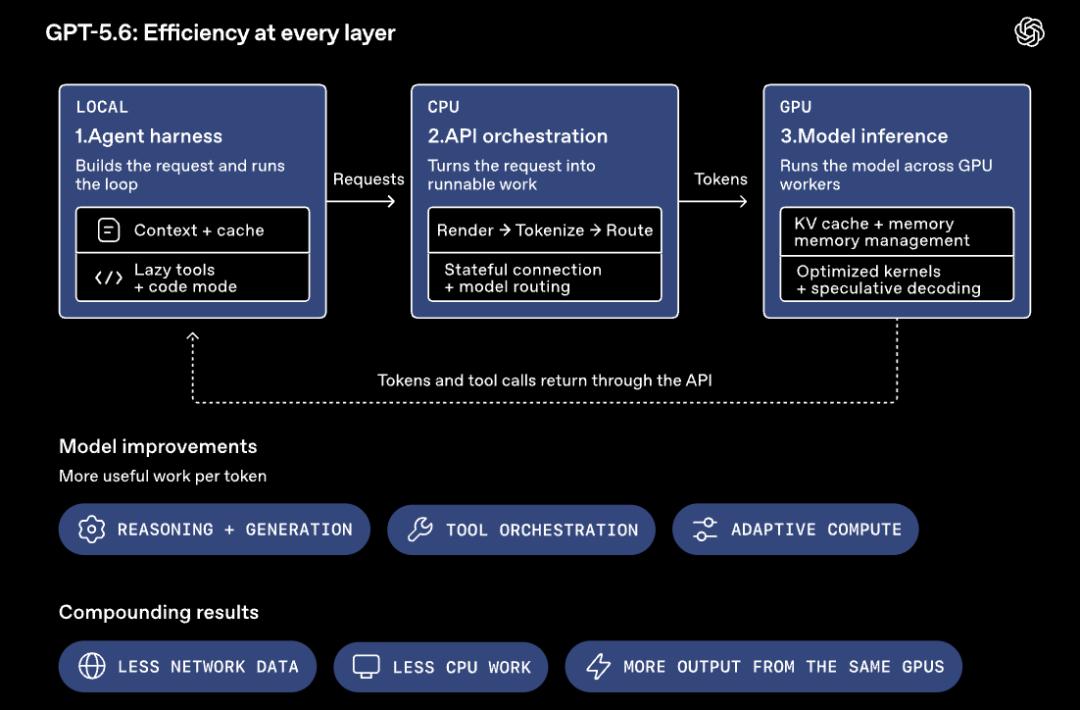
GPT-5.6 optimized three layers: the agent framework, API orchestration, and model inference, which brought less network transmission, lower CPU overhead, and higher GPU output.
Load balancing, in plain terms, means not letting a few GPUs work to the point of overheating while others stay idle;
KV cache means storing the calculated intermediate results for repeated use to avoid useless work;
Speculative decoding means letting a small model output predictions first, and the large model is only responsible for verifying the results. If the prediction is correct, multiple tokens can be output at one time, instead of generating them one by one slowly as usual.
Then let's look at what GPT-5.6 Sol has done.
It analyzed the real production traffic, identified the previously ignored load imbalance, and tested new routing strategies;
It autonomously rewrote the production kernels written in two GPU programming languages, Triton and Gluon, specifically looking for tasks that can be pre-calculated, skipped, or parallelized;
In the speculative decoding process, it designed and ran hundreds of architecture experiments for the supporting draft model, and even started and monitored the training process on its own, and took the initiative to intervene when encountering hardware failures and training instability.
By optimizing each of these modules meticulously, the two figures mentioned at the beginning were finally achieved: service cost reduced by 20%, and token generation efficiency increased by more than 15%.
In fact, as early as when GPT-5.6 was released on July 9, OpenAI had already revealed some clues.
Internal researchers have been using it to troubleshoot failures, optimize training systems, run experiments, and interpret results. They have also specially set up several "self-improvement" evaluations for it, including KernelGen, NanoGPT, and RSI Index.
This 20% cost reduction means that these deployments have been converted into real figures on the bill for the first time.
What is more important than saving 20% is a closed loop
The truly important change is that a closed loop has been successfully implemented.
Analyzing traffic, proposing optimizations, writing code, running experiments, handling failures, and then using production metrics to verify the results: now the model can participate in almost every link of this loop.
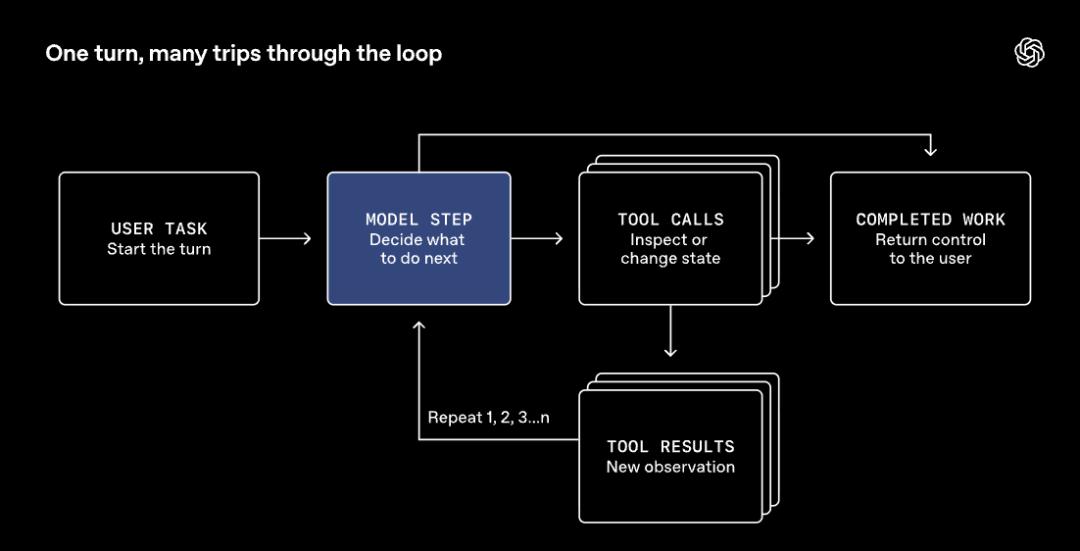
In one task, the model keeps repeating the cycle of "making decisions → calling tools → reading results → making new decisions" until the task is completed.
Take speculative decoding as an example.
This technology requires a smaller draft model. GPT-5.6 Sol designed and ran hundreds of architecture experiments for this draft model, modifying its size, structure, and features.
Hundreds of experiments would have required a scarce GPU engineer to manually test configuration after configuration based on experience and intuition for months in the past.
The configuration space is so large that it is impossible for humans to test all of them, and people can only make decisions based on rough rules of thumb.
Now, the model can compress the "measurement, optimization, verification" loop to an extremely short period of time. As a result, the team can explore more ideas and keep up with the ever-changing load faster.
More critically, this closed loop will keep running and strengthening itself.
The more powerful the model is, the more cost-effectively the inference stack can be optimized; the more cost-effective it is, the more requests the same hardware can serve; the more users it serves, the more powerful models OpenAI can provide to more people.
OpenAI's internal data can prove how fast this loop is running:
During the internal testing phase of GPT-5.6, the average daily token output per active researcher is more than twice the highest value in the GPT-5.5 era; in the past six months, the proportion of research computing power used for internal code inference has increased 100 times, and the internal agent token usage has increased by about 22 times.
Every bit of computing power saved is eventually turned into intelligence that more people can access.
Has AI started self-evolving?
So, is this "AI starting to self-evolve" after all?
At least for now, the answer is no.
What GPT-5.6 Sol optimized is the software running itself, service configurations, and the supporting draft model.
There is no evidence that it modified its own main weights online, nor is there any evidence that it can develop the next generation model on its own without the engineering team.
If we compare the weights to the "cargo" of model intelligence, the kernels and configurations are the trucks and routes that transport the cargo. What it optimized this time is the transportation process, and it has not touched the cargo itself.
Therefore, more accurately, this is the early form of the "self-optimization flywheel", not recursive self-improvement.
There is one more point to note.
The official used the word "autonomously" to describe the kernel rewriting and some experiments this time, which does not mean "completely no human participation". Links including who sets the goals, which production system to connect to, what tools to use for verification, and how to deploy online are still firmly controlled by OpenAI's engineering system.
For example, the verification link: the production kernel written by the model can only be launched after review.
OpenAI specially used an open source tool called FpSan (Floating Point Sanitizer) to check whether the structure and data flow of these kernels are correct.
Whether the automatic verification system can keep up is the real bottleneck of "daring to let AI write low-level code".
Looking ahead, OpenAI has been paving the way for RSI (Recursive Self-Improvement).
As early as February, GPT-5.3-Codex was described by the official as "participating in its own creation"; this time, GPT-5.6 Sol autonomously performed post-training on the smaller Luna model; on the RSI Index, which is specially used to measure self-improvement ability internally, it scored 16.2 points higher than GPT-5.5.
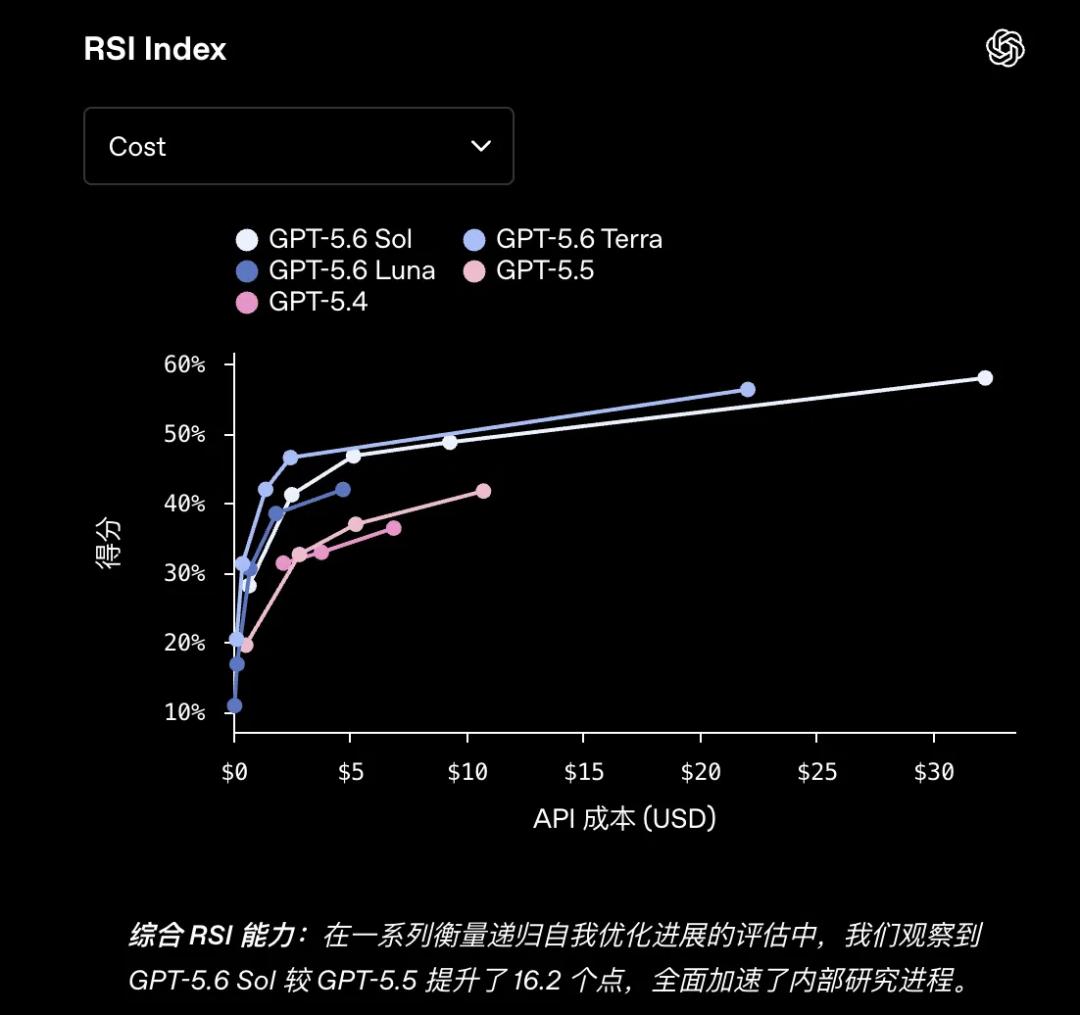
OpenAI's internal RSI Index cost-score curve: The three tiers of GPT-5.6 all outperform GPT-5.5 and GPT-5.4, and are more cost-effective at the same score level.
One of the judgments from its old rival Anthropic is more radical:
Humans are now only responsible for a single-digit percentage of directional decisions.
Its co-founder Jack Clark even stated that the probability of complete recursive self-improvement emerging by the end of 2028 is more than 60%.
The flywheel has started to rotate, but the real "AI creating AI by itself" is still on the way.
The competition axis has changed: from who has more GPUs to who can squeeze out more tokens
This 20% cost reduction means that with the same batch of GPUs, OpenAI can now take on 20% more tasks.
It points to a bigger change.
In the past few years, AI companies have competed on who can afford more GPUs. This logic is simple and crude, and costs huge amounts of capital.
But in a world where computing power is never enough and demand grows faster than production capacity, another key variable has emerged: with the same batch of GPUs, who can squeeze out more tokens?
Inference efficiency is becoming a bargaining chip as important as the number of chips.
OpenAI itself has voted with its product line.
GPT-5.6 is divided into three tiers at once this time: Sol, Terra, and Luna, with a core selling point: the same intelligence, fewer tokens.
Efficiency is placed in a position as important as intelligence.
And this time, it is the model itself that helps OpenAI's model improve inference efficiency.
The more powerful the model is, the better it can optimize the inference stack; the more efficient the inference stack is, the more tokens the same hardware can serve; once the cost is reduced, the more powerful model can be provided to more people.
OpenAI has already made this flywheel rotate.
References:
https://x.com/OpenAI/status/2082577277246972300
https://openai.com/index/gpt-5-6-frontier-intelligence-efficiency/
https://openai.com/index/gpt-5-6/
https://x.com/gdb/status/2082579736065372189
This article is from the WeChat official account "AI Era", author: ASI Revelation, published with authorization from 36Kr.