Free cash flow is choking the AI giants.
The focus of investors is shifting.
As AI capital expenditure enters the hundred-billion-dollar scale, the market no longer only cares about how much enterprises are willing to invest, but begins to ask — when these investments can be converted into revenue, and whether huge capital expenditure will drag down the company's cash flow and profitability.
While all are expanding AI infrastructure, tech giants have received completely different market feedback.
After Microsoft released its financial report, its after-hours stock price rose by more than 4%. The company's Azure business continued to grow at a high speed, and its remaining commercial performance obligations (RPO) reached a high level. The market believes that Microsoft currently has a clearer path to monetize AI infrastructure.
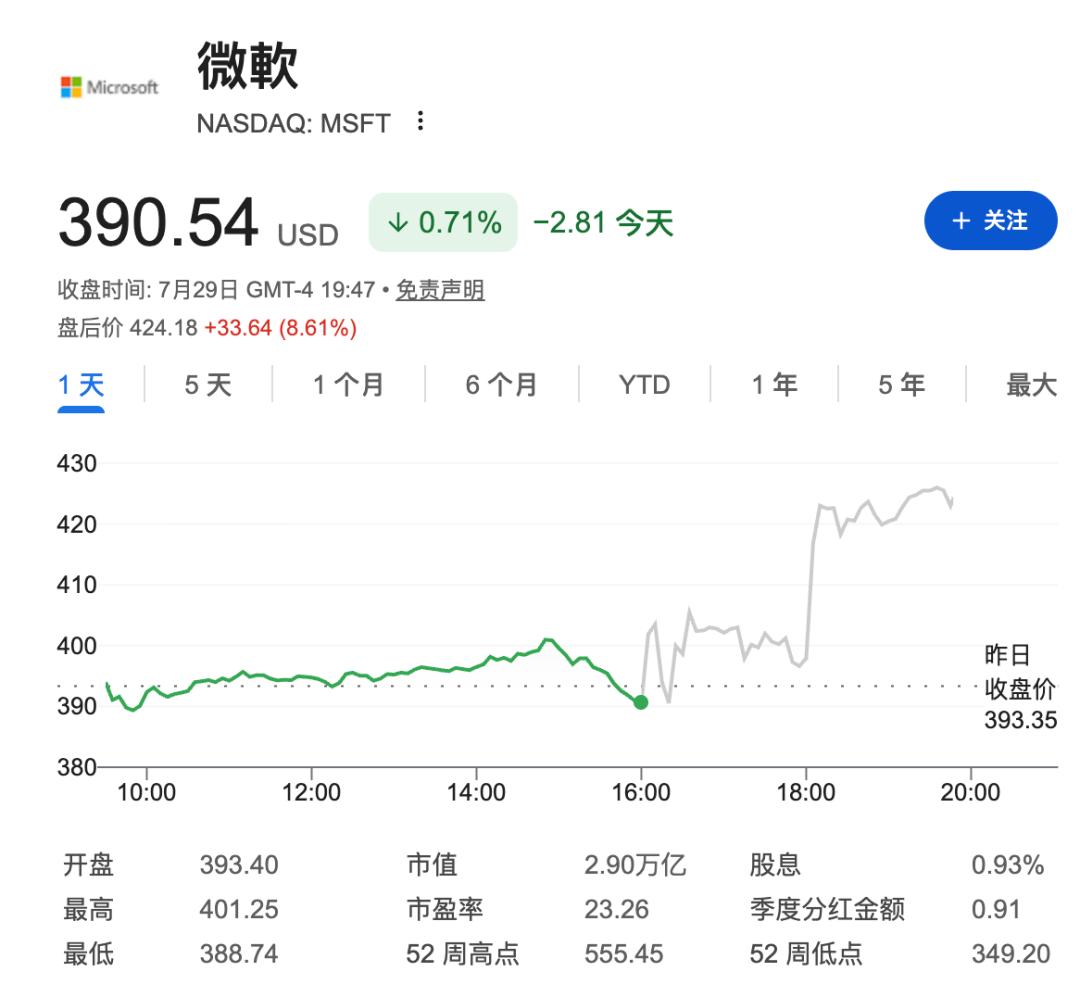
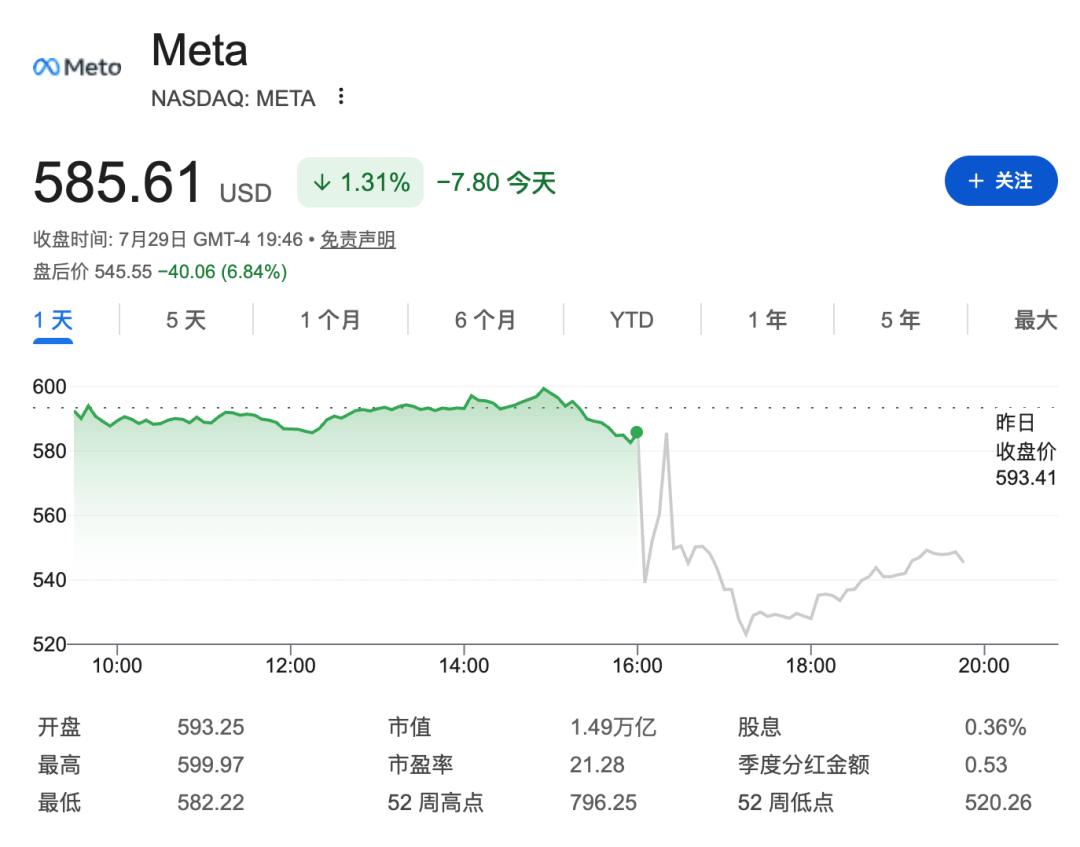
However, after Meta released its financial report, its after-hours stock price once fell by about 8% to 10%. The company's Q2 revenue reached 60.8 billion US dollars, a year-on-year increase of 28%, but free cash flow dropped to 784 million US dollars, down 91% year-on-year. Meanwhile, it continued to maintain the annual capital expenditure plan of 130 billion to 145 billion US dollars. Investors began to re-evaluate whether such large-scale investment in AI infrastructure can bring returns matching the scale of investment in the future.
Similar pressure also appeared on Google and Tesla.
After Alphabet released its Q2 financial report, its after-hours stock price once fell by more than 4%, and the decline expanded to about 7% the next day. Although Google Cloud's revenue reached 24.8 billion US dollars, a year-on-year increase of 82%, and the amount of unfulfilled contracts reached 5.14 trillion US dollars, showing that enterprise AI demand remains strong, the market is still worried about the company's continuously expanding investment in AI infrastructure.
Alphabet has raised its 2026 capital expenditure guidance to 195 billion to 2050 billion US dollars, and said that it will continue to increase investment in 2027. At the same time, the company's free cash flow turned negative in the second quarter, with an outflow of 5.9 billion US dollars.
After Tesla released its Q2 financial report, its stock price fell by 14.52% in a single day, and its market value shrank by about 214.5 billion US dollars. The company's capital expenditure in the second quarter reached 5.8 billion US dollars, and its free cash flow turned to -1.1 billion US dollars. The market began to re-evaluate the commercialization realization speed of AI businesses such as Robotaxi and robotics.
The demand for AI infrastructure is growing, but building these infrastructures requires more and more capital investment.
After tech giants have poured hundreds of billions of dollars into building AI infrastructure, whether these assets can finally generate sufficiently high returns is becoming the focus of the capital market.
The bill is getting bigger, and cash flow pressure is beginning to appear
In the past two years, AI capital expenditure once became an important driving factor for the rise of tech stocks.
In the early stage of the generative AI boom, the market believed that this was an infrastructure race: whoever could build more data centers, obtain more GPU resources, and have stronger computing power would be more likely to gain an advantage in the next round of AI competition.
From Meta's substantial increase in capital expenditure expectations to Microsoft and Alphabet's continuous expansion of data centers, the market once regarded investment in AI infrastructure as a necessary cost to compete for future market share.
But in 2026, the situation is changing.
As investment in AI infrastructure enters the hundred-billion-dollar scale, the focus of investors has begun to shift from the scale of investment to financial affordability: whether enterprises have sufficient cash flow reserves to support this long-term capital investment.
Among a number of tech companies under cash flow pressure due to AI investment, Microsoft has almost become a clear outlier.
Although the company continues to expand its investment in AI infrastructure, the market still gives positive feedback. After Microsoft released its financial report, its after-hours stock price rose by more than 4%. The company's quarterly free cash flow reached 19.6 billion US dollars, down 23% year-on-year, but higher than market expectations; the Azure business continued to maintain rapid growth, and the remaining commercial performance obligations (RPO) reached a high level.
Therefore, compared with other enterprises that invest heavily in AI infrastructure, Microsoft still has stronger financial affordability at present.

In contrast, for enterprises whose cash flow reserves have dropped significantly, their stock prices have also fallen accordingly.
Meta's Q2 financial report shows that the company's revenue reached 60.8 billion US dollars, a year-on-year increase of 28%, and the advertising business still maintains growth. But at the same time, the company's free cash flow dropped to 784 million US dollars, down 91% year-on-year, and it continues to maintain the annual capital expenditure plan of 130 billion to 145 billion US dollars.
Google's parent company Alphabet has raised its 2026 capital expenditure guidance to 195 billion to 2050 billion US dollars, and said that capital investment will continue to increase in 2027. At the same time, the company's free cash flow turned negative in the second quarter, with a cash outflow of 5.9 billion US dollars.
Oracle has also shown a similar trend: with the rapid growth of AI cloud demand, the company's cloud infrastructure business continues to expand. In fiscal year 2026, Oracle Cloud Infrastructure (OCI) revenue reached 18.1 billion US dollars, a year-on-year increase of 77%; remaining performance obligations reached 6.38 trillion US dollars, a year-on-year increase of 363%.
However, in order to meet these demands, Oracle has significantly increased its infrastructure investment. Its capital expenditure in fiscal year 2026 reached 55.6 billion US dollars, and its free cash flow turned negative at 23.7 billion US dollars. After the financial report was released, Oracle's after-hours stock price once fell by about 7%.
Tesla is also under cash flow pressure. The Q2 financial report shows that Tesla's capital expenditure reached 5.8 billion US dollars, and its free cash flow turned negative at 1.1 billion US dollars, which is the first time the company's quarterly free cash flow has been negative in more than two years. Although the company's vehicle delivery and revenue data are not bad, the market has begun to re-evaluate how much capital needs to be invested before the commercialization of future businesses such as Robotaxi and Optimus. After Tesla released its Q2 financial report, its stock price fell by 14.52% in a single day, and its market value shrank by about 214.5 billion US dollars.
There is no lack of demand in the AI infrastructure market. In fact, enterprises' demand for computing power, cloud services and AI capabilities is still growing rapidly.
What has really changed is the market's evaluation criteria:
AI infrastructure is shifting from a pure scale competition to a competition for capital returns.
With the same investment in AI infrastructure, different companies have different outcomes
The biggest difference in AI infrastructure investment does not lie in how much money enterprises spend, but in how these investments will be recovered in the future.
In the past, the market tended to put all AI investments in the same framework: building more data centers, purchasing more chips, and obtaining more computing power meant stronger competitiveness.
However, as the scale of investment expands, investors have begun to realize that AI infrastructure is not a single type of asset. Data centers, GPUs, cloud computing capabilities, model training capabilities, autonomous driving data and robotics capabilities are all important infrastructures in the AI era, but they correspond to completely different business models.
The real concern of the market is whether these assets have a clear cash recovery path.
From the perspective of return paths, companies investing in AI infrastructure construction can be roughly divided into three models.
The first category is companies that directly commercialize AI infrastructure.
The logic of this type of company is very simple: they directly obtain revenue by providing computing power to customers.
NVIDIA is the most typical example — in the past two years, the construction of AI infrastructure first drove the explosion of GPU demand. Different from data center operators, NVIDIA does not need to wait for the commercialization of AI applications to land, and it obtains revenue first from the infrastructure construction itself.
Cloud computing giants belong to another form.
Microsoft Azure, Google Cloud and Oracle OCI do not simply sell chips, but provide enterprise customers with a package of computing resources, model services and cloud platforms.
Therefore, for these companies, the core issue is whether investment in AI infrastructure can be converted into cloud revenue growth.
Microsoft's advantage is that AI investment has gradually been converted into visible revenue through Azure's growth, enterprise cloud contracts and Copilot commercialization.
Oracle is facing another kind of pressure: although orders are growing rapidly, in order to fulfill these orders, a large amount of data center and computing resources need to be invested in advance.
The second category is companies that convert AI capabilities into their own business value.
The goal of this type of company is not to directly sell computing power, but to strengthen their own products, businesses and future AI capabilities through AI infrastructure construction.
Meta is a typical case. It invests a lot of money in building AI infrastructure and promotes the R&D of basic models such as Llama at the same time, hoping to apply AI capabilities to recommendation systems, advertising delivery and consumer AI products.
But different from cloud vendors, Meta currently does not directly obtain revenue by leasing computing power.
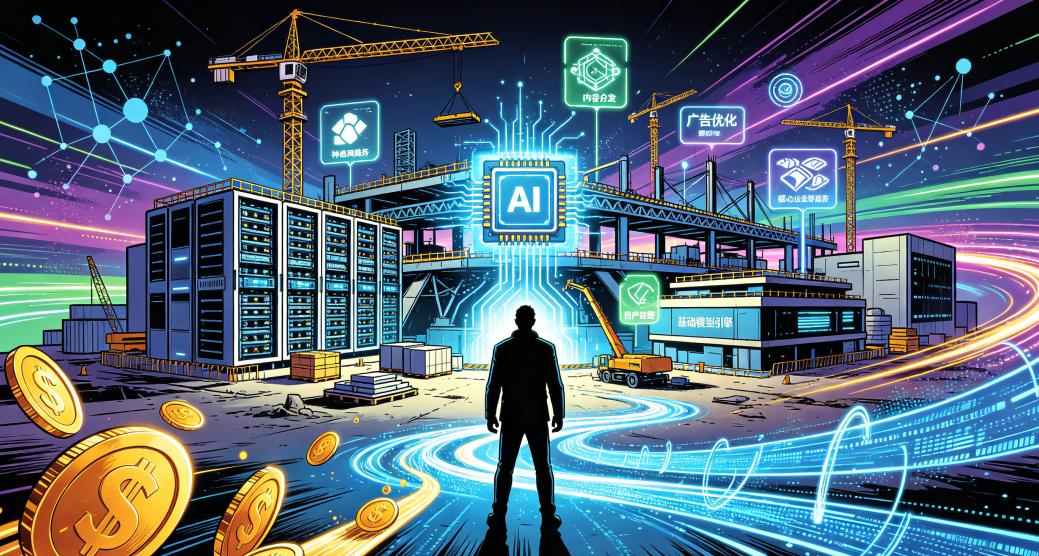
For this type of company, the return path of AI investment is not as direct as that of cloud vendors. Investors do not focus on simple computing power leasing revenue, but on whether AI can improve the efficiency of core businesses and create new growth space.
Google also has this attribute, and its situation is more complicated: on the one hand, Google Cloud is obtaining direct revenue through AI infrastructure; on the other hand, the company is using AI capabilities to transform core businesses such as search, advertising and Workspace, and layout the future AI ecosystem through Gemini and TPU.
Therefore, Google has both the attributes of "selling AI infrastructure" and "building its own AI capabilities".
The third category is companies that build future AI capability assets.
Tesla is the representative of this direction: it invests in AI training, autonomous driving data and robotics capabilities, mainly hoping to create new businesses in the future through these capabilities.
The commercial value of Robotaxi and Optimus depends on whether AI capabilities can reach a sufficiently high level in the future.
But the problem with this model is also the most obvious, that is, there is a longer time lag between asset construction and commercial returns.
Enterprises need to invest a lot of money first and wait for the future market to mature.
Therefore, Tesla's AI investment is more vulnerable to market doubts — investors not only need to judge whether the technology is feasible, but also measure its realization cycle.
With the same AI infrastructure investment, different companies receive completely different market evaluations.
This is why Microsoft and Meta released their financial reports almost at the same time, but their stock price reactions are in sharp contrast: both companies are building AI infrastructure on a large scale, but investors see different return paths.
Microsoft's AI investment has begun to be converted into visible revenue through Azure's growth, enterprise cloud contracts and Copilot commercialization. For the market, investment in AI infrastructure is gradually becoming part of cloud business growth.
Although Meta's advertising business is still strong, its investments in superintelligence teams, data centers and AI assistants are currently more reflected in future capability building, and have not yet formed an independent source of revenue. Investors need to wait to see how these investments will feed back into the advertising business, create new products, and eventually be converted into commercial value.
What the market really rewards is not whether an enterprise is radical enough or restrained enough, but who can provide a clearer and more credible return path.
AI infrastructure has shifted from an arms race to a competition for capital returns
As capital continues to flow in, AI infrastructure is gradually changing from a scarce asset to large-scale investment. The supply of computing power will gradually expand, and the scarcity of simply owning computing power may decline.
Computing power will become more and more popular. What is really scarce will no longer be the ownership of computing power, but the ability to convert computing power into profits.
Experience from the Internet era shows that infrastructure construction can promote industrial development, but excessive investment cannot bring equivalent returns, and similar situations will occur in the AI era.
Data centers, GPUs and computing resources are of course important, but they are only the foundation carrying AI value. What really determines long-term returns is whether an enterprise can invest computing power in the most valuable business links and finally convert it into sustainable revenue.
Therefore, the competition for AI infrastructure is shifting from a scale race to a competition for capital returns.
For cloud computing companies, the key is to improve the utilization rate of computing resources and convert AI demand into cloud revenue;
For model and application companies, the key is to convert computing power investment into product capabilities and further form user demand;
For autonomous driving and robotics companies, the key is to combine data, models and real-world scenarios to build a new commercial closed loop.
It can be inferred that companies that will truly benefit in the future need to have three characteristics at the same time:
First, control real demand.
Infrastructure ultimately needs to be used. Whether it is enterprise cloud services, AI software, robots or autonomous driving, only companies that can grasp the demand entry can digest huge capital investment.
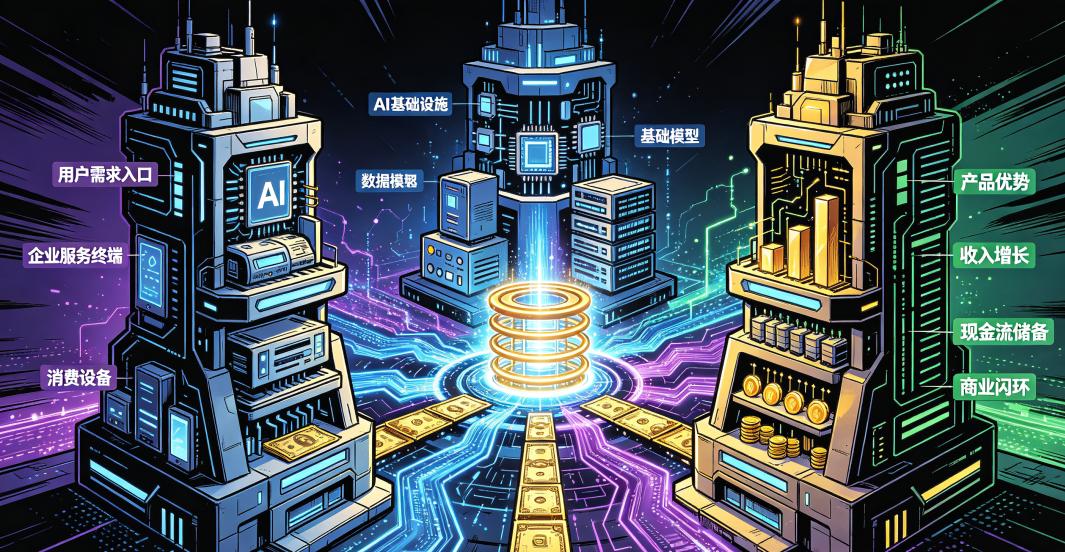
Second, have a clear commercial closed loop.
AI investment is not the end. When enterprises buy GPUs, build data centers and train models, they essentially only obtain a production capacity. What really determines the return on investment is whether this set of capabilities can be transmitted along the complete chain:
That is, computing power investment must be able to be converted into product advantages, product advantages can bring revenue growth, and revenue growth is sufficient to cover infrastructure costs.
Third, have long-term cash flow affordability.
AI infrastructure is a long-term competition. Building data centers, training models and accumulating data all require continuous investment.
The market will not reward the companies that simply invest the most capital, but only those that can prove that capital investment can be