Meta's share price plunged by 10% after its financial report release. How much longer will Mark Zuckerberg have to foot the bill for Wang Tao?
Meta generated $31.862 billion in operating cash flow in the second quarter, then spent $31.078 billion on building data centers and purchasing servers, leaving only $784 million in free cash flow.
It is worth noting that Meta's advertising machine is still making money at a high speed.
In the second quarter, Meta's revenue reached $60.801 billion, up 28% year-on-year; among which advertising revenue was $59.363 billion, up 27% year-on-year. Both ad impressions and average prices rose at the same time, and revenue also exceeded Wall Street expectations.
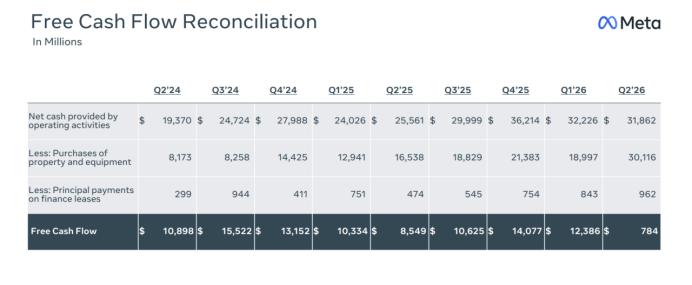
The money earned by the advertising machine is almost completely exhausted by AI.
The company also raised the lower limit of 2026 capital expenditure from $125 billion to $130 billion, with the maximum possible expenditure still reaching $145 billion.
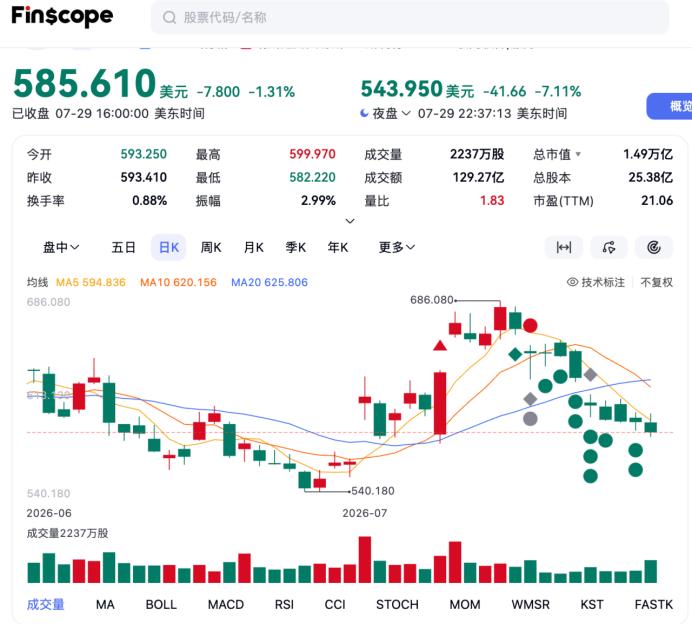
A financial report with revenue exceeding expectations was met with an almost 8% drop in stock price. Meta's stock closed at $585.61 that day, and the after-hours decline once approached 9% after the earnings release.
During the earnings call, Justin Post, an analyst at Bank of America Securities, directly raised the question to Mark Zuckerberg: Meta replaced the senior leadership of its AI lab a year ago, when will Wall Street see a significant acceleration in the release speed of products such as models and chips?
Zuckerberg responded that he is "quite satisfied" with the lab's current progress. Muse Spark and Muse Spark 1.1 are only early achievements of Meta climbing the model capability ladder, and the company is training larger and more capable models.
He did not announce the release date of this flagship model, nor did he present new evaluation results, only saying that more news would be available soon.
A year ago, Llama 4 underperformed expectations. Zuckerberg invested $14.3 billion to take a stake in Scale AI, recruited 28-year-old Wang Tao into Meta, and gave him the power to rebuild the AI system.
Wang Tao and Mark Zuckerberg have a lot in common — both dropped out of school to start businesses around the age of 19, both became billionaires in their early twenties, and both believe in founder-style centralized power and rapid execution. The 40-year-old Zuckerberg seems to have entrusted Meta's future to his younger self.
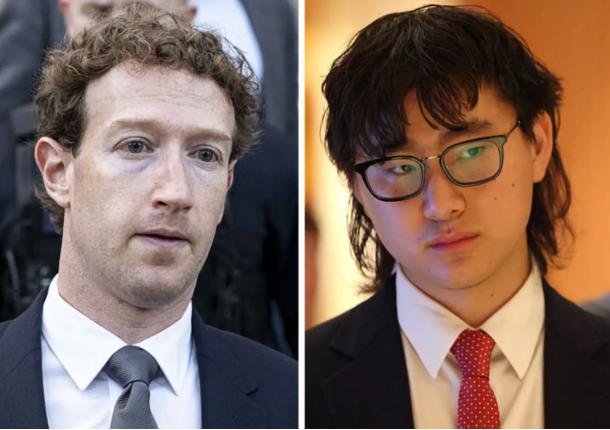
A year later, Wang Tao has reorganized Meta's AI team and launched the first batch of models and products. However, Watermelon, the flagship model that truly carries the expectations of Meta's counterattack, is still in training.
Competitors are still accelerating iteration, and the cost Meta pays for waiting for this answer sheet is getting higher and higher.
As long as Wang Tao does not deliver the flagship model, it will be difficult for Zuckerberg to prove what all this money, this reorganization and another year of waiting have brought. Replacing personnel or scaling back at this point is equivalent to admitting that the previously paid costs are hardly recoverable.
Wang Tao has become Zuckerberg's biggest sunk cost.
Misplaced "Savior"?
Of course, Wang Tao is not idle.
Zuckerberg's choice of Wang Tao was a somewhat risky decision in itself. Scale AI has long provided data and evaluation services for companies such as OpenAI, Google and Meta. Wang Tao knows what various labs are training and where they are likely to get stuck, but he had no previous experience leading cutting-edge model R&D.
Wang Tao's most prominent ability has always been management and resource scheduling.
After Scale AI had thousands of employees, he still insisted on personally approving new hires and randomly checking data before delivering it to customers. He calls this stubbornness "quality is fractal": if managers don't care about details, their subordinates will soon learn not to care either.
What Zuckerberg values is exactly the concentration, toughness and execution speed that are hard to find in a large company with tens of thousands of people. The Financial Times therefore called Wang Tao the "wartime CEO" that Meta needs.
After joining Meta, Wang Tao quickly brought this founder-style management approach to the AI department. Meta established TBD Lab, which directly targets cutting-edge models, poached talents from OpenAI, Google and other companies at high salaries, and at the same time compressed the original management levels, trying to transform the bloated AI department into a "wartime team" with faster actions.
The cost is obvious.
About 600 positions in Meta's original AI team were laid off, and Yann LeCun left Meta, where he had worked for 12 years, to start his own business to research world models. Cracks have emerged between the high-paid new team and the old research system.
The cost of this reorganization is now starting to appear in Meta's financial statements.
In the second quarter, Meta's R&D expenses reached $21.656 billion, up 67% year-on-year. CFO Susan Li said on the earnings call that the growth of the company's compensation expenditure mainly came from the technical personnel added in the past year, especially the high-priced AI talents recruited.
Even after deducting $2.4 billion in legal expenses and $1.18 billion in layoff expenses, Meta's total cost in the second quarter still increased by about 42% year-on-year, far exceeding the 28% revenue growth rate.
What Wang Tao brought is not only a new organizational structure, but also an increasingly expensive AI team.
The logic of Zuckerberg's big bet has thus become clear: he believes that Wang Tao's ability to rebuild the organization and mobilize resources can eventually be transformed into the ability to train cutting-edge models. The former has been proven, while the latter still depends on the model to deliver results.
In April 2026, Meta launched Muse Spark, the first model from Wang Tao's team. Meta emphasized from the very beginning that it is small in size and fast in speed, and it is only the "vanguard" of the Muse series, with larger models still to come.
By July, Muse Spark 1.1 raised the Artificial Analysis composite index from 43 points to 51 points, with improvements mainly concentrated in programming, scientific reasoning and knowledge capabilities. It charges $1.25 and $4.25 per million input and output tokens respectively.
This model is improving rapidly and priced low enough, but there is still an obvious gap in overall capability compared with the most cutting-edge models, which is not enough to prove that the $14.3 billion invested by Meta and the newly formed high-priced team are already worth the investment.
It is Watermelon, which is still in training, that truly carries this expectation.
According to Business Insider, citing two people familiar with the matter, Wang Tao said at an internal Meta meeting that the Watermelon still under training uses an order of magnitude more computing power than Muse Spark, and has caught up with GPT-5.5 in some benchmark evaluations. However, he did not specify the specific evaluation items, and Meta has not released the relevant results.
The latest earnings call also did not provide more evidence for this statement. Zuckerberg only confirmed that Meta is training larger and more capable models, did not mention the name Watermelon, nor did he announce the release date and evaluation results.
What is more realistic is that Watermelon has not been released yet, but OpenAI, Anthropic and Google will not stop and wait for it.
Wang Tao has been in Meta for a year and has not yet become a "savior".
Two Years Late
The most ironic thing is that Meta has never been a latecomer in the AI field.
In 2013, Facebook established FAIR and appointed Yann LeCun as its head. In the following ten years, Meta accumulated deep expertise in computer vision, self-supervised learning and other fields, and also gave birth to PyTorch; the recommendation and advertising systems of Facebook and Instagram have long used AI to process data generated by billions of users every day. Llama, released in 2023, also quickly brought Meta influence in the open model field.
After the emergence of ChatGPT, OpenAI built models, APIs and developer ecosystems around a consumer-level entry, while Meta's AI resources were scattered across FAIR, the generative AI team, product departments and infrastructure departments.
It was not until 2025 that Zuckerberg elevated AI to a company-level war, planning to invest $60 billion to $65 billion in infrastructure construction, only to get Llama 4, which underperformed expectations.
The centralized reform that Wang Tao later promoted was actually the reform that Meta should have completed in 2023. By the time it started the reorganization, OpenAI, Anthropic and Google had already established advantages in models, talents and products, and Meta was a full two years behind.
Wang Tao is more like a bill Zuckerberg received for his hesitation in the previous two years.
In early 2025, Zuckerberg planned to invest $60 billion to $65 billion in infrastructure construction. By 2026, capital expenditure is expected to reach $130 billion to $145 billion, with the maximum value already more than twice the previously planned amount.
However, Meta did not burn all this money on an unreleased flagship model. In the second quarter, Instagram's user usage time achieved double-digit growth, and Facebook's video viewing time increased by 9%. Meta stated that the new advertising model increased Facebook's ad clicks by 8.3% and conversion rate by 15.7%; more than 9 million small businesses are already using AI-generated advertising materials.
These results prove that AI can already help Meta's advertising machine make more money, but they cannot be directly counted as Wang Tao's answer sheet.
The improvements disclosed by Meta mainly come from the recommendation system, ad ranking and content understanding, and it does not specify how much role Watermelon or the cutting-edge models of Wang Tao's team play in them. Advertising and recommendation have long been Meta's strengths accumulated for more than ten years.
In other words, Meta can wait for Wang Tao's flagship model while continuing to improve its advertising with existing AI technologies. The strong advertising business has given Zuckerberg the confidence to continue waiting, and also makes this big bet temporarily have no mandatory stop point.
For the newly added huge amount of computing power, Meta has also prepared more destinations. Zuckerberg listed directions such as personal agents, enterprise agents, model APIs and direct computing power sales on the earnings call.
Meta Business Agents are already used by more than 1 million enterprises every week, and the company has received many offers to purchase computing power, which are reportedly significantly higher than Meta's cost of obtaining these computing power.
Brian Nowak, an analyst at Morgan Stanley, asked which of these businesses is most likely to scale up first and bring measurable returns to investors. Zuckerberg did not give a clear answer, only saying that he is optimistic about all these directions and will announce more news soon.
CFO Susan Li put it more directly: Even if Meta's models do not reach the cutting-edge level, the company is confident to use this computing power to improve existing products. If there is still excess capacity, it can also be sold directly to other enterprises.
This is equivalent to preparing several fallback options for the huge investment, but it also shows that Meta is still not sure which new business will eventually cover this bill.
Can It Afford to Delay Any Longer?
In the second quarter, Meta issued approximately $24.91 billion in long-term debt. By the end of June, the company's long-term debt reached $83.664 billion, an increase of $24.92 billion from $58.744 billion at the end of last year. Meanwhile, Meta did not repurchase any shares this quarter.
The reason is not complicated.
Meta generated $31.862 billion in operating cash flow in the second quarter, of which $31.078 billion was used for capital expenditure, leaving only $784 million in free cash flow, which is not even enough to cover the $1.35 billion in dividend expenditure for the same period.
The cash generated by the advertising business can no longer meet the needs of AI expansion, dividends and share repurchases at the same time.
Meta still has $90.26 billion in cash and marketable securities on its books, and it is not short of money in the short term. But it is worth noting that it no longer relies solely on the cash generated by the advertising business to build AI, and has begun to increase debt and introduce partners to raise more funds for long-term projects.
During the earnings call, Eric Sheridan, an analyst at Goldman Sachs, asked Susan Li how Meta plans to balance aggressive investment and capital needs.
Susan Li responded that the company has been increasing the proportion of debt in recent years, hoping to obtain low-cost, long-term funds to match the long construction cycle of AI infrastructure.
The cooperation between Meta and BlackRock is an example. One day before the earnings release, the two sides announced the construction of a 1GW data center in El Paso, Texas. Meta uses external partners to share construction costs while retaining the ability to use the computing power.
The money needs to be spent now, but the returns will not come until the data center is completed. Zuckerberg admitted on the earnings call that the data centers the company is building will not generate value before they go online. Susan Li also said that Meta's top priority now is to expand its computing power in 2026 and 2027 as much as possible, and then decide how many chips to purchase after 2028 based on actual demand.
This means that before the capability of Watermelon is publicly verified, the data centers, servers and networks used to train larger models must be prepared several years in advance. Even if the final results are not as expected, the land, power and data centers have already been invested in construction.
Meta just can hardly draw a clear stop-loss line for this big bet.
And don't forget that Meta has proven in the past that it can maintain amazing patience for a long-term big bet. In the second quarter, Reality Labs' revenue was only $431 million, but its operating loss reached $4.619 billion. AI glasses drove the division's revenue to grow by 16%, and Zuckerberg also said that the sales of new glasses exceeded expectations, but it is still far from covering the huge losses of Reality Labs.
External doubts fall on Wang Tao, and also on Zuckerberg's shoulders at the same time — the success or failure of Wang Tao is not only related to the success or failure of Meta, but also has become a touchstone to verify whether Zuckerberg is being irrational again after the "metaverse".
What Wall Street is worried about is exactly whether AI will become the next big bet without a clear deadline.
The longer the waiting time, the more funds and computing power Meta invests. The more it invests, the harder it is for Zuckerberg to admit that this path may not work.
Watermelon still has a chance to prove everything for Wang Tao. However, before that day comes, every additional quarter that Meta waits will continue to increase the "