2026 Research Report on the Development of China's Industrial Embodied Intelligence Industry (Part 1)
Abstract
The rise of industrial embodied intelligence stems from the combined changes in industrial demands and technical capabilities.
Manufacturing is shifting from mass production with fixed processes to multi-variety, small-batch and flexible production. Traditional industrial robots still have limitations in unstructured environments, complex task understanding and dynamic adaptation. At the same time, continuous advances in multi-modal perception, intelligent decision-making, motion control, simulation training and robot ontology technologies have created conditions for intelligent systems to enter real industrial sites. Therefore, industrial embodied intelligence is not simply a new type of robot category, but an on-site intelligent system that organizes perception, decision-making, execution, feedback and iteration into a closed loop around real industrial tasks.
Technological competition no longer only focuses on single-point capability breakthroughs, but shifts to system collaboration in the task closed loop.
Industrial embodied intelligence is not equivalent to humanoid robots, nor is it defined by a single ontology form or model capability; carriers such as fixed operation, mobile perception, mobile operation, in-plant logistics and production line transfer will coexist for a long time according to tasks. At present, modules such as perception, control and execution have a certain industrial foundation, but complex task understanding, exception handling, cross-scene generalization and continuous learning are still in the development stage. The key for technology to generate industrial value lies in whether it can support the stable operation, result verification, exception recovery and continuous optimization of real industrial tasks.
Industrial embodied intelligence will not expand in all scenarios simultaneously, but will achieve breakthroughs first from high-value, closed-loop achievable tasks.
Mature scenarios usually feature clear task boundaries, relatively stable environments, quantifiable value, manageable exceptions and clear acceptance standards, such as loading and unloading at fixed stations, rule-based sorting, in-plant logistics, and fixed-route patrol inspection. Transition scenarios have obtained partial verification, but problems such as exception handling, system transformation and replication cost still need to be solved. Long-term scenarios represent the upper limit of long-term capabilities, but are still in the stage of prototype verification and cutting-edge exploration in the short term. The overall expansion is more likely to follow the path of "single-point task validation - replication of the same task cluster - multi-point deployment in a single factory - promotion across multiple factories".
I. Industrial embodied intelligence is not a new robot category, but a task closed-loop system
The core of industrial embodied intelligence is not the robot form, but whether it can form an on-site closed loop of "perception - understanding - decision-making - execution - verification - iteration" around real industrial tasks. The industry is not in a full-scale explosion at present, but is transitioning from task closed loop to engineering delivery.
Industrial embodied intelligence is in a strategic window period
Industrial embodied intelligence is in a critical window period from technology verification to early commercialization
At present, the industrial embodied intelligence industry is in a critical strategic positioning window period: on the one hand, the supply side of the industry is expanding intensively, the demand side is beginning to form real traction, and the technology base has entered the engineering feasible stage, and multiple conditions jointly accelerate the commercialization of industrial embodied intelligence; on the other hand, the scenario, data and ecological advantages of leading players have not been finally solidified, and the whole industry is still in the early stage of commercialization.
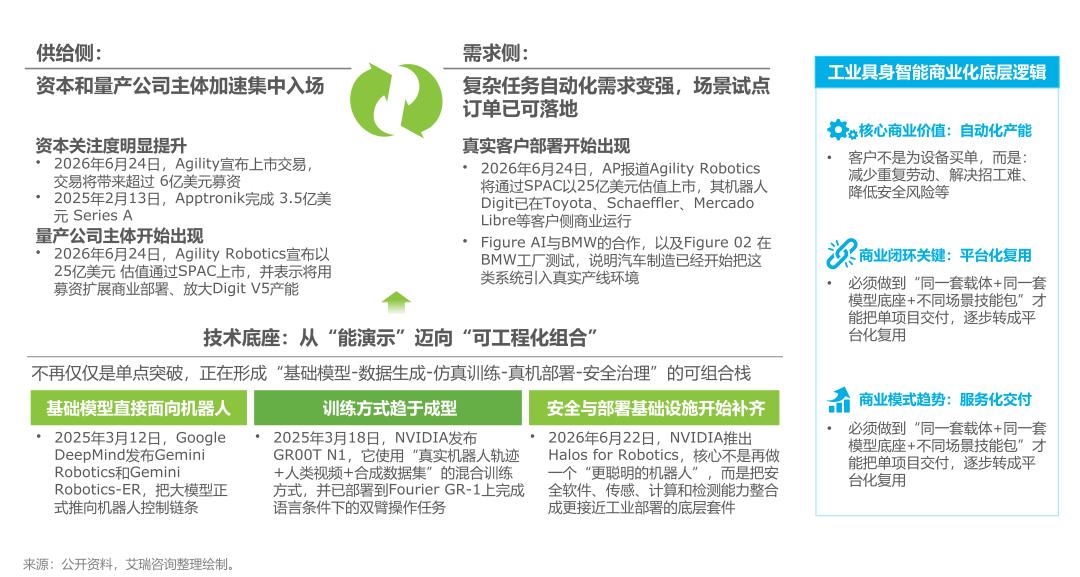
Definition and characteristics of industrial embodied intelligence
Focus on the results of industrial tasks to form on-site closed loop and continuous evolution capabilities
Industrial embodied intelligence is not a simple superposition of carrier and large model, nor does it lie in whether the carrier form is advanced, but the on-site closed-loop capability formed by the intelligent system around the task goal in the real industrial environment. The core of industrial embodied intelligence lies in: the system can continuously complete perception, understanding, decision-making, execution, verification and exception handling under the constraints of process, quality, rhythm and safety, and continuously optimize its capabilities with the help of data backflow. Therefore, the key of industrial embodied intelligence does not lie in what kind of carrier form is adopted, but in whether it really enters the execution layer of industrial tasks and is responsible for the task results.
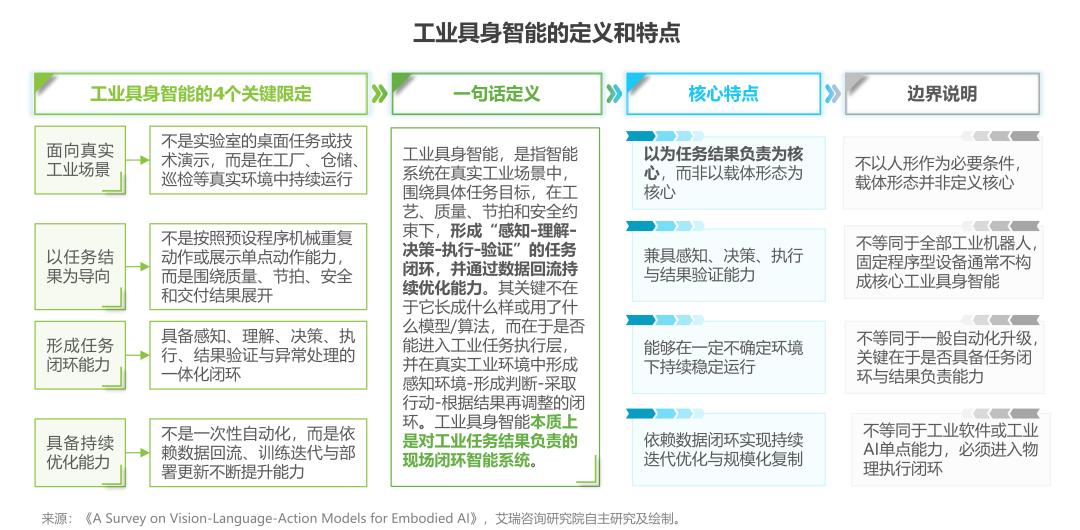
Operation and iteration closed loop of industrial embodied intelligence
The operation logic of industrial embodied intelligence consists of a dual closed-loop system of "online operation closed loop + offline iteration closed loop"
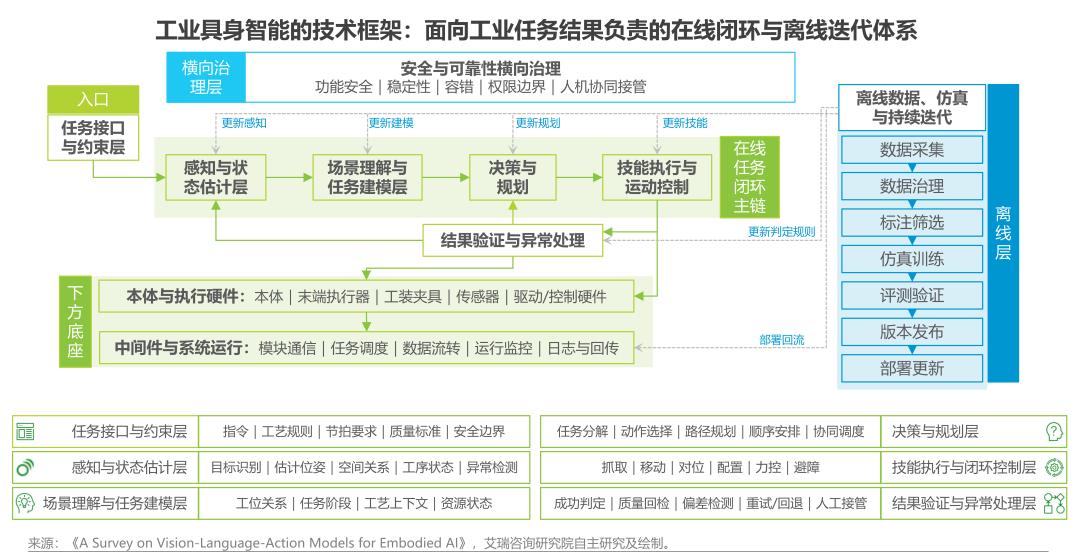
A complete workflow of industrial embodied intelligence is composed of a dual closed-loop system of "online operation closed loop + offline iteration closed loop". Among them: 1) The online operation closed loop is: task input → perception and state understanding → task understanding and planning → strategy and control → execution and feedback, whose main purpose is to solve the problem of whether the system can stably complete tasks at real industrial sites. 2) The offline iteration closed loop is: data collection → data governance → simulation and training → evaluation and release → deployment backflow, which precipitates on-site experience, exception samples and operation data into models, strategies, parameters and task templates, and solves the problem of whether the system can be continuously optimized and run more and more stably. Therefore, the value of industrial embodied intelligence is not only "whether it can be done this time", but whether it can accumulate operation experience after completion, and improve the success rate, stability, exception recovery ability and replication efficiency in the next round of deployment.
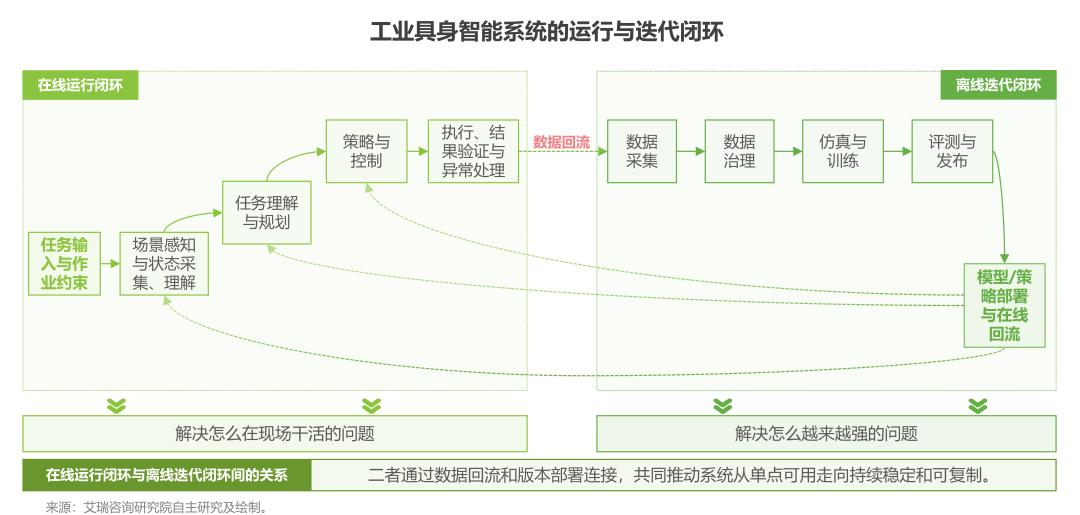
Relationship between industrial embodied intelligence and related industrial concepts
Industrial embodied intelligence does not replace a certain type of industrial technology, but reorganizes multiple types of technologies into on-site intelligent systems oriented to task results
Industrial embodied intelligence is not a simple superposition of industrial software, industrial robots, industrial internet, humanoid robots or traditional industrial AI. Instead, around real industrial tasks, it organizes execution carriers, perception control, intelligent decision-making, process rules and on-site data into a task closed-loop system that is operable, verifiable and iterable. The difference between it and related concepts does not lie in whether a certain type of technology is used, but in whether it enters the physical execution layer and forms an on-site closed loop of "perception-understanding-decision-execution-verification-iteration" for industrial task results. Its final value is not limited to the technical upgrade itself, but to promote the improvement of flexibility, dangerous task replacement, exception recovery and task coverage expansion in industrial scenarios.
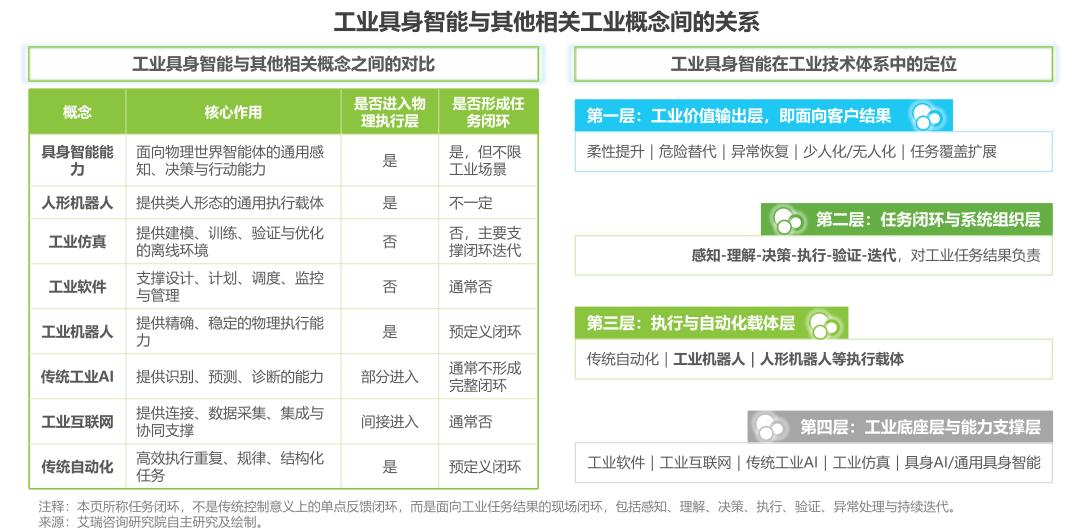
Focus on closed loop in the short term, reusability in the medium term and operation in the long term
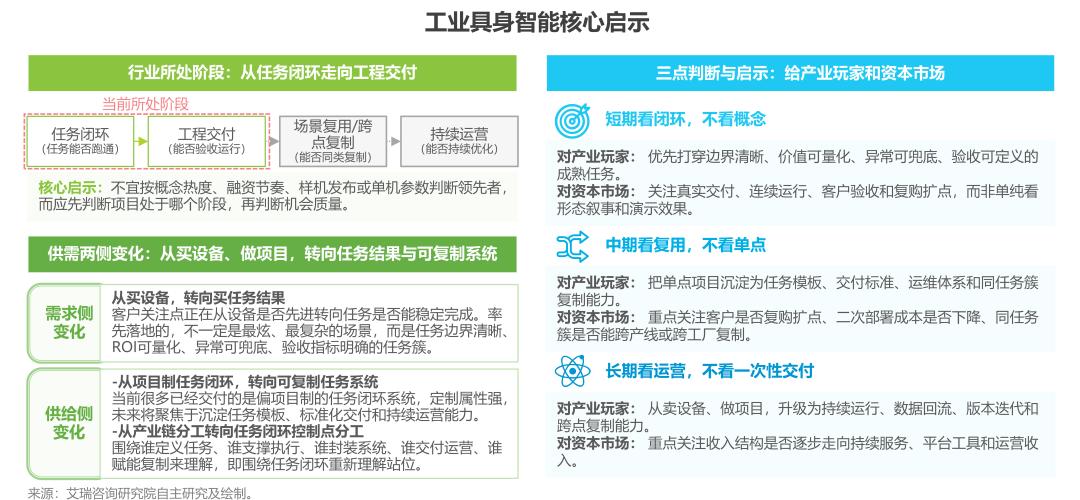
Industrial embodied intelligence is currently in the stage of transitioning from task closed loop to engineering delivery, and exploring scenario reusability in a few mature tasks. The focus of competition is whether real industrial tasks can be delivered/accepted/reused/operated
Industrial embodied intelligence is in the early stage of development. The current main line of industrialization is not equipment replacement or one-step realization of general-purpose robots, but advancing step by step along the path of task closed loop - engineering delivery - scenario reusability - cross-point replication - continuous operation. Among them: 1) The key on the demand side is to identify the tasks that can be run through, stabilized, accepted and replicated first. 2) Two points on the supply side need attention: first, find your own control point around the task closed loop; second, precipitate the project-based task closed loop into a templated, operable and replicable task system. On the whole, the competition characteristics of industrial embodied intelligence are as follows: focus on closed loop in the short term, replication in the medium term, and operation in the long term; the real competition is not a single-point capability contest, but a comprehensive capability competition focusing on task results to form system delivery, template precipitation, operation optimization and continuous service.
II. Not a single-point algorithm, but system closed-loop capability
The difficulty of industrial embodied intelligence is not whether a certain model is strong enough, but whether the system can learn to work, perform stably, and replicate at low cost. The short-term technical main line is not "one-step realization of general-purpose robots", but engineering enhancement, task closed loop and prototype verification.
Technical framework of industrial embodied intelligence oriented to task results
Take responsibility for task results as the core, and build online closed loop, offline continuous iteration, safe and reliable governance capabilities
The technical framework of industrial embodied intelligence oriented to task results is not determined by a single ontology form or model capability. Instead, it forms an online closed loop of "task interface - perception understanding - task modeling - decision planning - skill execution - result verification" around industrial task results, and iterates continuously through offline data, simulation training, evaluation verification and version release. Among them, result verification and exception handling are the key links that distinguish industrial embodied intelligence from single action demonstration; the offline iteration layer precipitates on-site experience, exception samples and operation data into models, strategies, parameters and task templates, promoting the system from single-point availability to stable replication.
Three core capabilities and implementation paradigms of industrial embodied intelligence
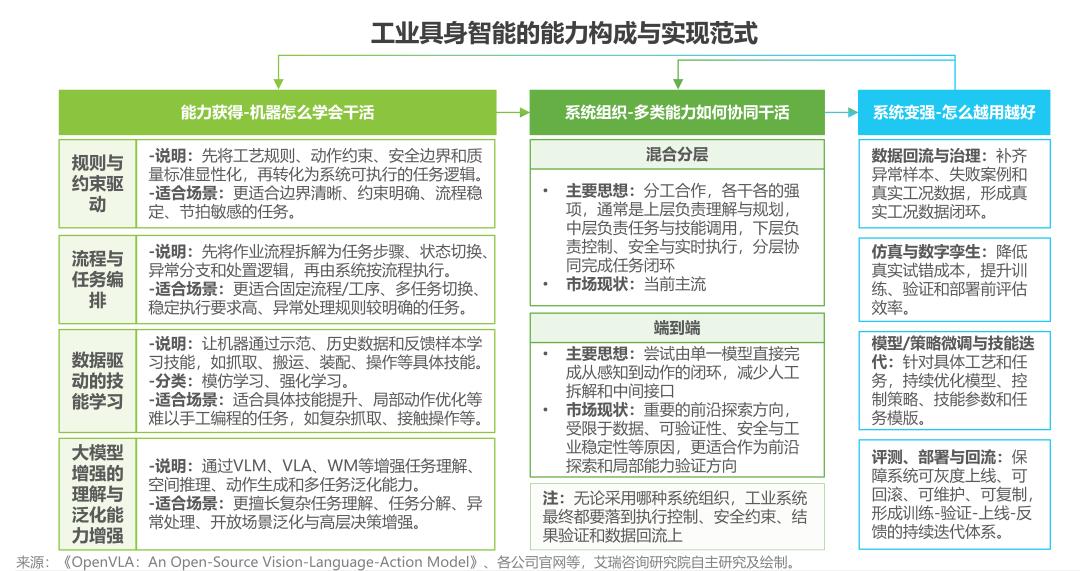
Industrial embodied intelligence needs to solve three problems at the same time: "how to learn to work, how to collaborate to work, and how to work better and better", corresponding to the formation of three core capabilities: capability acquisition, system organization and system evolution
Industrial embodied intelligence is not a single model capability, but a system composed of multiple types of capabilities in coordination. The core of industrial embodied intelligence does not lie in whether a certain algorithm is leading, but in whether it can complete the closed loop of capability acquisition, system organization and continuous evolution at the same time. It should be noted that large models are not a necessary prerequisite for industrial embodied intelligence, but are gradually becoming an important upper-layer intelligent enhancement module. In current industrial scenarios, many tasks are still dominated by rules, process orchestration, traditional control and dedicated models, and large models are more used for task understanding, generalization enhancement and exception handling. The mainstream implementation of current industrial embodied intelligence is not pure end-to-end, but a systematic solution based on multi-source capability acquisition, with hybrid hierarchical organization as the core and supported by data closed-loop evolution.
Core technical difficulties of industrial embodied intelligence
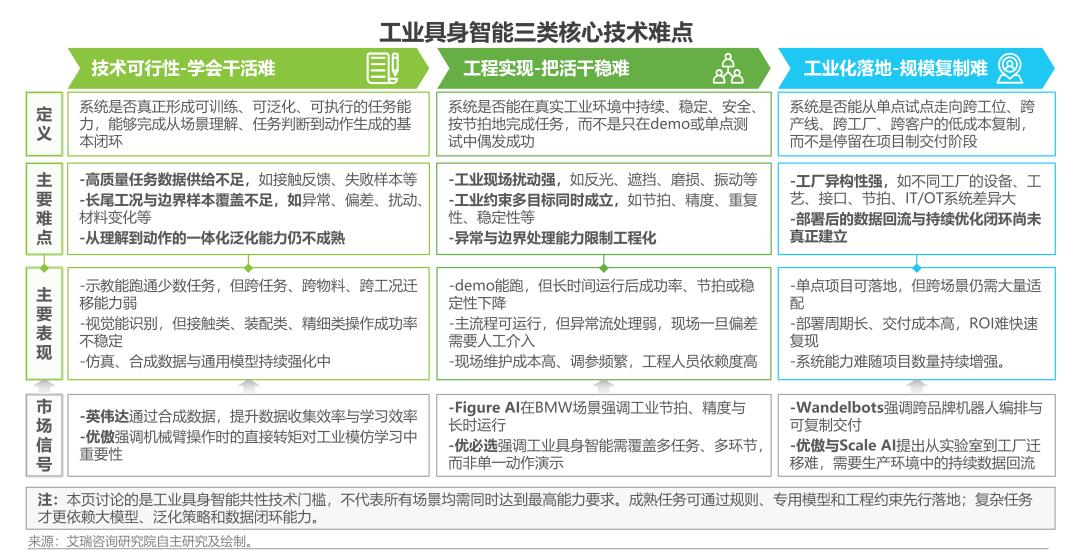
The key challenge of industrial embodied intelligence does not lie in single-point algorithm capability, but in whether it can cross the three thresholds of technical feasibility, engineering availability and industrialized implementation
From the perspective of long-term evolution, industrial embodied intelligence will be increasingly driven by large models, general strategy models, data closed loops and simulation training systems. But at the current stage, a large number of industrial tasks still rely on rule orchestration, dedicated models, process modeling, traditional control and system integration. Therefore, whether industrial embodied intelligence can truly move towards industrialization depends not only on "whether it can work", but also on "whether it can perform stably" and "whether it can be delivered at low cost and in a replicable manner". Short-term bottlenecks lie more in engineering availability and industrial replication, while long-term breakthroughs depend on whether data closed loop, simulation training and general strategy capabilities can be continuously improved.
Judgment on the technology evolution direction of industrial embodied intelligence
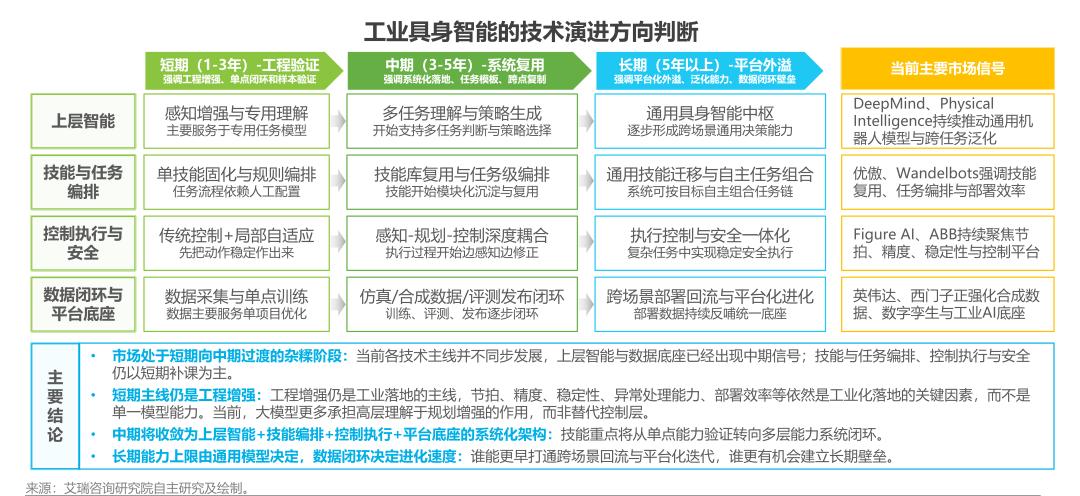
The evolution of industrial embodied intelligence is not a single-point breakthrough, but four main lines advancing in parallel, and finally converging to stronger generalization, higher stability and lower replication cost
The technology evolution of industrial embodied intelligence will continue to develop along four main lines, and different technology main lines will not mature simultaneously. Specifically: 1) Upper-layer intelligence evolves from dedicated task understanding to cross-task understanding and strategy generation; 2) Skill and task orchestration evolves from single skill solidification to skill reuse and task templating; 3) Control execution and safety evolve from local action stability to integration of control, verification, takeover and exception recovery; 4) Data closed loop and platform base evolve from single-point data collection to cross-scene data backflow and platform-based iteration. Among them, upper-layer intelligence and data base determine whether the system can continuously improve task generalization ability, skill and task orchestration determine whether the system can organize local capabilities into complete tasks, and control execution and safety determine whether the system can operate stably, reliably and safely in real industrial sites. At present, the whole market is in a mixed stage of transition from short term to medium term. The key of technology implementation is not a single model capability, but whether it can improve the rhythm, accuracy, stability, exception handling ability and replication efficiency in specific industrial tasks. In summary, focus on engineering enhancement in the short term, system closed loop in the medium term, and generalization ability and data platformization in the long term.
Implementation priority matrix of industrial embodied intelligence task carriers
From the perspective of task closed-loop depth and commercialization maturity, current opportunities are not evenly distributed, but concentrated on a few task carriers with clear closed-loop value and high implementation certainty