Is Microsoft about to crack down on pirated Windows 11? Its newly released TPM regulation has sparked widespread public panic, and the truth is that the company actually has no intention of taking any punitive actions against individual users.
"Is pirated Windows 11 going to be phased out?"
Recently, a piece of news about Microsoft strengthening the TPM security mechanism has sparked heated discussions in the technology community. After seeing the headline, many users' first reaction was: Is Microsoft finally getting serious, planning to use TPM chips to detect pirated systems, and directly invalidate Windows 11 installations that do not have a purchased license?
The answer is partially yes, but not entirely: Microsoft has indeed announced a new security upgrade — KMS Hardware-Secured, which requires KMS servers in Windows volume licensing environments to use TPM for hardware identity authentication.
However, this change does not target pirated Windows on ordinary users' personal computers, but the KMS activation servers deployed within enterprises.
TPM + KMS, to Fix the Bug in Enterprise Licensing System
This misunderstanding originally stemmed from a technical document released by Microsoft last week.
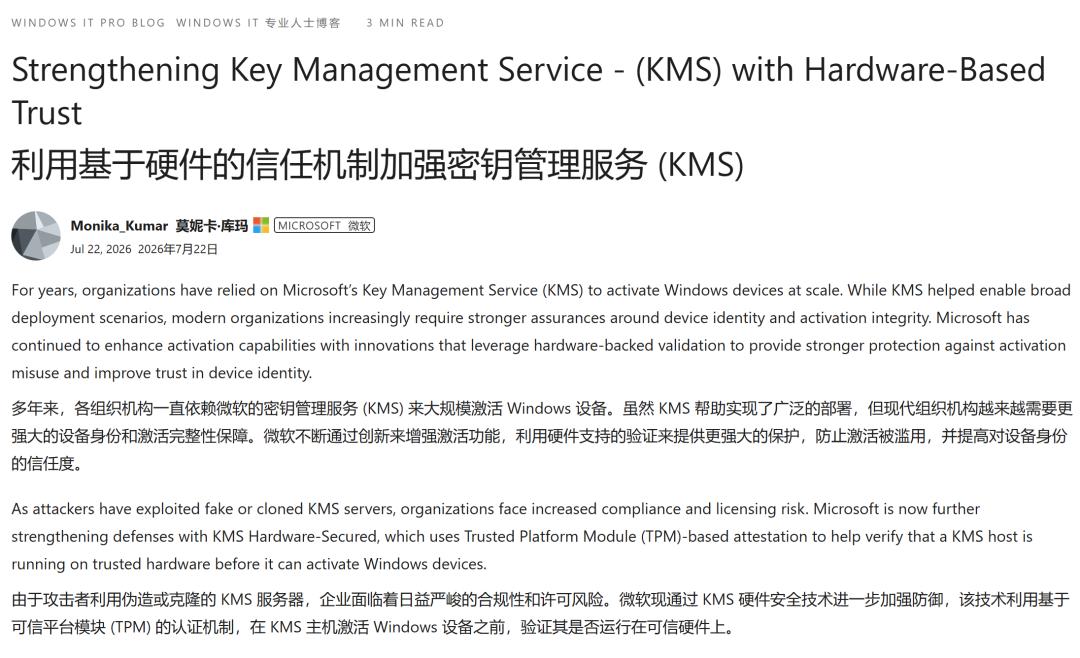
Since Windows 11 already mandates TPM 2.0 on supported devices, many media outlets have linked the two events together: on one hand, Windows 11 has TPM requirements; on the other hand, Microsoft announced the introduction of TPM verification for KMS. As a result, some reports came to a seemingly reasonable but actually wrong conclusion:
"Microsoft will use TPM chips to identify pirated Windows 11 and block pirated activation."
In fact, this upgrade from Microsoft targets KMS (Key Management Service).
For ordinary consumers, Windows activation usually relies on purchased product keys or digital licenses bound to Microsoft accounts; but for large enterprises, government agencies, schools and other organizations, when managing thousands of computers, it is impossible to enter a key for each device separately — therefore, these organizations usually deploy their own KMS servers.
In short, KMS functions like an internal "licensing center" for enterprises: employees' computers send activation requests to the KMS server → the KMS server confirms that the enterprise holds a valid volume license → then provides activation services for a large number of Windows devices.
This model greatly reduces enterprise management costs, but problems also arise: if an attacker creates a "seemingly legitimate" KMS server and connects it to the enterprise network, it may secretly respond to activation requests, providing Windows activation for devices in the enterprise that have not purchased licenses.
In other words, attackers do not even need to crack Windows itself, they only need to pretend to be a "legitimate licensing server" — the KMS Hardware-Secured launched by Microsoft this time is designed to close this loophole.
KMS Servers Need to Prove: "I Am Who I Claim to Be, and I Have Not Been Tampered With"
According to the official website, under the new mechanism, KMS hosts must use TPM to complete hardware-level identity authentication.
Microsoft requires KMS servers to prove two things:
First, it is a real, legitimate piece of hardware. TPM will generate and store device identity information, and Microsoft can verify that this identity meets expectations.
Second, it has not been maliciously tampered with. TPM can verify the state of the server platform to ensure that the operating environment has not been modified by attackers.
If a KMS server fails any of the two verification items, it will no longer be able to provide Windows activation services to devices.
Microsoft says this mechanism can prevent cloning of enterprise KMS servers, forgery of activation request responses, and unauthorized devices from obtaining Windows activation through fake servers, while also preparing for stricter security compliance requirements in the future.
Enterprise IT Administrators Can Check in Advance
According to Microsoft's instructions, if an enterprise uses a physical KMS host, two things need to be confirmed: whether the server is certified through the Windows Server Catalog; whether the TPM chip has been installed and enabled. As for KMS hosts running in virtual machine environments, Microsoft has not yet fully announced the specific requirements for virtual KMS environments.
For enterprise IT administrators, this change will not take effect immediately. Microsoft plans to start in August 2026, letting Windows Server 2025 display the readiness status of the KMS hardware security feature. Before that, administrators can check in advance whether their KMS environment meets the requirements.
For example, run the following command in PowerShell with administrator privileges:
- Get-TpmSupportedFeature -FeatureList "Key Attestation"
If the device supports this feature, the system will return relevant information, indicating that the hardware has TPM authentication capabilities.
In addition, you can also execute slmgr /dlv on the KMS host to view the current status. Meanwhile, in the Windows Event Viewer: Applications and Services Logs > Key Management Service, the corresponding status will also be recorded.
However, it should be noted that these prompts only help enterprises prepare in advance and will not block activation immediately, existing KMS deployments can still work normally. The full enforcement will not take effect until Microsoft releases the new Windows Server LTSC (Long-Term Servicing Channel) version in the future.
So, Will Ordinary Windows 11 Users Be Affected?
Now comes the question that ordinary users are most concerned about: Will my Windows 11 suddenly fail to activate? The answer is: No.
Some media believe that Microsoft blocked KMS38 last year, and this time it upgraded the KMS security mechanism, indicating that Microsoft is fully cracking down on "pirated Windows" — but in fact, there is no direct connection between the two actions.
The TPM verification mechanism this time checks the KMS servers used by enterprises for volume licensing: it will not scan the computers that users are currently using, nor will it verify whether the home edition of Windows 11 is activated via TPM, and Microsoft has not introduced new TPM licensing verification mechanisms for retail Windows 11.
Currently common legitimate activation methods, including Windows retail product keys and digital licenses bound to Microsoft accounts, will not be affected.
In fact, a large number of existing pirated Windows activation tools have even bypassed KMS.
For example, HWID activation, which simulates the legitimate digital licensing process, associates device hardware information with Microsoft's activation system, making the system behave as if it has a genuine license, and the entire process does not require a KMS server. Another method, TSforge, directly modifies the licensing data files in the Windows Software Protection Platform — by forging licensing information, the system considers itself to be activated, and it also does not rely on KMS.
Therefore, from a technical perspective: Microsoft's KMS Hardware-Secured cannot directly terminate the existing pirated Windows activation methods.
Why Doesn't Microsoft Crack Down on Individual Pirated Users on a Large Scale?
Many people may wonder: Since Microsoft has the ability to strengthen enterprise licensing security through TPM, why not directly use similar technologies to combat all pirated Windows?
The reason is very simple: Microsoft certainly hopes that users will purchase genuine licenses, but the cost of tracking every individual user and taking legal action is much higher than the benefit.
At present, the official price of Windows 11 Home is about 139 US dollars, and the Pro version is about 199 US dollars. For users who buy high-end computers, this cost may be acceptable; but for users who assemble low-cost PCs themselves or buy entry-level laptops, paying an additional fee for an operating system besides the hardware is indeed a considerable expense.
This is also the reason why some pirated activation tools still exist after many years.
In addition, Microsoft's current business model no longer only relies on Windows licensing revenue: regardless of whether users purchase Windows licenses, Microsoft can still generate revenue through ecosystem services such as Microsoft 365, OneDrive, Copilot, and MSN service advertisements.
In the past few years, Windows 11 has also been complained by many users for "more and more advertisements". Microsoft later admitted that there was too much promotional content, and began to reduce some built-in system recommendations, such as turning off some Widgets and MSN feed advertisements by default.
Therefore, compared with whether users have paid for a Windows license once, what Microsoft cares more about is probably: whether users stay in the Windows ecosystem all the time.
Reference link: https://www.windowslatest.com/2026/07/27/you-heard-wrong-microsoft-isnt-ending-pirated-windows-11-with-tpm-and-the-new-rule-only-affects-enterprise-servers/
This article is from the WeChat official account "CSDN", compiled by Zheng Liyuan, and is published with authorization from 36Kr.