Orders have increased tenfold, and this tactile sensing company has secured another round of financing.
Another critical financing deal has closed in the data entry point of the physical world.
According to exclusive information from ChinaVenture, Yaole Technology has completed its new Pre-A+ financing round led by Dinghe Gaoda, with listed companies Changshu Automotive Trim and Zulong Entertainment participating as followers. Yundao Capital acts as the long-term exclusive financial advisor. Prior to this round, Yaole had already received exclusive angel investment from Xiaomi, and Pre-A round funding from Yinfeng Fund (in which Ecovacs holds shares), Silicon Harbor Capital and Chuhui Capital.
New investor Dinghe Gaoda has deep roots in the cutting-edge technology track, with star portfolio companies including Hesai and Momenta. Its LP background covers listed companies in embodied intelligence, automotive and related sectors, which will help Yaole supplement overseas resources and the capability to connect with European clients.
In 2026, the primary market's enthusiasm for embodied intelligence has cooled down somewhat, but a more long-lasting judgment is gaining traction: for AI to truly enter the physical world, what is missing is not another mobile and agile ontology, but scalable, real physical interaction data beyond vision and language. Compared with the models' demand for tens of millions of hours of samples, the global gap in physical interaction data that can be used for training may exceed 95%. Tactile sense is exactly the most scarce modality to fill this gap.
As a result, a group of players have poured into the tactile track: visuo-tactile, piezoresistive films, flexible electronic skins... But most of them are still stuck in the stage of "selling sensors to robots". For this reason, the public is used to positioning Yaole, which started with vehicle-grade fabric sensors, as a "flexible tactile sensor" manufacturer, but in fact, Yaole's positioning goes far beyond that:
Hardware is only the entry point of the world model. The end goal is to turn the pressure, posture and feedback when humans come into contact with the world into learnable, reusable data assets that can be directly fed into the training chain of the world model. The carrier is the flexible surfaces that humans naturally come into contact with: gloves, seats, mattresses and so on.
Ten years ago, no one believed this path could work. Now, the industry is finally starting to reprice it.
Vehicle-grade Tactile Technology, Penetrating Embodied Intelligence with Dimensionality Reduction
Yaole is not a tactile company that emerged out of nowhere.
Founder Lv Liyun once served as chief architecture engineer in the global innovation department of Harman, a leading international automotive electronics giant, leading the multi-modal sensor fusion computing platform, serving more than 10 OEMs including Maserati and Porsche, and has in-depth experience in autonomous driving cloud and robot perception.
Co-founder Zhou Xiao comes from the Advanced Institute of the Chinese Academy of Sciences, with over ten years of experience in integrated circuits and intelligent sensing; Co-founder Luo Zheng graduated from the Department of Electrical Engineering, University of Michigan, and the multi-modal sensor fusion algorithm he led has achieved mass production and deployment on hundreds of thousands of vehicles; CMO Meng Xianglin is a serial entrepreneur with Peking University background, who has led top consumer brands from 0 to 1 and directed the development of multiple hit products. The four pillars of this business — technology, algorithm, mass production and commercialization — are all fully in place.
This defines Yaole's DNA: from the very beginning, it is not a hardware company, but a team that develops tactile data products with systems engineering thinking.
But why did they choose fabric as the tactile entry point?
The starting point was very simple. In 2015, Lv Liyun wanted to develop a smart yoga mat. But she soon found there were no suitable sensors on the market: thin-film printing sensors are not fold-resistant, while rigid solutions are both stiff and expensive. Further thinking led to a deeper problem: the premise of collecting real human behavior data is that the device itself must not alter human behavior. Once the sensor is bulky, stiff or fragile, human movements will be distorted, and the collected data will also be inaccurate.
Following this logic, she raised a question that later determined the fate of the company: is there a medium that humans naturally come into contact with, and can be scaled up into a data network?
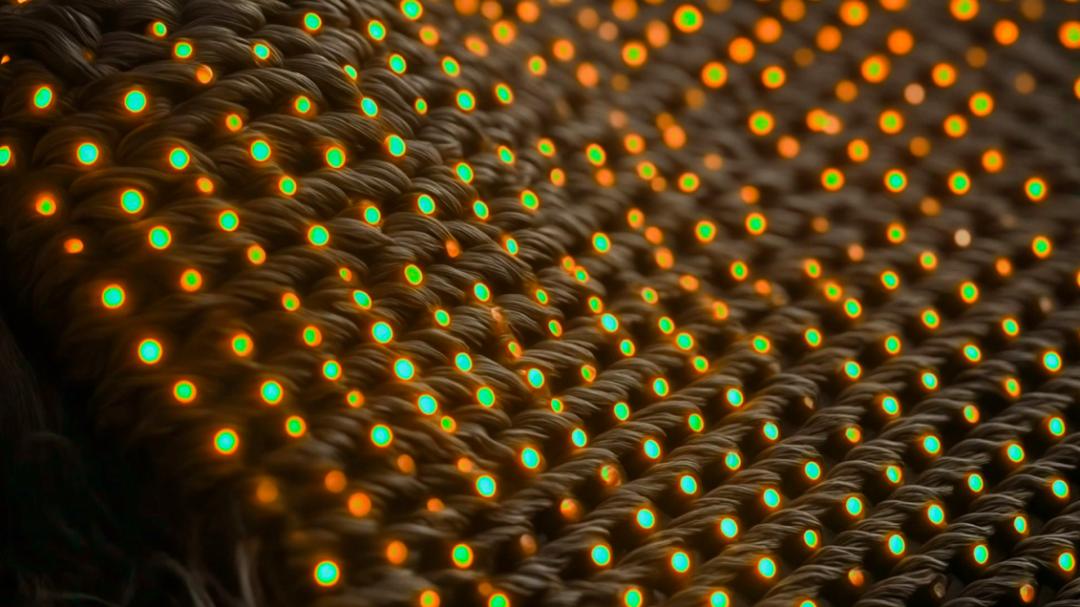
Caption: Fabric is the sensor
The answer points to fabric. Soft, large-area, low-cost replaceable surfaces such as gloves, seats, mattresses and socks are inherently where humans make contact with the world. Weaving sensors into the fabric instead of pasting them on makes it closer to "non-intrusive collection" than any rigid solution.
Different from data factories, what Yaole wants to capture is not standard movements, but the real moments when humans interact with the world, such as grabbing a cup, rolling over in bed, putting on shoes. Each contact contains long-tail variations, muscle habits, soft contact strategies, error correction and environmental feedback. These can only be captured by non-intrusive and continuous recording on the surfaces that humans naturally touch.
This judgment was soon verified by the market. The first customer to reach out was iFlytek, for a pressure sore prevention mattress for elderly care. The order was not large, but it proved that real scenarios do require this kind of large-area, non-intrusive and sustainable physical interaction data.
In 2018, automotive orders pushed product requirements to the limit: door panel touch control and seat pressure sensing. Vehicle-grade standards for reliability, durability and consistency far exceed consumer-grade requirements. The first-generation solution passed vehicle-grade tests in 2019, the seat solution passed vehicle-grade certification again in 2022, and in 2025, Yaole became the core supplier of the smart seat pressure solution for a leading luxury carmaker, completing mass production delivery, and securing designated projects from multiple top automakers.
In the eyes of investors, this is more convincing than any demo. The vehicle-grade certification process usually takes more than three years, with dozens or even hundreds of tests for extreme temperature, vibration, electromagnetic interference and other factors, before a product can be qualified as "industrial-grade". Yaole takes this capability as the foundation that can be downward compatible with all scenarios.
"Entering the automotive sector is essentially to refine the technology to the highest standard, and then extend the capability to other scenarios," Lv Liyun set this strategy from the very beginning. When the embodied intelligence wave came, the capabilities polished by vehicle-grade requirements were almost fully transferred: high-density deployment in limited space, resistance to repeated mechanical fatigue, millisecond-level response and high consistency, all based on the same underlying physical interaction logic.
"Having a mass production track record in high-standard industries is the core basis for investors to judge whether a tactile company is worth investing in this year," said Cao Jishan, founding partner of Yundao Capital. "There are many companies in the tactile track now, but most of them are still in the 'handmade' delivery stage, far from achieving stable mass production. When we evaluate projects, what we care most about is no longer the paper parameters or how cool the demo is, but whether the company has truly secured designated projects or even achieved mass delivery in industries with complete verification systems and mature supply chain thresholds such as the automotive industry. What the world model needs is not one-off samples, but scalable, reusable data production capacity."
Embodied Intelligence is Only the Entry Point, the World Model is the End Goal
In 2026, Yaole Technology's orders are expected to increase 10 times, and nearly half of the increment comes from embodied intelligence. But if this growth is only interpreted as "sensor shipment volume", the core value of the company will be underestimated.
A large number of clients related to robots and world models have reached out, behind which is the emerging industry consensus: no matter how dexterous the dexterous hand is, without real physical interaction data, fine manipulation cannot pass the threshold. Vision can see the position, but cannot perceive force, sliding and contact results; simulation can supplement some samples, but cannot eliminate the gap between virtual and reality. Physical interaction data is changing from an optional "extra" to a mandatory requirement that determines whether embodied intelligence can be implemented.
This is exactly where Yaole's product value lies. It weaves the sensor network into surfaces that humans naturally touch, such as gloves, clothing and seats, covering key parts including palms, torso and soles of feet, to capture force, posture and feedback in real time. Lightweight, foldable and fatigue-resistant — these characteristics that rigid sensors do not have are the premise of non-intrusive entry into real scenarios and continuous acquisition of high-quality physical data.
This year, the team has focused on data gloves. This smart fabric, which looks no different from ordinary gloves but can accurately perceive pressure changes, is expected to be launched in August this year. Its long-term positioning is a consumable collection terminal: the more widely the terminals are deployed, the denser the data network will be.
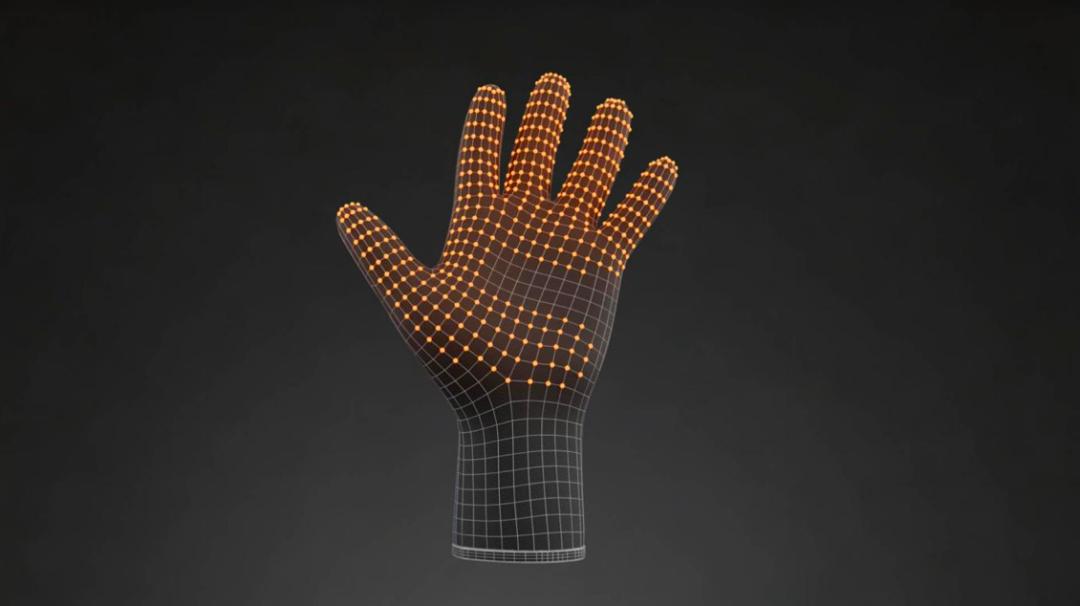
Yaole Technology — Schematic diagram of the sensor point distribution of data gloves
At present, Yaole has reached cooperation with leading robot enterprises, consumer wearable manufacturers and other partners, and has built a self-owned factory of about 7,500 square meters in Jiaxing, realizing the full process from yarn to sensor network. The value of the self-owned production line lies not only in the scale, but also in the full control of every process link.
If you only look at the hardware, what Yaole Technology makes is sensors. But from a long-term perspective, the end goal of this company is actually a tactile data platform.
Fabric sensor networks such as gloves, seat cushions, insoles, seats and mattresses are collecting data on human interaction with the physical world all the time. Hardware revenue can support cash flow and scenario verification; when the collection volume is large enough, the value of data will far exceed the hardware itself. Whether this business model can succeed depends on two prerequisites: the sensors must be cheap enough to be widely deployed, and the data must be sufficiently standardized to be called for use.
Fabric has structural advantages in terms of cost. With textile-grade large-scale equipment and processes, and industrial-grade reliability forged by vehicle-grade standards, its cost structure is closer to consumable textiles. For investors, this means that data production capacity can expand synchronously with terminal shipments, instead of being constrained by high-cost hardware.
In terms of standardization, the industry is still in the early stage. Lv Liyun observed that clients' concerns have shifted — from "whether there is tactile hardware" to "whether there is training-ready data". The core of the next stage is to convert continuous, unstructured tactile signals into annotatable, callable and trainable data assets through calibration, cleaning, segmentation, labeling systems and API interfaces. Whoever first turns this paradigm into standard supply will get the next admission ticket.
Then, where is Yaole's moat?
The answer does not lie in a single material, but in the superposition of system capabilities: materials, processes, mass production, calibration, algorithms — the coupled system formed by ten years of trial and error cannot be replicated by simply disassembling a few samples.
"It is very difficult to replicate the technology just by disassembling the product; it takes more than a year to reach a stable state," said Lv Liyun. The company's short-term moat comes from deep industrial chain layout and first-mover advantage; the long-term moat lies in who first forms the data flywheel. The wider the hardware is deployed, the more data flows back, the more the model relies on this supply, and the more willing customers are to pay for it. Once this closed loop is realized, the entry point of physical interaction data will be basically locked.
At present, the technical routes are far from converging. This is both a risk and an opportunity for investors: the risk is uncertainty; the opportunity is that the market ceiling is high enough, and the players who first achieve mass production, scenario coverage and data standardization will have the opportunity to participate in defining the training paradigm of the next generation of Physical AI.
Xiaomi, Ecovacs, Dinghe Gaoda, All Betting on the Same End Goal
Yaole's financing pace is not fast, but each round is at the node of industry cognitive upgrading.
In December 2022, the exclusive angel round from Xiaomi opened the first door. At that time, the company had just passed the vehicle-grade test, and the mass production orders had not yet been fulfilled. Xiaomi was intensively deploying in the upstream and downstream of the automotive industry at that time, and this investment in a new physical interaction solution that "passed vehicle-grade certification and had not yet achieved mass production" was more like a forward-looking strategic layout.
The nearly 100 million yuan Pre-A round at the end of 2025 was led by Yinfeng Lanxiu Fund (in which Ecovacs holds shares), with Silicon Harbor Capital and Chuhui Capital participating as followers. The funds are mainly used for technology iteration, overseas expansion and large-scale mass production.
At that time, Yaole had secured designated projects from multiple top automakers in the smart cockpit sector and achieved large-scale deployment; at the same time, the wave of embodied intelligence and world models emerged, and the industry began to realize that tactile sense is not an optional feature, but an essential modality for robots to interact with the physical world.
The entry of Yinfeng Fund, which is backed by Ecovacs, is particularly critical. Backed by the leading sweeping robot brand, Yinfeng values the transfer of vehicle-grade capabilities to robot scenarios, as well as the prospects of physical interaction data in robot applications. Lv Liyun said: "They invested in us first because the vehicle-grade capabilities will be more solid when applied to robots. Secondly, they are optimistic about the application prospects of robots."
The latest round, led by Dinghe Gaoda with Changshu Automotive Trim and Zulong Entertainment participating as followers, complements the resource map of smart cockpit, overseas deployment and future mobility.
Wang Ying, Managing Partner of Dinghe Gaoda, said that its portfolio companies including Hesai, Momenta and 6D Tech are all oriented to the same proposition: to enable machines to better perceive, predict and interact with the physical world, and Yaole is exactly one of them.
Luo Xifang, Executive Deputy General Manager and Board Secretary of Changshu Automotive Trim, also said that OCS (Occupant Classification System) has gradually become a rigid demand for overseas OEMs. Changshu Automotive Trim hopes to promote China's vehicle-grade mass production solutions to overseas markets, and will give full play to its overseas customer resources to fully support Yaole's overseas business expansion.
Li Yi, CFO of Zulong Entertainment, is more firmly optimistic about the huge value of Yaole as the tactile data infrastructure, betting that Chinese enterprises are relying on their ultimate engineering capabilities and rich scenario density in the new round of AI technological innovation, starting from the underlying infrastructure, to achieve a unique "Chinese speed" in the global Physical AI competition.
Cao Jishan, founding partner of Yundao Capital, judged that the track is still in the early stage and the routes have not converged, but the screening criteria are clear — whether the scenario verification is solid, whether mass production and cost can be scaled, and whether standardized physical interaction data can be accumulated on top of the hardware. Yaole's moat does not lie in a single material, but in system capabilities; Yundao is not betting on short-term concepts, but on a company that turns "fabric weaving" into the data infrastructure required by world models and Physical AI.
Looking back at the three financing rounds, Yaole's investor structure presents a clear hierarchy of "industrial capital + hard technology fund + intelligent manufacturing and mobility resources": Xiaomi values the scarcity of vehicle-grade capabilities, the Ecovacs-backed fund focuses on the irreplaceability of tactile perception in robot scenarios, and the lead investor Dinghe Gaoda complements overseas connection and industrial synergy resources.
The three financing rounds also clearly outline Yaole's development path — from vehicle-grade verification to mass production deployment, and then to the window of embodied intelligence and data infrastructure. Every step is at the node of industry cognitive upgrading. Multiple industrial capitals have made successive bets, pointing to the same end goal: the data entry point of the physical world. When robots begin to perceive the world like humans, all interaction data will flow back through tactile surfaces. Whoever masters this entry point will get the next ticket to the future.
This article is from the WeChat official account "ChinaVenture", Author: Zan Zhu, published with authorization from 36Kr.