A single sentence allows AI to create an inference engine that is 6.3 times faster. Jia Yangqing left NVIDIA and officially announced his second entrepreneurial venture: AI Infra is evolving from "managing computing power" to "building systems".
A month ago, we covered the story of Yangqing Jia leaving NVIDIA.
At that time, external speculation was that he would most likely return to the GPU cloud track.
After all, from Alibaba Cloud to LeptonAI, then to NVIDIA DGX Cloud, Yangqing Jia has been working on infrastructure issues such as computing power scheduling, multi-cloud deployment and GPU utilization for the past few years. In early June, GPU cloud service provider Hyperbolic hired him as a consultant, whose business direction almost seamlessly continued the old path of LeptonAI.
But now, the real answer has come to light.
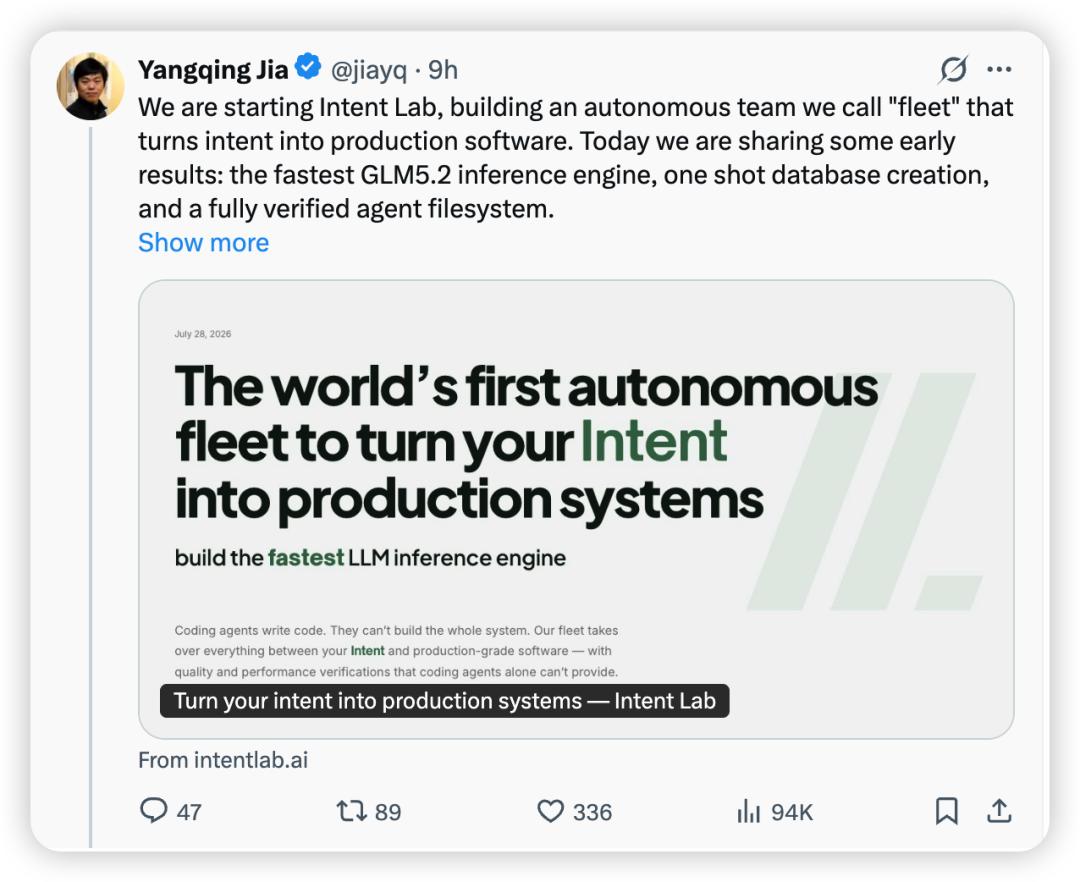
Yangqing Jia, together with veteran open source practitioners including Junjie Bai, Xiang L. and Casber Wang, has officially founded a new company Intent Lab. This time, he did not continue to build a GPU cloud platform, nor did he simply retread the old path of AI Infra, but tried to solve a higher-level problem:
When models are getting better and better at writing code, what exactly is the missing step for AI to truly independently develop a production-grade software?
Along with the official announcement, the first batch of achievements of Intent Lab were also unveiled:
1) A GLM-5.2 inference engine that increases the output speed from 102 tokens/s to 647 tokens/s on two Grace Blackwell nodes, representing a 6.3x performance boost;
2) A database engine that starts from a vague requirement and finally passes 6 million SQLite compatibility tests;
3) A distributed file system with formal verification that can catch data corruption bugs in code generated by ordinary coding agents.
From the inference engine to the database, and then to the agent file system, all are low-level tools that seem unrelated on the surface. In fact, what Yangqing Jia really wants to demonstrate is the capability of the same underlying system, Fleet.
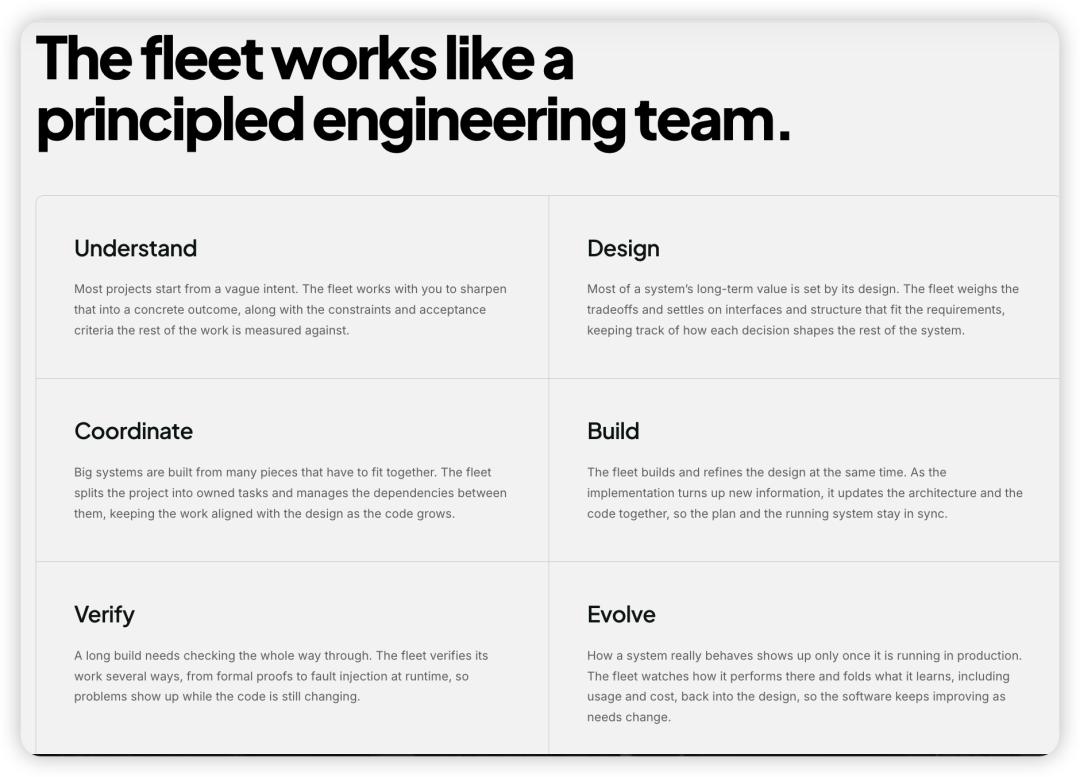
Yangqing Jia defines Fleet as "the world's first autonomous team that turns intentions into production-grade software". That means users no longer give AI a command like "write a piece of code", but put forward a higher-level goal, which is then fully handled by a group of agents to complete understanding, design, coding, verification and subsequent evolution independently.
This also makes Yangqing Jia's new round of entrepreneurship far more noteworthy for the industry than the event of "AI guru leaving NVIDIA".
The underlying proposition of AI Infra has changed
Over the past decade, Yangqing Jia has worked on Caffe, ONNX and PyTorch 1.0, and is widely recognized as the founding father of the previous generation of AI frameworks; he also participated in the construction of large-scale AI infrastructure at Alibaba and NVIDIA. At LeptonAI, he tried to lower the threshold for developers to use GPUs and deploy models.
Now at Intent Lab, his goal is to enable AI to directly build deliverable foundational software.
Behind this is essentially a re-evaluation of the value of AI Infra that is taking place.
As we discussed in our previous report, the proposition of lowering the threshold for developers to use and manage GPU clusters seemed like a problem worth spending hundreds of millions of dollars to solve back in 2023. But today, the solutions and barriers to this problem have loosened.
Agentic Coding tools represented by Cursor, Claude Code and Codex are reshaping the underlying logic of software development. Developers can already describe requirements in natural language, and AI agents will automatically generate, debug and deploy complete infrastructure code.
This also means that the complexity that traditional AI Infra tries to encapsulate in a productized way is being directly bypassed by Agentic Coding through code generation.
Those platform tools that only focus on "making engineering work easier" are facing systematic challenges of being replaced by a combination of open source components and agents. This is also the objective background that led to a series of issues including DGX Lepton failing to meet Jensen Huang's expectations and unfulfilled open source commitments.
Therefore, the core question for entrepreneurship in the AI Infra sector has become: Are you solving superficial complexity, or underlying scarcity?
Yangqing Jia gave his answer with Intent Lab. He stated very plainly in the official announcement post:
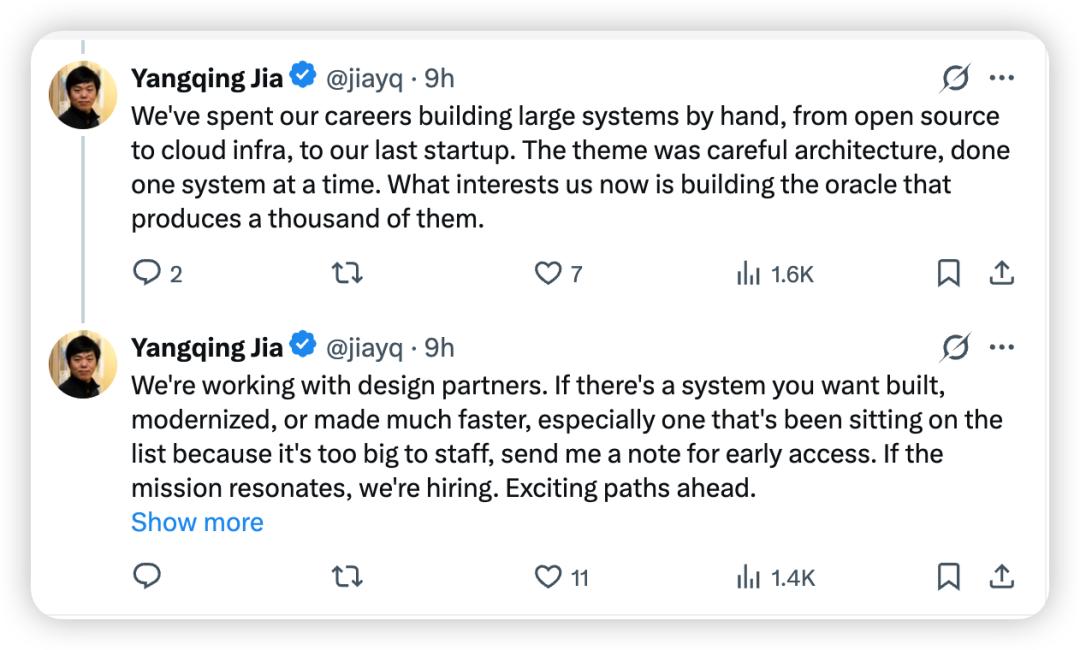
"We have spent our entire careers working on the world's largest distributed systems and AI infrastructures, focusing on careful architectural design, building one system at a time. But now we are more interested in building a system that can produce a thousand systems at a time."
Instead of building middleware that wraps complexity, they are building "a system that can produce a thousand systems". This is the underlying logic behind his new round of entrepreneurship.
It is not about AI writing code, but about creating an engineering team
The core product of Intent Lab is called Fleet. Positionally, it is not a faster code completion tool, nor a new IDE plugin, but a team of autonomous agents for production systems.
What is the difference between them?
Most current coding agents solve the "code generation" problem. Users give a prompt, and the AI writes a function, fixes a bug, adds a set of tests, or even completes a small feature. This is already very valuable, but it is still far from real software engineering.
Real engineering does not end when the code is written. It requires understanding requirements, splitting goals, designing architectures, defining interfaces, balancing performance and costs before moving on to coding, testing, review, verification and launch. After launch, it is also necessary to monitor the running status, and continue to modify and evolve the system according to real workloads.
Intent Lab wants to hand over this entire chain to AI.
Fleet is designed to start from a rough human intention, end-to-end complete the design, implementation and verification, and continuously evolve in the production environment. It does not automate a single action of human engineers, but tries to reproduce the complete collaborative workflow of a reliable engineering team.
This is why the first batch of demonstrations from Intent Lab are not a chat app or a website demo, but inference engines, databases and file systems.
All of these items have one thing in common: they are not "good enough to run" application-layer software, but system software with extremely high requirements for performance, reliability, compatibility and correctness.
The GLM-5.2 inference engine case in particular is a good example to demonstrate the capability boundary of Fleet.
The initial goal given to Fleet was just a high-level intention: optimize TensorRT-LLM to make GLM-5.2 run faster on Grace Blackwell nodes, and let the agent identify optimization spaces, implement them and verify the results on its own.
Note that this is not writing a toy inference service from scratch, but squeezing more performance on top of NVIDIA's already highly optimized TensorRT-LLM stack. In other words, Fleet is not facing the challenge of "low-level code generation", but hardcore system optimization.
Finally, it delivered four types of optimizations.
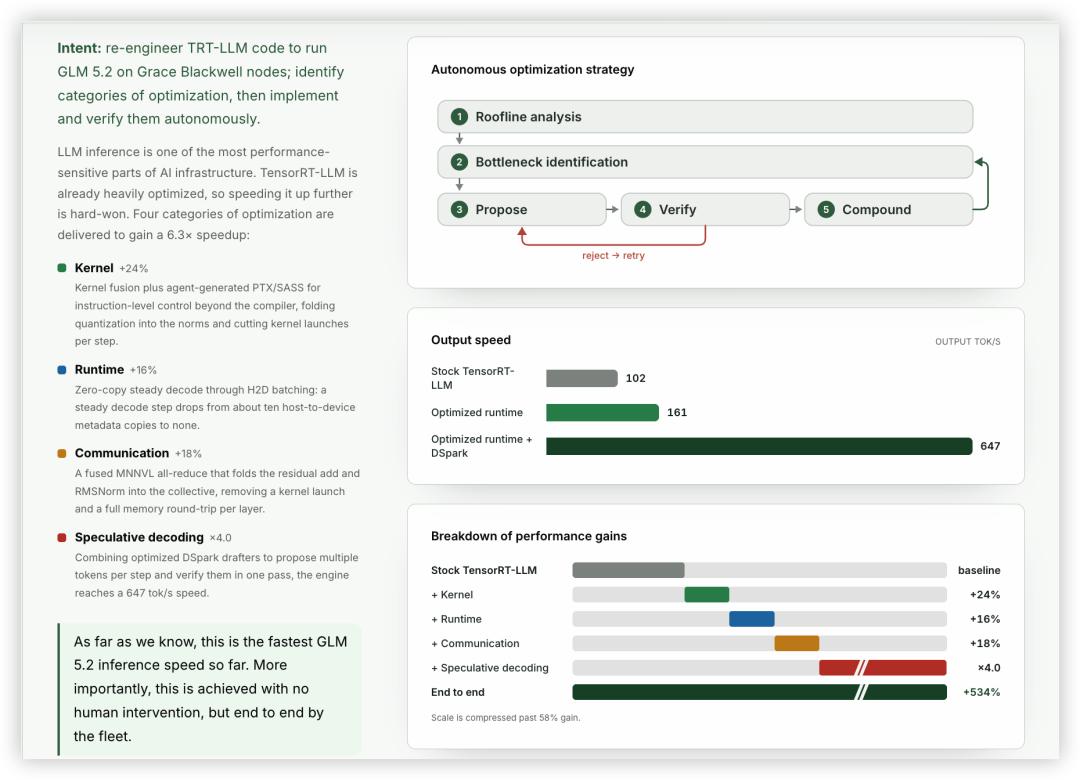
Kernel layer optimization: Through kernel fusion, and direct generation of PTX and SASS, the agent bypasses the normal compiler path to achieve more fine-grained instruction-level control.
Runtime optimization: Through H2D batching, the metadata copy from CPU to GPU during the stable decode phase is greatly reduced, cutting unnecessary scheduling overhead.
Communication optimization: Residual add and RMSNorm are folded into the fused all-reduce operation, reducing per-layer kernel launch and memory round trips.
Speculative decoding optimization: Combined with a better drafter, the model proposes multiple tokens at once, which are then verified in batches by the large model, significantly improving output throughput.
The end result is that the output speed of GLM-5.2 increased from 102 tokens/s to 647 tokens/s, delivering a 6.3x performance boost.
But what is more noteworthy is Fleet's working mode. It does not rely on humans to pre-write all optimization rules. Instead, just like a system engineering team, it first conducts bottleneck analysis, then proposes solutions, implements them, and verifies the results, rolls back if it fails, and continues to look for the next bottleneck after success.
This is hardly like an ordinary coding agent, but more like an automated system engineering loop.
Why databases and file systems?
If the GLM-5.2 inference engine demonstrates performance optimization capabilities, the database and file system demonstrate another type of capability: correctness of complex systems.
The second case demonstrated by Intent Lab is generating a database engine with a single sentence, which finally passes 6 million SQLite compatibility tests.
It should be noted that databases are not ordinary business code. They not only need to execute SQL, but also handle query semantics, storage structures, transaction behaviors, edge cases and compatibility issues. Many bugs will not be exposed in simple tests, but emerge gradually in complex statements, abnormal inputs, concurrent states and historical compatibility scenarios.
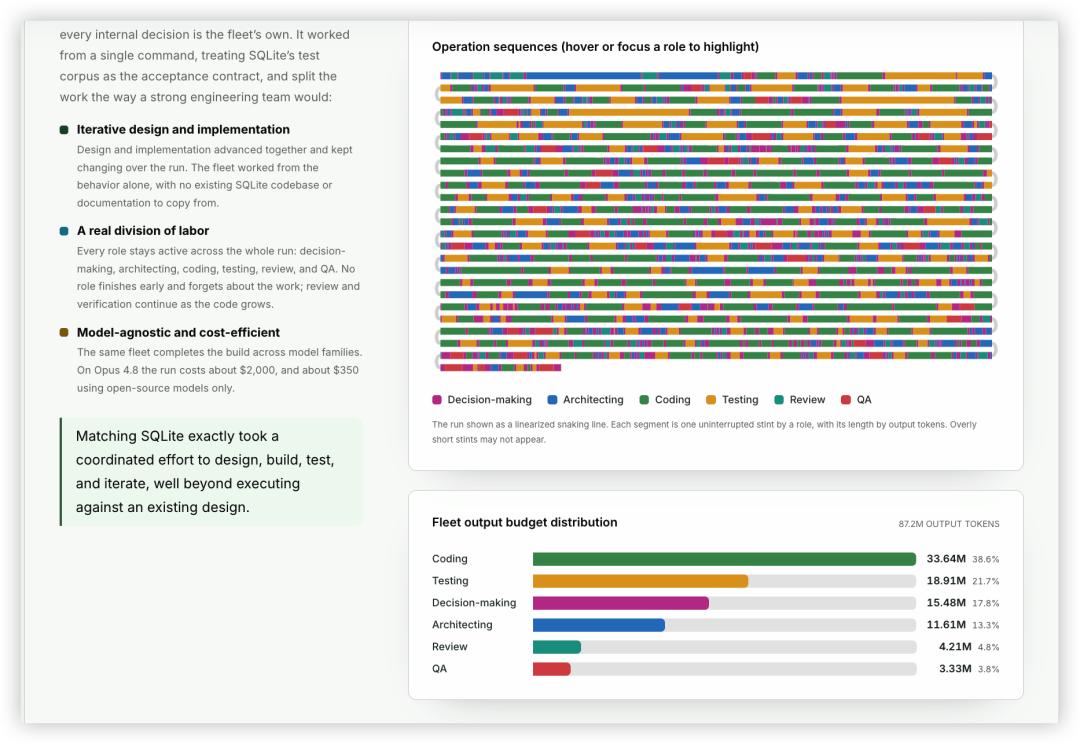
If an agent only writes a database that "appears to run", there is nothing special about that. The real difficulty is whether it can put itself into a strict testing system, make rounds of corrections, until its behavior meets the requirements of a real production system.
The third case is AgentFS, a file system specifically built for AI agents, whose difficulty lies in direct state management.
Why build a new file system from scratch? Because when agents run in the cloud, they constantly start sandboxes, scan directories, and read and write a large number of small files, which are often stored on shared cloud storage. Traditional solutions such as Amazon EFS and S3FS work, but they are not suitable for this high-frequency, small-file, high-concurrency agent workload. The challenge is that they must maintain consistency and recoverability as much as possible under various edge cases.
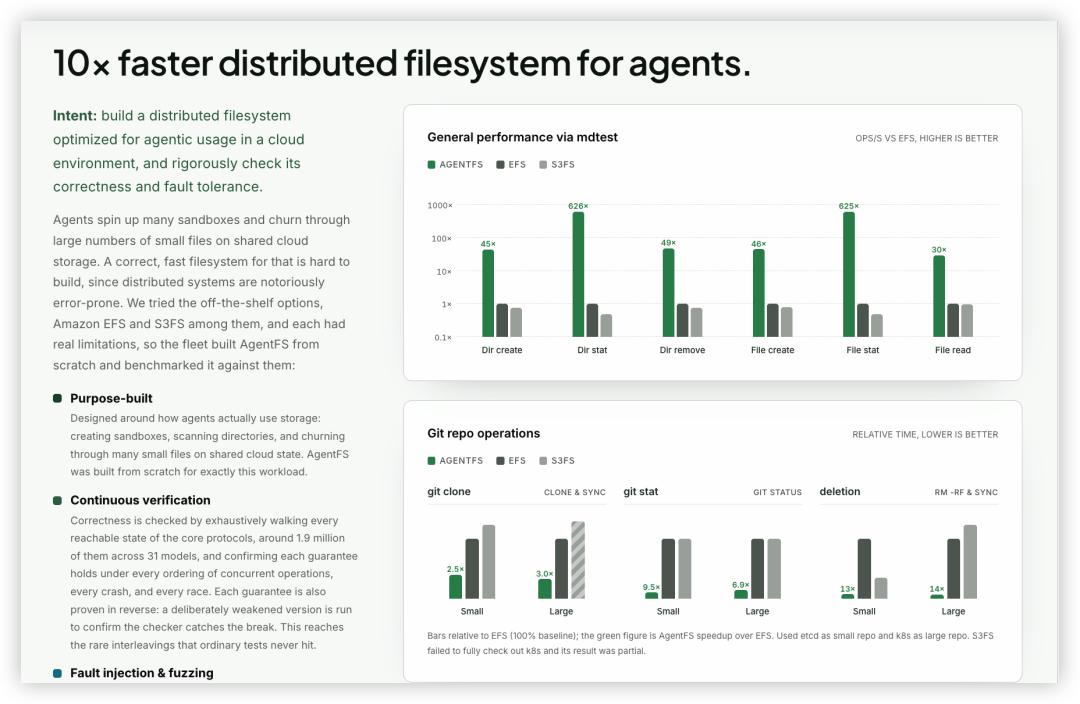
So Fleet built AgentFS from scratch. The results show that in basic operations such as directory creation, file creation and file reading, AgentFS delivers tens to hundreds of times of performance improvement compared with EFS, with some indicators exceeding 600x; in Git repository operations, tasks such as clone, status check and deletion synchronization are also 2.5 to 14 times faster.
More critically, Fleet does not just write out the code, it also verifies its reliability. It conducted formal verification of about 1.9 million states for the core protocol, combined with 300 integration tests, fault injection and fuzz testing to cover extreme scenarios such as crashes, concurrency and race conditions. During the process, it also identified and fixed a data corruption bug caused by coding agents when creating and deleting files in a distributed manner.
This case shows that the value of Fleet is not just "being able to write code", but being able to redesign the system around real workloads, and make both performance and correctness verifiable.
This is also the biggest dividing line for current Agentic Coding.
Over the past year, AI's code writing capabilities have improved very rapidly. But many teams have found in real use that there is still a clear gap between the "demonstration effect" and "production value" of coding agents. They can quickly write a version and quickly fix a bug, but when the system becomes more complex, with more states, longer dependencies and higher error costs, they can easily turn from "efficiency tools" into "risk sources".
What Intent Lab is trying to fill is exactly this gap, and shift the main body that uses infrastructure from humans to agents.
The new watershed of AI Infra
Connecting Yangqing Jia's path over the past few years, we can see a clear main line: he has been lowering the threshold for others to access computing power and systems.
Caffe brought deep learning out of the lab, PyTorch turned models into production infrastructure, and Lepton AI made GPU clusters easier to use. Now at Intent Lab, he is trying to turn the act of "building a production-grade system" itself from a craft skill into something automated.
This essentially means that the value of AI Infra is being re-evaluated. In the past, the most valuable assets of Infra were "resources and encapsulation", but with the rise of Agentic Coding, part of the value of encapsulating complexity is being consumed by AI itself. What has truly become scarce is the deep system capability that enables AI to understand vague intentions, break down architectural designs, continuously verify and discover hidden bugs.
In short, the competition of AI Infra is shifting from "helping humans manage infrastructure" to "making AI the builder of infrastructure".
Yangqing Jia is betting on the latter this time. If this direction succeeds, the future form of software may become more fragmented and more specialized. Because the essence of software is to turn intentions into machine-executable rules, which used to require layers of translation, but the Infra layer is trying to deconstruct this layer of translation.
This article is from the WeChat official account "AI Front" (ID: ai-front