Both demographic vitality and economic prosperity are thriving! Dongguan has firmly secured its position as the third most influential city in Guangdong Province.
01
Dongguan: A Surge in Popularity and Economic Strength
Dongguan, which experienced a brief two-year downturn, has ushered in all-round vigorous development.
Take population for example: its population growth ranked second nationwide last year, only after Shenzhen.
In 2025, the permanent resident population of Dongguan rose to 10.8004 million, with an increment of 229,600, making it one of only two cities nationwide with a population increment exceeding 200,000.
Take the performance in the capital market for example: its market value growth ranked second nationwide.
According to the sorting results of 21st Century Business Herald, in the ranking of market value growth of trillion-yuan GDP cities in the first half of this year, the top 10 cities by total market value growth of listed companies are Wuhan, Dongguan, Suzhou, Wuxi, Yantai, Nantong, Shanghai, Tianjin, Chengdu and Shenzhen respectively.
In the first half of the year, the total market value of 64 A-share listed companies in Dongguan exceeded 1.4 trillion yuan, with a growth rate of 76.25%, ranking second only to Wuhan's 80.99%.
Take GDP as another example.
From 2023 to 2024, Dongguan fell into a development downturn.
From the first half of 2023, the first three quarters to the whole year, Dongguan's GDP growth rate ranked last among cities of the same tier.
The reasons lie in industry and exports.
In 2023, the city's industrial added value above designated size was 517.1 billion yuan, down 1.9% year on year. The total export volume was 846.09 billion yuan, down 8.9% year on year.
However, Dongguan quickly got out of the trough in 2024, but had not fully recovered yet.
It gradually recovered in 2024 and 2025, but the growth rate was still lower than the national average, until it officially stepped out of the downturn this year.
In the first quarter of this year, Dongguan's GDP growth rate was 5%, equal to the national average. Dongguan has completely got rid of the downturn cycle and recovered from the transformation of old and new growth drivers.
In the first half of this year, Dongguan's GDP reached 642.729 billion yuan, with an actual GDP growth rate of 5.1%, 0.4 percentage points higher than the national average.
02
Dongguan: Firmly Securing the Title of the Third Largest City in Guangdong
Over the past four years, Dongguan and Foshan have taken turns to face development downturn.
In 2023, Dongguan's GDP growth rate ranked last among trillion-yuan GDP cities, and recovered in the following two years, while Foshan has seen its growth rate continuously rank last among trillion-yuan GDP cities since 2024, and even recorded negative GDP growth for several months.
When both cities were in a downturn, Dongguan's growth rate was higher than Foshan's, and the GDP gap between the two cities narrowed to 39.715 billion yuan last year.
Most importantly, Foshan has not recovered yet. In the first quarter of this year, Foshan's GDP was 292.314 billion yuan, down 2.4% year on year at constant prices.
The actual growth rate was -2.4%, and the nominal growth rate was -3.91%, with the GDP decreasing by 11.881 billion yuan compared with the first quarter of last year.
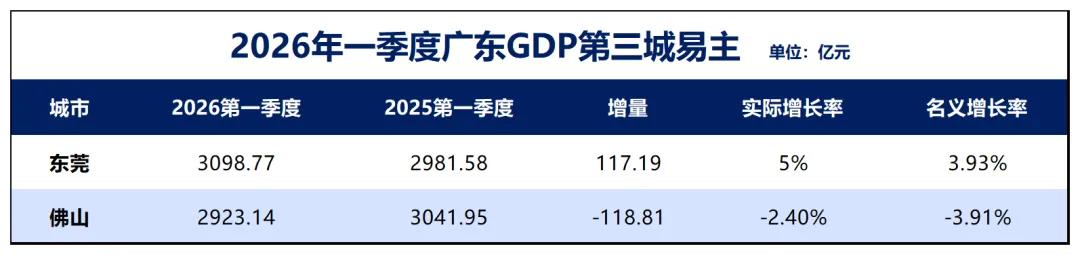
Illustration: City Finance; Data source: Bureau of Statistics of Dongguan and Foshan
This marks another negative GDP growth of Foshan after the first quarter of 2024 and the whole year of 2025.
With one side growing and the other declining, Dongguan overtook Foshan for the first time in history, completing the shift of the position of the third largest city in Guangdong.
In the first half of the year, Dongguan's GDP growth rate has exceeded the national average, while Foshan has not yet released relevant data. Judging from the data of the first 5 months released by Foshan, it is still mired in difficulties for the most part.
From January to May 2026, Foshan's completed fixed asset investment decreased by 40.6% year on year. By district, the growth rates are ranked as follows: Gaoming District (-27.6%), Chancheng District (-33.3%), Shunde District (-33.7%), Nanhai District (-46.5%) and Sanshui District (-57.5%).
From January to May, the investment completed by real estate development enterprises in Foshan decreased by 37.6% year on year; among which residential investment decreased by 34.6%.
From January to May 2026, Foshan's total retail sales of consumer goods reached 169.986 billion yuan, down 0.4% year on year.
Among the three main drivers of economic growth, only exports performed satisfactorily. In the first half of the year, Foshan's total import and export volume reached 257.54 billion yuan, up 10.1% year on year. Among which exports reached 199.66 billion yuan, up 8.8% year on year.
In contrast, Dongguan's major industries are booming, and all three main drivers of economic growth are performing well. In the first half of the year, Dongguan's industrial added value above designated size increased by 6.9% year on year, among which the added value of the leading electronic information manufacturing industry increased by 8.4% year on year.
In addition, the added value of electrical machinery and equipment manufacturing industry increased by 11.3% year on year. New kinetic energy industries are growing well: the added value of advanced manufacturing and high-tech manufacturing increased by 7.4% and 9.4% year on year respectively, 0.5 percentage points and 2.5 percentage points faster than the overall growth rate of industrial added value above designated size respectively. In terms of product output, the output of high-tech products has achieved rapid growth: the output of integrated circuits, industrial robots and mobile phones increased by 37.0%, 35.0% and 17.7% year on year respectively.
In terms of the three main drivers of growth: In the first half of the year, Dongguan's fixed asset investment increased by 7.3% year on year; excluding real estate development investment, the city's fixed asset investment increased by 14.4% year on year. In the first half of the year, the city's total retail sales of consumer goods reached 222.673 billion yuan, up 1.4% year on year. In the first half of the year, Dongguan's total import and export volume reached 815.2 billion yuan, up 8.82% year on year; among which exports reached 490 billion yuan, up 7.47% year on year.
This means that Dongguan's full-year GDP will overtake Foshan in 2026, and it is a certainty that Dongguan will officially become the third largest city in Guangdong.
03
How Did Dongguan Achieve This
The key question is, how did Dongguan achieve rapid economic recovery and rank second nationwide in population growth?
Regarding population growth, we have made a special analysis before, and the main reasons lie in its rich industrial structure and low living cost.
In terms of industrial structure, as the "World Factory", Dongguan's industrial strength ranks among the top 10 nationwide.
Factories are spread all across the city.
Dongguan has 220,000 industrial enterprises, and 14,000 industrial enterprises above designated size, second only to Shenzhen (15,000) nationwide and higher than Suzhou (13,500).
Dongguan has formed a manufacturing system covering 34 major industrial categories and more than 60,000 products. It has a 1-trillion-yuan level new-generation electronic information industry, a 500-billion-yuan level electrical machinery and equipment manufacturing industry, and a 100-billion-yuan level new material industry. The cultivation of emerging industries such as semiconductors and integrated circuits, new energy, biomedicine and artificial intelligence has achieved initial results, forming an echelon of "trillion, 100-billion, 10-billion" level industrial pillars with leading enterprises supporting the development and a large number of innovative small and medium-sized enterprises growing vigorously.
At present, the proportion of the secondary industry in Dongguan exceeds 55%, ranking first among all trillion-yuan GDP cities. Calculated by the total output value of industries above designated size, Dongguan ranked 7th nationwide in 2024.
The wool textile industry in Dalang, furniture industry in Houjie, apparel industry in Humen, electronics and hardware industry in Chang'an, and trendy toy industry in Shipai are well-known across the country. Almost every town has its own signature industry.
The rich industrial structure provides abundant and multi-level employment posts.
According to the data from the fifth economic census, among key national cities, Dongguan has 6.788 million employed units (excluding self-employed individuals), with the proportion of employed people in the total population reaching 64.7%, ranking third nationwide, only after Shenzhen and Xiamen.
In addition to the rich jobs provided by diverse industries, low living cost is also a key plus point.
When we analyzed that the population competitiveness of the Pearl River Delta outperforms the Yangtze River Delta before, we emphasized that the relatively lower living cost is one of the most critical factors.
According to the official data released by Dongguan municipal government, there are 405 urban villages spread all across the city.
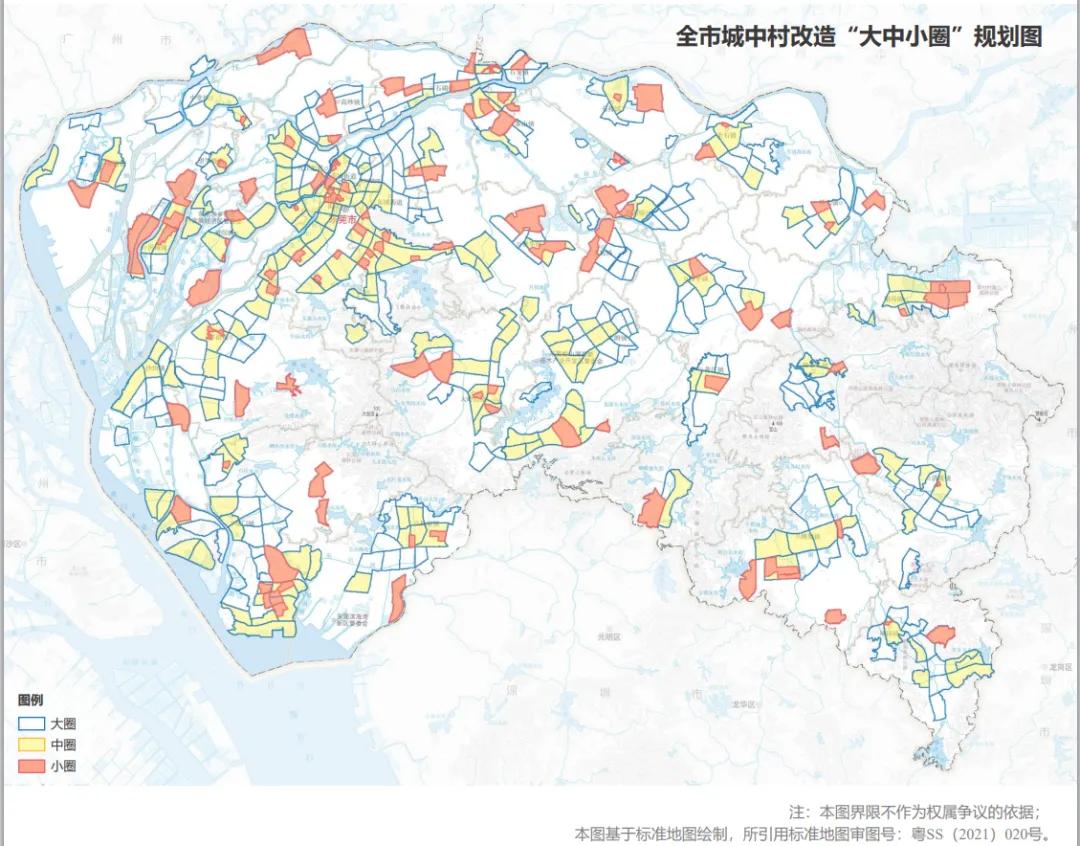
Source: Official website of Dongguan Municipal Government
The Dongguan Municipal Bureau of Housing and Urban-Rural Development once disclosed in 2021 that the rental housing units in urban villages account for 80% of the total rental housing in Dongguan, which can accommodate more than 7 million people.
In the three mega-cities with a population of over 10 million, namely Shenzhen, Guangzhou and Dongguan, most of the residents live in urban villages.
Urban villages provide natural low-cost living spaces. In an era when it is increasingly difficult to make money, the Pearl River Delta, which has a large number of urban villages, undoubtedly has stronger population competitiveness.
How did the economy recover rapidly? The secret lies in rapid industrial upgrading.
The biggest impact Dongguan encountered in the past two years came from the downward cycle of the consumer electronics industry. As one of the world's largest electronic information industrial bases, the slowdown in demand for consumer electronics such as mobile phones and computers directly dragged down Dongguan's industry and exports.
However, Dongguan did not wait for the industry to recover, but quickly completed a round of transformation of old and new growth drivers.
First, traditional industries are upgrading to high-end manufacturing.
Dongguan is no longer just an OEM base for mobile phones and computers, but continuously extends to high value-added links of the industrial chain such as semiconductors, integrated circuits, high-end equipment and smart terminals.
In the first half of this year, Dongguan's output of integrated circuits increased by 37% year on year, the output of industrial robots increased by 35% year on year, the added value of high-tech manufacturing increased by 9.4% year on year, and the added value of advanced manufacturing increased by 7.4% year on year, all significantly faster than the overall growth rate of industries above designated size.
This means that the main engine of Dongguan's growth has gradually shifted from labor-intensive manufacturing to technology-intensive manufacturing.
Second, emerging industries are growing rapidly.
In recent years, Dongguan has focused on deploying strategic emerging industries such as new energy, robots, artificial intelligence and low-altitude economy.
Dongguan's biggest advantage does not lie in a single leading enterprise, but in its globally leading manufacturing supporting capacity.
A large number of precision manufacturing enterprises, core component enterprises and industrial scenarios enable industries such as robots and intelligent equipment to achieve rapid industrialization, which is also an important reason why Dongguan can continuously cultivate new growth points.
Third, the trendy toy industry has completed the upgrading from OEM to independent brand operation.
Nowadays, Dongguan is no longer the traditional "toy factory", but the most complete industrial cluster of the trendy toy industry across the country.
Official data shows that Dongguan has more than 4,000 toy manufacturing enterprises and more than 1,500 upstream and downstream supporting enterprises, making it the largest toy export base in China.
More than one third of the global animation derivatives and about 85% of domestic trendy toys are produced in Dongguan.
More importantly, Dongguan has begun to get rid of the past development model of only earning processing fees.
With the rise of domestic trendy toy brands such as Pop Mart and TOP TOY, and the continuous popularity of phenomenal IPs such as LABUBU, Dongguan's enterprises are extending to high value-added links such as IP design, original development and brand operation.
In the past, what they sold was manufacturing capacity, but now what they sell is IP value.
For this reason, Dongguan has proposed to build a 100-billion-yuan level trendy toy and animation industrial cluster, promoting the trendy toy industry to further upgrade from manufacturing advantages to brand advantages and cultural industry advantages.
This is also the most noteworthy part of Dongguan's industrial upgrading.
The electronic information industry is upgrading to the semiconductor sector, traditional manufacturing is upgrading to intelligent manufacturing, and the toy industry is upgrading to trendy toy IP operation. All old and new industries are developing simultaneously, finally forming a new growth engine.
At the same time, Dongguan has another advantage that is difficult for other manufacturing cities to replicate:
Shenguan focuses on innovation, Dongguan focuses on manufacturing. Shenzhen concentrates on R&D and design, while Dongguan is responsible for large-scale production. The two cities jointly build the most complete and efficient electronic information industrial chain across the country. A new product completes R&D in Shenzhen, and can soon realize mass production in Dongguan. It often only takes a few days from proofing to large-scale production.
This kind of industrial coordination allows Dongguan to receive innovative achievements at the first time, and always stay at the forefront of industrial upgrading. Therefore, this round of rebound in Dongguan is not a simple cyclical recovery, but a revaluation after the optimization of industrial structure.
If Dongguan in 2023 was dragged down by the consumer electronics cycle, then today's Dongguan is relying on the four growth poles of high-end manufacturing, robots, semiconductors and trendy toy IP to regain its growth momentum.
With the explosive growth of population, industry and economy, a world factory that has completed industrial upgrading is re-proving its competitiveness.
This article is from the WeChat official account "City Finance", written by City Finance, authorized for release by 36Kr.