Embodied Intelligence "20-Billion Club": 8 Companies, Attracting Hundreds of Billions in Funding, Betting Big on the Future
Robots haven't really mastered practical work tasks yet, but the valuations of robotics companies have already hit 20 billion yuan.
As of June 2026, 8 domestic embodied AI companies have reached a valuation of 20 billion yuan, known in the industry as the "20 Billion Yuan Club", including Unitree (hereinafter referred to as Unitree), Agibot (hereinafter referred to as Agibot), Galaxy Universal, StarSeas Map, Qianxun Intelligence, Zibianliang Robotics (hereinafter referred to as Zibianliang), Zhipingfang, and Lingxin Qiaoshou.
Among them, Agibot has not officially announced a new round of financing in the primary market, but in March 2026, it became the first domestic embodied AI company with a cumulative output of over 10,000 units. In July, it has launched the process of listing in Hong Kong, and the industry generally estimates that its valuation has exceeded the 20 billion yuan mark.
A year ago, 20 billion yuan was still an unreachable figure for this industry. Now 8 companies have reached this threshold at the same time, and they can be roughly divided into three factions.
One faction, represented by Unitree and Agibot, has taken the lead in closing the loop of "selling hardware" relying on shipment volume and cost control; the other faction, represented by Galaxy Universal, StarSeas Map, Qianxun Intelligence, Zibianliang, and Zhipingfang, bets on the long-term value of the "brain", trading model capabilities and data barriers for future premiums; Lingxin Qiaoshou stands out as its own faction, which does not manufacture robot bodies but only dexterous hands. After the B+ round of financing in April this year, its valuation exceeded 20 billion yuan, and the value of "one dexterous hand" is almost on a par with the valuation of a full humanoid robot.
Even with the same valuation of 20 billion yuan, the market is not paying for the same value. Some investors are betting on next year's shipment volume, some on the future generalization ability of models, and others on the fine manipulation capability of robots.
Next, we will disassemble these 8 companies one by one from four dimensions: valuation logic, data route, implementation scenarios, founding team genes and shareholder background. Although the ranking of each company is different under each dimension, the superposition of the four dimensions can roughly show the most real appearance of this industry at the moment.
01. Three Valuation Logics, You Are Not Paying for the Same Thing
With the same valuation of 20 billion yuan, the valuation logic of the 8 companies can be roughly divided into three categories.
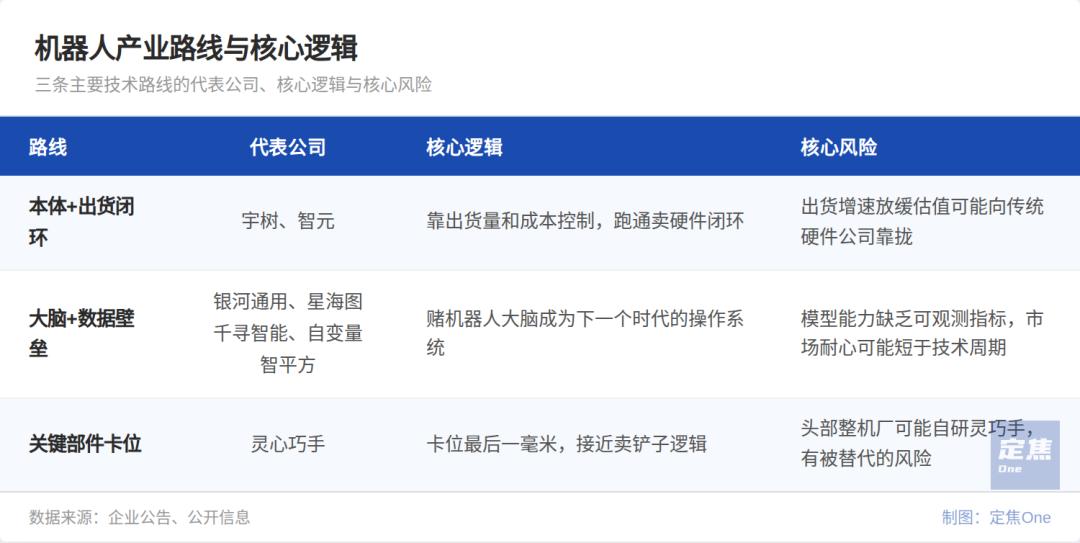
The first category bets on "body + shipment closed loop", represented by Unitree and Agibot. These two are also the only two of the 8 companies that rely on real shipment volume to prove their value. The market's valuation of them mainly focuses on the already proven path of "selling hardware".
According to statistics from Omdia, a global technology market research and consulting agency, based on the caliber of general humanoid robots including wheeled dual-arm models, Agibot shipped 5,168 humanoid robots in 2025, accounting for about 39% of the global market share. Unitree disclosed in its prospectus based on the caliber of pure bipedal humanoid robots that its shipment volume in 2025 was 5,500 units, which is also "the first in the world". The coexistence of the two "firsts" stems from the difference in statistical calibers. In terms of valuation, the two rank top two in the industry, which is beyond doubt.
Financially, Unitree is one of the few profitable companies in this echelon, with revenue of 1.699 billion yuan in 2025 and non-net profit of 590 million yuan. It is also the fastest in the listing process, having passed the IPO registration on the Sci-Tech Innovation Board, with an issuance valuation of about 42 billion yuan. Agibot's revenue is slightly lower, exceeding 1.05 billion yuan in 2025, and it has not disclosed whether it is profitable. At present, it has also launched the process of listing in Hong Kong.
The common point of the two companies is that every penny they earn is supported by real shipment volume and customer orders.
However, this "verifiability" is also a double-edged sword. Once the shipment growth rate slows down, the market may reprice them as hardware companies. The market valuation multiple for hardware companies has a ceiling. For example, FANUC, the world's largest industrial robot manufacturer in terms of cumulative installed capacity, has a highest price-to-sales ratio (PS) of around 10 times. The current PS corresponding to Unitree's IPO issuance valuation is about 24.7 times, and the extra part includes the "track premium of humanoid robots". If the shipment growth rate fails to meet expectations, this premium is likely to be compressed, and the valuation will fall back to the level of traditional hardware companies.
The second category bets on "brain + data barriers", including five companies: Galaxy Universal, StarSeas Map, Qianxun Intelligence, Zibianliang, and Zhipingfang. Their shipment volume is far less than that of Unitree and Agibot, and many are still at the level of hundreds of units, but their financing scale is extremely large.
Galaxy Universal has raised a total of about 7 billion yuan in less than three years, and the National Artificial Intelligence Industry Investment Fund (initiated and established by the National Major Fund Phase III) made its first investment in it; Zhipingfang completed 12 rounds of financing in one year, and one round in June 2026 was nearly 5 billion yuan; Zibianliang completed three rounds of financing in two months, and is the only domestic embodied AI company that has been separately led by four major manufacturers: Meituan, Xiaomi, Alibaba, and ByteDance; StarSeas Map received two consecutive rounds of financing totaling 3 billion yuan in less than two months, and its valuation almost doubled in more than a month; Qianxun Intelligence raised nearly 5 billion yuan through three rounds of financing in more than three months.
For such companies, capital bets on the long-term premium brought by model capabilities and data barriers, betting that the "robot brain" will become the operating system of the next era. But there are also risks: the progress of model capabilities lacks intuitive observation indicators like shipment volume. If the market's patience is shorter than the cycle required for technological breakthroughs, the valuation is likely to face a substantial downward adjustment.
The third category bets on "key components".
Lingxin Qiaoshou is the only one of the 8 companies that does not make robot bodies. Its value lies in its strategic positioning. As long as the humanoid robot track is expanding, no matter which complete machine manufacturer wins in the end, dexterous hands are needed to complete physical interaction actions such as "grasping, holding, and pinching". After completing the B+ round of financing at the end of April, Lingxin Qiaoshou has a valuation of about 3 billion US dollars (exceeding 20 billion yuan), and in May, it was reported that it is seeking a new round of financing with a valuation of 6 billion US dollars, and there are rumors of an IPO in Hong Kong. Its short-term revenue certainty is the highest among the 20 Billion Yuan Club, and the long-term risk is that leading complete machine manufacturers are likely to develop their own dexterous hands.
It is worth mentioning that the boundaries between these three factions are also becoming blurred. Unitree has allocated a large part of its raised funds to invest in the robot "brain". StarSeas Map and Galaxy Universal are developing models while accumulating data by selling hardware, and Lingxin Qiaoshou has built its own data factory to feed back its own dexterous hands.
02. The Battle of Data Routes: Simulation vs. Real Data, Which Is the Optimal Solution?
The underlying capability supporting the valuation of 20 billion yuan is the intelligence level of each company's robot brain, which is determined by data.
On the issue of where data comes from, the 8 companies are first divided into two camps: simulation-oriented and real (world) data-oriented. But it is necessary to explain an industry background first: simulation training + real machine migration has long been the basic process in the field of embodied AI, and almost no company completely does not use simulation data. The only difference is which one is dominant. Simulation data refers to building a virtual scene in a computer and letting the robot practice repeatedly in it; real data is divided into two categories: one is real machine data, which is directly generated by the robot body, including data recorded when humans remotely control the robot (teleoperation) and data of the robot running autonomously in real scenes. The other is body-free data, which does not pass through the robot body. Humans wear wearable devices or hold collection devices such as grippers to demonstrate directly in the real environment, record human movements, and then map them to the robot.
Only Galaxy Universal takes the simulation-oriented route. It initially started with an extreme ratio of 99% synthetic data + 1% real data. As the number of official business implementations increases, the proportion of real data is gradually rising.
In recent years, simulation technology itself has advanced rapidly. Technologies such as more realistic physics engines and domain randomization (adding various random changes in virtual training, such as flickering lights and changing object positions) have continuously improved the migration efficiency from virtual to reality. But the fundamental challenge of this route has not changed: no matter how high the success rate is in the simulation environment, it needs to be re-verified when applied to the real world. Whether this gap can be continuously narrowed is the key to the validity of this route.
The remaining 7 companies all take real data as the absolute main force, but there are three different ways to obtain data.
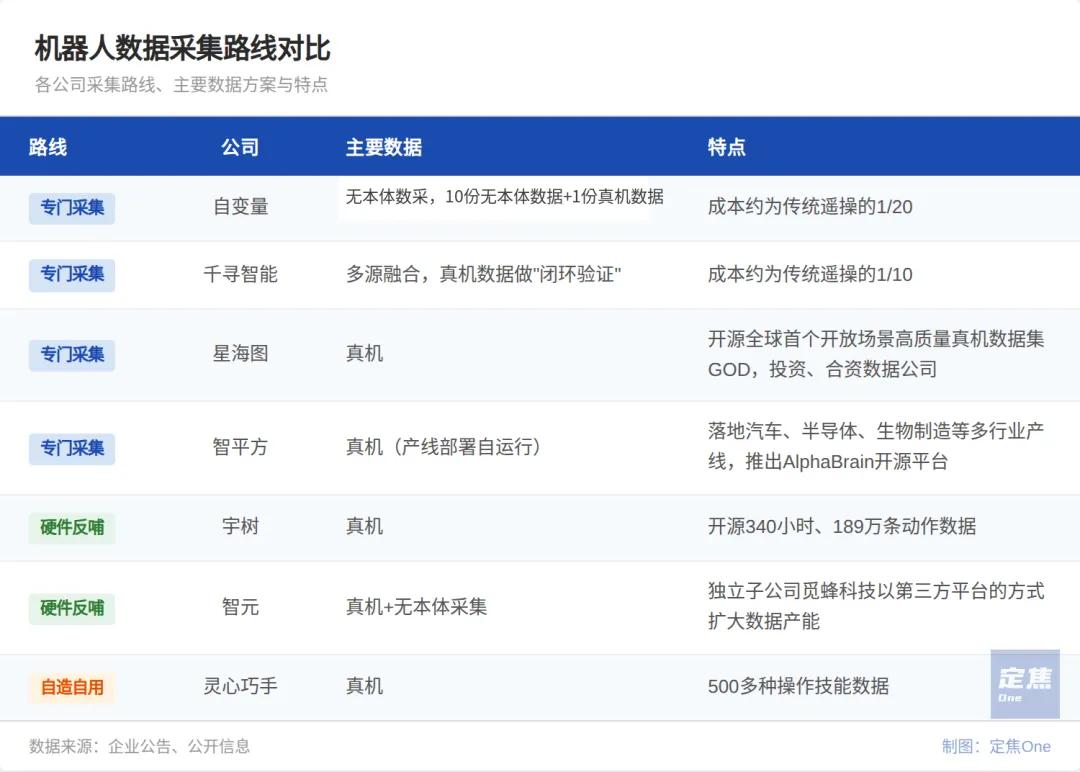
The first category is the dedicated data collection faction, including Zibianliang, Qianxun Intelligence, StarSeas Map, and Zhipingfang, which can be distinguished by the two dimensions of "whether there is a robot body" and "whether the data is for personal use or open source".
Zibianliang takes the body-free cost reduction route. It saves the cost of the robot body, allows people to wear wearable devices to operate in real scenes, and cooperates with the self-developed XRZero series body-free data collection solution. Through the 10:1 mixing ratio of body-free data and real machine data and the complete data pipeline, the cost is reduced to 1/20 of the traditional teleoperation. Its biggest feature is low cost, but the price is accuracy. The robot body is less involved, and the mapping error between data and the real robot model is always a hidden danger.
Qianxun Intelligence takes the multi-source fusion route of the "data pyramid". The bottom layer is a massive amount of human videos from the Internet, combined with simulation, for pre-training to expand volume and diversity; the middle layer is interactive data collected by the self-developed fifth-generation full-body UMI wearable device. When people wear the device to work normally, the movements of arms and fingers are recorded in real time, and the collection cost is reduced to 1/10 of traditional teleoperation; the top layer is high-precision data returned from real machine teleoperation and commercial deployment, for model fine-tuning. But fusion itself will bring new problems: data formats, quality standards, and spatiotemporal alignment from different sources are all challenges, and the cost of distributed management is not low.
StarSeas Map takes the route of real machine accumulation + open source amplification. It regards real machine teleoperation data as core assets for long-term accumulation, and open sourced GOD, the world's first high-quality real machine dataset for open scenarios, covering complex scenarios such as residences and supermarkets. At the same time, it invests in data infrastructure and has laid out companies such as Jianzhi Xinchuang, Data Intelligence, Whale Jump Power, and Yishu Intelligence. Its differentiation mainly lies in scale, using time to accumulate data thickness, and using open source to expand ecosystem influence. The problems are how to control the quality of collected data and whether open source will dilute the data barrier.
Zhipingfang takes the route of self-collection in scenarios + open source for data exchange. Its data is mainly collected by itself in real scenarios, which is officially called the dual closed loop of data and business, and accumulates data through large-scale deployment in production lines such as automobile manufacturing, semiconductors, biotechnology, and public services. Different from StarSeas Map's "open source dataset", it has built AlphaBrain Platform, the world's first one-stop embodied model community, which open sources all model architectures, training frameworks, and evaluation tools. The imaginative space of this ecosystem is that developers train and deploy in their own scenarios based on the platform, which theoretically will precipitate a large amount of real scenario experience to feed back the community. However, this ecosystem is still in a very early stage, and the scale of data return and quality control are both unknowns. Moreover, the official has not promised a data return mechanism at present.
In the final analysis, the real data of the four companies is either cheap but lossy, or large in volume but mixed, and no route is perfect.
The second category is hardware feedback, represented by Unitree and Agibot.
In March 2026, Unitree open sourced UnifoLM-WBT-Dataset, which is the first complete full-body teleoperation real machine dataset publicly open sourced by a leading global humanoid robot manufacturer. The dataset contains 340 hours and 1.89 million motion trajectories, all collected by G1 robots in real home and industrial scenarios. Its core feature is to emphasize "full-body collaboration", recording bipedal walking, dynamic center of gravity adjustment, and fine fingertip manipulation at the same time, and it is fully open source under the Apache 2.0 license.
Agibot is doing the same thing with a broader path. In April 2026, Agibot open sourced the AGIBOT WORLD 2026 dataset, which is collected from the real world and covers multiple scenarios such as commercial spaces, hotels, supermarkets, and homes. At the same time, its independent data platform Mifeng Technology plans to achieve 10 million hours of data production capacity in 2026. It is worth noting that Mifeng Technology not only collects real machine data, but also launched the MEgo series of body-free collection hardware, serving the entire industry, not just feeding back Agibot's own robot hardware.
The common logic of the two is that the more robots are sold, the faster data is accumulated. Unitree relies on the large-scale shipment of G1 to naturally accumulate data through real machine teleoperation, and then feeds back the ecosystem through open source; Agibot not only accumulates data through its own robots, but also expands data production capacity in the form of a third-party platform through Mifeng Technology, walking on two legs. But the key to data quality is whether customers are willing to let robots run in sufficiently diverse real scenarios. If most robots are eventually sold only to university laboratories, even if the data volume is large, the generalization ability will be significantly limited.
The last category is self-production for self-use, represented by Lingxin Qiaoshou.
It does not manufacture complete machines, nor does it wait for others to provide data. Instead, it builds its own "data factory" to produce training data through the system of dexterous hand - data acquisition system - skill library - large model. The official stated that it has accumulated data of more than 500 human operation skills, and has also developed special collection equipment, and the data can be directly used for its own dexterous hands.
At present, data is regarded as the watershed of the robot industry. The above routes have their own advantages and disadvantages: the simulation faction bets whether synthetic data can approximate the real world, and the real data faction bets whether the data quality can cover the cost.
03. Implementation Scenarios: Scientific Research, Production Lines, Homes, The Ceiling Rises Gradually
Data determines how powerful the robot brain can be, but valuation ultimately falls on one question: where can robots work? At present, the commercial scenarios of embodied AI can be roughly divided into three categories, and the 8 companies have different focuses.
