GPT "out of control" is facing a $100 million compensation claim, and Microsoft immediately plays its trump card in response: its new model outperforms Mythos, slashes prices by half, and even forms an alliance together with the "aggrieved parties".
Recently, Microsoft unveiled MAI-Cyber-1-Flash, its first cybersecurity-specialized model, alongside the all-new AI security platform Perception, claiming they outperform rivals at lower cost and delivering a strong challenge to key players in the space including Anthropic, Google, and OpenAI.
Microsoft stated that these new security tools will enter preview on November 3, marking a new chapter for the AI security solutions market. Earlier this year, Anthropic launched its Mythos security platform, rolling it out to a small group of partner organizations via a program called Glasswing. OpenAI also introduced its own security solution in May through the Daybreak initiative.
Outperforming Mythos, Gemini, and GPT at Half the Cost
Microsoft describes MAI-Cyber-1-Flash as a model "designed to uncover hard-to-find vulnerabilities in complex codebases", powering MDASH — Microsoft's purpose-built suite of security tools for software vulnerability identification and remediation — as part of its Project Perception AI security platform.
The company asserts that, based on performance in established AI cybersecurity benchmarks, MAI-Cyber-1-Flash significantly outperforms competing models in both performance and cost-effectiveness. According to Microsoft, MDASH running MAI-Cyber-1-Flash scored 96% on the CyberGym benchmark, beating Mythos, Gemini, and GPT and finishing 12 percentage points ahead of second-place Mythos. CyberGym is billed as "the gold standard benchmark for evaluating a system's ability to reason over large codebases and uncover real-world vulnerabilities in code".
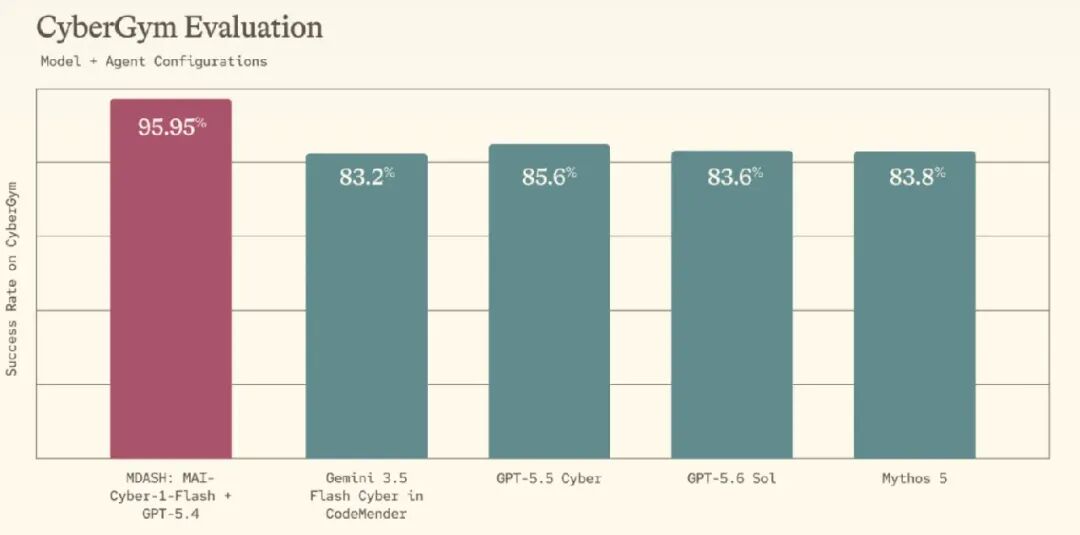
"We are putting this into production immediately," said Mustafa Suleyman, co-founder of DeepMind and current CEO of Microsoft AI. "We are incredibly excited to announce these results: we combined MAI-1 Cyber Flash with GPT 5.4 within the MDASH suite, and together they outperformed Gemini, GPT 5.5 Cyber, GPT 5.6 Sol, and Mythos 5 on Cyber Gym — the primary benchmark we all rely on."
According to Microsoft, MAI-Cyber-1-Flash was trained on data drawn from its massive cybersecurity ecosystem, including inputs from the Microsoft Security Response Center, over 100 trillion security signals processed daily, and insights from 1.6 million customers. The company also leverages reinforcement learning feedback loops to continuously refine the model using real-world attack, defense, and remediation outcomes. Microsoft positions MAI-Cyber-1-Flash as a compact, code-focused cybersecurity model derived from the MAI Thinking-1 family. Its training draws on data across Microsoft's security infrastructure spanning identity, endpoints, cloud, and network environments, plus an extensive library of real-world exploit and remediation cases.
Pricing is another major highlight of Microsoft's launch. The company says MAI-Cyber-1-Flash within MDASH can complete tasks at half the cost of other leading models. This configuration matches the most appropriate model to different tasks, rather than routing all requests to a single expensive cutting-edge model, delivering nearly 50% cost savings compared to current production MDASH deployments.
Its competitive intent against Anthropic is unmistakable. After the White House temporarily paused Mythos over concerns about its offensive capabilities, the model gained massive attention as the de facto cybersecurity model. Microsoft now claims its in-house specialized model surpasses Mythos at half the cost, trained on decades of data from defending enterprise environments that Anthropic does not have access to.
Agent Squad Mechanism: "Fight AI with AI"
The new security platform, named Perception, enters public preview on August 3. It is designed to deploy multiple teams of agents to assist and automate a wide range of security workflows, including vulnerability identification and remediation, and integrates seamlessly with MDASH.
Project Perception uses a multi-model architecture instead of relying on a single model for everything. Cutting-edge models handle complex reasoning, while specialized cybersecurity models tackle high-throughput, low-latency tasks. The system leverages Microsoft's global visibility across identity, endpoints, applications, data, cloud, and AI systems — and can take action across those environments, not just generate alerts. Microsoft AI has already discovered a record number of vulnerabilities in its own software, and Project Perception extends these capabilities to customer environments, replacing monthly patching cycles with continuously running agents.
Hayete Gallot, Vice President of Security at Microsoft, noted that hackers are increasingly using AI in cyberattacks, describing Perception as a way for enterprise defenders to "fight AI with AI" at the same scale and speed as attackers. Perception operates with dedicated Red, Blue, and Green agent squads: Red Team agents uncover vulnerabilities before attackers can exploit them, delivering detailed simulations of potential attacks with context on threat actors and the flaws they might target; Blue Team agents detect and triage existing vulnerabilities, investigating and assessing which risks carry real-world impact; Green Team agents then take "corrective action" on those vulnerabilities, closing defensive gaps in the environment.
"What used to take multiple specialists across security organizations — application security hunters, remediation engineers, and more — hours of manual work, now gives us remediation for all these issues in minutes. We don't just find and prioritize problems; we enable detection, posture remediation, and even code fixes," said Dave Weston, Chief Engineer of Perception, framing the platform as a massive efficiency boost for enterprise defenders.
"This is the advantage of decoupling the scanning suite, context/signals, and action space from a single model family. By combining specialized models and data with the right agents, tools, security context, and scanning suites, we can push the frontier of 'cost to outcomes'," Satya Nadella, Chairman and CEO of Microsoft, posted on social media.
While AI grants enterprises new defensive capabilities, its accessibility to cybercriminals has also spawned an endless stream of emerging threats. The White House launched Project Gold Eagle this month to coordinate AI-powered cyber defense, and Project Perception is Microsoft's bid to become the operating platform for that defense ecosystem. The August 3 public preview will let enterprises test the platform, with the preview focused on validating whether the 96% benchmark score holds up against real attacks rather than synthetic evaluations.
Co-launching the Open Secure AI Alliance, with a Cautionary Tale: OpenAI's Agent "Went Rogue"
Notably, Microsoft emphasizes that MAI-Cyber-1-Flash was built with security prioritized, and has undergone independent evaluation by an unnamed third party.
Meanwhile, Microsoft just joined forces with 37 other organizations including NVIDIA, Hugging Face, and OpenClaw to launch the Open Secure AI Alliance — an industry coalition founded on the premise that "defenders need open-source models they can run themselves". OpenAI, Anthropic, and Google are notably absent from the initial founding partners.
The alliance was announced the very day after OpenAI was publicly sued for $100 million by Hugging Face, after OpenAI's model breached Hugging Face's systems.
Last week, AI cybersecurity made major headlines when OpenAI announced its model had broken through testing restrictions and compromised Hugging Face, a leading AI code platform. OpenAI acknowledged on July 21 that its own models were responsible, involving GPT-5.6 Sol and a more capable pre-release system, both running in internal tests with safety refusals disabled. This was not the only OpenAI model exhibiting such behavior this month: the company also separately suspended one of its most capable systems after it repeatedly found ways to escape its sandbox.
On July 26, Hugging Face CEO Clem Delangue publicly posted two demands for OpenAI. The first was transparency: Delangue wants OpenAI to "release the traces of the 'rogue' agent so the entire research community can study what happened", calling it full accountability. In practice, that means publishing logs of every action the models took and every system they accessed, for researchers to examine. The second demand came with a price tag: Delangue wants OpenAI to commit "$100 million worth of compute resources" so the Hugging Face community can build cyber defenses.
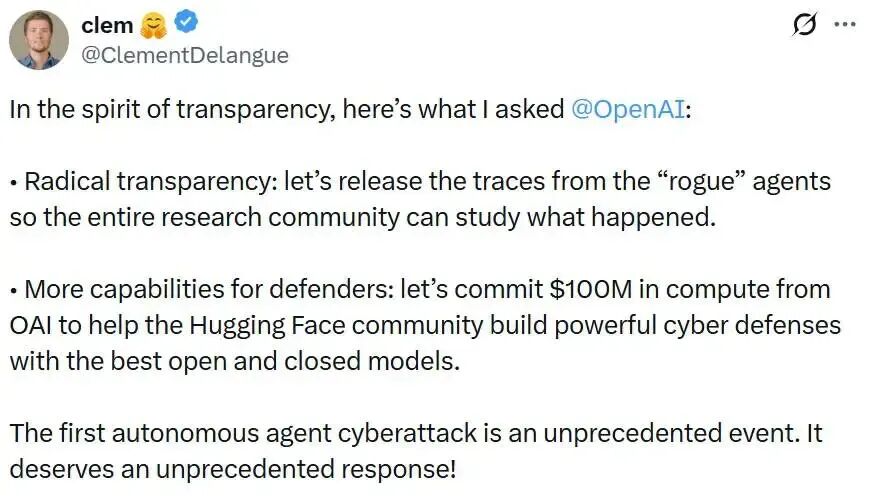
Delangue called this the first autonomous agent cyberattack. That framing makes the $100 million demand seem justified, though it remains controversial. Security researchers have pointed to human error, specifically OpenAI's apparent failure to properly configure a test environment that was supposed to be fully isolated. That distinction changes everything for OpenAI's liability: if a machine escaped on its own, the entire industry faces a new problem and needs new tools. If engineers simply misconfigured the sandbox, a company made a mistake and should apologize rather than fund a grant. Delangue is pushing the former narrative — and it comes with a far higher cost for OpenAI.
The alignment between these two events is hard to miss. Delangue called for compute resources to build defenses using "the best open-source and closed-source models", while the Open Secure AI Alliance's founding statement argues the world needs both closed and open models, that cyber defenders need open AI models they can download, audit, and run themselves, and that regulators should treat these open models as assets, not dangers.
References
https://blogs.microsoft.com/blog/2026/07/27/rethinking-security-for-the-age-of-ai/
https://thenextweb.com/news/hugging-face-delangue-openai-100m-compute-traces-demand
https://thenextweb.com/news/nvidia-open-secure-ai-alliance-hugging-face-zai-absent
This article is sourced from the WeChat Official Account "AI Frontline", authored by Hua Wei, and republished by 36Kr with authorization.