All the top 5 products ranked by global large model call volume are Chinese products, and Xiaomi MiMo-V2.5 tops the list.
Recently, the weekly global AI large model usage ranking (July 20 to July 26) released by the multi-model aggregation platform OpenRouter shows that all top five positions are occupied by large models independently developed by Chinese enterprises, with domestic models delivering outstanding performance in the overseas developer market.
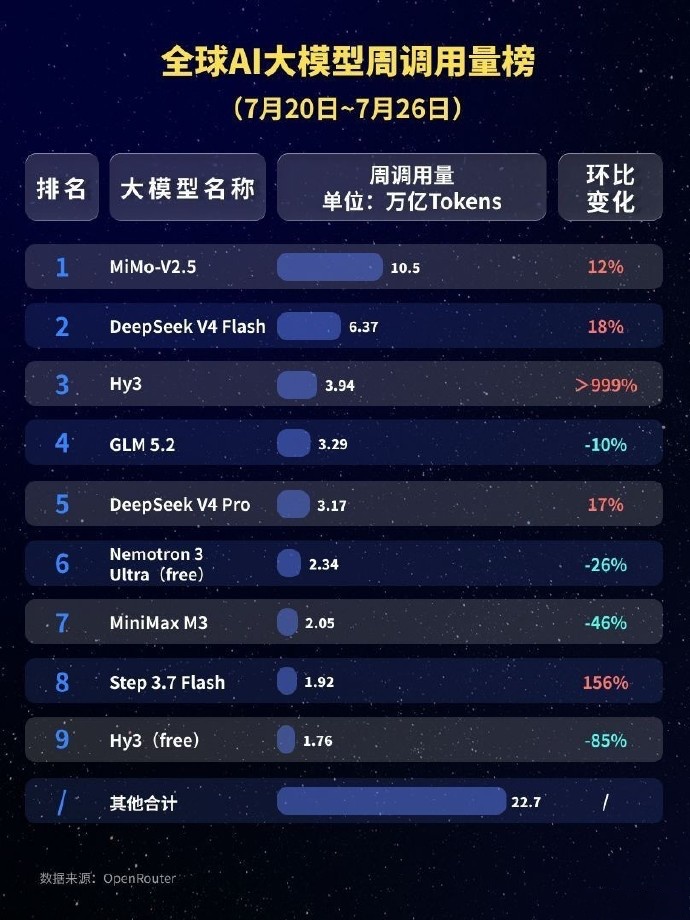
Topping the ranking is Xiaomi's MiMo-V2.5, which recorded a weekly usage of 10.5 trillion Tokens, marking a 12% month-on-month increase. Xu Jieyun, Special Assistant to the Chairman of Xiaomi Group and Deputy General Manager of the Strategic Marketing Department, also reposted the ranking list.
Xiaomi's model officially entered public beta on April 23 this year, and completed full-series open-sourcing by the end of April. It adopts the Mixture-of-Experts (MoE) architecture, with total parameters exceeding the trillion level and 42B activated parameters. It is standardly equipped with an ultra-long 1 million-token context window, and supports full-modality interaction covering text, voice and image. Low reasoning cost and stable agent operation capability are its core advantages that attract overseas developers to access in batches.
The models ranking second and fifth both come from DeepSeek. The two models form a high-low matching setup to cover different development needs. The second-ranked DeepSeek V4 Flash recorded a weekly usage of 6.37 trillion Tokens, with a 18% month-on-month increase. The fifth-ranked DeepSeek V4 Pro recorded a weekly usage of 3.17 trillion Tokens, with a 17% month-on-month growth.
The two aforementioned DeepSeek products were simultaneously released on April 24, with the full series standardly equipped with 1M context. The lightweight Flash version has a total parameter of 284B and 13B activated parameters, focusing on low-cost fast reasoning; the flagship Pro version has a total parameter of 1.6T and 49B activated parameters, with its performance in code and complex agent tasks comparable to top overseas closed-source models, and adopts the MIT full open-source license.
Tencent's Hunyuan Hy3 ranks third, with a weekly usage of 3.94 trillion Tokens and a month-on-month increase of over 999%, making it the fastest-growing model on the list. This model was officially open-sourced on July 6, with a total parameter of 295B and only 21B parameters activated in a single reasoning. It adopts a fused fast-slow thinking architecture, supports a maximum of 256K context, with greatly improved code generation and intelligent interaction capabilities. It achieved explosive growth in overseas usage three weeks after its open-sourcing.
The fourth-ranked Zhipu AI GLM 5.2 recorded a weekly usage of 3.29 trillion Tokens, with a 10% month-on-month decline. This model was fully open-sourced on June 15. Its 753B parameter base model focuses on long-cycle engineering task processing, and is in the first tier of open-source models in specialized evaluations of code and data analysis.
Different from internal enterprise usage data, the OpenRouter platform aggregates real paid usage requests from tens of thousands of overseas independent developers and overseas small and medium-sized AI applications worldwide. All Token usages follow a unified measurement standard, which can objectively reflect the real choices of global developers. This also means that domestic open-source models are breaking the ecological barriers of overseas vendors and taking the lead in fully market-oriented third-party channels.
However, the ranking also has limitations. Traffic from domestic internet giants' own apps, enterprise private deployments, and closed APIs of US giants are not included in the statistics. It cannot fully represent the total global AI usage, and only serves as an observation window for the overseas open-source track.
In addition to the OpenRouter usage ranking, there are two other types of frequently mentioned evaluation rankings in the AI industry, focusing on comprehensive performance and real-person battle experience respectively.
The first one is the Chatbot Arena ranking, which uses real-person blind-test Elo scores to evaluate the models' comprehensive capabilities in dialogue and reasoning. In the latest July ranking, DeepSeek V4 and GLM 5.2 are among the top five open-source models. The other is the Artificial Analysis comprehensive technical evaluation ranking, which covers full-dimensional standardized tests of code, mathematics, logic and long text. Multiple domestic open-source models continue to refresh the highest scores in the open-source track, but the ceiling of comprehensive performance is still held by the US Claude and GPT series closed-source models.
The data from the two aforementioned rankings both show that domestic models have overtaken in terms of market-oriented operational traffic, but there is still a small generation gap in their core comprehensive reasoning capabilities.
It is worth noting that Jensen Huang, CEO of NVIDIA, recently talked about the performance of Chinese and US AI technologies and said, "Exceptional talents will always find excellent solutions, and China is destined to deliver outstanding AI technologies. We should continue to learn from them and cooperate with them."
He also opposed the US ban on Chinese AI models, believing that Chinese AI models are very excellent, and said, "The market initially misunderstood the impact brought by DeepSeek, and then misunderstood Kimi again."
Kimi's newly released K3 temporarily ranks 10th on the OpenRouter weekly ranking. This model has a total parameter of 2.8 trillion and is equipped with an ultra-long 1 million-token context window, making it the largest open-source large model in the world in terms of parameter scale at present.
Elon Musk, the world's richest man, has also been paying continuous attention to Kimi recently. In March this year, Moonshot AI published the paper *Attention Residuals*, proposing the "attention residual" mechanism to replace the residual connection in the traditional Transformer architecture. At that time, Musk reposted and commented on the social platform: "Kimi's work is impressive." Moonshot AI responded humorously: "Your rockets are also well built!"
After the launch of Kimi K3, Musk immediately left a short comment "Impressive" in the comment section of the related evaluation report, once again affirming Moonshot AI's technical capabilities, and voluntarily disclosed information about Grok 4.6, intending to compete with Kimi.
Just on July 25, according to The Paper, Musk said in an interview with *The Economist* that at some point in the future, China is very likely to become an AI leader, and even if the US bans Chinese models, it cannot stop this trend.
However, leading in traffic is just the starting point. To achieve the leap from "leading in usage" to "fully leading in technology", China's AI industry still needs to make continuous efforts in multiple dimensions such as independent computing power, underlying ecology, and cutting-edge innovation, so as to consolidate the hard-won market advantages with long-term technological accumulation.
This article is from "Jiemian News", reporter: Song Jianan, published by 36Kr with authorization.