Is the tech talent market undergoing a reshuffle? The high-value talents with 3 years of work experience, campus recruits offered 3.5 million yuan in compensation, and the diminishing value of P7 roles at major tech firms.
In the early stage of an industry, HR professionals who excel at demanding multiple conflicting traits from candidates often push this tendency to the extreme.
They require applicants for AI positions to have over 5 years of experience using AI products and to have built products with millions of users from scratch. However, ChatGPT, which was only launched at the end of 2022, has existed for less than 4 years in total. Where could anyone get 5 years of experience using AI products?
When large companies recruit senior HR staff, they require candidates to be under 30 years old, preferably with a background from top overseas universities (even top domestic C9 universities are not considered sufficient), and to have an extremely thorough understanding of human nature. Suppose a candidate goes to study in the United States at 22, is excellent enough to graduate and return to China within one year. But a person under 30 may have only just completed understanding themselves, how can they understand all aspects of human nature for the company?
Some companies want to recruit a global sales director, requiring candidates not to be "old people" over 45 years old. But the boss is already 46 years old—has anyone told the boss that he is already old?
Many entrepreneurs have mentioned that they want to find a "Joe Tsai from 20 years ago". Corresponding to this, does this entrepreneur possess the personal charisma of Jack Ma from 20 years ago?
These are definitely not jokes, but absurd recruitment requirements (JDs) heard by "UnDefined".
From another perspective, behind these "nonsensical demands", it seems that due to the rapid technological changes, companies no longer know what kind of employees they will need in the future, so they start to describe people that hardly exist in reality:
They want someone both young and sophisticated;
They want someone with past successful product experience and future AI usage experience;
They want someone with a background from a large company but without the bureaucratic baggage of large enterprises;
They want someone with an entrepreneurial spirit, ideally also low in ego, manageable, and available on call...
Why do these conflicting demands exist? What exactly has changed in the talent structure? To explore this, "UnDefined" interviewed three senior headhunters.
Shen Jia, founder of FuLie Consulting, has 21 years of deep experience in the headhunting industry, and has served a certain "universal app factory", a company that originally did cross-border e-commerce and now operates a content community, several of the "Six Little Dragons" tech firms, and multiple technology startups.
Sister A, a headhunter who has been accompanying embodied intelligence companies for three to four consecutive years, has helped dozens of intelligent companies complete the entire process of building and launching their 0-1 teams, and has a deep understanding of the underlying logic of organizational building and position allocation in the fields of artificial intelligence and hard technology.
Zheng Nan, who has 20 years of experience in HR and headhunting and has served hundreds of hardware and robotics startups, has shared a lot of organizational management experience for startups in her capacity as "the top headhunter in the Greater Bay Area".
They have accompanied the growth of today's large companies in the past, and are also thriving in the current AI boom.
They are among the few people who can see three things at the same time:
What companies are thinking, what changes are happening in the market, and where people are flowing.
This article attempts to answer these three questions.
What Companies Are Thinking: Using Fewer People to Solve Greater Uncertainty
Talking only about cases is useless, let's look at the data.
While everyone publicly claims to favor AI-native talents, in reality, what enterprises want most now are people with more than five years of experience, making the survival environment harsh for young workplace newcomers:
Data from Zhaopin shows that the recruitment proportion of senior white-collar positions (with 5+ years of work experience) has slightly increased since the end of November 2022 (when ChatGPT was officially launched), the proportion of mid-level positions (1-5 years of work experience) has risen steadily and slightly, and the proportion of junior positions (0-1 year of work experience) has continued to decrease;
Another set of third-party data also shows that by September 2025, employment for software developers aged 22-25 has dropped by nearly 20% compared to its peak at the end of 2022.
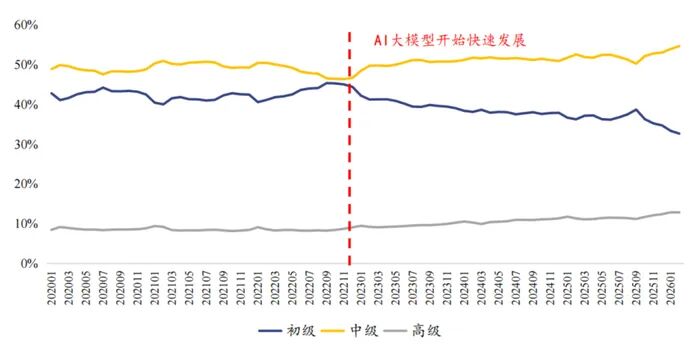
Caption: Changes in the proportion of recruitment for junior, mid-level and senior white-collar positions Source: Zhaopin
Experienced people have become more advantageous in the AI era, because AI can quickly generate a bunch of wrong results along the wrong direction. Therefore, companies are starting to pay for uncertainty: at the very beginning of a task, they want to judge the direction correctly, clarify the boundaries clearly, and block risks in advance.
People who can do this, after being empowered by AI, will see their productivity expand rapidly.
What is being squeezed out are entry-level positions.
Basic sorting, repetitive execution, standardized testing, simple code patching, and junior operation support—these menial tasks that used to be used to train new employees are being taken over by AI.
Now, more and more companies will ask themselves before recruiting:
Do we really need to hire someone for this? Can AI do it? Can a consultant do it? Can an outsourced worker do it? Can a more capable person take care of it easily as part of their work?
Positions are decreasing, and organizations are getting smaller.
An entrepreneur once mentioned that at the moment the company goes public, the team size will not exceed 50 people; if it exceeds 50, it is a failure.
In the direction of AI applications and Agents, composite positions have long begun to appear.
Last year, Alibaba Cloud internally established positions similar to "AI Product Design Front-End Engineer", where one person, with the assistance of AI, simultaneously undertakes product, design, and front-end development work.
There are also internal leaks from Cainiao International stating that some back-end R&D staff were forced to transition to full-stack roles after training.
Recently, Alibaba Group has internally established a number of full-stack teams, pushing front-end, back-end, and testing staff to officially become full-stack engineers.
The boundaries of positions are being broken, and the pricing of talents is being rearranged.
Shen Jia mentioned that in the 2026 Agent wave, there are two types of people whose salaries are rising the fastest.
One type are people with non-technical backgrounds who extensively use Agents to solve problems. They are like the full-stack engineers mentioned earlier—"people who use the tools".
The other type are engineers who have built multi-agent frameworks in advance, that is, "people who build the scaffolding". They may not be traditional large model foundation algorithm talents, but they are very close to the model, know how to adjust performance, connect tools, and handle engineering issues such as ultra-long conversations, memory, and responses.
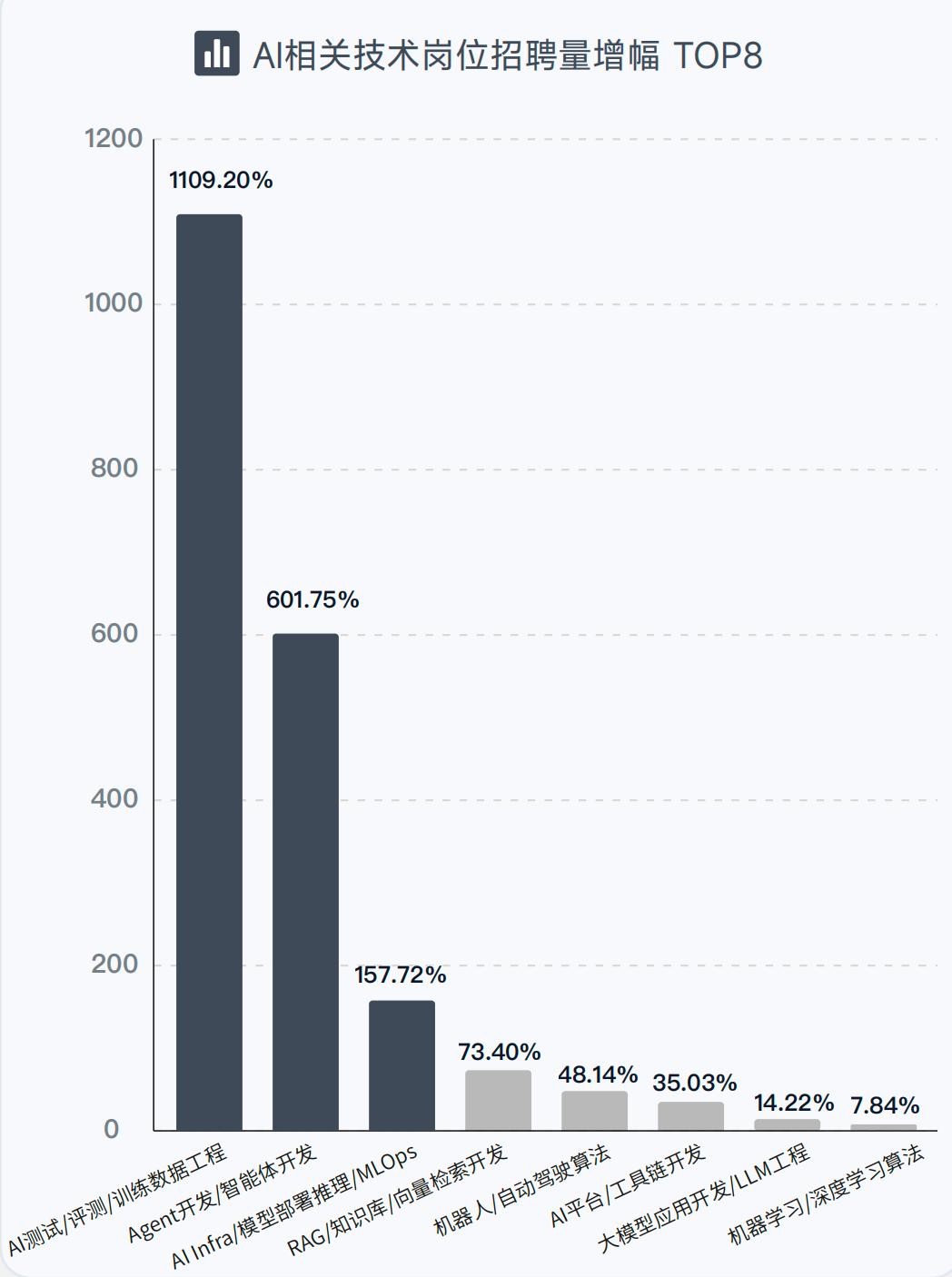
Caption: Talent trends of major manufacturers Source: 2026 Maimai R&D and Operations Talent Black Paper
In the embodied intelligence direction, the logic of talent pricing has changed again. What companies want are "people who have actually worked on-site".
Sister A said, The most sought-after people in the embodied intelligence circle are those with 3-5 years of vertical experience who have actually operated real physical machines.
Even people with 1-2 years of experience have opportunities, as long as they are young, high-potential, and willing to grow together with the enterprise.
Senior talents with more than 10 years of experience in the internet or autonomous driving fields will find it difficult to obtain core management positions at leading companies if they did not participate in early on-site operations, and try to enter the embodied intelligence industry only in 2026.
Because large model talents may be very capable, but if they have never touched a real physical machine, their experience with virtual simulation data cannot be directly transferred to robots. Different robots have different forms—wheeled, bipedal, varying heights and weights, with different hardware-software collaboration mechanisms. People without real machine experience will find it difficult to get up to speed quickly.
No matter how impressive your background is, you still need to re-adapt.
Therefore, age does not equal experience. Only by having directly confronted new problems can you be said to have real experience. Ten years of seniority may just be old experience that the new system you are working hard to build no longer needs.
Data positions in embodied intelligence are also suddenly seeing rapid salary increases.
Sister A also mentioned that in 2025, almost no company was recruiting large numbers of data platform or data engineers for embodied intelligence. But by 2026, the limited existing data has been fully utilized. To continue iterating the models, companies need to supplement data, build platforms, and establish teams. As a result, better-funded enterprises have begun to develop their own algorithm models, making these talents highly valuable.
In the AI hardware direction, what companies want are "people who can sell the products".
In today's Huaqiangbei, you can even select a solution, determine the design, and calculate the BOM (bill of materials) for an AI glasses directly from a solution provider's PPT. Brand owners can decide to produce 500 or 5000 units first, and after a few days, "UnDefined brand" AI glasses are launched on the market.
On the last day of the Hong Kong Consumer Electronics Show, a delicate fan that sells for 600-700 yuan in shopping malls was cleared out for only 40 yuan.
A large number of factories in Bao'an, Dongguan, and Huizhou can quickly deliver almost all hardware categories at extremely low costs. The hardware production process is so powerful that it is no longer mysterious.
When production is no longer a problem and costs have been pushed to the extreme, people who are good at discovering users' hidden needs and have access to traffic will become the fastest-rising talents in the market.
At this point, the talent portrait in the minds of companies is very clear:
Large companies want people who can integrate AI into their existing businesses; startups want people who can do multiple jobs and run through the entire process from 0 to 1; hardware companies want people who understand the supply chain and GTM (go-to-market); embodied intelligence companies want people who have operated real physical machines and have practical project experience.
Companies are paying for those who use AI to amplify leverage—the few who can cross boundaries, self-drive, and turn technology into real value in business and the physical world.
However, companies also share a common anxiety: Hiring the wrong person is more dangerous than not hiring anyone at all.
Therefore, more and more entrepreneurs are starting to evaluate candidates in non-interview scenarios, because candidates in the meeting room know they are being assessed, while candidates in relaxed scenarios are closer to their real selves.
Another increasingly common interview method is paid trial work for one day. Both parties agree on the compensation in advance, the organization sets up some desensitized tasks, and lets the candidate collaborate with the team on a specific task, so as to observe the candidate's real abilities and their fit with the team.
Resumes can only verify the past, interviews can only verify expression, and only trial work can test the present.
How the Market Is Changing: New Large Companies, New Labels
In the last era when the internet was still growing, people rose with the tide along with the platforms they worked for.
From 2011 to 2015, entrepreneurs with backgrounds from Tencent or Baidu could easily raise 5 million yuan in angel financing, because they understood market scale, traffic, growth, and organizational capabilities. The brand of the company itself was a form of credibility.
Today, the same aura is shifting to new hardware giants such as DJI, Dreame, and Insta360.
In recent years, Dreame Technology has been regarded as the "Huangpu Military Academy" in the robotics field. Many of its executives have left to start their own businesses and obtained large amounts of financing in the early stages.
Gu Renjie, former executive president of Dreame China, founded the home embodied intelligence robot company Lexiang Technology, with total angel round financing of about 500 million yuan across three rounds; Yu Chao, former head of Dreame's humanoid robot business, founded Luming Robotics, which completed nearly 200 million yuan in three angel rounds within half a year.
The DJI ecosystem is also seeing talent spillover.
Tao Ye, former head of the consumer drone division, Gao Xiufeng, former head of the system engineering department, Liu Huaiyu, former head of glasses and FPV products, and others co-founded Bambu Lab, with 30 million yuan in Series A financing; Wang Lei, former head of the battery business, founded EcoFlow, whose initial team mostly came from DJI, with 30 million yuan in Pre-A round financing.
The aura of large companies has not disappeared, it just has new owners.
In this round of changes, the key is not "who has become a new large company". In fact, because the time is still short, the market has not formed a consensus valuation for these new large companies.
But the market has begun to price people using new labels.
These labels have changed from "mobile internet" to "AI + physical world"; from "company business line" to "industrial project practice and closed-loop capabilities"; from "full-time employment" to "higher-leverage capability combinations".
When the labels change, people's perception of their own value begins to shift.
First, explicit good opportunities in the market are getting fewer and fewer. The probability of ordinary people getting opportunities at large companies, in core departments, or in star teams is continuously decreasing.
But AI has also created implicit good opportunities, which may be hidden in an early team that has not yet gained market consensus, which greatly tests professionals' judgment of future trends.
Second, the income gap between top talents and ordinary people is widening. Shen Jia mentioned that in the 2026 campus recruitment for top AI companies, outstanding students can get a cash annual salary of 1 million to 2 million yuan, top students can reach 3.5 million to 3.8 million yuan, and the daily salary for internships in core positions is 4500 to 4800 yuan. But at the same time, junior engineers, older P6/P7 employees in non-core businesses of large companies, and basic skill positions in modern service industries are all being squeezed by AI.
One group stands next to the model, the other stands in the old system. One group gets a pay raise, the other gets depreciated.
Third, the quality of projects is beginning to outweigh a single resume. Sister A says that currently, the gap between companies in the embodied intelligence industry may only be 3-6 months. As long as a candidate has participated in a publicly showcased, high-quality product, they will attract attention from the entire industry. When the industry is in a period of fierce competition, projects are the "life-saving gold medal" for talents.
Fourth, organizational boundaries are loosening. Consultants, trial workers, Agents, freelancers, and solution providers are all being included in the definition of "team". Full-time employment is no longer the only option. What companies are purchasing has changed from fixed employees at workstations to a network of combinable, callable, and verifiable capabilities.
Whether you like it or not, the market has opened up a new battlefield, with new organizational forms and a new pricing system.
Where Talents Are Flowing: AI Hard Technology, Industrial Sites, New Company Brands
A good commander guides the situation to their advantage.
Talents are migrating along the path of "new technology — new on-site scenarios — new company brands — new achievements".
The first flow is to the center of new technology