Ordinary people cannot afford the cost of running K3, Kimi is open-sourced, and Anthropic made a subtle statement that it has never advocated banning open-weight models.
On the evening of July 27, Beijing time, Moonshot AI Kimi officially released the model weights, technical report and key Infra technologies of K3.
Almost simultaneously, Dario Amodei, co-founder and CEO of Anthropic, published an article responding to recent discussions around open-weight models. Amodei explicitly stated, "Anthropic has never advocated for a ban on open-weight models."
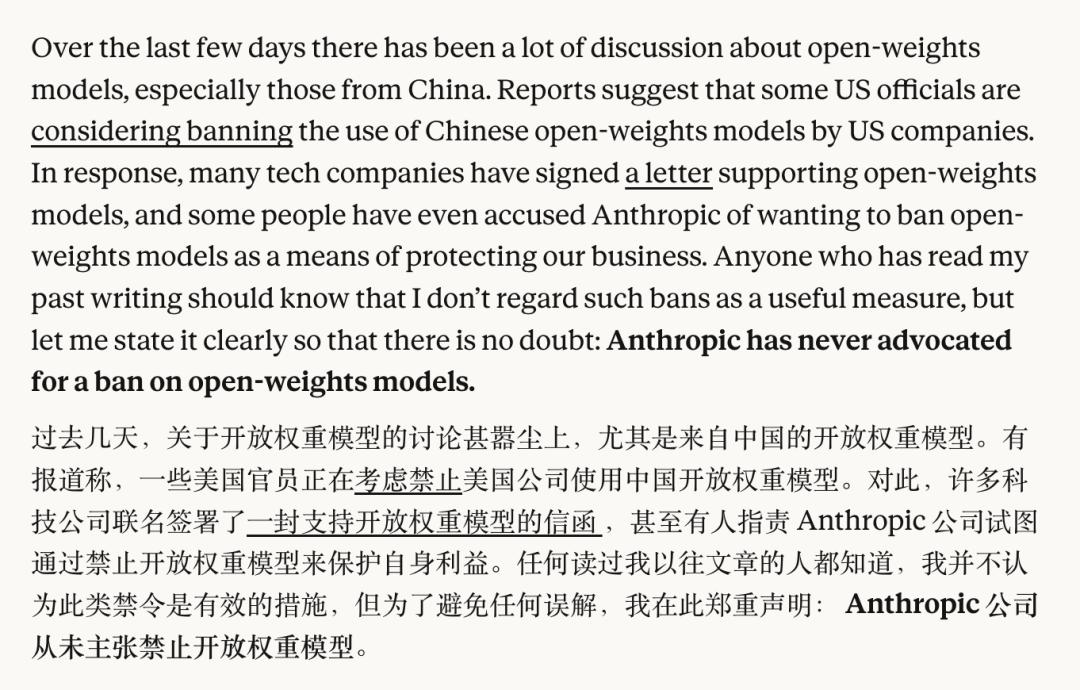
"Open-weight models that do not possess dangerous capabilities are a public good: they incur no additional costs beyond the computing power required to run them, while creating value for enterprises, developers and researchers," Amodei said.
The background of this statement is that since the release of Kimi K3, discussions have emerged overseas about imposing usage restrictions on open-weight models from specific sources. Meanwhile, multiple tech companies have publicly expressed their support for the open-weight ecosystem, and some argue that certain closed-source model companies, such as Anthropic, may push for the implementation of relevant restrictive policies out of commercial competition considerations.
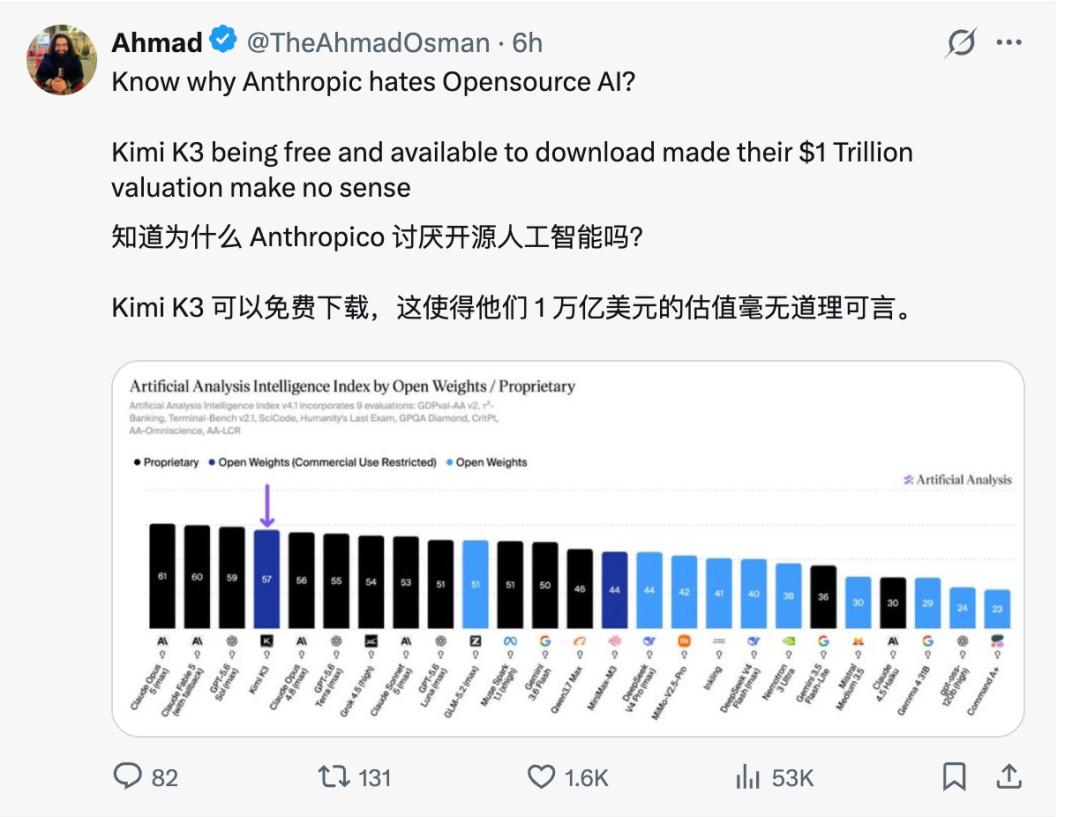
The open-sourcing of Kimi K3 and Amodei's statement, when viewed together, show that as model capabilities grow stronger, the debate between open-source and closed-source models is becoming increasingly fierce, and the open-source trend is difficult to resist.
A response under public opinion pressure, with core positions unchanged
In his response, Amodei still emphasized his concerns from a security perspective.
His primary concern is that other countries could develop AI models more powerful than those of the United States, and use these models to gain permanent military advantages, or to impose extremely strict suppression on their own people. He noted that this concern is widely shared within the U.S. government. In this scenario, it does not matter whether the models are released in open-weight form, and it certainly does not matter whether they are used by U.S. companies.
Secondly, he is worried that powerful AI models could be misused to launch cyberattacks or biological attacks, and there could also be serious alignment issues. "Open-weight models do carry higher risks than closed-source models, because it is difficult to set up effective safety guardrails for them, and it is hard to monitor their usage; moreover, once model weights are released, they cannot be recalled," Amodei added. "However, banning U.S. companies from using these models will not solve this risk, because malicious actors are unlikely to be legitimate U.S. companies in the first place. Such a ban might protect U.S. AI companies from competition, but that was never my goal."
After that, Amodei put forward three measures he had repeatedly mentioned before:
First, do not sell high-performance chips or chip manufacturing equipment to China, and crack down on acts of obtaining these chips through other evasive means. Amodei's exact words were, "China has limited advanced chip production capacity domestically, so under the Scaling Laws, if it cannot obtain U.S. chips, China will not be able to train models more powerful than those of the United States."
Second, crack down on industrial-scale distillation activities. "It allows China to use limited chip resources to train models far exceeding normal levels, thereby partially bypassing the ban," Amodei emphasized. "We should curb this behavior through policy interventions. A comprehensive ban on open-weight models is neither the correct solution nor a measure we have ever advocated."
Third, all models with sufficient capabilities, whether open or closed-source, should undergo mandatory safety testing. He stressed that for safety testing to be truly effective, it must be implemented globally.
His targeted orientation has not actually changed, but he has repeatedly reduced the "attacks" on open-source models. Another reason for Amodei's public and formal response this time is the overseas public opinion pressure brought by the open letter "Open Weights and American AI Leadership" reposted by Jensen Huang a few days ago.
On July 24, Jensen Huang posted his first post on X and reposted the open letter, calling on the U.S. government not to restrict downloadable AI models. The letter states that open weights can reduce the risk of vendor lock-in and enhance enterprises' control over models, data and infrastructure. The open letter was initially signed by 25 companies, and quickly expanded to 50, with new signatories including OpenAI, Google, AMD, Cisco, Cloudflare, GitHub, Block and Ollama. As of press time, 77 companies have signed it.
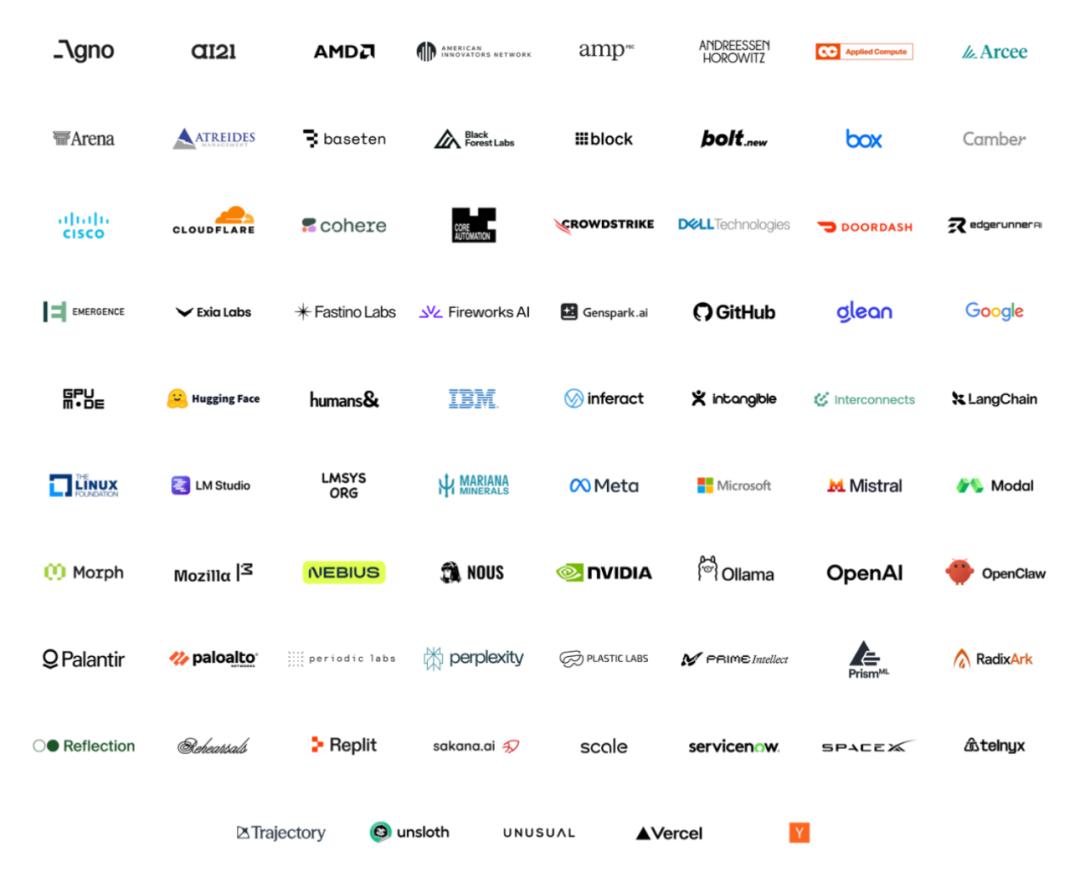
The fact that the number of signatories doubled within one day reflects that open weights are rapidly becoming a core topic in U.S. AI policy discussions.
It is worth noting that Anthropic and Amazon are still not on the signatory list. Amazon is one of the largest investors in Anthropic, and Anthropic also uses Amazon Trainium chips to train and deploy models. The two companies have not yet explained their absence.
Amodei said he agrees with much of the content of the open letter: "Open weights expand opportunities for people to participate in the AI economy, enhance competition in at least some application scenarios, and give customers greater control. Concerns about distillation should be addressed through targeted legal and commercial frameworks, which are the measures I mentioned above."
But he also said he does not agree with other claims in the open letter, such as that open-weight models are necessarily more conducive to developing safety protection measures, or that widespread opening of model capabilities will necessarily give defenders greater advantages than attackers. "In my opinion, the opposite outcome is at least equally likely."
This is still a very familiar narrative. Amodei's response this time is more about appeasing public sentiment in the United States.
It is worth noting that the "openness" mentioned in the open letter is mainly focused on the model layer. NVIDIA, which organized the open letter, still controls its proprietary CUDA software ecosystem, Microsoft also sells closed-source models on Azure, and the "openness" advocated by most signatories does not touch their own core competitive barriers.
For enterprises, open weights first mean that they can download, inspect and retrain models, and keep data in their own infrastructure. However, whether the model can actually run still depends on chip supply, computing cost and deployment capabilities; model openness cannot solve issues such as agent authorization, version tracking and auditing.
Even if an enterprise can read the model weights, it cannot prove from the model alone whether an agent is authorized, or confirm whether the model running in different regions is consistent with the version approved by the security team. Therefore, open weights only solve part of the vendor dependency problem, not the complete AI governance problem.
Tier-T Model Open-Sourcing: 2 Million Yuan Is Just the "Entry Ticket"
Previously, there have been long-standing overseas concerns that a domestic open-source model comparable to Fable 5 would emerge, and the release of K3 has exacerbated such concerns. With the release of the K3 technical report, we can also see the potential impact of tier-T model open-sourcing.
"Now, everyone can download and deploy the Kimi K3 model — whether for internal R&D or embedding into end-user-facing products, it can be used freely." This sentence in Moonshot AI's official announcement sparked the enthusiasm of netizens. However, some netizens also found that for a model of K3's level, individual deployment is basically impossible.
As of now, the lowest deployment configuration of Kimi K3 that can be publicly verified is a server equipped with 8 AMD MI355X accelerators, and the total cost of the machine is estimated to be between 1.7 million and 2.4 million yuan. But this configuration only solves the problem of "loading the model", and there is still a clear gap from a production-level service with acceptable speed, concurrency and long-context support.
A Zhihu user named "Pingfan" speculated that according to the deployment suggestion of more than 64 accelerators proposed in Kimi's official technical article, the hardware investment for truly commercial-facing services could reach the tens of millions of yuan level. This means that K3, with a parameter scale of 2.8T, has basically moved beyond the scope of individual local deployment. For the vast majority of ordinary enterprises, building their own inference clusters is very limited in economic viability, and directly calling APIs may still be a more realistic choice.
Specifically, the Kimi K3 model file is approximately 1.5609TB, with a total parameter count of 2.8T, and only about 104B parameters are activated per generation. The model weights are in MXFP4 format. Although it adopts a Mixture-of-Experts architecture that does not require all parameters to be called for a single inference, the complete model weights, KV cache and running state still occupy a huge amount of video memory space.
According to test results disclosed by AMD, a single MI355X is equipped with 288GB HBM video memory, and 8 cards have a total of 2.304TB of video memory, which can accommodate K3's model weights and necessary running data. AMD has verified the deployment scheme of 8×MI355X with tensor parallelism TP8, and vLLM also lists 8 MI355X or 8 B300 cards as the currently relatively easy-to-deploy configurations for K3. It is worth noting that the maximum context size in AMD's publicly announced first-day tests is only 16K, and key indicators such as generation speed, first token latency, throughput and concurrency have not yet been disclosed.
"The era when you could buy a 512GB Mac Studio and deploy a large model of hundreds of B parameters is gone forever. Models of that level are no longer competitive today," the user concluded. In addition, for a 2.8T model like K3, even if the weights are in a low-precision format, the memory capacity, bandwidth and computing power of ordinary workstations cannot meet the deployment requirements.
The user roughly listed four solutions, ranging from barely able to run to barely achieving normal usage.
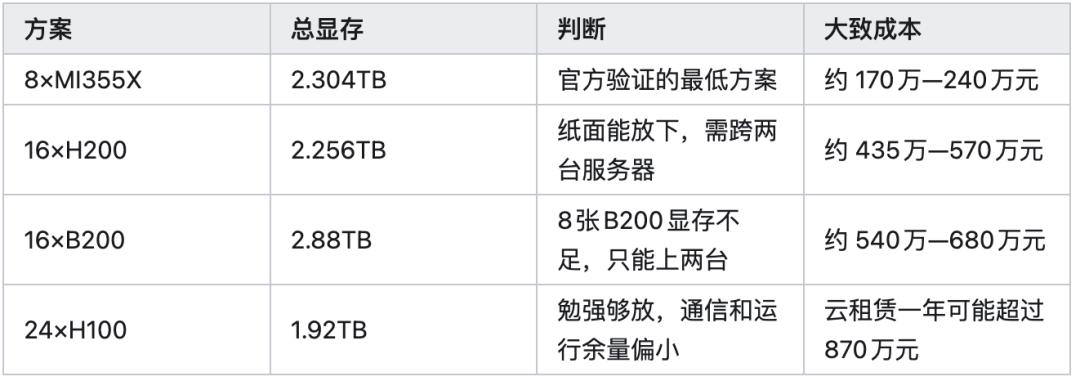
Among them, 8 MI355X cards are the lowest-cost and most verified solution in the current public configurations. Since there is no unified public quotation for the complete MI355X server, the market can only estimate through the quotations of servers and individual cards. Supermicro's 8-card server supporting the MI350 series starts at around $245,000. Combined with the market valuation of about $25,000 per MI355X card, the total cost of a complete 8-card server is estimated to be between $250,000 and $350,000, equivalent to about 1.7 million to 2.4 million yuan.
Other solutions have higher costs. 16 H200 cards have a total video memory of about 2.256TB, which can theoretically accommodate the model, but usually need to be deployed across two servers, with hardware costs estimated at 4.35 million to 5.7 million yuan; 16 B200 cards have a total video memory of about 2.88TB. Since the video memory of a single 8-card B200 server is still insufficient, two servers are required, with costs ranging from 5.4 million to 6.8 million yuan; 24 H100 cards have a total video memory of about 1.92TB, which can barely fit the model, but with little running margin, and cross-server communication will become a significant bottleneck. If cloud services are used, the annual rental cost may exceed 8.7 million yuan.
Even the lowest-cost 8×MI355X solution can hardly guarantee an ideal practical usage experience for K3. K3 has a parameter scale close to 3T. Generating each token requires scheduling data between a large number of model weights and expert modules. Although a single 8-card server can complete the loading, throughput, concurrency and long-context performance may be significantly limited. For users, "being able to load the model" and "being able to provide production-level services" are two completely different concepts.
K3's architecture further amplifies the importance of cluster communication. The model has 896 experts, and 16 experts are selected from them to participate in the calculation for each token. When different experts are assigned to different GPUs, the system needs to frequently transmit activation data between accelerators. As concurrency and context length increase, the interconnection bandwidth between GPUs will directly affect token generation speed.
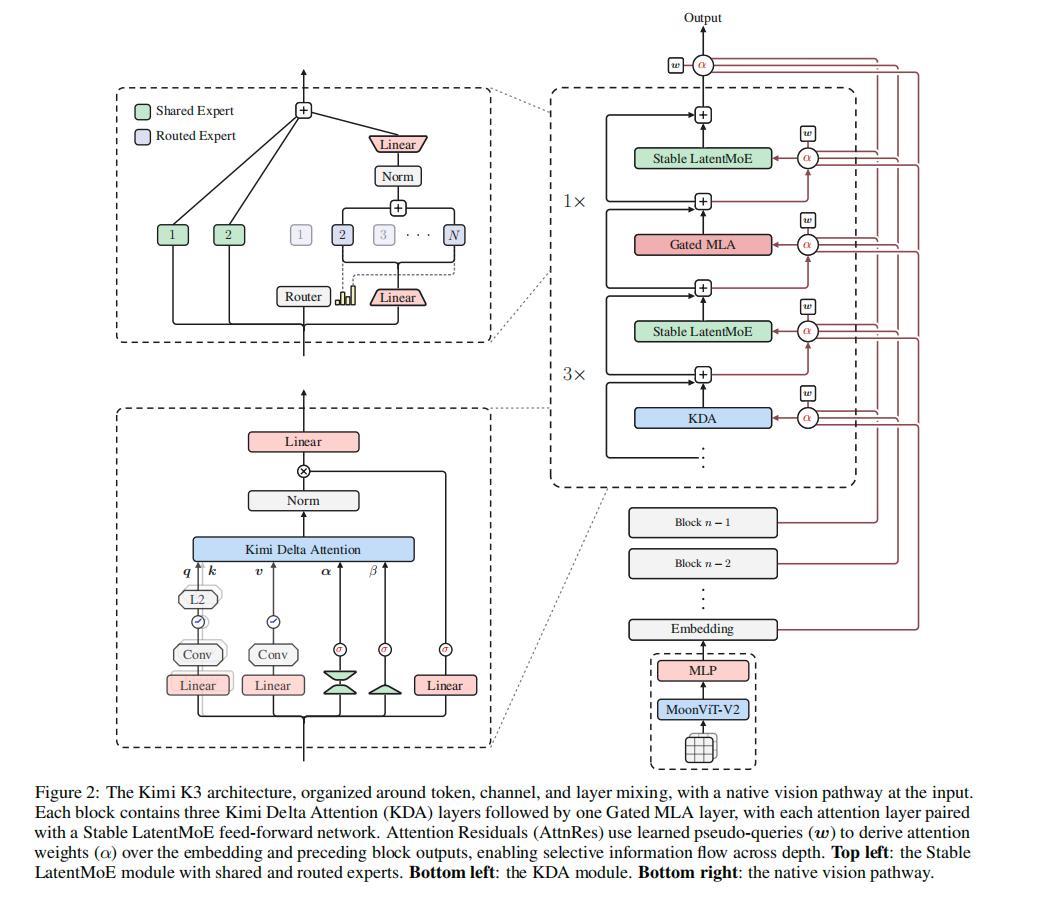
Therefore, Kimi's official technical article does not recommend that large-scale services rely solely on a single 8-card server, but suggests using more than 64 accelerators located in the same high-speed interconnection domain. Calculated based on 64 MI355X cards, deploying K3 requires 8 eight-card servers, and the hardware investment alone is estimated to be between 13.6 million and 19 million yuan. If cloud resources are used, estimated based on Oracle's relatively low instance prices, the annual cost is about 4.09 million yuan; calculated based on Vultr's current prices, the annual cost could reach 9.86 million yuan.
In addition, the total power demand of a 64-MI355X cluster could be close to 100kW. If it runs continuously throughout the year, the electricity bill alone could be close to one million yuan, not including costs such as computer rooms, heat dissipation, networks, storage, operation and maintenance personnel and redundant equipment.
"2 million yuan is just the 'entry ticket' for K3, and the tens of millions level is closer to the starting point of commercial services," the user concluded.
The emergence of tier-T open-weight models is also changing the traditional perception that "open-source models can benefit local deployment for all".
Open weights mean that developers can download, research and modify models, but it does not mean that individuals and small and medium-sized enterprises have the hardware conditions to run these models. For ordinary individual users, in the future, they will mostly only be able to analyze model architectures, study technical reports, or use small versions that have been heavily distilled and quantized, instead of directly running the complete model.
Even for ordinary enterprises, local deployment of models like K3 can hardly show cost advantages. Unless an enterprise has long-term, stable and extremely large-scale inference needs, and has mature cluster scheduling and model engineering capabilities, the tens of millions of yuan in hardware investment, continuous electricity costs and operation and maintenance burdens may not be as cost-effective as directly purchasing API services.
The user "Pingfan" concluded that models like K3 are more suitable for large cloud service providers, leading internet enterprises, scientific research institutions, and even national-level projects that hope to build independent AI infrastructure. For example, some countries or large organizations that lack independent foundational model capabilities can centrally purchase thousands or even tens of thousands of accelerators, and use open-weight models such as K3 as the base for fine-tuning, post-training and localized deployment, thereby building their own model service systems.
What lies behind this is not just the profits of individual enterprises, but will encourage more companies and developers to use K3, and then build a complete ecosystem of tools and infrastructure around the model. Over time, this will help the model become a "de facto standard", which is one of the concerns of some overseas experts and enterprises.
Finally, it should be reminded that the Kimi K3 license announced by Moonshot AI shows that individual developers and ordinary