Giving away a 2.8-trillion-parameter model for free without any hesitation, how does Moonshot AI make this deal add up?
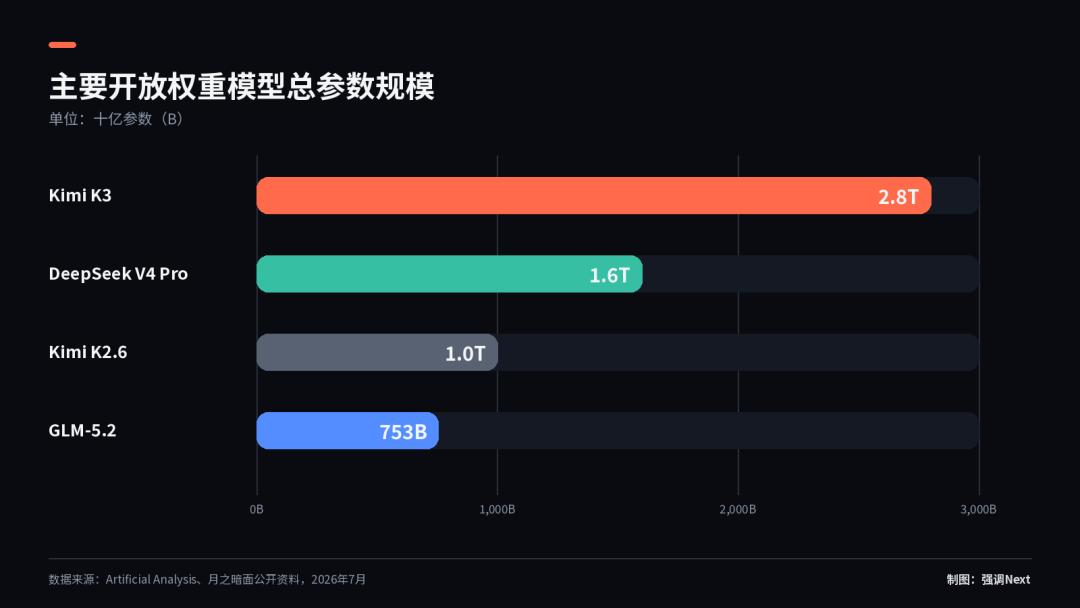
On the night of July 27th, Moonshot AI officially released the full model weights of Kimi K3 on Hugging Face, GitHub, and ModelScope as scheduled. With 2.8 trillion parameters, the world's first open-weight model to approach the 3 trillion parameter threshold, it is available for anyone to download for free, deploy locally, and conduct secondary development.
Ten days ago, Elon Musk left a comment "Impressive" under a K3 evaluation report, and soon announced on social platforms that xAI's new 2-trillion-parameter model would complete initial training next week, which "may surpass Kimi". The official Kimi account simply responded: "Welcome Musk to join the 2 trillion club."
Then, it directly tore down the door of this club: You are still competing for who has more parameters? Sorry, the largest one is now free for everyone.
This is clearly not a purely emotional gesture. Looking back at Moonshot AI's movements over the past month: its ARR (Annual Recurring Revenue) exceeded $300 million in mid-June, with API revenue accounting for more than 70%. It suspended new C-end user subscriptions on July 19. The previous round of financing at a $20 billion valuation has just been closed, and the pre-money valuation for the new round has been set at $31.5 billion.
Careful developers noticed that next to the approximately 1.56TB model file on Hugging Face, a license document of only 3.07KB reveals more commercial information.
According to the Kimi K3 License, if an enterprise operates a "Model as a Service" business, and the total revenue of the enterprise and its related parties in any consecutive 12-month period exceeds $20 million, it must sign a separate agreement with Moonshot AI before using K3 and its derivative models for commercial purposes.
This license pulls the discussion of K3 from technology back to business.
01 Moonshot AI does not want to work for cloud vendors for free
Open models have long faced an awkward situation: model companies bear the training costs, but cloud vendors may take away subsequent revenue. This is also the fundamental reason why Robin Li of Baidu mentioned earlier that open-source models have no prospects.
Under the MIT license, cloud vendors can download models, optimize inference, package them into APIs, and then charge fees using their existing customers, computing power, and sales channels. Model companies get download volume and industry visibility, but customer relationships, invocation data, and billing all remain on the cloud platform. The faster the model iterates, the more likely the laboratory will become an upstream R&D department of cloud vendors.
The "Model as a Service" in K3's license refers to allowing third parties to exercise substantial control over inputs, parameters, or training data. Embedding K3's capabilities into a specific function of one's own product, or simply forwarding requests to other platforms, is not included in this scope.
In other words, Moonshot AI has no intention of blocking developers and most enterprise users; what it is blocking are cloud vendors and inference platforms that download weights, package them into APIs, and then sell inference services externally using their own brands and pricing systems.
Overseas analysts focusing on open-source infrastructure have already compared this threshold to events from a decade ago.
MongoDB and Confluent also expanded their adoption scale through permissive licenses in the early days. When cloud vendors such as Amazon directly packaged their open-source databases into paid cloud services, the original developers could not get a share of the revenue, forcing them to switch to SSPL and BSL licenses that restrict resale.
First exchange openness for scale, then use rules to regain bargaining power. Theoreticaly, from ultra-large-scale cloud vendors to model hosting-focused inference platforms such as Fireworks and Together, all are included under the $20 million revenue threshold. K3 faces similar commercial challenges as MongoDB and Confluent, but has chosen a more moderate legal path: instead of directly prohibiting MaaS resale, it requires operators that reach the revenue threshold to sign separate agreements.
The open model industry has moved from the stage of "competing for who open sources first" and "competing for who open sources more thoroughly" to the stage of "competing for who can regain pricing power from the open ecosystem".
Also releasing weights in July, Zhipu GLM-5.2 and DeepSeek V4 Pro still use the clean MIT license without adding any resale threshold. Of course, this may not necessarily be because they are more generous.
As for the "Certified Inference Partners" mentioned by Moonshot AI that can be exempted from this threshold, no one can clarify the standards and list for now, and the original license text also does not give a definition.
02 From "competing for parameters" to "competing for scenarios"
The license is just a commercial choice for K3. Back to the models themselves, K3, DeepSeek, GLM, and Qwen have already embarked on four different paths.
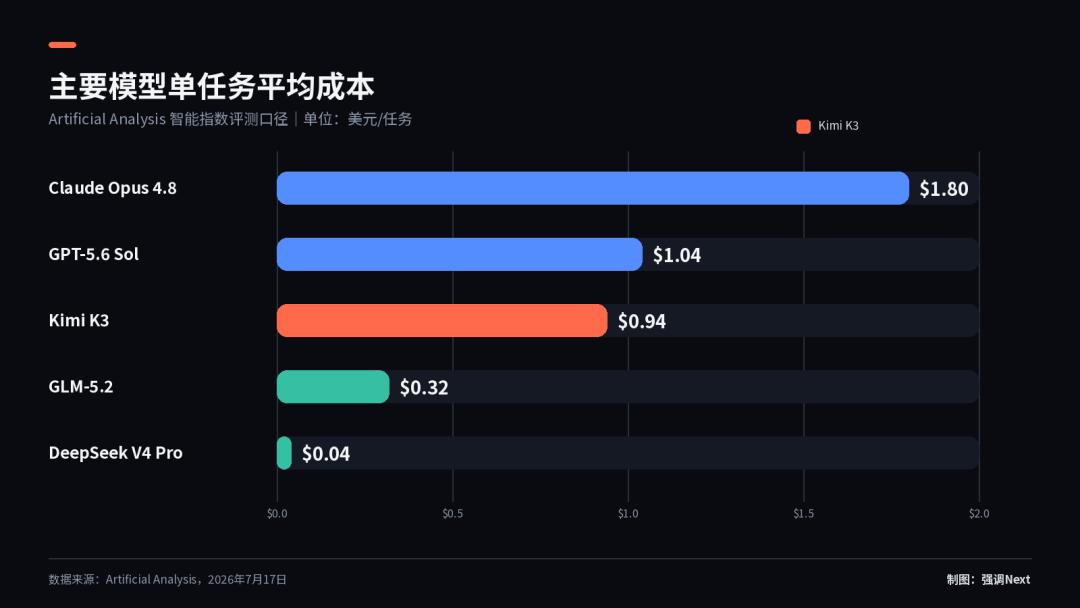
K3 follows the "large and comprehensive" route. It has a total of 2.8 trillion parameters, 1 million token context window, and native visual understanding capabilities. In official demonstrations, K3 wrote a complete GPU compiler from scratch, and even participated in chip design and generated 3D open-world games. However, with an input price of $3 per million tokens and an output price of $15, the average cost per task is about $0.94, making it the most expensive one among the four.
DeepSeek V4 Pro takes the opposite route. Its total parameters reach 1.6 trillion, but the activated parameters are controlled at about 49 billion. The input and output prices are $0.435 and $0.87 respectively, with an average task cost of about $0.04.
DeepSeek has also introduced peak-valley pricing: charges are doubled from 9 a.m. to 12 p.m. and 2 p.m. to 6 p.m., while off-peak usage can save half the cost. This is consistent with its consistent strategy: the total parameter count can be large, but the activation scale and usage cost must be kept as low as possible.
Zhipu GLM-5.2 has chosen the third path. It adopts an upgraded version of DeepSeek Sparse Attention, reducing the inference overhead of the million-token context to a range that general hardware can afford. With a single-token activation parameter of about 40 billion, it achieves the shortest first-token latency among the three.
The input and output prices of GLM-5.2 are $1.4 and $4.4 respectively, falling between K3 and DeepSeek, focusing on competing for response speed in coding and Agent scenarios.
Alibaba Qwen does not pursue extreme performance at a single point, but pursues wide coverage. With support for hundreds of languages and more complete multimodal capabilities, it is more like a general-purpose base model for enterprise customers, rather than a flagship product specifically designed for benchmarking.
However, Kimi's move also made Alibaba unable to stay calm. Three days after K3 was released, Alibaba previewed Qwen3.8-Max with 2.4 trillion parameters, clearly stating that it would also release open weights. Over the past year, Kimi has pushed the scale ceiling of open-source models for 9 months. Now, flagship-level open-weight release is becoming a standard move for Chinese large model vendors.
The four routes can no longer be ranked by a single dimension. "Competing for parameters" has begun to shift to "competing for scenarios": K3 leads in long text, DeepSeek leads in cost performance, GLM leads in response speed, and Qwen leads in coverage.
Differentiation does not mean anyone can rest easy. DeepSeek, GLM, and Qwen may continue to strengthen their respective strengths at any time, and K3's price disadvantage will not disappear automatically.
03 The premium of closed-source models is being squeezed
What makes this round of open models particularly eye-catching is the comprehensive comparison of benchmark scores and prices.
On the Artificial Intelligence Index list of the third-party evaluation agency Artificial Analysis, K3 scored about 57 points. Ahead of it are Claude Fable 5 and GPT-5.6 Sol, with scores of about 60 and 59 respectively; Claude Opus 4.8 follows closely with about 56 points.
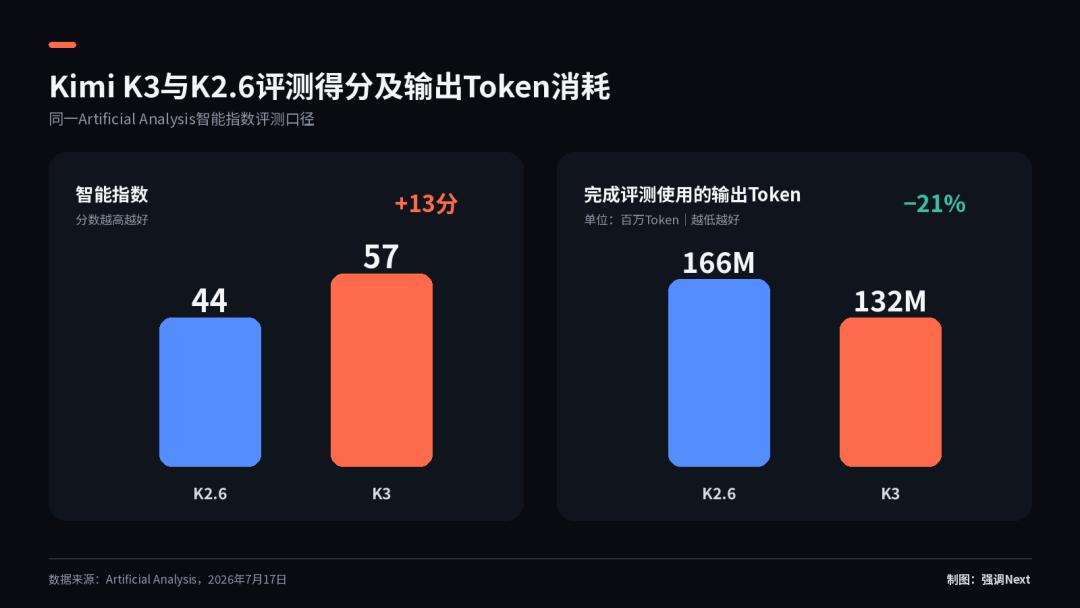
This is the first time that an open-weight model has achieved results that are only two or three points behind the top closed-source models. On the Arena Frontend Code Leaderboard, K3 reached the top within 24 hours of its launch, surpassing Claude Fable 5 and rising 17 places compared to the previous generation.
More critically, these near-world-class results correspond to prices that are significantly lower than most closed-source flagship models.
The average cost per K3 task is about $0.94, which is about half of that of Claude Opus 4.8. If the premium of closed-source models is built on the premise that "only we can achieve this level", then when an open-weight model narrows the performance gap to two or three points while the price is only about half, the explanatory space for this premium logic is rapidly shrinking.
Microsoft CEO Satya Nadella calls this the "reverse information paradox": buying a closed-source model actually means paying twice, once for the bill, and once by giving away the business know-how fed to the model.
In January this year, a court in New York ordered OpenAI to hand over 20 million desensitized user conversations, which served as a reminder to all enterprises: if your data is on someone else's server, you can no longer control it. What K3 provides is exactly the option of "data staying within your own walls".
04 Weights are just the appetizer, the real battlefield is in the inference layer
Releasing open weights is no longer news in this camp. The flagship models of DeepSeek, GLM, and Qwen have long been available on Hugging Face, with no restrictions on downloading, commercial use, and fine-tuning.
What really brings freshness this time with K3 is the parts beyond the weights.
Because KDA changed the traditional prefix caching mechanism, Moonshot AI directly contributed its own cache implementation to the vLLM project. On the day the weights were released, the two mainstream inference engines vLLM and SGLang simultaneously provided deployment solutions. The AMD team completed the first-day adaptation for the MI355X chip, the cloud platform Modal launched the K3 hosting service, and Inferact trained and open-sourced the DSpark speculative decoder adapted to K3.
The simplest deployment configuration provided by vLLM requires 8 NVIDIA B300 or 8 AMD MI355X chips. These two are top-tier data center chips that have not been widely deployed yet, and the required computing power is far beyond the reach of individual developers.
This means that what Moonshot AI wants is not just the headline of "having a larger model". It also wants to occupy a position in the inference framework and deployment tool chain.
Anyone can release open weights. But if the service solutions, cache implementations, and speculative decoders used by developers are all developed around your architecture, the cost of switching models will no longer be as simple as "just changing a file".
The license's design of "exemption from resale terms through use by certified inference partners" also gives Moonshot AI a switch: it can screen who can enter this ecosystem and who needs to sit down for negotiation first.
Releasing weights is a one-time action, and embedding into the tool chain is the only way to truly retain developers. This is why K3's release of open weights this time is better understood as a beginning rather than an end.
However, custom rules also come with costs. When large enterprises choose open models, they value not only capabilities and costs, but also whether the license is simple and stable. The reason why MIT and Apache 2.0 are popular is that legal departments can easily judge the usage boundaries.
K3 adds conditions such as revenue thresholds, related party definitions, MaaS definitions, and certified partners, requiring enterprises to invest more in compliance reviews before deployment. If GLM, DeepSeek, or Qwen launches alternatives with similar capabilities but simpler licenses, platforms may completely bypass K3.
Open models inherently have low switching costs. The technical lead brought by a single release can hardly sustain a set of custom rules in the long run.
It is rumored that K3.1 is already on the way, and will be released as soon as next month. The "open source - verification - iteration" strategy may have just begun to be verified.
This article is from the WeChat official account "Emphasize Next" (ID: leo89203898), author: Xin Jian, published with authorization from 36Kr.