New Stanford Research: AI Has Not Yet Impacted Employment, But Recent Graduates Need to Be Aware
Has AI actually started taking away jobs?
Stanford professor Neale Mahoney argues that, based on overall employment data, the answer is likely not yet;
But for recent graduates who have just stepped out of campus, they may have already experienced this impact in advance.

In early 2026, the unemployment rate for recent graduates in the United States reached 5.6%, 1.6 percentage points higher than three years prior.
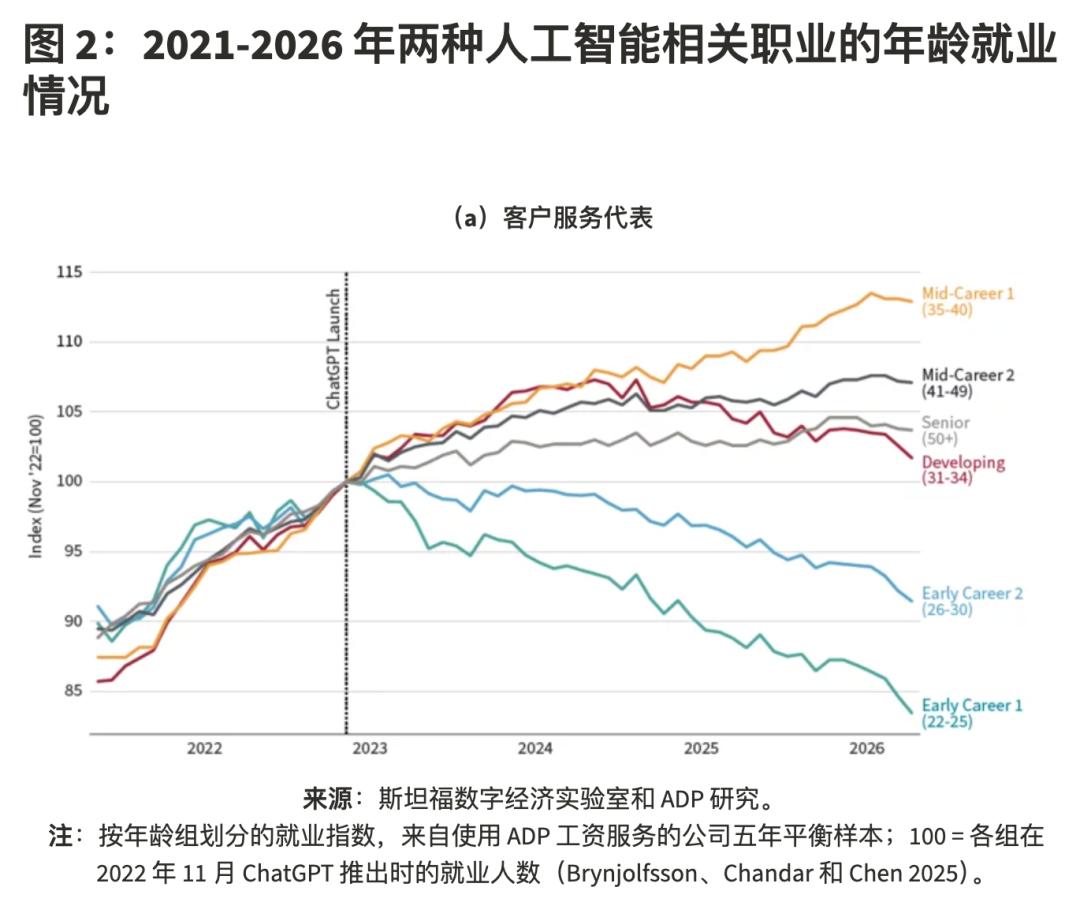
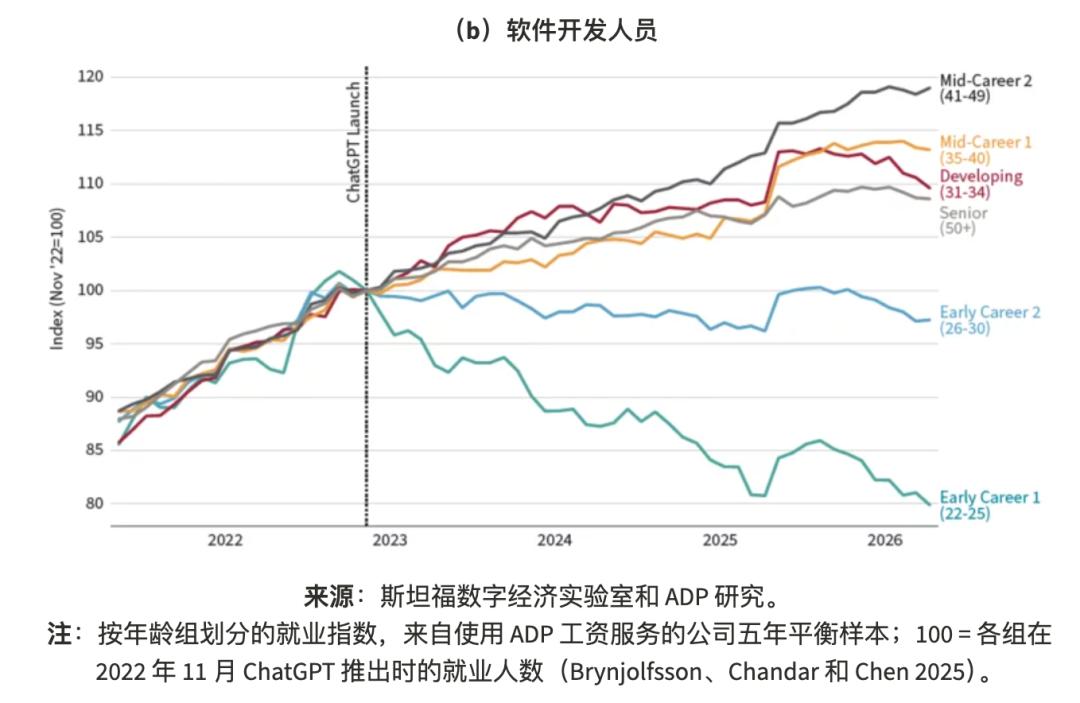
In AI-exposed professions such as software development and customer service, the employment of young workers has declined significantly, while that of senior workers remains relatively stable.
In other words, AI may not have yet triggered a tsunami sweeping across the entire job market, but the lack of work experience may have already washed away part of the entry-level positions in the job market.
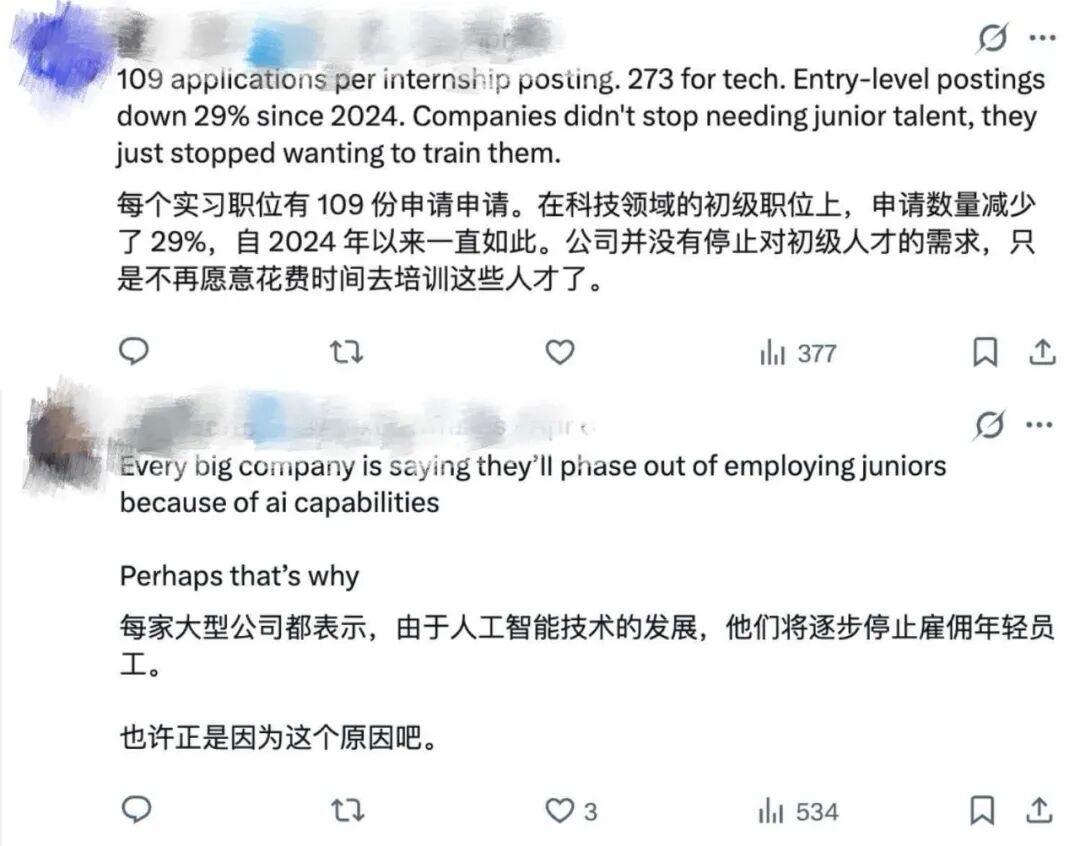
Is this situation caused by AI taking young people's jobs, or is it a combined aftereffect of interest rate hikes, tech industry layoffs, and over-hiring for remote work?
Recently, the Stanford Institute for Economic Policy Research released a policy brief, attempting to find answers from real-world employment, hiring, productivity, and corporate survey data.
The lead author of the paper, Neale Mahoney, is a professor of economics at Stanford University, director of the Stanford Institute for Economic Policy Research, and previously served as a special policy advisor to the White House National Economic Council.
The conclusion drawn by the research team is not straightforward:
AI has not yet caused mass unemployment, but its impacts across different groups of people, job roles, and enterprises are uneven. Recent graduates may have been the first to face this pressure, and the truly far-reaching changes may have only just begun.
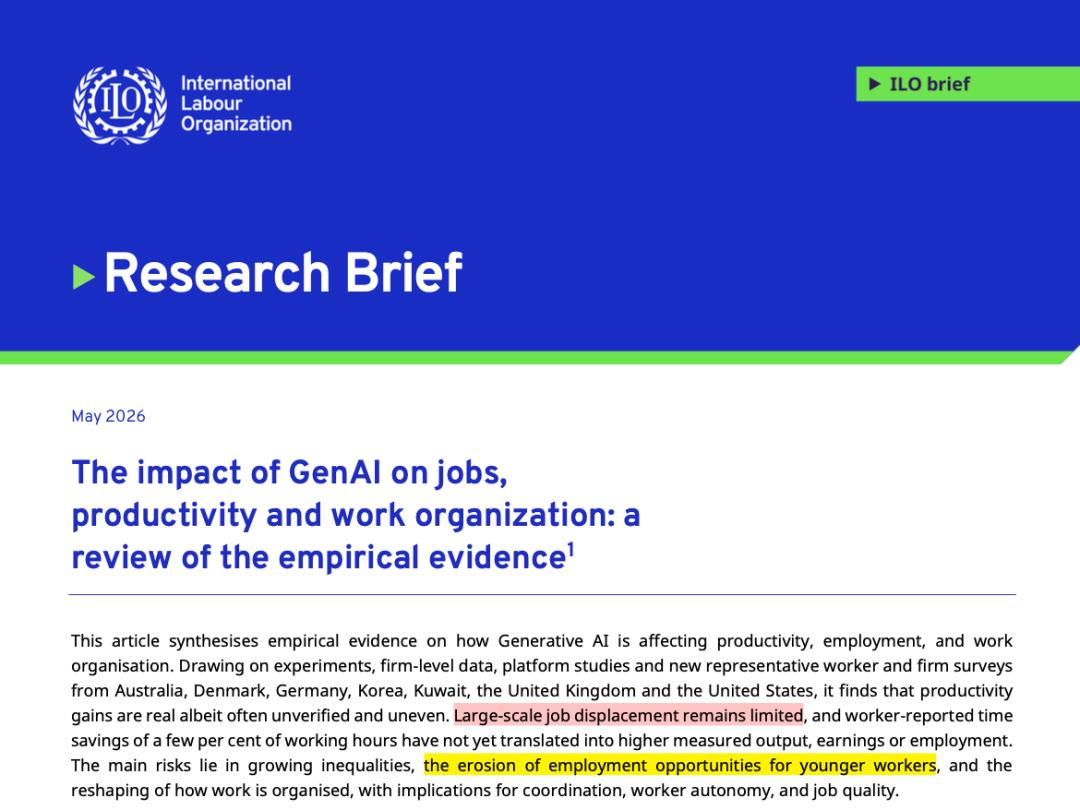
The International Labour Organization (ILO) also issued a warning in its 2026 research brief:
Existing evidence is insufficient to prove that generative AI is causing large-scale job displacement, but some studies have observed that employment opportunities for entry-level positions and young workers in high AI-exposed occupations are decreasing, which may further widen inequality in employment opportunities.
Overall employment has not been disrupted by AI
To start with the conclusion, at least for now, there is insufficient evidence showing that AI is causing mass unemployment.
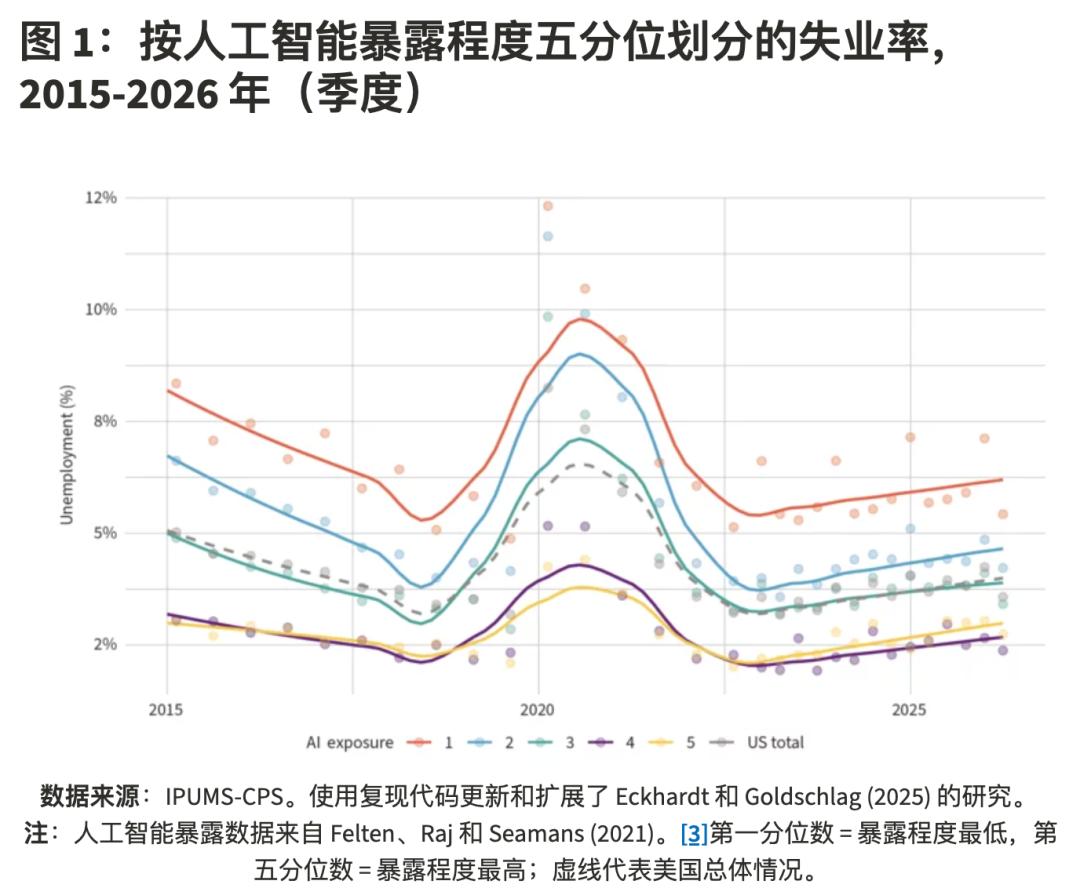
Since 2022, the unemployment rate in professions with the highest exposure to AI has risen by 0.77 percentage points; by contrast, the unemployment rate in professions with the lowest AI exposure has risen by 0.85 percentage points.
In other words, AI has not prioritized eliminating the most easily replaceable positions.
This set of data is more indicative that the entire job market is cooling down, rather than AI launching a targeted strike on certain specific professions alone.
Some positions classified as high-risk areas for AI are not as bad as people might imagine.
Although the employment growth rate of programming-related positions has slowed down, it still maintains overall growth.
In the past year, the number of online job postings for software development positions has even grown faster than that of other professions.
Other research has found that within two years after enterprises adopt AI, their employee size has increased by an average of 10%, and the growth is more significant in enterprises with higher AI investment.
As for companies that cite AI as the reason for layoffs, we should not take their explanations at face value.
These layoffs are all related to AI, but the underlying logic varies.
For example, Meta laid off nearly 8,000 employees to free up funds for hundreds of billions of dollars in AI investments; HP plans to cut 6,000 jobs to streamline operations with the help of AI; while Amazon eliminated about 30,000 positions in two rounds, which was more about absorbing the burden of over-hiring during the pandemic, while expanding the application of AI tools at the same time.
It can be seen that although the disappearance of some positions is directly related to AI automation, we cannot equate every layoff with "AI replaces human" in a simplistic way.
AI may be the real reason for layoffs, or it may simply be the most prominent explanation when enterprises adjust their cost structure and organizational structure.

Compared with direct layoffs, the more common impact of AI at present may be another: enterprises combine work that was previously distributed to multiple people, or simply reduce the recruitment of relevant positions.
So, our jobs may not be taken away immediately, but there may be fewer new job openings available.
Recent graduates are the first to be affected
However, although the overall employment data seems relatively stable, when we zoom in on the young people group, the situation is not so optimistic.

In early 2026, the unemployment rate for recent graduates in the United States reached 5.6%, rising by 1.6 percentage points compared with three years ago, and they are facing one of the toughest job markets in many years.
Behind this situation, AI may indeed have played a contributing role.
Many entry-level positions are responsible for tasks such as information collection, basic analysis, content organization, and copywriting. These tasks were usually assigned to new hires for practice in the past, but now they can be completed quickly by AI.
A widely noticed study found that since the release of ChatGPT in 2022, in AI-exposed professions such as software development and customer service, the employment of young workers has decreased significantly; while the employment situation of senior workers in the same profession is basically stable, or even still growing.
Researchers therefore refer to young workers as canaries in the coal mine, meaning that they are likely the first group to feel the impact of AI.
However, we cannot directly "convict" AI for this situation yet.
The Federal Reserve started raising interest rates in March 2022, several months before ChatGPT was released; tech companies are still digesting the aftermath of over-hiring; the popularity of remote work has also made the ability to "work independently" a more critical measurement standard than "willing to learn". As a result, enterprises are more inclined to recruit senior employees who can get started quickly, complete work independently, and basically require no extra training costs.
After excluding some interfering factors, the significant decline in entry-level positions did not actually appear until 2024.
This time point is worth noting. By 2024, both AI capabilities and enterprise adoption rates have increased significantly, making the explanation that AI has directly impacted new graduate recruitment more convincing.
Therefore, a more accurate statement is not that "AI has already taken young people's jobs", but that "the already sluggish job market for recent graduates may have been further suppressed by AI."
AI does improve efficiency, but you won't get returns just by using it
If AI has not caused mass unemployment for the time being, has it made people work faster?
The answer is generally affirmative, but the effect is far from being as uniform and exaggerated as "everyone's productivity is skyrocketing".

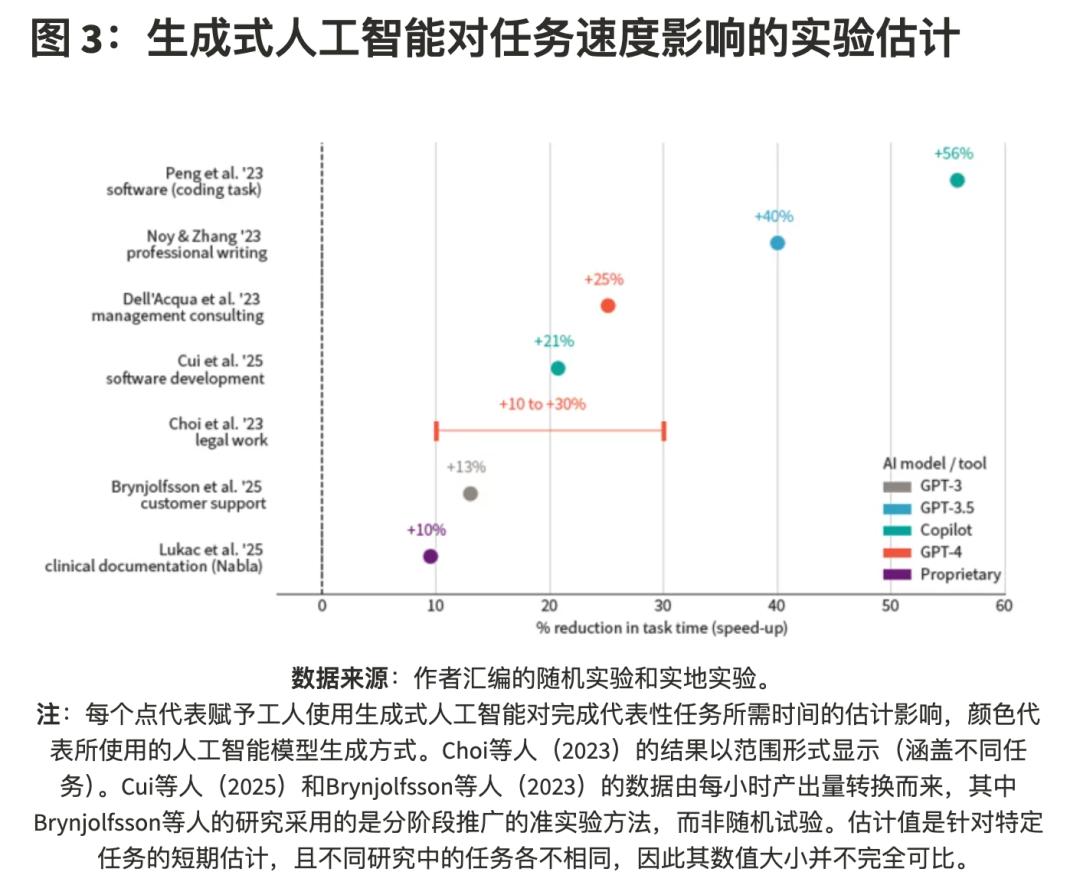
In a large call center, generative AI assistants have increased the overall productivity of customer service staff by 15%. Among them, novice and less skilled employees have achieved the most significant improvement, with the number of issues resolved per hour increasing by 30%.
But experienced customer service staff have hardly improved their efficiency, and the quality of their responses has even slightly declined.
A similar situation also appears in software development.
An experiment shows that GitHub Copilot can make programmers complete tasks 56% faster, and the biggest beneficiaries are still developers with less experience. However, another study measured an improvement of only 10% to 30%, and there are large differences between different enterprises.
Tasks such as writing, contract drafting, and medical record processing also follow a similar pattern: AI usually saves time, but the effect depends on the task itself, the skill level of the user, and whether the user can judge whether AI's output is reliable or not.
This is exactly the crux of the problem.
AI's capabilities are not consistent. The same model that may have delivered impressive performance on one task a moment ago may suddenly underperform on another.

In an experiment targeting Kenyan entrepreneurs, less capable entrepreneurs saw their income and profits decline after using AI. The reason is that they are more likely to directly copy the generic suggestions provided by AI, without judging whether these suggestions are suitable for their own business.
AI may also make creativity increasingly homogeneous.
Studies have found that AI can improve the story quality of some writers, but the stories created with AI are also more similar to each other. After scientists use AI, they publish more papers, but their research topics have narrowed, and their interactions with other researchers have also decreased.
Therefore, AI improves the speed of task completion, but does not necessarily simultaneously enhance the quality of judgment, creativity, and decision-making.
Enterprises are all adopting AI, but their progress varies greatly
Whether the economic impact of AI will break out intensively within three years or penetrate slowly over 20 years largely depends on the speed of enterprise adoption.
The answers from existing surveys show that, the adoption of AI by enterprises is indeed accelerating, but it is far from being fully rolled out.
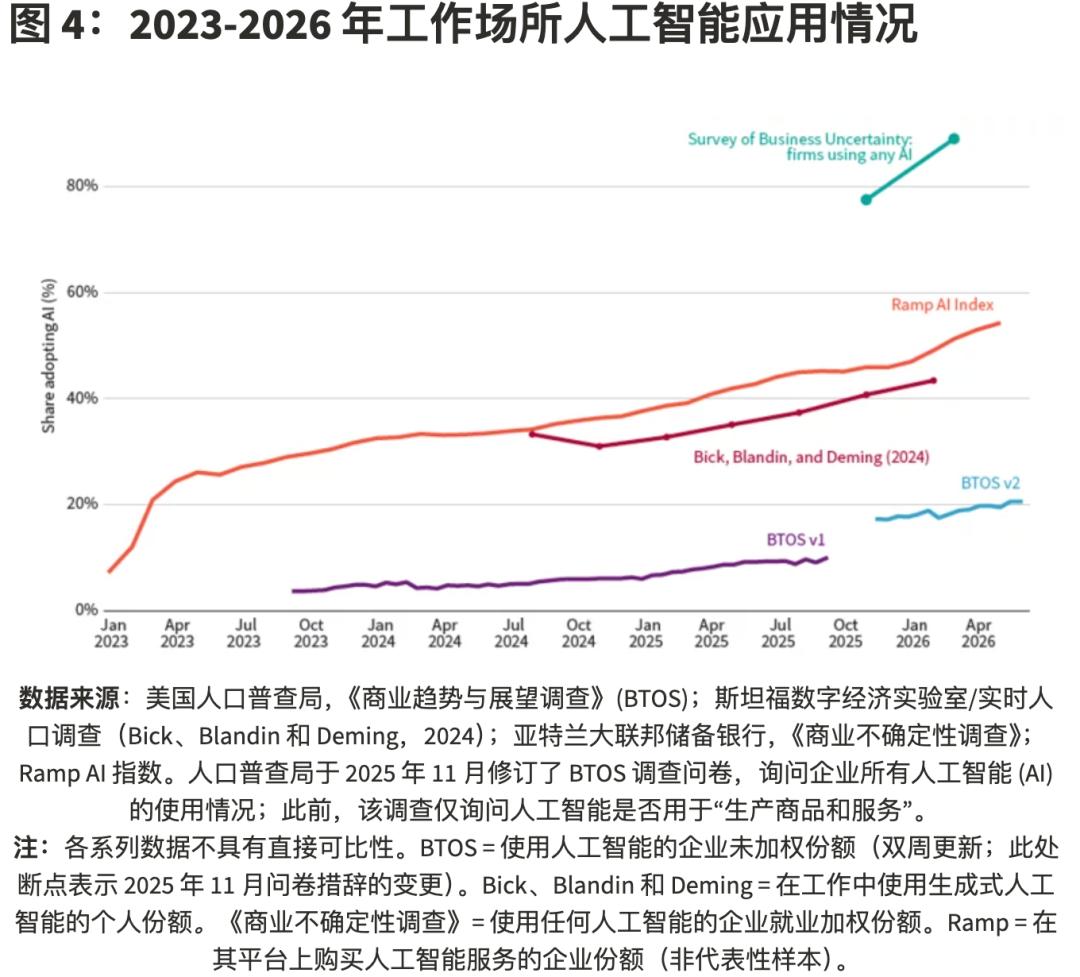
A national survey by the U.S. Census Bureau shows that currently about 20% of enterprises are using AI.