CUDA's 20-year moat crumbled over a single weekend, and Claude has successfully achieved full independent operation on AMD's new GPUs.
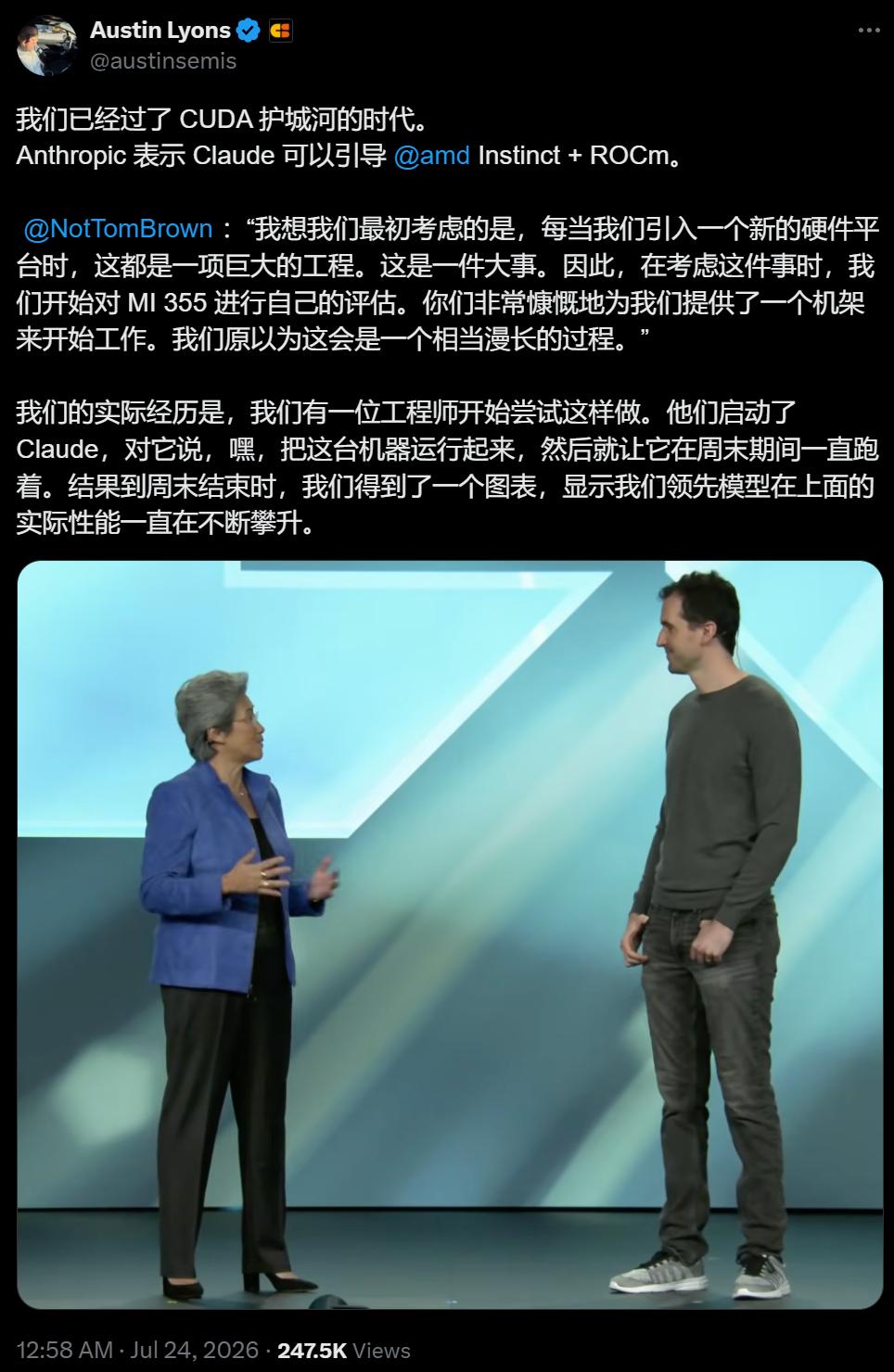
Just one sentence, one weekend — Claude got Anthropic's most advanced model running on a brand-new AMD MI355X rack!
No human engineer wrote or modified a single line of code throughout the entire process.
Who could have imagined that NVIDIA's 20-year-old CUDA moat would be crossed so easily?
In One Weekend, Claude Got AMD's New GPU Fully Working
Here's how the story unfolded.
A while back, AMD delivered a rack equipped with the MI355X to Anthropic.
After reviewing the hardware, the team braced themselves for a tough battle — a new platform paired with a new software stack was bound to require extensive adaptation work.
Fortunately, Anthropic had Claude at their disposal.
The team decided to let one engineer give it a try: they connected Claude to the machine and simply told it, "Go make this machine run."
When the team returned to their desks after the weekend, a steadily rising performance curve was displayed on the screen. Not only was the model running, but its performance was continuously improving iteration after iteration.
After Tom Brown, co-founder and Chief Computing Officer of Anthropic, shared this story, Lisa Su immediately chimed in:
When she learned that only one Anthropic engineer was working on the MI355X, her first reaction was to tell the AMD team to go offer assistance right away.
But the AMD team came back and reported that Anthropic said no help was needed — everything was already fully completed.
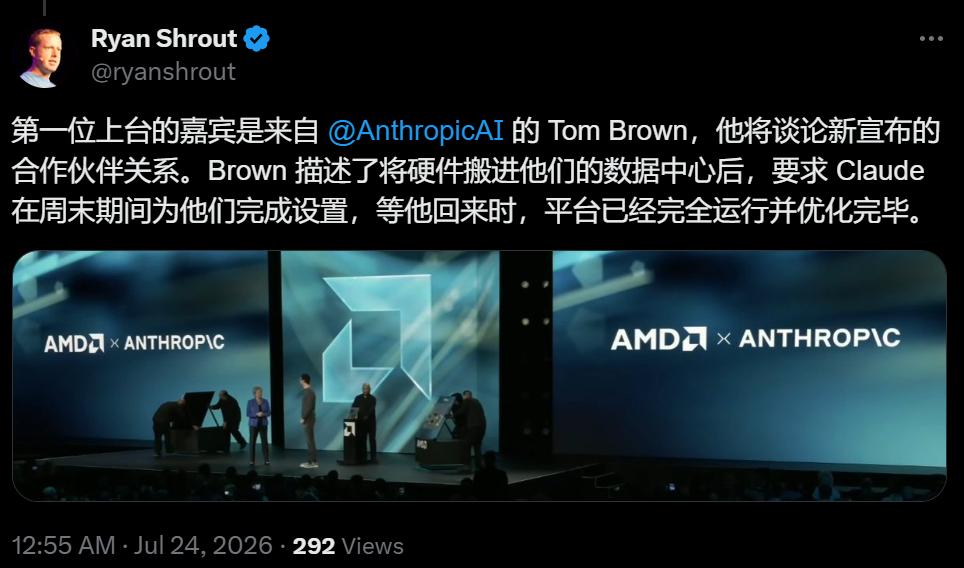
Soon after, this weekend experiment transitioned directly into a formal deployment plan.
Recently, Anthropic announced that it will deploy up to 2GW of Instinct GPUs across AMD Helios systems, with the first 1GW phase scheduled to launch in the first half of 2027.
The two companies will also use Claude directly to optimize AMD workloads and accelerate ROCm software development.
Chip Manuals Now Have a Non-Human Reader
The reason Claude can achieve this "dimensionality reduction strike" against the CUDA ecosystem is that AMD has developed a set of tools specifically designed for AI to tune GPUs.
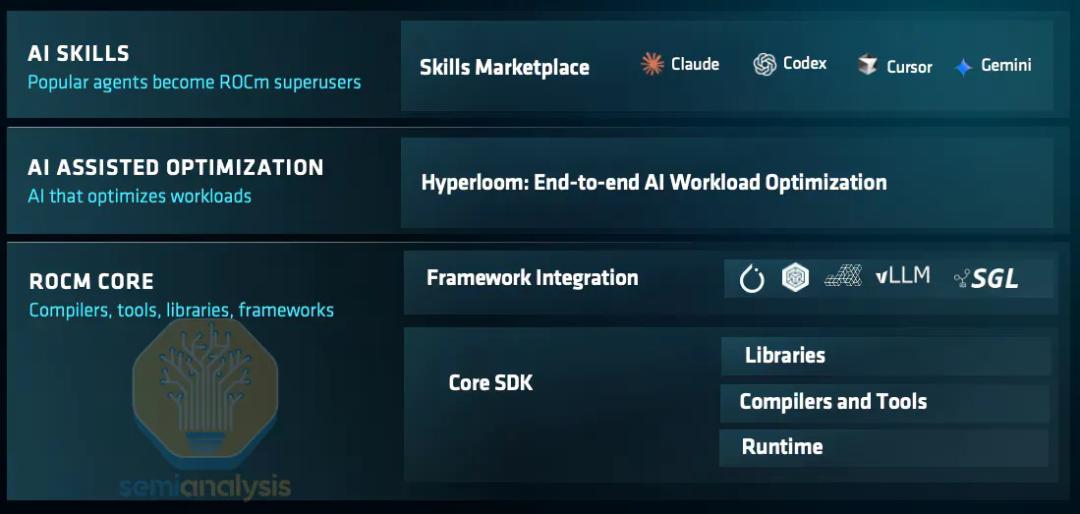
ROCm.AI, unveiled at the AMD Advancing AI 2026 conference, is a complete GPU toolbox built for Claude, Codex, and Cursor.
Its entry point is called AMD Skills, which is preloaded with fully verified ROCm knowledge.
Once Agents acquire this knowledge, they can independently set up environments, deploy models, read logs, diagnose faults, and access real hardware via the ROCm CLI. Developers only need to state their goals, and the Agent will figure out the rest of the workflow on its own.
Key point: AMD has even redesigned how its chip documentation is written.
Anush Elangovan, AMD's Vice President of AI Software and Solutions, revealed on-site that every generation of AMD GPUs will publicly release its instruction set architecture and provide an AI-readable ISA.
Once an Agent understands the documentation, it can directly start tuning performance manually.
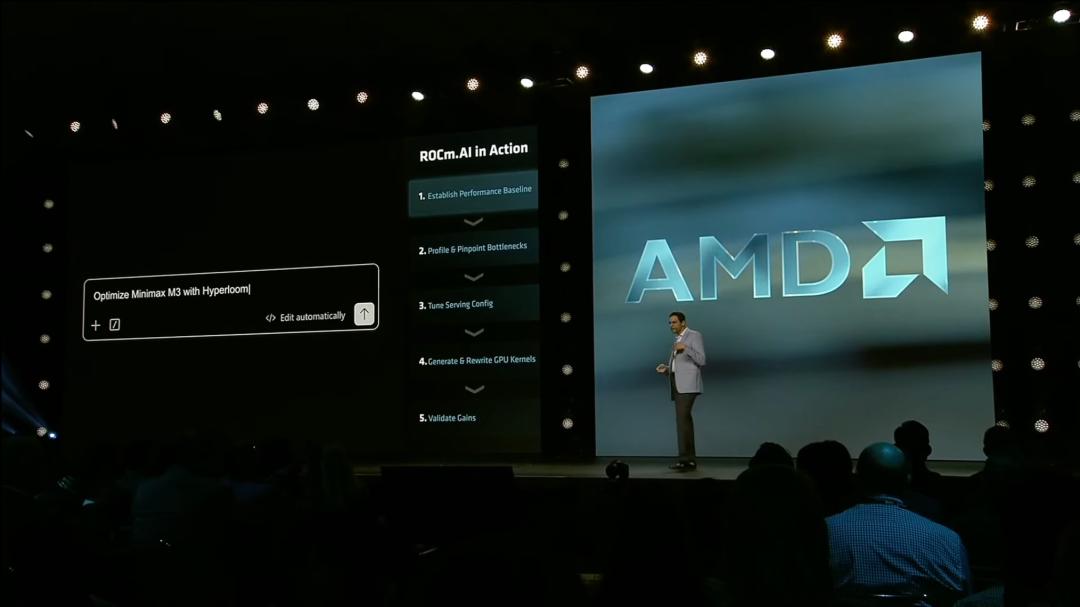
AMD has entrusted this part of the work to Hyperloom. It launches inference services, establishes baseline performance metrics, identifies bottlenecks across CPUs and GPUs, tests different configurations, generates custom kernels, and then re-runs the new optimized solution.
In the on-site demonstration, Hyperloom increased the output speed of MiniMax M3 by 38%. AMD also had it run over 14,000 models in one go, turning the test results into reusable experience that can be directly applied for future tasks.
AMD is also collaborating with leading model developers to refine these capabilities. As Elangovan put it: enabling cutting-edge models to "natively speak AMD's programming language."
In the future, when evaluating a chip, peak computing power and memory bandwidth will of course remain important — but whether AI can understand it, utilize it, and unlock its full performance will also be listed on the same specification sheet.
Chip companies now have a new category of developers to cater to: Agents.
The Dimensionality Reduction Strike from ASI
Over the past 20 years since its launch in 2006, CUDA has built its ecosystem through countless lines of code written by generations of engineers.
Compilers, math libraries, debuggers, performance profiling tools, and comprehensive development documentation — everything you could need is available.
What's even harder to replicate is the accumulated hands-on expertise built up by successive generations of engineers.
How to tune operators, accelerate communication, allocate memory efficiently, and identify where distributed deployments are most likely to fail — all this experience is locked in the minds of a small group of specialists.
Even if a latecomer manufactures a chip with comparable performance, they still have to traverse the entire long software development path from scratch. While chip tapeouts can be progressed on a quarterly cycle, ecosystem accumulation can only be achieved over years of effort.
This is exactly the gap that Agents fill.
They can read platform documentation, use performance analysis tools, locate speed bottlenecks, modify code, compile, and run tests. If one solution doesn't work, they immediately try another; if benchmark results improve, they continue optimizing in that direction.
Training a top-tier human GPU engineer takes years, but spinning up an additional Agent only requires launching a new task.
A single engineer can deploy a fleet of Agents to parallelly troubleshoot errors and pinpoint performance bottlenecks. Successfully validated configurations, optimized kernels, and lessons learned from past failures can immediately become the starting point for the next batch of Agents.
Condensing a years-long catch-up process into task-based progress is where AI delivers its greatest value. This is the ASI-style capability that delivers a dimensionality reduction strike against the CUDA ecosystem.
Today, Chinese engineers are at the forefront of this AI-driven transformation of the GPU software stack, and their deep, low-level accumulated experience is being organized into capabilities that more Agents can leverage.
A new starting point for catching up to CUDA has arrived: hand over hardware interfaces and software tools to AI, and let Agents get straight to work.
For the first time ever, a 20-year ecosystem gap can be closed by a fleet of Agents working around the clock to narrow it down.
This article is from the WeChat public account "AI Era", author: ASI Insights, published with authorization from 36Kr.