Just now, Kimi K3 went open-source, with 2.8 trillion parameters released globally, which has left Silicon Valley giants utterly stunned.
Reported by Zhidx on July 28, Moonshot AI has just released the model weights and technical report of Kimi K3, and open-sourced the key infrastructure technologies that support Kimi K3's model training: MoonEP, FlashKDA, and AgentEnv.
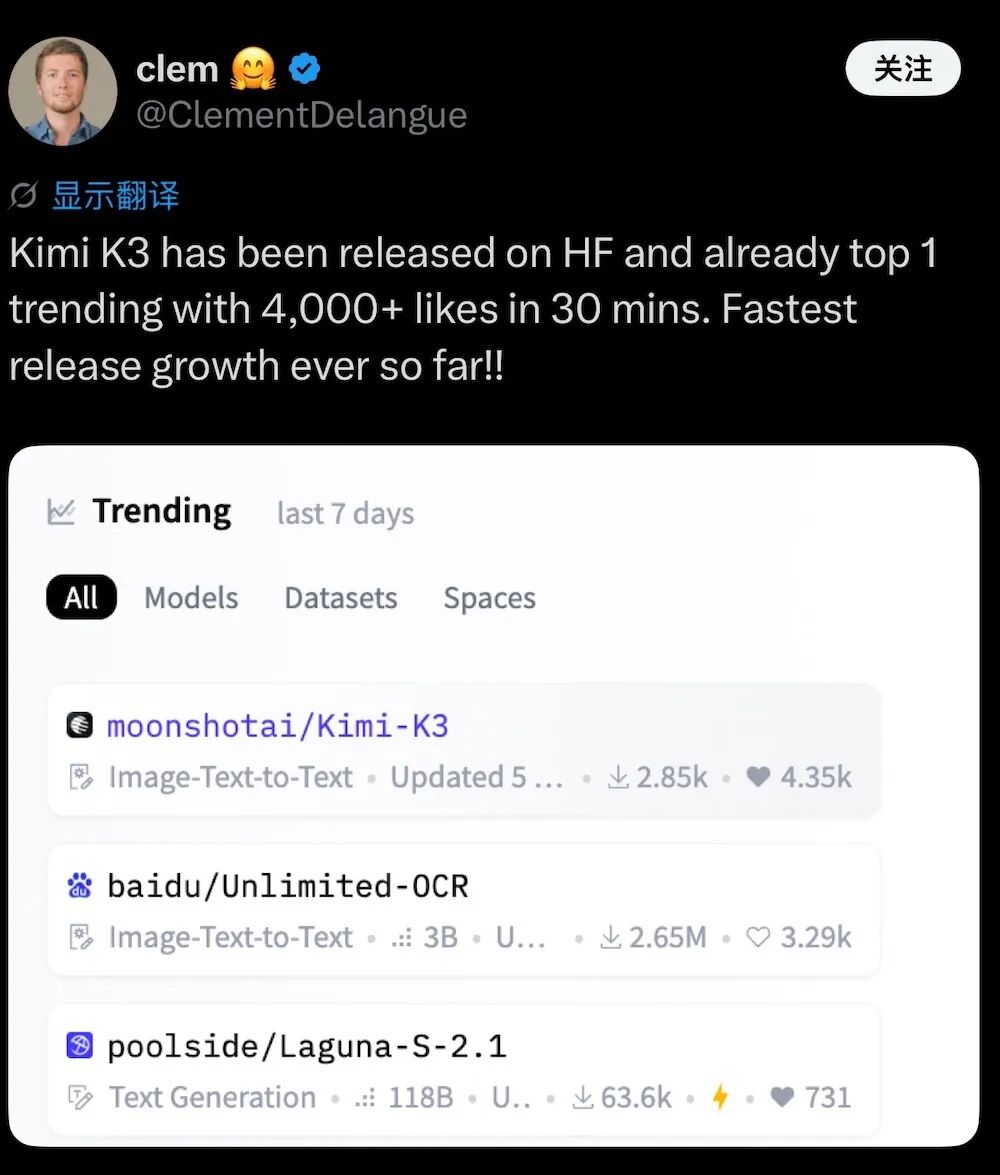
Hugging Face CEO Clem Delangue posted that Kimi K3 topped the trending list with over 4000 likes in 30 minutes. The fastest release growth rate ever!
Earlier on July 17, Moonshot AI released Kimi K3 with 2.8 trillion parameters, which was soon called "China's Fable 5 moment" by many netizens for its excellent benchmark performance and real-world experience.
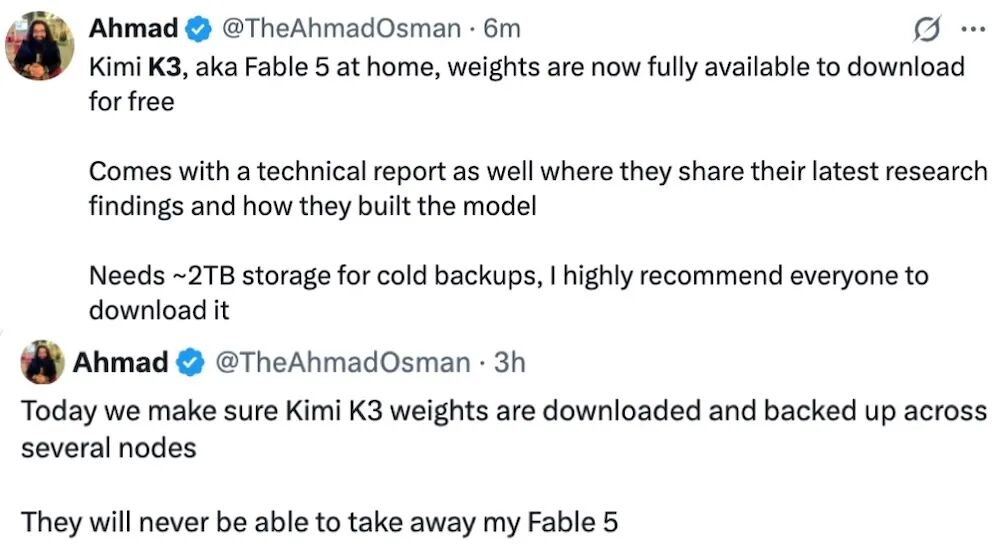
After Kimi K3 was open-sourced, Ahmad, Founder and CEO of North American AI infrastructure startup OsmanticAI posted, referring to Kimi K3 as the "local Fable 5" and "strongly recommending everyone to download and experience it", so that "they can never take my Fable 5 away".
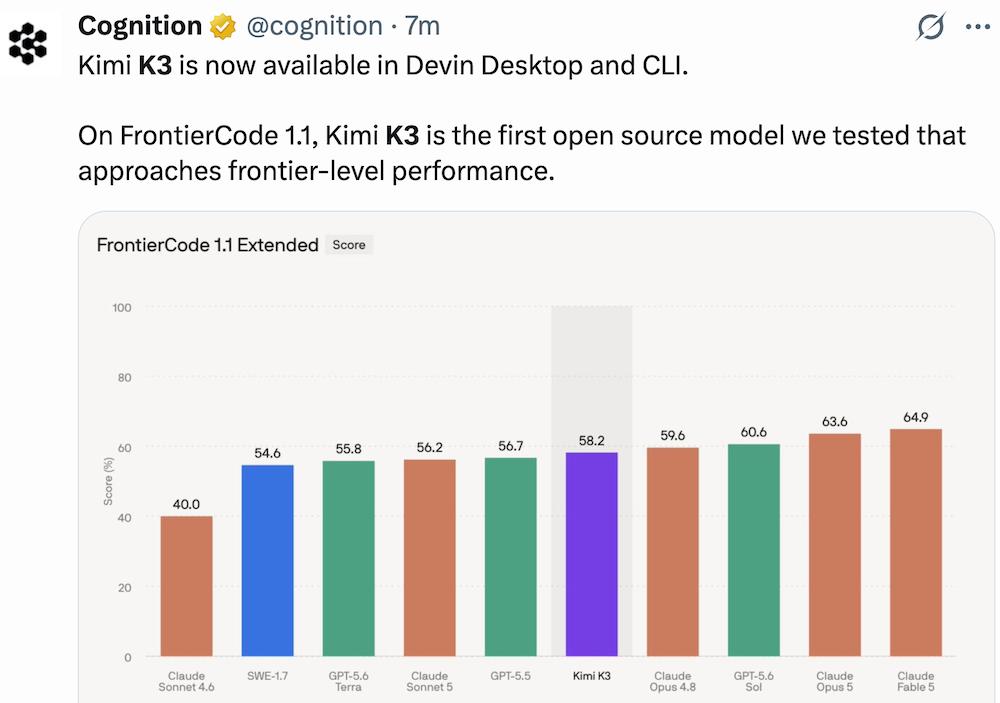
Cognition, the well-known U.S. AI startup that developed the digital employee Devin, announced that Kimi K3 is now integrated into the Devin desktop client and command-line tool (CLI), stating: "On the FrontierCode 1.1 evaluation benchmark, Kimi K3 is the first open-source model we have tested whose performance is close to the cutting-edge level."
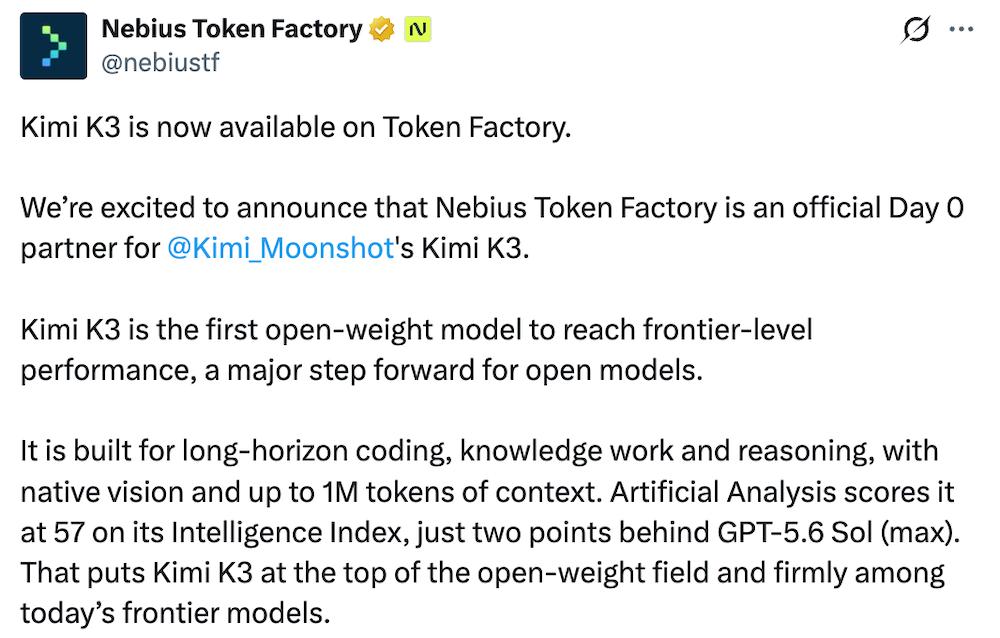
Overseas AI infrastructure vendors including Nebius, Baseten, and Fireworks soon announced Day 0 adaptation for Kimi K3. Nebius stated: "Kimi K3 is the first open-weight model to reach cutting-edge performance levels, representing a major advancement in the development of open models."
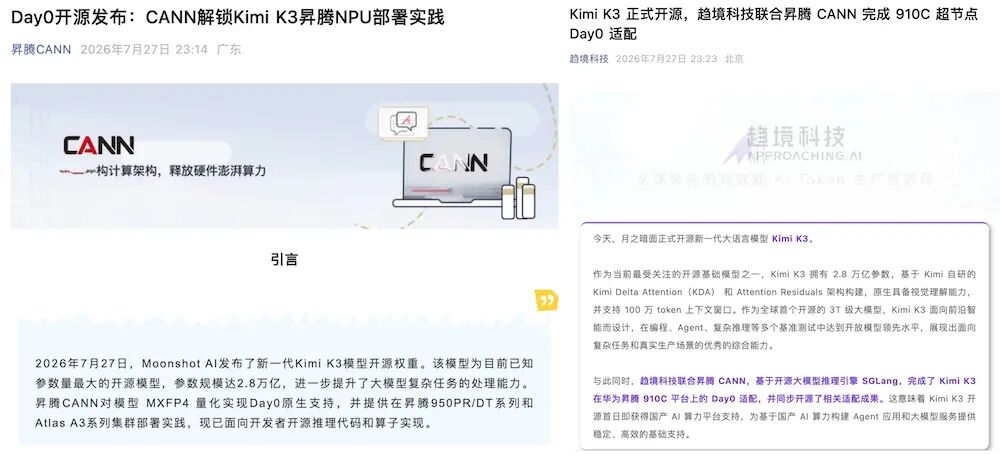
Huawei Ascend CANN announced native Day 0 support for MXFP4 model quantization, and provides cluster deployment practices for the Ascend 950PR/DT series and Atlas A3 series. Meanwhile, Edge Computing Tech announced that based on the open-source large model inference engine SGLang, it has completed the Day 0 adaptation of Kimi K3 on Huawei Ascend 910C supernodes, and open-sourced the relevant adaptation results simultaneously.
Discussions among netizens before Kimi K3's launch were also extremely heated. Some netizens posted jokingly that Hugging Face even created a pre-launch webpage for Kimi K3.
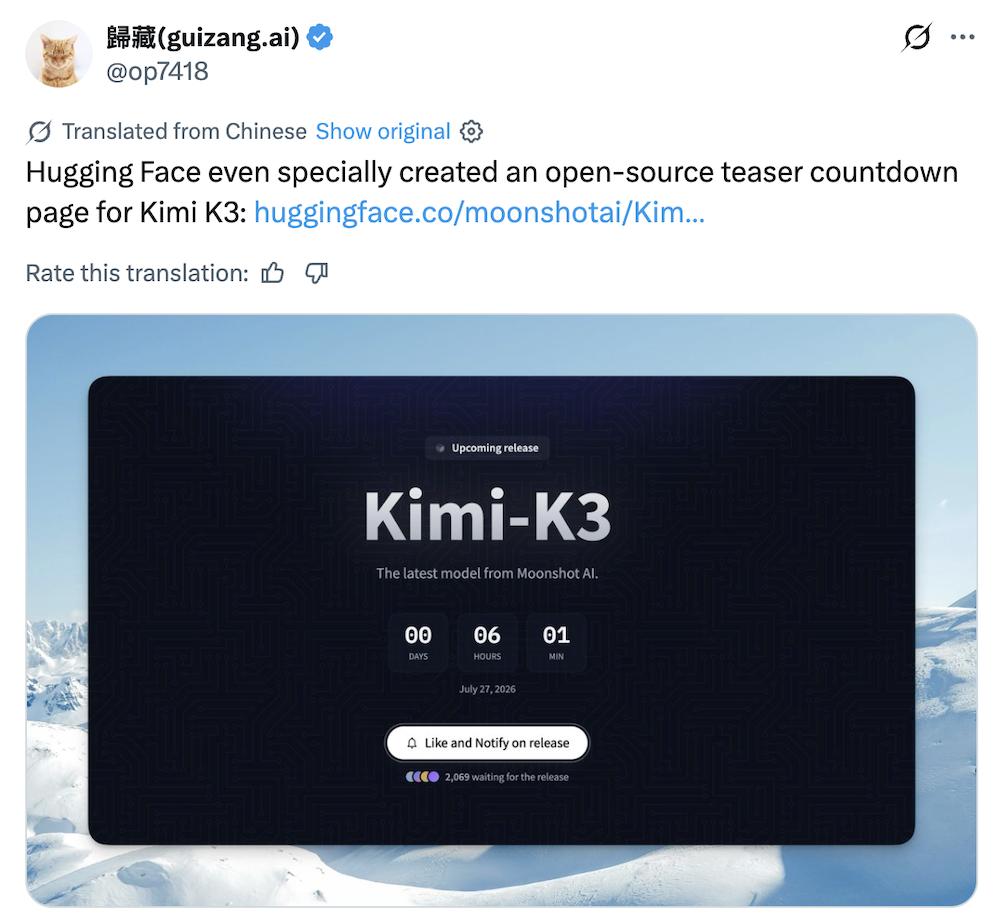
Half an hour before Kimi K3 went online, nearly 3700 developers were waiting for its release. And 10 minutes before the launch, the Kimi K3 access page briefly showed a 404 error.

Model weights address: https://huggingface.co/moonshotai/Kimi-K3
01 Full Access to 2.8 Trillion Parameter Model Weights, Three Key Infrastructure Technologies Open-Sourced
Kimi K3 is a Mixture-of-Experts (MoE) model with 2.8 trillion parameters, featuring native visual understanding capabilities and supporting a 1 million-token context window.
Now, everyone can download and deploy the Kimi K3 model. Whether for internal R&D or embedding into end-user-facing products, it can be used freely.
This release of Kimi K3 also open-sourced its training system, namely three infrastructure technologies at the infrastructure layer: MoonEP, FlashKDA, and AgentEnv.
Among the three open-sourced infrastructure technologies, MoonEP is a high-performance communication library designed for ultra-fine-grained MoE, ensuring extreme efficiency for expert parallel communication even under imbalanced conditions.
FlashKDA is a high-performance operator for Kimi Delta Attention. On NVIDIA H20, its prefill speed is 1.72-2.22 times higher than the flash-linear-attention baseline, and can be directly used as a replacement backend.
AgentEnv is a sandbox system developed in cooperation with KVCache.ai, which provides a high-fidelity, strongly isolated runtime environment for large-scale Agent training, supporting fast snapshots, recovery, and forking to handle massively parallel Agent workflows. Among them, FlashKDA has been open-sourced previously, while MoonEP and AgentEnv are officially open-sourced with this release.
In terms of model architecture, KDA+AttnRes mixes KDA and Gated MLA at a 3:1 ratio, enhancing cross-layer information flow through block-level attention residuals to achieve efficient long-context modeling.
Stable LatentMoE enables each token to activate 16 out of 896 routing experts, maintaining training stability at extremely high sparsity through SiTU-GLU and Quantile Balancing.
The MoonViT-V2 visual encoder is trained from scratch using next-token prediction without contrastive pre-training, achieving baseline performance while obtaining a more stable optimization process.
In terms of post-training, the model has undergone large-scale task synthesis in three major domains: general reasoning, general Agents, and programming Agents, paired with reinforcement learning infrastructure for million-token contexts, and completed full evaluation across nearly 20 internal evaluation datasets.
02 Multi-Dimensional Evaluations Verify Comprehensive Improvements in Programming, Agent, and Visual Capabilities
In the officially announced evaluation results, Kimi K3 demonstrates strong capabilities in multiple directions such as programming, Agent tasks, and visual understanding.
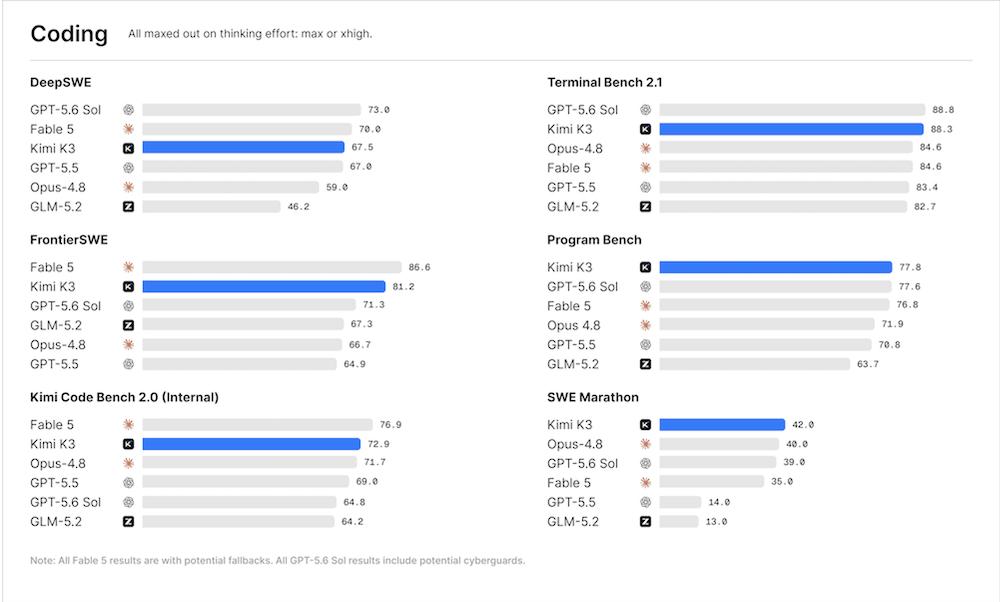
In terms of programming capabilities, Kimi K3 performs outstandingly in tests including the ultra-long sequential continuous development SWE Marathon, software reverse engineering Program Bench, and terminal operation and maintenance Terminal Bench 2.1.
Among them, it ranks first in both SWE Marathon and Program Bench, and scores 88.3 in Terminal Bench 2.1, close to GPT-5.6 Sol; in the high-difficulty software engineering task FrontierSWE, Kimi K3 ranks second with 81.2 points, second only to Claude Fable 5.
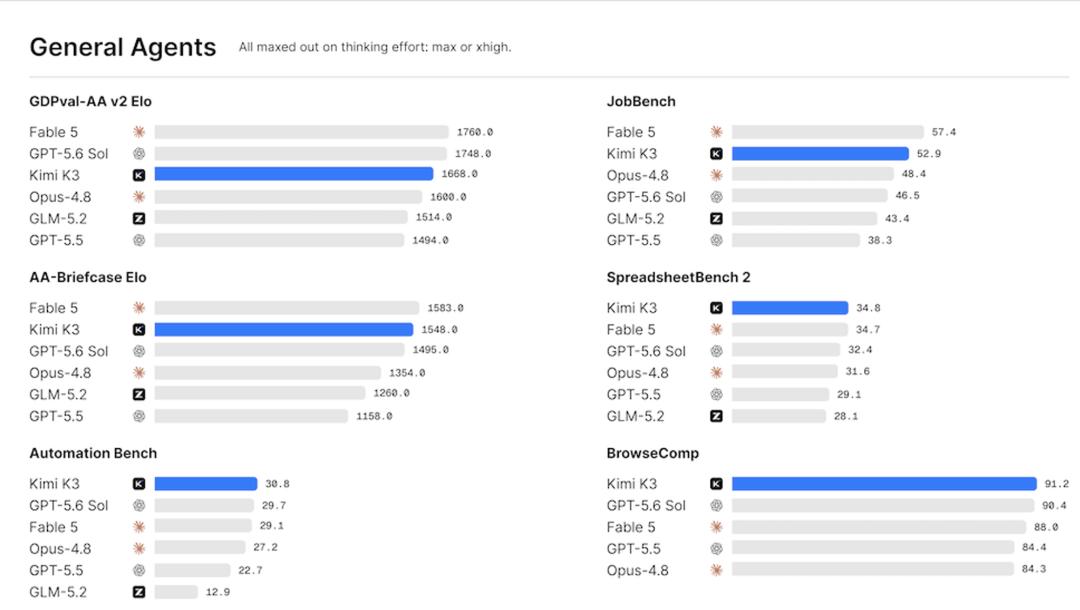
In Agent and knowledge work scenarios, Kimi K3 also demonstrates strong task execution capabilities. It takes the lead in tests such as in-depth web research BrowseComp, office automation Automation Bench, and Excel financial modeling SpreadsheetBench 2, scoring 91.2 points in BrowseComp and ranking first in both Automation Bench and SpreadsheetBench 2.
However, in evaluations that are closer to real office workflows, such as the comprehensive white-collar task GDPval-AA v2 and APEX-Agents, Kimi K3 is still weaker than top closed-source models like Claude Fable 5.
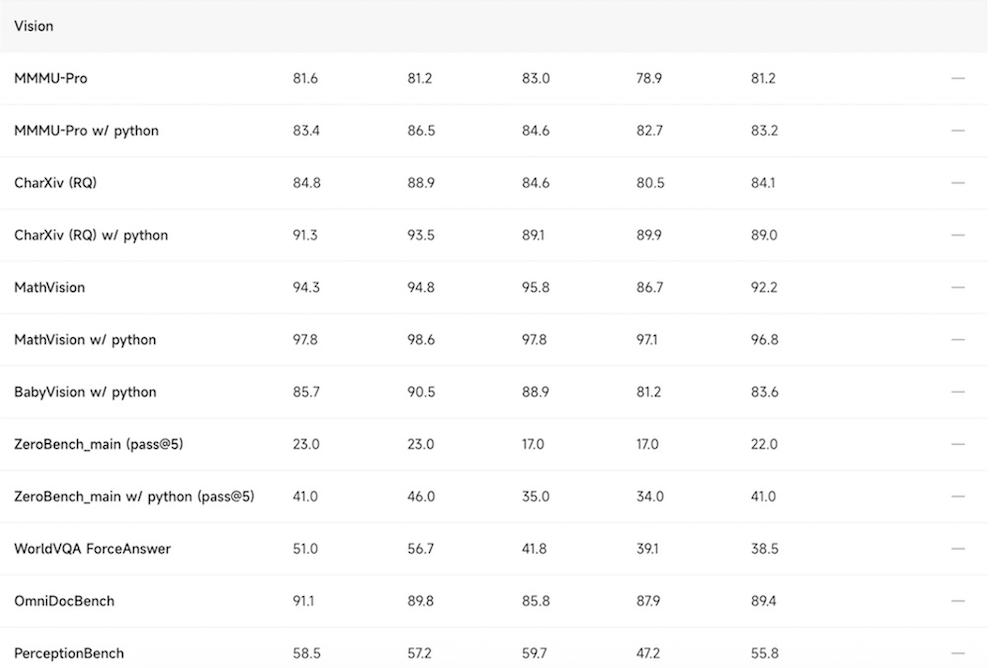
In terms of visual capabilities, Kimi K3 performs strongly in tasks such as chart understanding CharXiv and document analysis OmniDocBench, scoring 91.1 points in OmniDocBench and outperforming multiple models in the comparison; however, there is still a gap in some visual reasoning tasks, for example, it scores lower than Claude Fable 5 in the zero-shot visual tool task Zerobench.
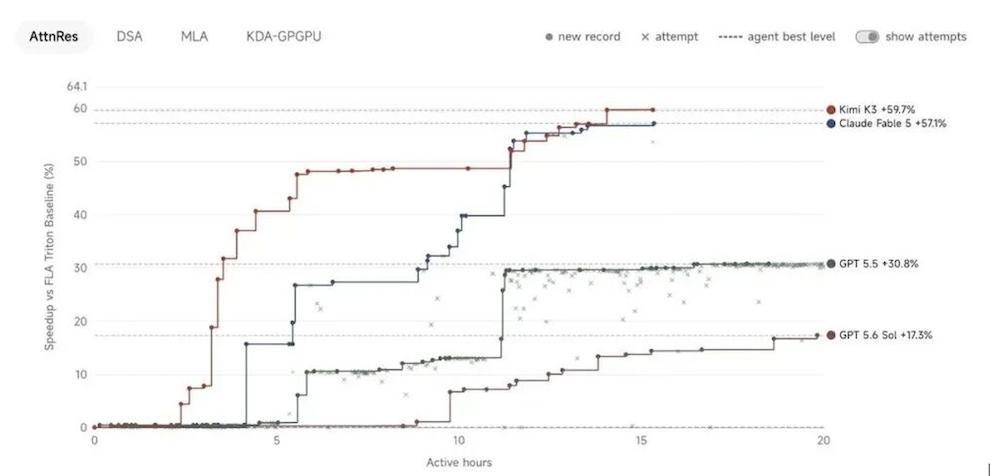
Moonshot AI also tested the engineering capabilities of Kimi K3 internally. In the GPU kernel optimization test, Kimi K3 needs to independently complete code analysis, kernel rewriting, and performance verification, covering GPU computing tasks such as AttnRes, KDA, and MLA. The results show that under maximum inference intensity, Kimi K3's performance is close to Claude Fable 5 (including fallback mechanism) and exceeds Claude Opus 4.8, GPT-5.6 Sol, and GPT-5.5.
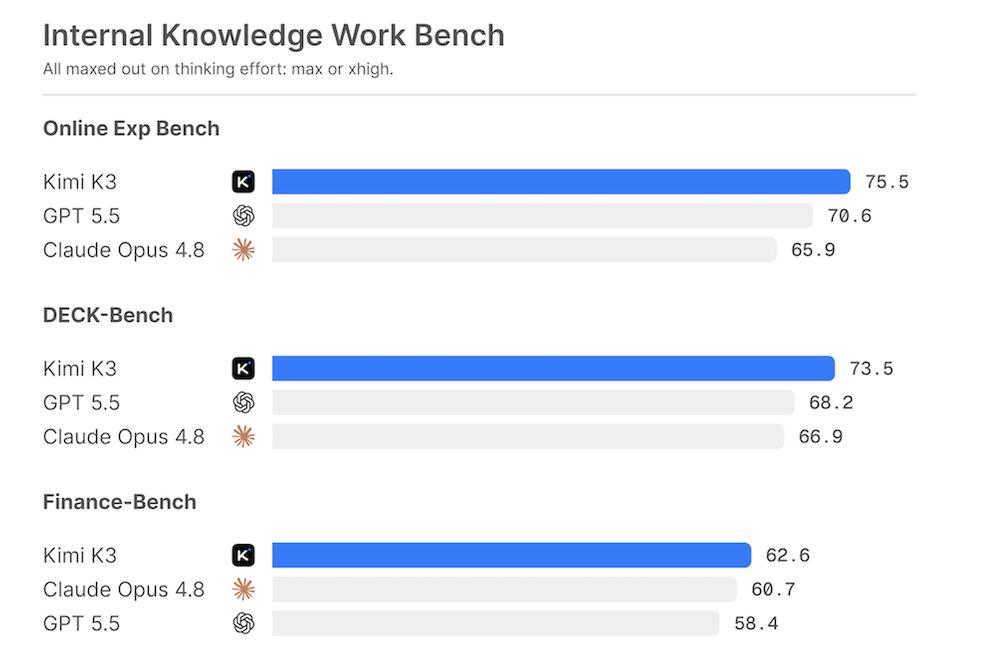
In terms of knowledge work, Moonshot AI's internal Internal Knowledge Work Bench test shows that after uniformly enabling the maximum deep thinking mode, Kimi K3's performance in three types of tasks: general reasoning, deep document analysis, and financial specialization, all exceeds GPT-5.5 and Claude Opus 4.8.
03 Kimi K3 Tackles Complex Tasks: Generating Games, Designing Chips, and Analyzing Scientific Research Data
After Kimi K3 was released, Zhidx tested the model's multimodal and code generation capabilities under the Kimi K3 Max mode. In the test requiring the generation of a 3D side-scrolling fighting game, the prompt involved complex settings such as "a dilapidated city map invaded by Decepticons", "low-polygon style", "5 Optimus Prime faction characters", and "5 Decepticon variant enemies". Kimi K3 completed the game creation in one attempt without any errors.
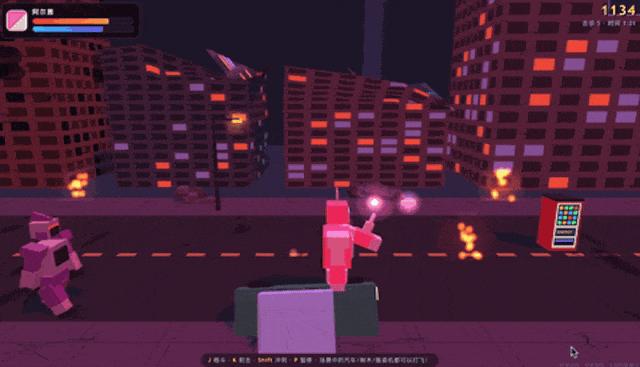
Overseas developer @He1s_Sammy conducted a comparative test of Kimi K3, GPT-5.6 Sol, and Fable 5 in the game design scenario, inputting exactly the same prompts to all three, and conducting a comprehensive evaluation based on solution quality, gameplay experience, and invocation cost.
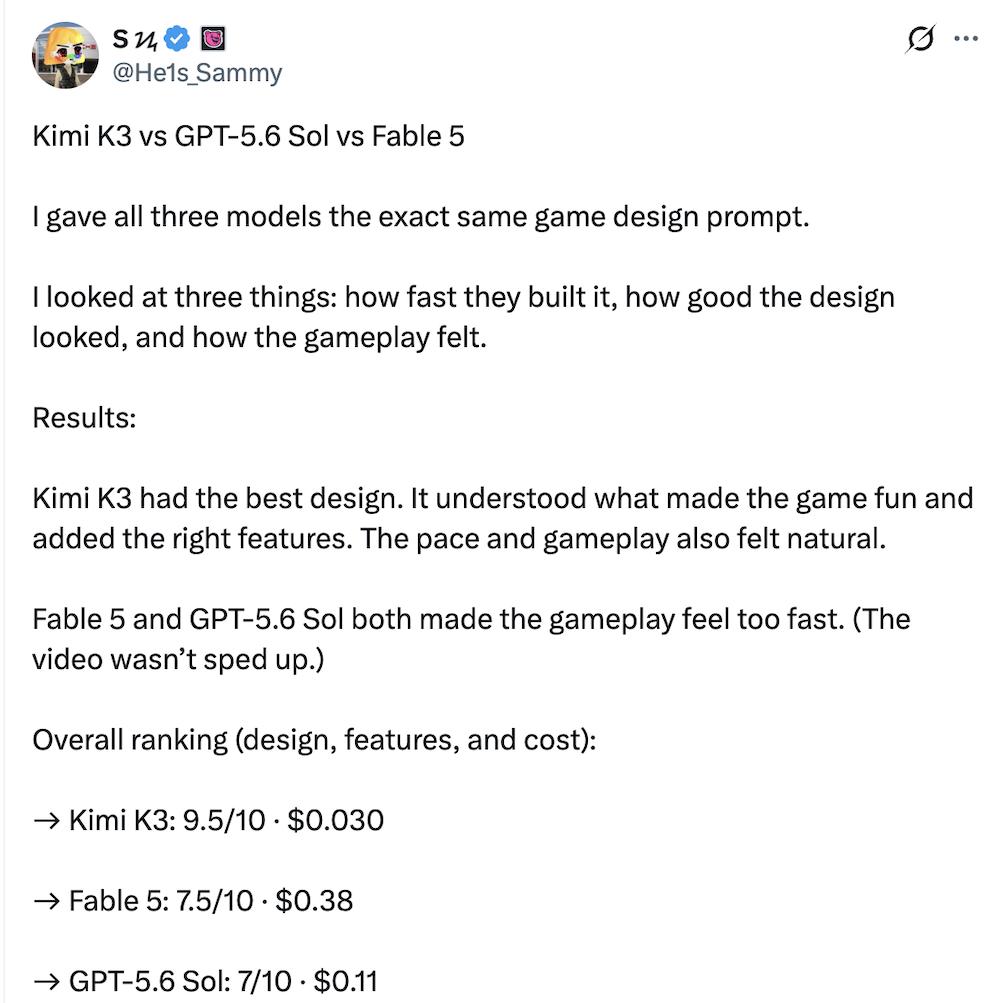
The test results show that Kimi K3 delivers the best