vivo earbuds support Wi-Fi. With Qualcomm and Xiaomi taking the lead, will the micro-power Wi-Fi ignite the AI hardware sector?
Are Headphones Going to Support Wi-Fi Now?
Recently, we discovered that vivo's new-generation flagship true wireless headphone vivo TWS 5 Pro is not only equipped with dual dynamic-balanced drivers, an independent Hi-Fi DAC, and 60dB noise cancellation, but also supports Wi-Fi lossless audio transmission at up to 4.6Mbps. While this feature is currently only compatible with select vivo phones such as the X300 series and X Fold6, its transmission rate is higher than the 4.2Mbps of last year's Xiaomi Buds 5 Pro Wi-Fi Edition, making it the highest wireless audio transmission rate among true wireless headphones to date.
However, vivo uses a proprietary solution, which is not the Qualcomm XPAN used by Xiaomi, and fundamentally different from the Wi-Fi headphone concept envisioned by Qualcomm.
vivo Wi-Fi Headphones Are Not the Same as Qualcomm XPAN
According to vivo's specifications, the TWS 5 Pro adopts a "point-to-point direct connection between the phone and the headphone". Whether Wi-Fi lossless audio works depends on the phone's current WLAN connection status and the frequency band in use. Enabling this feature will also occupy part of the phone's WLAN capability. The headphones do not connect to home or office Wi-Fi networks like phones and computers, let alone bypass the phone to directly access the internet.
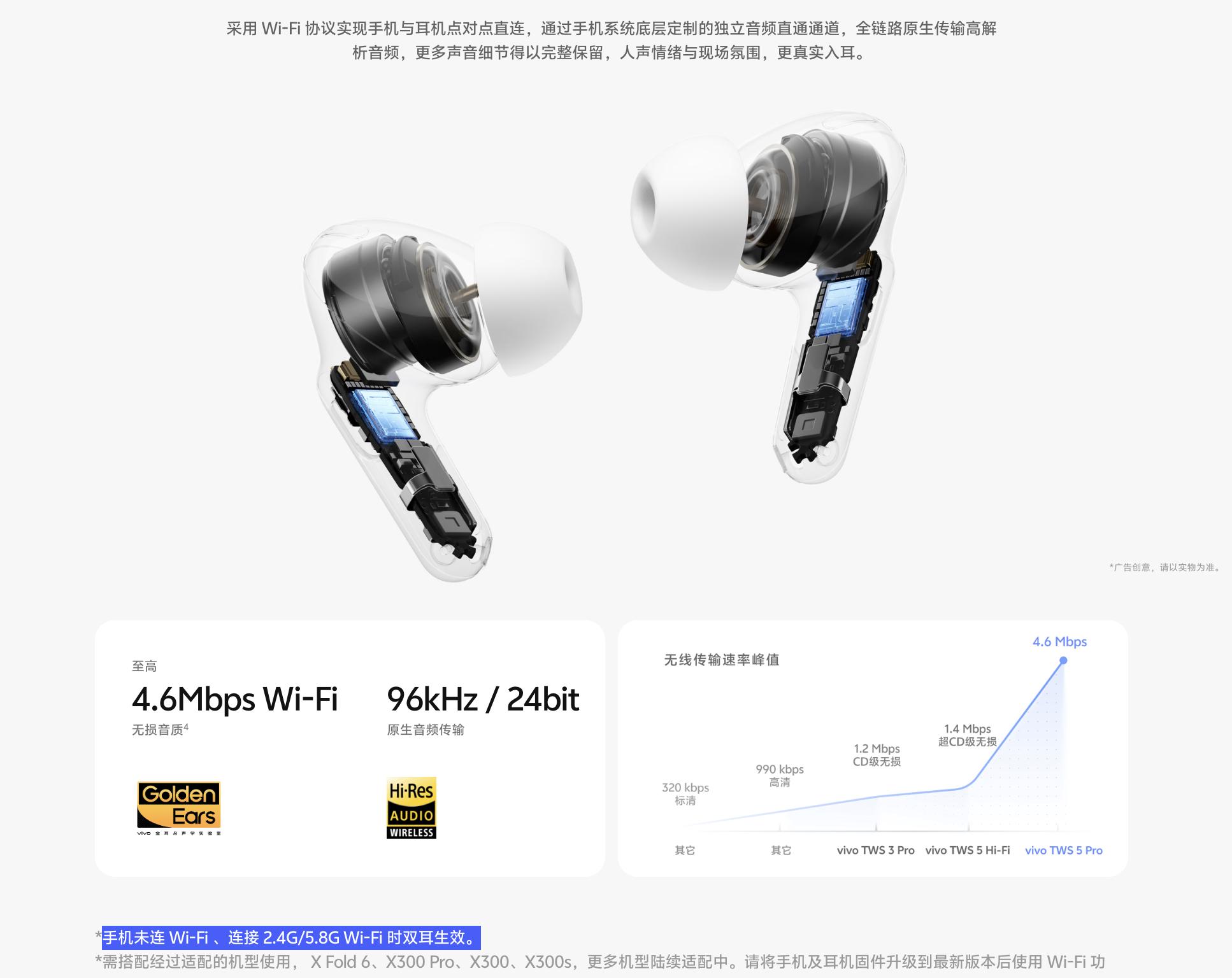
Image Source: vivo
In simple terms, vivo simply replaced the audio link between the phone and the headphone from Bluetooth to Wi-Fi. It solves the problem of insufficient Bluetooth bandwidth, and the phone remains the center of the entire experience.
Qualcomm XPAN follows a different path. Using micro-power Wi-Fi to transmit high-bitrate audio, XPAN allows headphones to connect to existing Wi-Fi access points, continuing to play music, make calls, or use AI assistants even beyond Bluetooth range. Bluetooth and Wi-Fi are not mutually exclusive—the system dynamically selects the appropriate link based on bandwidth, distance, and power consumption.
More importantly, Qualcomm has also proposed Direct to Cloud around the same micro-power Wi-Fi capability. Small wearable devices can obtain independent IP connections to communicate directly with cloud-side agents, without having to use the phone as a relay every single time.
Headphones are just the first product form to launch and the easiest for users to understand. What I am more eager to follow up on is what will happen after Qualcomm extends the same micro-power Wi-Fi capability to personal AI terminals.
However, apart from the first true wireless headphone adopting XPAN—the Xiaomi Buds 5 Pro Wi-Fi Edition—no other products using this solution have been launched in the market over the past year or more, making it feel more like a joint "experiment" between Qualcomm and Xiaomi. But in May this year, Qualcomm has made it clear that more XPAN-enabled products are under development, and a new generation of XPAN is also in planning, which will be introduced alongside upcoming new products.
From a timeline perspective, the Snapdragon Summit to be held in late September will most likely bring more definitive updates. Here's a preview: Leitech has been invited to this AI hard technology event in Hawaii, USA. Our reporting team will bring you the latest information as soon as it is available—stay tuned.
Xiaomi Made the First One, But XPAN Did Not Solve All Problems
Back in 2023, Qualcomm released the Snapdragon S7 Pro Gen 1 audio platform that supports XPAN. The actual consumer product did not launch until 2025: the Xiaomi Buds 5 Pro Wi-Fi Edition became the world's first true wireless headphone adopting XPAN, supporting up to 4.2Mbps, 96kHz/24bit lossless audio transmission.
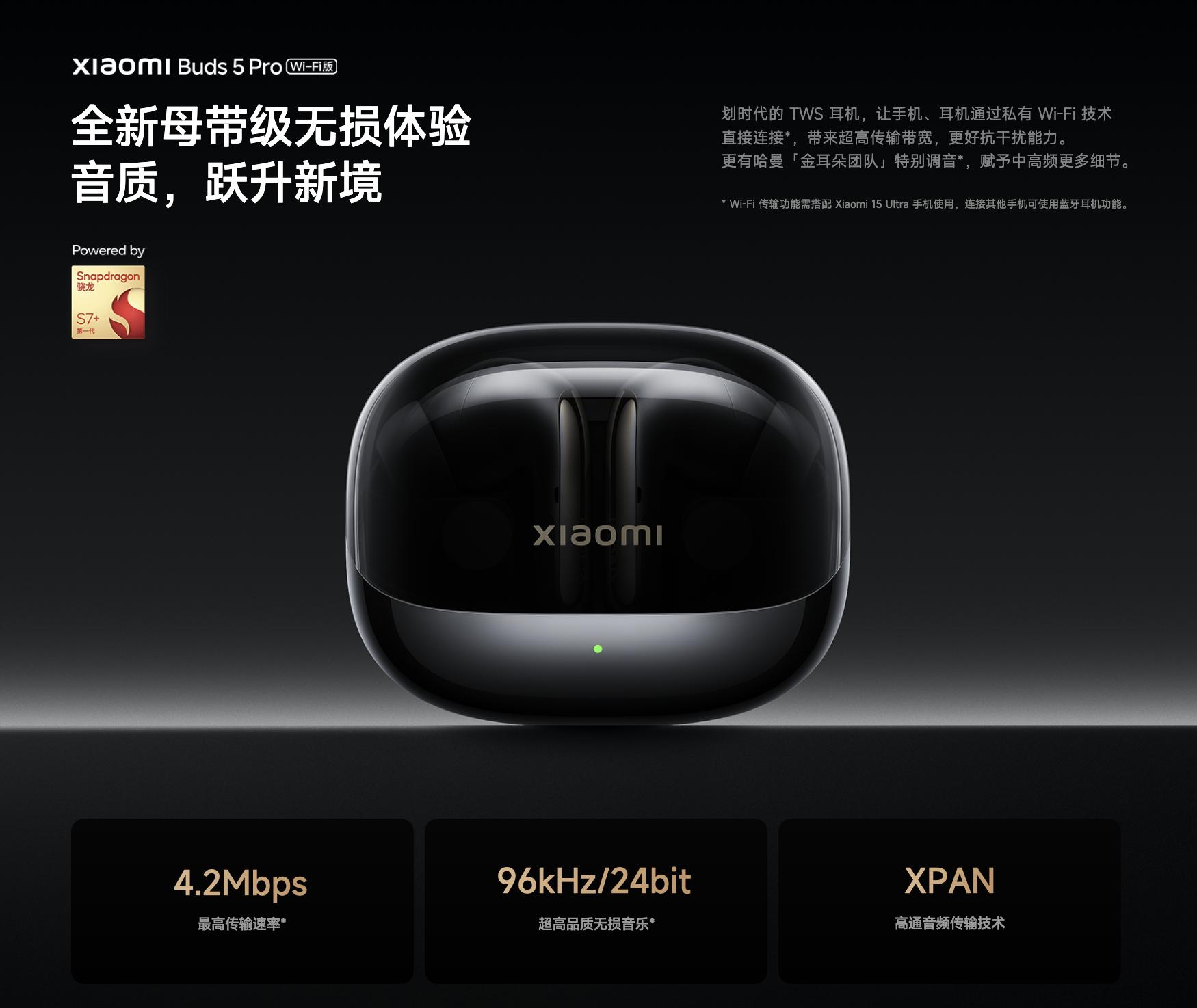
Image Source: Xiaomi
Moreover, the single-headphone battery life of the Wi-Fi Edition can reach 10 hours, which at least proves the power consumption value of micro-power Wi-Fi connection technology.
On paper, the Xiaomi Buds 5 Pro Wi-Fi Edition looks quite attractive. But it is basically only supported by new-generation models such as the Xiaomi 15, Xiaomi 17 series, and MIX Fold 4. At least for now, this Xiaomi "Wi-Fi headphone" still has strong experimental attributes.
XPAN, short for Expanded Personal Area Network, retains both Bluetooth and Wi-Fi while the system dynamically selects the link: low-bandwidth calls can continue to use more power-efficient Bluetooth; when playing high-bitrate lossless music or when the user walks out of the Bluetooth coverage area, it switches to micro-power Wi-Fi. It can utilize existing 2.4GHz, 5GHz, and 6GHz Wi-Fi access points, without requiring homes and offices to replace dedicated routers.
In short, Bluetooth has always had the advantages of power efficiency, convenience, and maturity, but its problems are limited bandwidth and short coverage range; traditional Wi-Fi features large bandwidth and wide coverage, yet it is difficult to integrate into a true wireless headphone that needs to work continuously for hours. What XPAN truly aims to do is reduce Wi-Fi power consumption to a sufficiently low level, and let the system decide when it is worth enabling Wi-Fi based on scenarios.
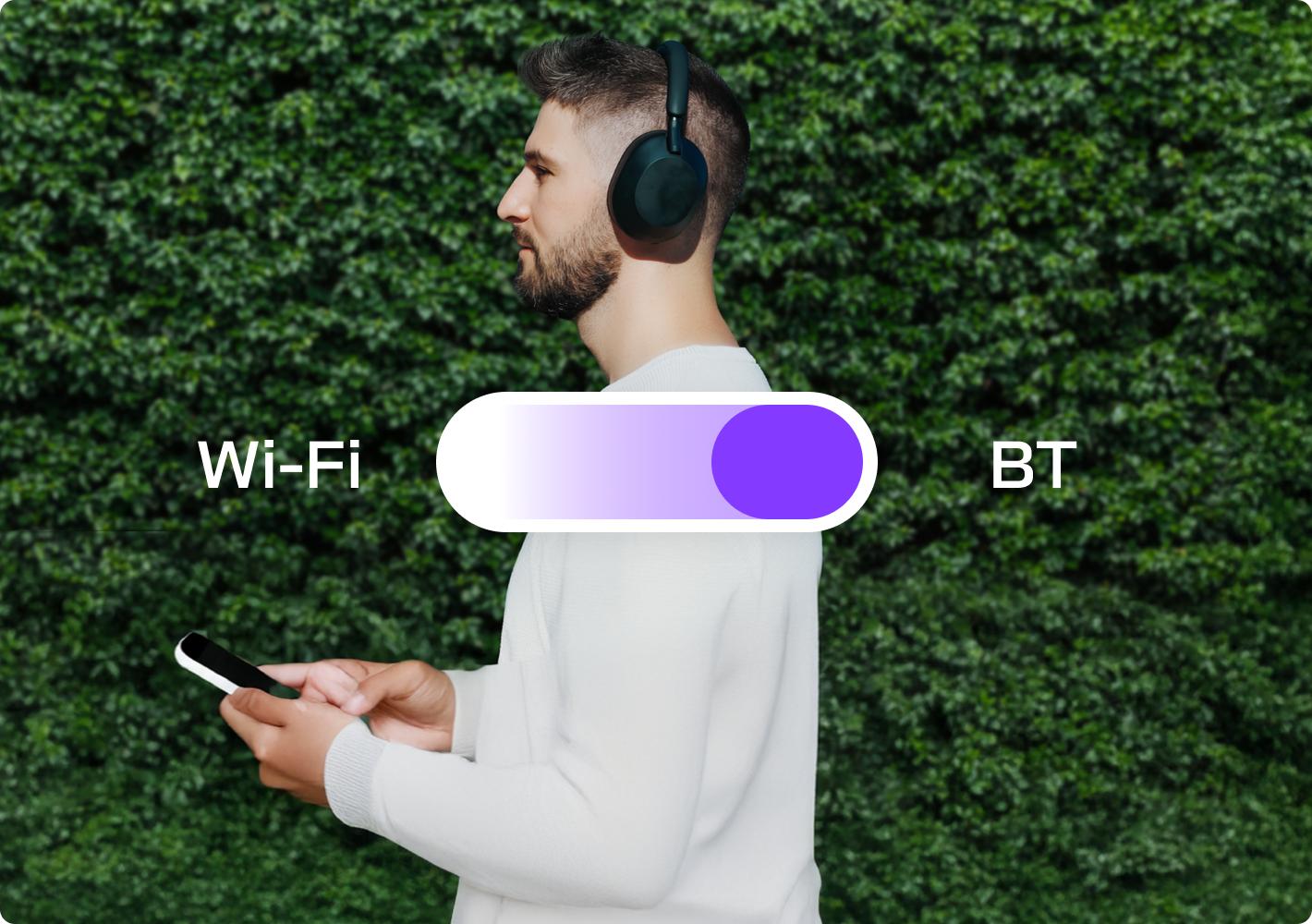
Image Source: Qualcomm
Once achieved, headphones will not need to make too many compromises between "low latency" and "high bitrate", and users will no longer hear intermittent sound on the second floor when their phone is left on the first floor. Qualcomm currently claims that XPAN supports up to 24bit/192kHz lossless audio; when transmitting 24bit/96kHz lossless audio, its power consumption can be comparable to that of 96kHz lossy Bluetooth transmission, and it may even be more power-efficient in higher bandwidth scenarios.
To be fair, these capabilities have not been fully realized in Xiaomi's first product. However, the compatibility issues exposed by XPAN are more due to the first-generation ecosystem not being fully deployed; the contradictions in bandwidth, coverage, and power consumption it solves are real long-standing problems for the entire wearable industry. And headphones are just the most accessible test field for users to perceive.
With Wi-Fi Power Consumption Reduced to Bluetooth Levels, Personal AI Terminals Will Be Always-Online
At the Lenovo Tech World Innovation Conference @CES this January, Qualcomm CEO Cristiano Amon specifically mentioned a connectivity technology when talking about next-generation personal AI devices:
"We are achieving a breakthrough capability: running Wi-Fi at Bluetooth-level power consumption, so that even when users are far away from their phones, they can obtain an IP address and maintain a persistent connection to agents through cellular networks."

Image Source: Qualcomm
The importance of this statement may be greater than how high a bitrate a Wi-Fi headphone can transmit.
At first glance, it is easy to get confused. The key point emphasized by Amon is actually "obtaining an IP address": small wearable devices no longer have to borrow the phone's internet connection only via Bluetooth—when Wi-Fi coverage is available, they can also directly connect to cloud-side agents. Of course, Wi-Fi will not replace Bluetooth and cellular networks; the three will work in tandem according to different scenarios.
Over the past decade, wearable devices have basically evolved around smartphones. Watches, bands, headphones, and glasses connect to the phone via Bluetooth, and then borrow the phone's network and applications. The advantage is power efficiency, but the downside is obvious: once Bluetooth disconnects, many so-called "smart" features disappear; if a full cellular communication module is directly embedded, it will bring higher power consumption, larger size, and a whole set of costs including tariffs, certification, and antenna design.
For traditional fitness bands, this dependency may not be a problem. But personal AI terminals require a different mode of operation.
In Amon's vision, devices like glasses, headphones, necklaces, and brooches will become the user's personal AI companions. They need to understand the environment and user intentions under user authorization, continuously preserve context, and respond instantly when needed. AI will run collaboratively locally and in the cloud, with the device side responsible for wake-up, perception, and part of the inference, while handing over complex tasks to cloud models.
This means the connection cannot be temporarily established only after the user opens an app. It needs to be available at any time without draining the battery nonstop.
Micro-power Wi-Fi exactly fills this middle gap: in Wi-Fi-covered homes, offices, schools, and public spaces, small wearable devices can obtain their own IP connections to exchange data directly with cloud-side agents, without having to use the phone as a relay every time. After leaving Wi-Fi coverage, Bluetooth, the phone, or low-power cellular networks will take over. It is never a single connectivity technology that solves all problems—different networks each address their most adept use cases.

Image Source: Qualcomm
This will not make wearable devices break away from smartphones overnight, but it will turn the phone from a "must-pass path" between personal AI devices and agents into a collaborative device.
The Snapdragon W5+ Gen 1 Wearable Platform that Qualcomm released in March has already turned this concept into platform capabilities. In addition to micro-power Wi-Fi, the platform also integrates 5G RedCap, Bluetooth 6.0, UWB, GNSS, and narrowband satellite communication. Different connectivity technologies take on different tasks: Bluetooth handles short-range low-bandwidth interactions, Wi-Fi undertakes indoor high-speed transmission and cloud access, and 5G RedCap provides more independent wide-area connectivity outdoors.
At COMPUTEX 2026 in June, Amon gave a more specific metric: Qualcomm's technology coverage has extended to headphone platforms below the 2mW level, allowing headphones to connect to agents via micro-power Wi-Fi.
If this technology truly matures, personal AI terminals will likely see three distinct changes:
First, greater independence. AI glasses no longer need to send every object recognition request to the phone in the user's pocket; AI headphones will not just play sounds sent by the phone, but can directly connect to the user's agents. The devices will still collaborate with the phone, but will no longer be just wireless peripherals of the phone.
Second, greater continuity. For personal AI to be useful, it cannot only remember what the user just asked—it also needs to understand where the user is, what they are doing, and the unfinished tasks on the previous device. Micro-power Wi-Fi provides a channel that can be established on demand and maintain low-power online status, allowing the context captured by glasses, heard by headphones, and perceived by watches to converge on the same agent within the scope of user authorization.
Third, more flexible form factors. In the past, manufacturers developing AI hardware often had to choose two out of three priorities: internet connectivity, battery life, and compact size. After connectivity power consumption decreases, headphones, glasses, pendants, and even smaller wearable form factors will have room to allocate battery and antenna space to sensors, on-device AI computing power, or simply become lighter.
Of course, technical feasibility does not guarantee product success. Always-on connectivity will push privacy, security, and user authorization to a more sensitive position; home Wi-Fi coverage does not equal ubiquitous online access; interoperability of connections, accounts, and agents across different brands is far more challenging than embedding a chip into headphones.
Personal AI terminals need a more power-efficient, stable connection, but they also need a product rationale that makes users willing to wear them long-term, willing to share data, and truly solves their problems.
Micro-Power Wi-Fi Is the Next Big Thing for Wearable Devices
The commercialization pace of XPAN is not fast, and the upcoming new products are certainly worth paying attention to. But the focus of this article is not discussing whether Wi-Fi headphones can become popular, but whether the underlying "micro-power Wi-Fi" technology can be truly utilized by more small wearable devices.
When Wi-Fi can run at power consumption close to Bluetooth, small wearable devices will have the opportunity to obtain their own IP connections, communicate directly with cloud-side agents through Direct to Cloud, without having to detour through the phone every time. The phone will still participate in collaboration, but will no longer be the only path for all data and requests.
This certainly will not immediately create some kind of "ultimate device" that replaces smartphones. Wi-Fi coverage, cross-brand compatibility, privacy authorization, agent services, and actual product value are all indispensable. Micro-power Wi-Fi only solves the problem of "how to stay always-online", and has not yet answered why users need an always-online personal AI device.
Conversely, without low-power, stable, and relatively independent connectivity, the so-called "always-online", "always-perceiving", and "instantly-responsive" features can only remain as concepts in press conferences.
Therefore, what Leitech cares more about is not how high the audio quality of the next batch of Wi-Fi headphones can reach. The more imaginative change is that headphones, glasses, and more close-to-body devices can directly connect to cloud-side agents without going through the phone. Wi-Fi headphones are just the beginning. Whether personal AI terminals can truly take a step away from smartphones may depend on this connectivity that few people paid attention to in the past.
This article is from the WeChat official account "Leitech", authored by Leitech, and published with authorization from 36Kr.