36Kr Exclusive | Ex-DJI Engineers Founded a Startup Developing Intelligent Tennis Serving Machines, and the Products Have Launched Mass Delivery in Overseas Markets
Author | QIAO Yujie
Editor | YUAN Silai
36Kr has learned that intelligent sports hardware company "AceiiLab" has started mass delivery. Previously, it completed an angel round of financing of over 10 million RMB, invested by Zero One Capital, Variable Capital, and Hyee Capital. The funds will be mainly used for product R&D iteration and market expansion.
AceiiLab was founded in December 2024. It cuts into the market with AI tennis robots, and attempts to build an intelligent training ecosystem covering hardware, software, data, AI coaches and sports services. The company's founder LIU Liqian has more than 10 years of experience in robot R&D and product development, and has engaged in R&D work at enterprises such as DJI and KUKA. The co-founder CHAO Guang previously worked in investment institutions and robotics companies, and has long focused on investment and operational growth in the intelligent hardware field. The team covers robotics segments including drones, autonomous vehicles, commercial cleaning, lawn mowing, and pool cleaning. They have accumulated rich experience in the overseas expansion of consumer hardware, and possess full-link capabilities from product definition, R&D to marketing promotion.
With the gradual maturity of AI capabilities, robotics technology and sensor technology, an intelligent upgrading trend is emerging in the sports consumption sector. Compared with traditional sports equipment, intelligent sports hardware is evolving from data recording to assisting training and enhancing experience, covering multiple scenarios such as smart fitness equipment, sports wearables, and AI training partners. Among them, sports with strong training attributes such as tennis, badminton, and golf have become important directions for intelligent hardware exploration due to their high technical thresholds and repetitive training requirements.
From AceiiLab's perspective, traditional tennis serving machines only provide "fixed-point serving", but what tennis training really needs is a consistent rhythm, stable ball delivery at different spatial positions, and feedback. Therefore, the company did not choose to make the robot complete the full "receive and serve" process, but proposed the product logic of "multi-space serving instead of hitting", which simulates real high-frequency rallies through stable serving rhythm and variable serving positions, helping users establish a better training experience and improve training efficiency.
"Playing tennis is essentially about judging rhythm and spatial position. Tennis courts are large, and the success rate of returning the ball is a factor that affects user experience. However, returning the ball will disrupt the serving rhythm, affect user training, and may also increase the computing power and development investment of the machine, raising the user's usage cost. We think returning and serving should be handled as two separate issues," co-founder CHAO Guang introduced to 36Kr.
Based on this idea, AceiiLab has endowed its first intelligent tennis robot, the Aceiilab A1, with high-speed mobility. The product is equipped with a self-developed binocular vision system, which can perceive the ball, people, position, speed and trajectory in real time, and achieve flexible movement with a differential speed chassis, reaching a maximum speed of 5m/s. Compared with traditional fixed-point serving machines, the A1 can intelligently track the landing point of the hit ball and generate more diverse ball paths, truly restoring the movement and hitting rhythm in rallies.
In addition, targeting the habit that coaches often feed balls on the same side as trainees at the beginner stage, A1 supports multi-position serving training on the same side, and can automatically switch between various modes such as sideline feeding and service line feeding to meet the needs of different training scenarios.
In terms of product form, the company redesigned the product from the perspective of consumer hardware, making the device a mobile form similar to a suitcase. When the device is unfolded, it forms a stable high-speed movement unit through driving wheels, a drive system and support legs; when stored, it can be towed like a suitcase.
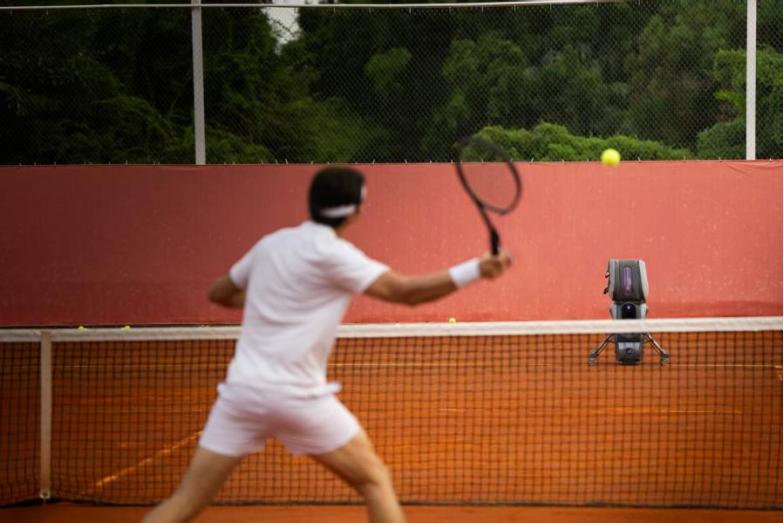
(Image source / the enterprise)
At the software level, AceiiLab has developed a supporting App, providing functions such as ball path setting, training courses and data analysis, and has jointly developed systematic courses with domestic and international partners. The company hopes to create a training environment through robots, collect data such as ball speed, landing point, rotation and displacement during the user's hitting process, further form a user skill profile, and provide personalized training plans based on the user's level, weaknesses and growth curve.
CHAO Guang stated that the core of future competition will not only be hardware performance, but the software service capabilities formed around training data. As the user base grows and more real training data is accumulated, the system can further optimize the training model, forming a cycle of "data accumulation - improved training effect - increased user retention".
Previously, AceiiLab's first tennis AI robot, the Aceiilab A1, raised over $820,000 in total on Kickstarter, and is currently in mass delivery. In terms of the domestic market, AceiiLab plans to launch on e-commerce channels, while the next-generation product is also under planning, and distributors have already signed framework agreements worth tens of millions of RMB.
The following is an excerpt from the conversation between 36Kr and CHAO Guang from AceiiLab:
36Kr: What are AceiiLab's advantages in making tennis serving machines?
CHAO Guang: Our core advantage is first reflected in our robotics DNA. The team has R&D experience in a full range of categories from AGVs, AMRs, drone prototypes, to commercial cleaning and lawn mowing robots. The essential difference between robotics products and ordinary AI hardware is that they not only rely on algorithms, but also require comprehensive capabilities in mechanics, electronic control, motion control and system integration. This allows us to create new usage scenarios from the bottom up, rather than just overlaying AI functions on existing hardware.
Secondly, we have complete overseas expansion experience for consumer products. The team has gone through the whole process of product definition, supply chain setup and overseas marketing from 0 to1 multiple times, and is more experienced in delivery and production ramp-up. At present, for complex new categories like mobile tennis robots that have more than 200 parts, we have built the production line at the beginning of mass production following the idea of large-scale delivery, including independent design of testing processes, fixtures and data management systems, to ensure stable product launch.
36Kr: There are many players in the tennis serving machine track. What makes AceiiLab's product logic different?
CHAO Guang: The core of tennis training is not a single hit, but the judgment of rhythm and spatial position. Therefore, we chose the path of "multi-space serving instead of hitting", not pursuing the robot to mechanically complete all ball-returning actions, but simulating the real rally rhythm through combinations of different serving positions and serving rhythms, using stable, high-quality serves to let users form effective muscle memory.
In addition, we hope to turn the robot from a tool into a consumer product. Different from the stacked sheet metal structure of traditional serving machines, we adopt a suitcase-style design, so that users can tow it directly to the court, and the supporting design also solves the problem of carrying balls.
On the other hand, we believe that software and data will become long-term barriers. Our App is not a simple electronic remote control, but part of the entire training closed loop. After the robot enters the court, it will create a standardized training environment, and continuously collect data such as ball paths and hits, to help users form skill profiles and provide targeted training plans.
36Kr: How is the current user feedback?
CHAO Guang: Before the crowdfunding, we carried out multiple offline surveys and experience activities in the United States, and received a large number of positive reviews from real users, covering multiple dimensions such as product performance and training experience. These feedbacks also provided important references for our subsequent iterations. At the same time, we operate a community of hundreds of people overseas, whose members actively discuss product usage and tennis training every day. We are also doing some offline activities in China now, and the feedback is quite good.