Changes in China's outbound tourism landscape: Japan stumbles, South Korea picks up the spillover market demand.
In the first half of 2026, which countries did Chinese tourists travel to for outbound trips?
First of all, the biggest structural change in outbound tourism is that Japan has lost its position as the top destination for Chinese outbound travelers, which has been taken over by South Korea. In the first half of 2026, Japan received 2.05 million Chinese tourists, a year-on-year decline of 56.4%, dropping to fourth place in the ranking of Chinese outbound travel destinations.
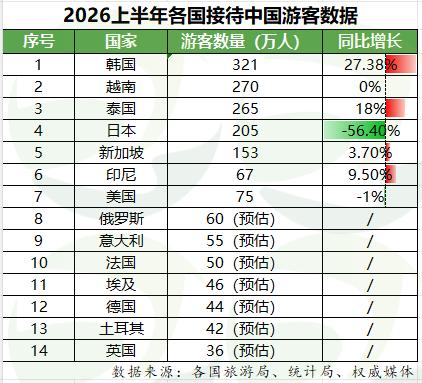
South Korea received 3.21 million Chinese tourists, a sharp year-on-year increase of 27.38%, making it the country that receives the most Chinese tourists. This is also the first time South Korea has claimed this title.
In fact, the title of top destination for Chinese outbound tourist flows has long been monopolized by Japan and Thailand. At present, both of these two countries have encountered unexpected changes, allowing South Korea to seize the opportunity.
As for Japan, after Japanese Prime Minister Sanae Takaichi made inappropriate remarks involving Taiwan in November last year, the tourism popularity between China and Japan cooled down significantly. Tourists who originally planned to travel to Japan have changed their travel plans to South Korea one after another.
In terms of Thailand, it received 2.65 million Chinese tourists in the first half of the year, ranking third, with a year-on-year increase of 18%. This figure seems good, but in fact the high growth rate is due to the low base of last year. Thailand used to be the top outbound travel destination for Chinese tourists for a long time. Many Chinese tourists would choose Thailand for their first overseas trip, usually joining group tours with very favorable prices. However, the safety issues in Thailand in 2024 and 2025 have been continuously discussed on Chinese internet. The Wang Xing incident in early 2025 pushed Thailand's tourism image to the bottom. In the first half of that year, the number of Chinese tourists visiting Thailand plummeted by 34.1%, falling back to the level of 2013. On this basis, Thailand's tourism has picked up somewhat in 2026, but it is still far from the peak level of 10 million annual tourist arrivals in the past.
Behind the alternating leading positions of South Korea, Japan and Thailand in Chinese outbound tourism, there is another important factor: independent outbound travel is replacing group outbound travel.
Both Japan and South Korea are suitable destinations for independent outbound travel, with good public security, convenient infrastructure, rich leisure activities, and the film, television, animation and celebrity cultures of Japan and South Korea have strong appeal to the new generation of Chinese tourists. In contrast, traditional group tour destinations like Thailand are gradually declining.
In fact, Thailand itself is also a destination for independent travel, and European and American backpackers all travel independently in Thailand. But for most ordinary Chinese tourists, there are still certain barriers to traveling independently in Thailand. The surge in Chinese tourist arrivals in Thailand from 2013 to 2019 was also driven by group tours.
In the first half of 2026, Vietnam received 2.7 million Chinese tourists, ranking second among all Chinese outbound travel destinations. This figure is very high, but it also contains a lot of inflated data. The main reason is that China and Vietnam have developed border tourism and border trade. The two countries have also cooperated to build the China-Vietnam Detian-Ban Gioc Border Tourism Zone. Tourists can join one-day group tours to Vietnam from some border ports in Guangxi without applying for visas. This has led many travel agencies to add Vietnam one-day tours to their routes in southwest China to enrich the selling points of their products.
This kind of border one-day tour can be regarded as inbound travel, but it is very different from the "formal" inbound tours to Japan, South Korea and Thailand in terms of length of stay, consumption capacity and subjective experience. About 1.92 million of Vietnam's international tourists in the first half of 2026 entered the country by land, a considerable number of whom were Chinese border tourists.
East Asian and Southeast Asian countries such as Japan, South Korea, Thailand, Vietnam and Singapore are close to China and have low travel costs, making them the main regions for Chinese outbound tourism. Long-haul destinations such as the United States and Europe have fewer Chinese tourists, but they represent the changing trend of China's high-end tourism consumption power.
As for the United States, in the first half of 2026, it received 750,000 Chinese tourists, a year-on-year decline of 1%. This figure is at a low level. During the peak period of 2015-2018, the United States received 3 million Chinese tourists every year, about 1.5 million in the first half of each year. The 750,000 arrivals in the first half of 2026 are only equivalent to the data of one quarter in the past peak period.
The reasons include the tightening of US inbound visa policies, the persistently high prices of Sino-US flights, the declining economic and trade ties between China and the United States that have reduced business travel demand, and the decline in high-end consumption power is also one of the contributing factors.
Since Europe has the Schengen visa, which allows holders to travel to all European countries with one single visa, there is no need for border checks and customs clearance within the Schengen area. Therefore, the statistics of international tourism in Europe are relatively difficult, and are usually based on foreigner accommodation declaration data, which has a large lag. At present, most European countries only release their international tourism statistics up to March or April 2026. The first-half data for European countries in this article are all estimated based on the data of March and April.
The political, economic and trade relations between China and Europe are relatively stable, and the tourism data are also relatively stable. France, Italy and Germany all received about 500,000 Chinese tourists, and the UK received about 360,000. Russia opened 30-day visa-free access to Chinese tourists at the end of 2025, so its tourism data has increased in 2026. The growth rate of Chinese tourists in the first half of the year is around 25%, while the number of Russian tourists traveling to China has also increased significantly.
This article is from the WeChat Official Account "Zhiku Culture & Tourism", author: Zhikujun, published with authorization from 36Kr.