Shocking, 60 car models sold fewer than 10 units in half a year.
"Only 40 car models have monthly sales exceeding 10,000 units, yet surprisingly there are 60 models with total sales of less than 10 units over the first half of the year. That's absolutely staggering." A few days ago, when the H1 vehicle sales figures were released, a peer in the industry made this remark with a tone of disbelief.
After all, with a flood of new cars hitting the market in the first half of this year, one would logically expect far more breakout bestsellers and far fewer slow-selling models amid such a bustling scene. The fact that the number of 10,000+ monthly sales bestsellers has not surpassed the count of stagnant models is enough to catch anyone off guard.
According to statistics, a total of 701 new vehicles (including all-new models, facelifted variants, and newly added trim levels) launched in the domestic market in H1, with 768 distinct models recording terminal sales. The market is fully supplied with vehicle options covering every segment and price bracket, yet among this massive lineup, very few products can truly establish a solid market foothold and maintain consistent strong sales.
Data shows that only 40 models achieved an average monthly sales volume of over 10,000 units in the first half of the year, accounting for a mere 5.2% of the 768 tracked models. In other words, less than 10% of all models on the market are responsible for the vast majority of the industry's total sales and revenue, with fewer than one in ten products capable of sustainably generating profitable returns for automakers.
In stark, jarring contrast to this scarcity of breakout hits, the scale of stagnant, underperforming models is far larger — in the first half of this year, no fewer than 60 models across the country posted total cumulative sales in single digits, effectively cut off from the mainstream consumer market and reduced to neglected, fringe products.
Behind the Arms Race: Widespread Industry Anxiety
In H1 2026, the overall downward trend in auto market sales is deeply concerning, as the last time such a market contraction occurred was all the way back in 2018.
Yet the market downturn has done nothing to slow the blistering pace of new vehicle launches. Reports indicate that 701 new vehicles were released across the domestic market in the first half of the year, covering categories ranging from passenger cars to light pickup trucks and box vans.
Breaking it down month by month: no new models launched in January, while the number of new releases from February to June stood at 44, 167, 208, 142, and 140 respectively. Averaged out, that works out to 3.8 new vehicles entering the market every single day in H1. Excluding the launch-free month of January, the daily average from February to June jumps to 4.7 new models — meaning multiple new products hit the market nearly every day.
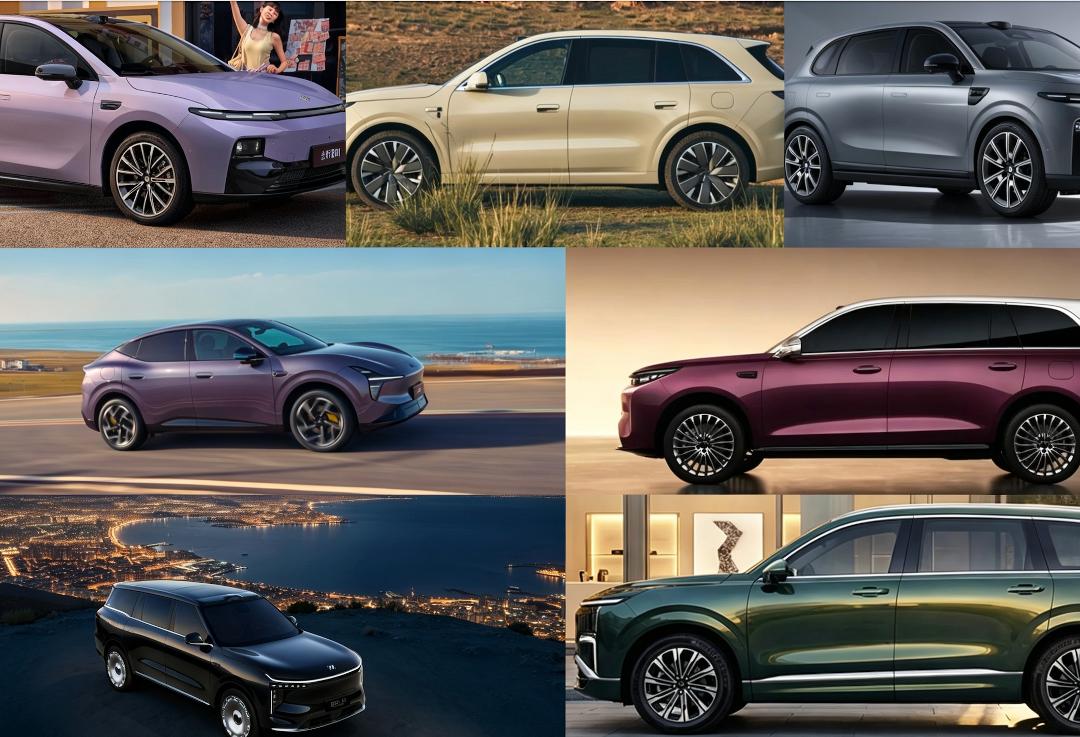
Even as we move into the second half of the year, the trend of dense new product rollouts shows no sign of abating. For instance, on July 16 alone, 7 new vehicles made their public debuts all at once, with the hashtag #July16 Auto Launch Frenzy even trending to the top of social media hot lists.
Beneath automakers' frantic push to launch new models lies deep-seated anxiety in this saturated, stock market environment.
As we all navigate what many call "the once-in-a-century transformative shift", beyond technological advancements and energy system transitions, the elimination phase of the automotive market is accelerating at an ever more intense pace. The old market order could collapse and a new industry ecosystem could solidify seemingly overnight. For every market player, the top priority is to maintain consistent product updates and preserve brand visibility. As one industry insider quipped: The saddest fate isn't that no one buys your cars — it's that no one even remembers your brand exists.
Meanwhile, per longstanding industry conventional wisdom, the strategy of "more children make for easier fights" has long been seen as a universal tactic to seize market share. Many automakers hope to expand their product portfolios, join this arms race, and capture consumer attention as well as greater market share.
Yet this playbook has clearly failed to deliver results in 2026. As noted earlier, with nearly 4 new vehicles launching every single day on average, only 40 models hit the 10,000+ monthly sales benchmark — less than 6% of the 768 sales-tracked models, meaning over 90% of new launches end up as also-rans in the industry.
Clearly, this flood of new products pouring into the market has not stimulated growth at all; instead, it has intensified internal industry friction, which combined with the broader market contraction, has made the automotive market downturn far more severe.
As a result, domestic narrow passenger vehicle retail sales totaled 8.701 million units in H1, down 20.2% year on year. Monthly performance remained equally sluggish, with June narrow passenger vehicle retail sales hitting 1.602 million units, a 23.2% year-on-year drop, as downward market pressure keeps mounting.
Even the new energy vehicle segment, which once carried the banner for overall industry growth, has seen its period of rapid expansion come to an end, with clear deceleration setting in. Specifically, NEV retail sales reached 4.704 million units in H1, down 14% year on year. The fuel vehicle market, meanwhile, continues its prolonged slump with steadily shrinking sales volumes.
The overall market pie has shrunk, yet automakers have ramped up new product launches rather than scaling back. This supply-demand imbalance has pushed industry competition into an even more brutal phase. A huge number of homogeneous models that lack core technology and unique differentiating advantages are now trapped in a quagmire of high inventory and terminal poor sales — which exactly explains why only 40 models top 10,000 monthly sales, while 60 models posted single-digit cumulative sales in H1.
Most New Models Are Destined to Be Also-Rans
Countless new cars flood the market, yet only a tiny handful can break through and stand out.
Per incomplete statistics, at least 40 all-new passenger vehicles launched in the domestic market in H1 this year, and their market performance clearly falls into three distinct tiers. 35% of these models sell over 5,000 units per month, 30% log monthly sales between 2,000 and 5,000 units, and the remaining 35% are underperforming models with monthly sales below 2,000 units.
More notably, roughly one-third of these all-new models have already seen month-on-month sales declines during their critical post-launch growth phase, with the market's tolerance for underperforming new products dropping to an all-time low.
Looking at the June sales rankings, market dominance remains firmly in the hands of long-popular existing models — nearly every entry in the top 30 sales chart is a proven bestseller that already existed in 2025. By comparison, the only all-new 2025 launch that made it onto the list is the Leapmotor A10, standing out as the sole top-selling new model of the first half.
As for the rest, most models that manage to maintain stable sales and market visibility only achieve renewed breakthroughs through targeted product facelifts.
For example, the Xiaomi SU7 saw its sales surge after its facelift launch, claiming the top spot in the mid-to-large sedan segment; BYD rolled out its full-series fast-charging technology, driving a sales rebound for models including the Fangchengbao Ti7; the updated AITO M9 and revised Li Auto L9 quickly reclaimed their positions in the top tier of the large SUV segment after their launches.
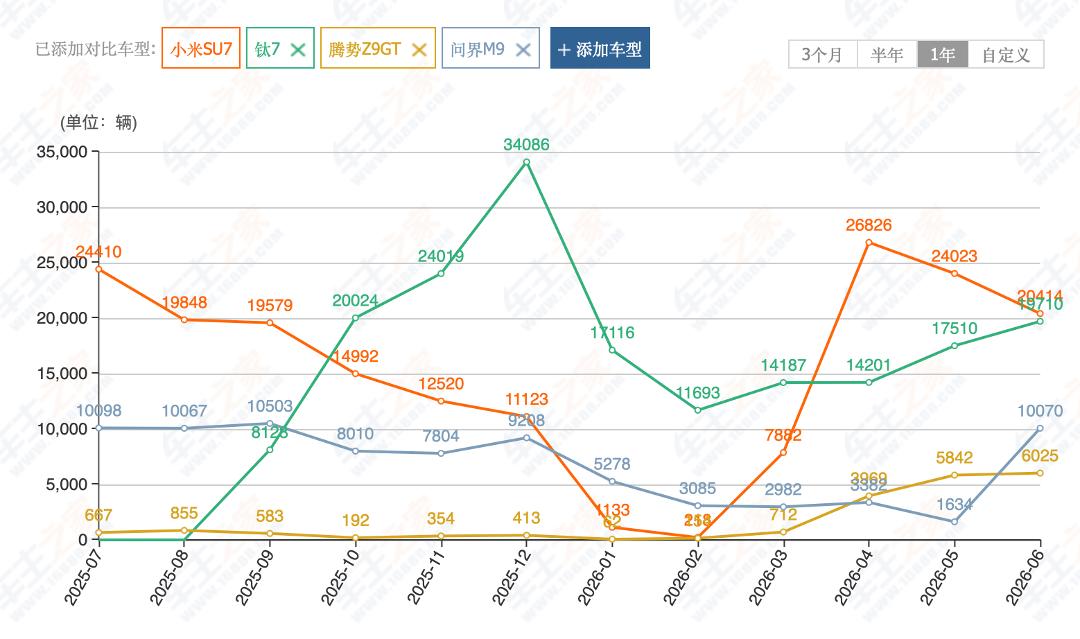
The Denza Z9GT stands out as a prime example of a facelift that reversed fortunes. Previously stuck in long-term triple-digit monthly sales, the new version added an entry-level trim, upgraded its chassis and range configurations, boosted cost-effectiveness, reversed its downward sales trajectory, and became the brand's core volume-driving model.
Yet high-quality, impactful facelifts are rare. The vast majority of mid-cycle updates in the market are minor, lightweight tweaks that only adjust superficial details like exterior color palettes and wheel designs, without any meaningful upgrades to core product competitiveness. For instance, a box-style off-road model that only made cosmetic changes for its new variant saw no sales improvement at all after launch, recording just around 500 units sold in June and unable to escape its stagnant predicament.
The highly talked-about "full-size 9-Series SUV battle" in H1 perfectly illustrates just how cutthroat industry competition has become.
Seven all-new 6-seat full-size SUVs spanning the 150,000 to 600,000 RMB price range hit the market: NIO ES9 and Leapmotor D19 both exceeded 8,000 monthly sales just two to three months after launch, while BYD Tang EV notched over 100,000 pre-orders, showing strong market potential. But models like the WEY V9X and SAIC Volkswagen ID.ERA 9X have posted underwhelming sales, as the limited capacity of this niche segment cannot accommodate multiple homogeneous high-end offerings.
Meanwhile, countless new vehicles that cost hundreds of millions in R&D investment and take over two years to develop fail to sustain public interest for even three months, quickly fading into obscurity after launch. Multiple automaker executives have publicly criticized this chaotic industry trend, stating that the current level of unhealthy internal competition in the auto market has gone far beyond reasonable intensity.
Of course, recently launched new models are still in their production ramp-up phase, with their full sales potential yet to be unlocked, leaving a window for some models to still carve out a market position. But based on current available data, the old "more children make for easier fights" extensive growth model is clearly no longer viable.
For automakers, moving away from this high-intensity, disordered internal competition to embrace a premium product-focused strategy — concentrating resources to develop highly competitive breakout bestsellers — may well be the only viable survival formula for today's saturated market.
This article originates from the WeChat Official Account "Auto Community" (ID: iAUTO2010), authored by LI Sijia, and published with authorization from 36Kr.