You have to admit that Shunyu Yao is the "Qin Shi Huang" of Tencent AI.
We have identified three pieces of evidence that Yao Shunyu is the "First Emperor of Qin" of Tencent's AI division.
The first is to unify the realm and standardize the written language.
In the past, Tencent's AI capabilities were scattered across various business lines including WeChat, Advertising, Games, and Cloud Computing, with each operating independently. After Yao Shunyu joined, the Hunyuan large model no longer focused on benchmark rankings—MMLU, GSM8K, all these benchmarks were set aside, and now all four large model teams follow his unified command.
The second is to build the Great Wall and lay the infrastructure foundation.
After joining Tencent, he reports directly to Martin Lau, President of Tencent, and then reconstructed the infrastructure for pre-training and reinforcement learning. Previously, Tencent had long been criticized for "falling behind" in the large model battlefield. In less than a year since Yao Shunyu's arrival, Hunyuan has achieved continuous leaps from Hy2 to Hy3 preview, then to the official Hy3 release. One week after Hy3 was launched, its total call volume surged over 68 times compared with the previous generation.
The third is to dismiss hundreds of competing approaches and uphold a unified core system.
Tencent's unique collaborative "Model × Product Co-Design" methodology ensures that AI models serve products rather than benchmark rankings. Whenever a new version is iterated, it is first deployed to Yuanbao, with issues fed back immediately.
In the past, algorithm engineers focused on publishing papers and chasing benchmark scores; now all of them are directed to prioritize serving products and enabling real-world scenarios. Regardless of AGI or other grand concepts, the top priority is to boost Yuanbao's daily active users first.
Of course, all of the above are just playful metaphors. But it is undeniable that Yao Shunyu has led five key internal transformations of Tencent's AI in less than ten months, achieving remarkable results, and now Tencent is finally ready to take a seat at the AI table.
Tencent's AI: United into a Fist Under Yao Shunyu
What Yao Shunyu unified in less than a year is not just several large model teams of Tencent, but the "feudal division" system of AI capabilities that Tencent formed over the past decade.
In the past, Tencent's AI capabilities were scattered across different business groups and lines. WeChat developed its own AI, the Advertising division built its own AI, and the Games, Cloud Computing, and Content businesses all maintained their respective algorithm teams. Even in the Hunyuan era, the Large Language Model Department for text, the Multimodal Model Department for image and video, and the nearly 10-year-old AI Lab all operated relatively independently for a long time.
This model is very characteristic of Tencent. In the mobile internet era, Tencent has always adhered to the horse-racing mechanism: assigning the same direction to multiple teams to work on simultaneously, and directing traffic and resources to the team that delivers results. The success stories of QQ and WeChat have proven that internal competition can indeed give rise to super products.
However, in the large model era, the cost of the horse-racing mechanism has changed. When multiple teams develop separate apps, the maximum redundant work is rewriting code multiple times. But when multiple teams train large models separately, it means redundant construction of computing power infrastructure, repeated cleaning of training data, duplicated design of evaluation systems, and burning through expensive training costs all over again.
Worse still, teams may not even align on their core development directions.
According to a report from *LatePost*, after joining Tencent, Yao Shunyu once stated bluntly internally that "there is a major flaw in Hunyuan's evaluation system": the team excessively chased benchmark rankings, even adding relevant corpora to the training set, resulting in models that performed well on exams but lacked stability in real-world scenarios. He required the team to stop focusing on rankings and instead re-examine underlying links including data, pre-training, and infrastructure.
Therefore, Yao Shunyu's first move after arriving at Tencent was not to rush to release a new model, but to overhaul the entire system from scratch.
In December 2025, Yao Shunyu was appointed as the Chief AI Scientist of Tencent's "CEO/President Office", reporting directly to Martin Lau, President of Tencent. He also concurrently served as the head of the AI Infrastructure Department and the Large Language Model Department, essentially taking charge of both the "brain" and the "foundation" of Tencent's large model system.
One month later, Hunyuan launched the reconstruction of its underlying infrastructure, covering pre-training, reinforcement learning, data, and evaluation systems. This effort first rebuilt the most fundamental production system, resolving long-standing issues such as inconsistent standards across teams, fragmented capabilities, and disconnection between models and products.
In March this year, Tencent's nearly 10-year-old AI Lab was disbanded, with some R&D personnel integrated into the Large Language Model Department to report to Yao Shunyu. As one of Tencent's oldest AI research institutions, the dissolution of AI Lab represents far more than a simple departmental restructuring: it means that the previously relatively independent academic research force has fully shifted its focus to foundational model development and product implementation.
By July 23, the last two pieces of the puzzle were put in place: the Hunyuan Large Language Model Department and the Multimodal Model Department were officially merged to form the Foundational Model Department, under the unified management of Yao Shunyu. Linus, former head of the Multimodal Model Department, now also reports directly to Yao Shunyu.
At this point, Tencent Hunyuan's capabilities in text, image, video, speech, 3D generation, reinforcement learning, and Agents have been integrated into a single foundational model system for the first time. This has created a landscape where "all AI capabilities belong to Hunyuan, Hunyuan belongs to the Foundational Model Department, and the Foundational Model Department is led by Yao Shunyu".
This is the main reason why Yao Shunyu is likened to the "First Emperor of Qin". What he has done is not to replace every algorithm engineer personally, but to unify technical languages, training systems, evaluation standards, and resource scheduling, so that the AI capabilities previously scattered within Tencent can finally move forward in the same direction.
After the organizational unification was completed, the iteration speed of Tencent Hunyuan also increased significantly. On July 6, Tencent officially released Hunyuan Hy3. One week after launch, the total call volume of Hy3 was over 68 times higher than that of the previous generation Hy2, and it ranked first on OpenRouter's global model call volume leaderboard. After WorkBuddy opened up model selection options, 60% of users chose Hy3.
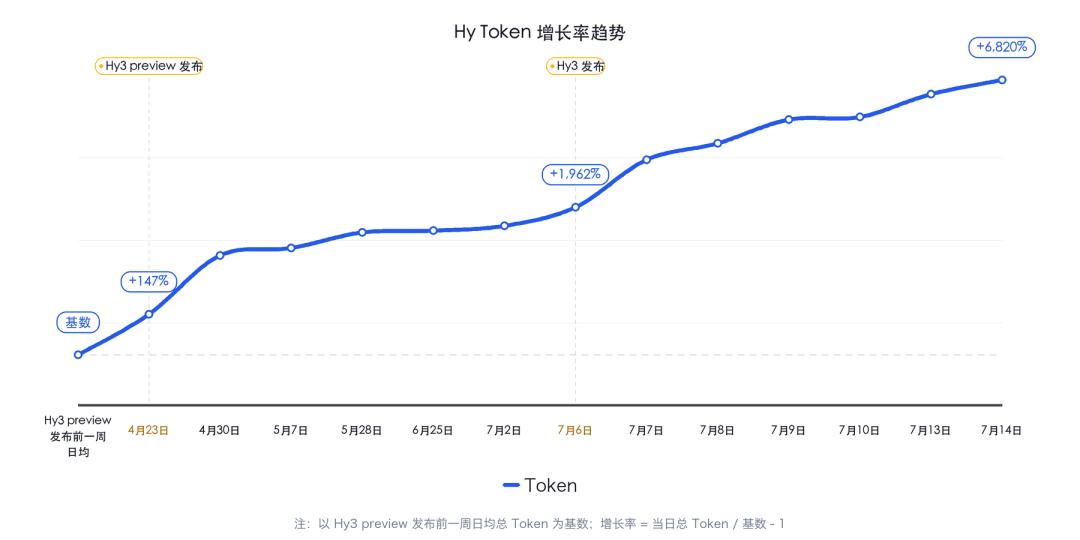
Certainly, these achievements cannot be entirely attributed to Yao Shunyu alone. But the progress from Hy3 preview to the official Hy3 release, and then to the establishment of the Foundational Model Department, at least proves that Tencent's previous fragmented AI system is being replaced by a clearer technical roadmap.
However, unifying the models alone is not enough. If the underlying layers have achieved "standardized writing systems and unified axle tracks", while the upper product layers still have more than a dozen teams simultaneously developing AI assistants with similar functions, Hunyuan will still be pulled in conflicting directions by competing demands.
Therefore, after Yao Shunyu completed the "grand unification" of models, Tencent also began to rein in its product horse-racing initiatives.
Tencent's AI Horse-Racing Mechanism Begins to Tighten Control
After OpenClaw became a hit in March this year, a vigorous "claw-rearing movement" unfolded within Tencent.
Tencent Cloud launched WorkBuddy, the PC Manager team developed QClaw, and products including WeCom, QQ, and Tencent Cloud Lighthouse successively integrated OpenClaw. Coupled with existing products such as Yuanbao, ima, CodeBuddy, QQ Browser, and Tencent Docs, almost every important entry point of Tencent has its own AI assistant.
In the "Efficient Agent Toolkit" officially released by Tencent in June, multiple products including QClaw, WorkBuddy, Yuanbao, ima, and Tencent Docs were listed at once, covering more than 20 scenarios for individual users, office work, and enterprise use cases.
While the coverage appears extensive, a closer look at the functions of these products quickly reveals familiar Tencent-style characteristics.
QClaw focuses on remote PC operation via WeChat, enabling file organization, local software invocation, and complex task execution. WorkBuddy also supports PC operation, covering scenarios such as office work, programming, design, and data processing. One emphasizes local and individual use, while the other focuses on cloud and office scenarios—their positioning is somewhat distinct, but their capability boundaries in "enabling AI to operate computers on behalf of users" have highly overlapped.
This is Tencent's familiar product horse-racing approach: different teams place their bets separately, allowing products to iterate quickly for trial and error, and then decide where to concentrate resources after the market delivers results. However, this horse-racing initiative has only been running for more than four months when Tencent began to pull the reins.
According to a report from Leiphone, on July 20, Tencent issued an internal organizational restructuring notice, transferring the relevant business and part of the team from the QClaw Product Center to the Cloud Product Division 6—the very department that manages WorkBuddy. QClaw will not be shut down and will continue to operate, but the two AI office products with similar functions have now been brought under the same management system after previously developing independently.
On the surface, this is a regular team adjustment, but in reality, it sends a clear signal: Tencent still allows multiple products to exist, but it no longer intends to maintain a separate full team for each product.
Behind this decision is a very practical consideration. Data from Analysys shows that in June 2026, the monthly visit volume of WorkBuddy in China's native PC-side AI office agent market has exceeded 20 million, surpassing the sum of the second and third place in the market. In contrast, although QClaw grew rapidly in its early launch stage, it has shown increasing overlaps with WorkBuddy in terms of functional forms, target users, and commercialization directions.
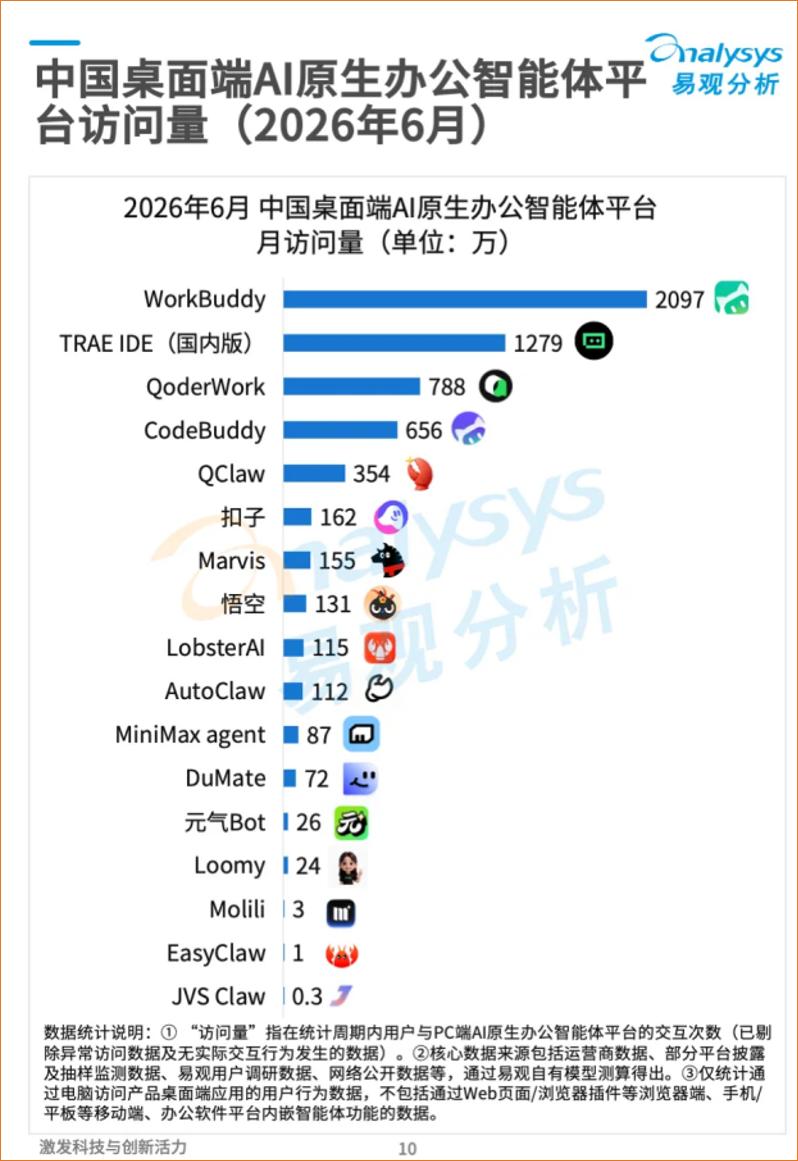
When the horse-racing process has already identified a temporary leader, there is little need to keep two teams duplicating construction efforts.
More importantly, products in the large model era are not just a simple shell wrapped around the model. Every AI product generates user queries, invocation data, and failure cases. This real-world feedback is sent back to the model team to refine post-training data, evaluation methods, and next-generation model capabilities.
Yao Shunyu once revealed that to promote the Co-Design between Hunyuan and Yuanbao, the model team even transferred their strongest post-training core members to support Yuanbao. Even when pre-training work was not fully completed, priority was given to helping the product solve real-world problems.
In his view, external benchmark rankings are prone to overfitting, and what is truly valuable is the prompt distribution, user follow-up queries, and model failure cases generated in real products. The important role of preview versions of models is not to announce benchmark scores in advance, but to obtain real user feedback as early as possible. This means that having more AI products is not necessarily better.
If Yuanbao puts forward a set of requirements, ima proposes another, and QClaw and WorkBuddy train their respective capabilities separately, the model team will not receive a clear product signal, but a pile of conflicting task lists. For Co-Design to operate effectively, a stable feedback loop must be formed between the model and the product.
Therefore, Tencent has not completely abolished the horse-racing mechanism, but is changing its rules. In the past, multiple teams worked independently from start to finish, and only one winner remained in the end. Now, different products are allowed to iterate quickly for trial and error in the early stage, and once the direction becomes clear, teams are merged, capabilities are shared, and resources are concentrated on the most promising main line.
Yuanbao, ima, WorkBuddy, and QClaw will still coexist in the short term, as the scenarios they serve are not completely identical. However, the era in which every business line could retrain models, rebuild Agents, and compete for entry points on their own is coming to an end.
In the past, Tencent allowed all horses to run freely to determine the champion. Now, Tencent first unifies the track, provisions, and destination, and then decides which horse will take the lead.
This article is from the WeChat public account "foci", authored by Sean, and published with authorization from 36Kr.