Who is AI referencing when recommending vehicle models?
Abstract
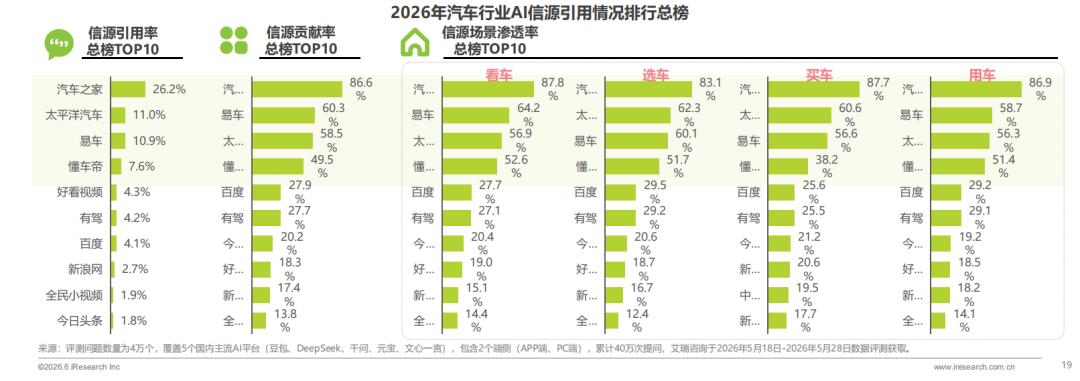
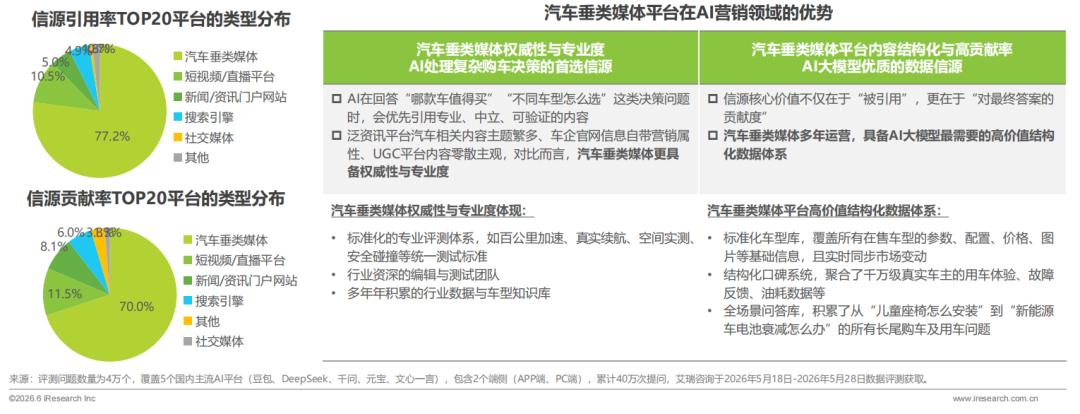
When AI answers automotive-related questions, the sources it cites are highly concentrated on automotive vertical media platforms. Among the top 20 platforms by source citation rate, automotive vertical media account for 77.2%, and 70.0% among the top 20 by source contribution rate; the head effect is extremely prominent, with a clear order-of-magnitude gap between the top few vertical media and subsequent platforms.
Concentration does not mean uniformity: the source preferences of the five mainstream AI platforms differ significantly, and there may also be differences between the PC and APP ends of the same platform. Some platforms show extreme concentration, with the contribution rate of a single source approaching 99% on both ends, which is cited in almost every answer; on some platforms, the contribution rate of short-video sources even exceeds that of some vertical media; on other platforms, the top sources for the PC end and APP end are not the same.
Citation rate and contribution rate measure two different metrics: the former reflects the frequency of a source being retrieved and its reach intensity, while the latter reflects how many user question scenarios it can cover. By combining the two metrics, data bubbles caused by artificial volume inflation can be identified.
Introduction: AI Answers "How Is This Car?" for Users
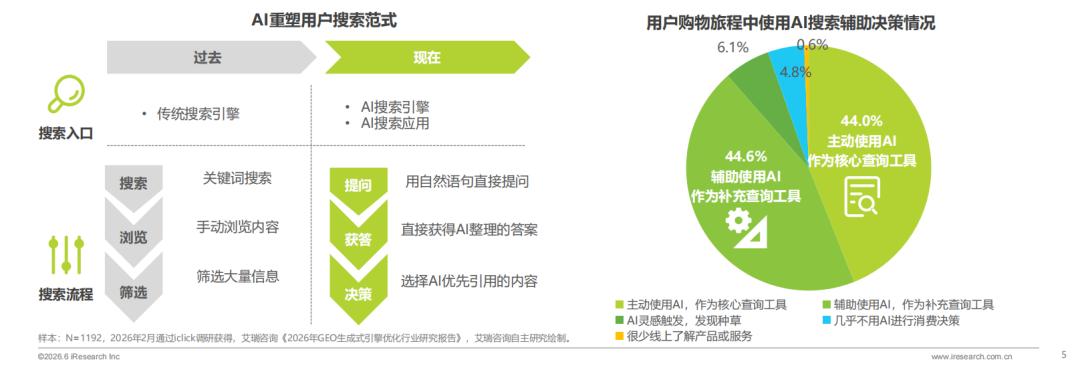
88.6% of consumers use AI search to assist decision-making before shopping, among whom 44.0% regard AI as a core query tool and 44.6% as an important supplementary tool, especially for products with high technical thresholds and long decision cycles. Automobiles are exactly such a category: with high unit price and a 3-6 month car purchase decision cycle, users will repeatedly raise questions at every stage of car viewing, selection, purchase, and usage.
Every AI answer is based on the batch of sources it cites at that time. Only when brand content enters the AI's "citation source pool" can it be included in users' decision lists.
So who do mainstream AIs prioritize citing when answering automotive questions?
I. Over 70% of Source Share Belongs to Vertical Media
From May 18 to 28, 2026, an evaluation covering 40,000 real questions conducted 400,000 queries on both PC and APP ends of five platforms (Doubao, DeepSeek, Qianwen, Yuanbao, and Wenxin Yiyan), returning millions of pieces of data. The question bank covers 300 mainstream car models and four major scenarios (car viewing, selection, purchase, and usage), which are divided into 9 primary dimensions and 44 secondary dimensions, with about 2,000-5,000 questions for each secondary dimension. The whole process was completed by evaluators simulating real user queries manually, without direct API calls or guiding modifications to the questions.
The result points to a highly concentrated pattern. Among the top 20 platforms by source citation rate, automotive vertical media account for 77.2%; among the top 20 by source contribution rate, they account for 70.0%. Short-video and live streaming platforms account for 10.5% and 11.5% of the two lists respectively, news portals account for 5.0% and 8.1%, search engines account for 4.9% and 6.0%, and social media account for less than 1% and 1.3%.
The top tier also shows high internal concentration: the top positions by citation rate and contribution rate are mostly occupied by a few automotive vertical media, and there is often an order-of-magnitude gap between the leading platforms and subsequent ones. These top vertical media have different content focuses — some focus on consumer decision-making and transaction conversion, and are more relied on in car selection and purchase scenarios; some focus on content marketing and after-sales services, and are more active in car viewing and usage scenarios; others have relatively balanced performance in all metrics.
General information and short-video platforms have prominent traffic capabilities, but lack professional knowledge accumulation and in-depth content systems for the automotive industry. They mainly focus on automotive content distribution, and play a supplementary role in AI citation sources.
II. Source Preferences Vary Across the Five AI Platforms
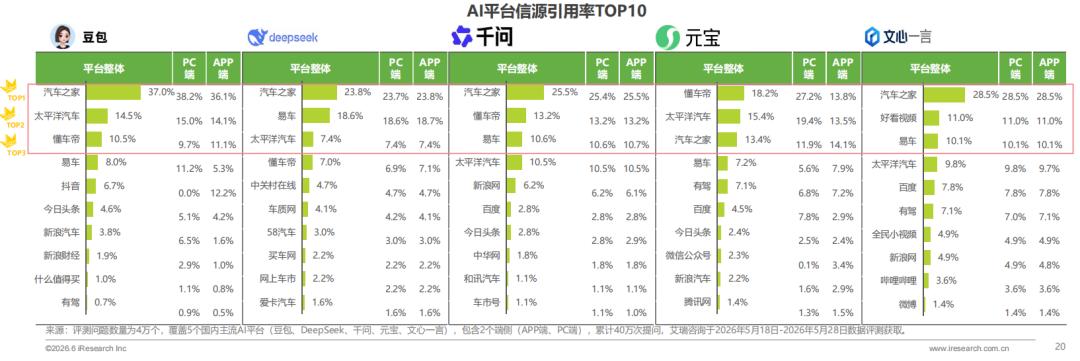
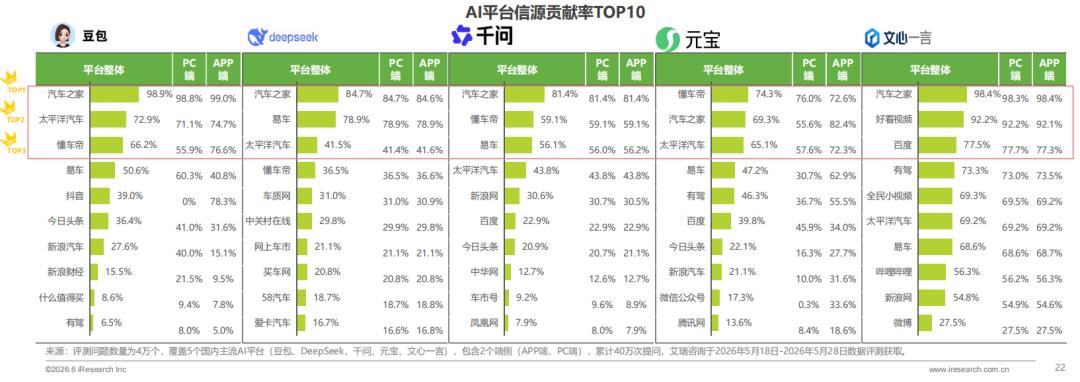
The overall ranking is the average result of the five platforms. When broken down to individual AI platforms, significant preference differences emerge immediately.
Doubao: The distribution is highly concentrated, with the contribution rate of the top single source approaching 99% on both ends and a citation rate of about 37%, showing a huge gap with the second-ranked source; the end-side difference is obvious, the APP end relatively prefers short-video sources, while the PC end relies more on professional vertical media and information sources (the citation rate of the same type of short-video source is 0 on the PC end, but exceeds 12% on the APP end);
DeepSeek: The distribution is relatively balanced, with a small gap in citation rate between the top two sources (about 23.8% and 18.6%); there are also a number of sources not seen in the overall ranking in the top 10, giving more citation opportunities to long-tail sources;
Qianwen: The source selection logic does not distinguish between terminals, the data of the PC end and APP end of the same platform are basically consistent, and the top tier division is clear;
Yuanbao: The end-side preference difference is significant, the top sources for the PC end and APP end are not the same, showing a "dislocated leading" pattern; the scenario penetration gap between top sources is also smaller than that of other platforms, the pattern is relatively decentralized, and private domain ecosystem sources (such as WeChat official accounts) are included in the top 10;
Wenxin Yiyan: The proportion of short-video sources is relatively high, the contribution rate of some short-video sources exceeds that of some automotive vertical media, and social and video platforms also enter the top 10.
The same content is almost cited in every query on some platforms, is only one of the parallel options on some platforms, and has to compete with short-video sources on other platforms. Understanding each platform only through the overall ranking will ignore such inter-platform differentiation.
III. Scenarios and Question Dimensions Form the Second Layer of Differentiation
Within the same platform, the ranking of sources will also change with scenarios:
In the car purchase scenario of some platforms, general information sources jump to the top with high penetration rate, becoming a rare non-vertical media source in this scenario;
On some platforms, the leading sources in car viewing, selection, purchase and usage scenarios will be replaced, rather than being dominated by the same source;
In the car purchase scenario of some platforms, portal sources rank among the top in scenario penetration;
In the car purchase and usage scenarios, information sources and short-video sources show differentiated values respectively.
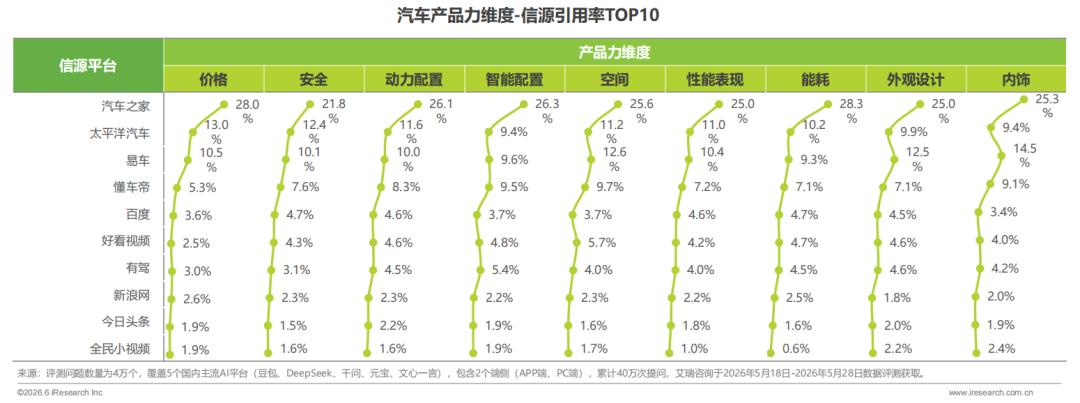
In terms of product strength dimensions, automotive vertical media as a whole occupy the top positions of citation rate in all 9 dimensions, but different vertical media have different content strengths — some rank higher in dimensions such as price, safety, power configuration, performance, and energy consumption, while others have advantages in dimensions such as intelligent configuration, space, exterior design, and interior trim. Short-video platforms are good at scenario-based dynamic display, with higher citation rates in dimensions like intelligent configuration and space than general information platforms, becoming important supplementary sources beyond vertical media.
Models focusing on intelligent driving and high-volume models focusing on price and residual value do not need to deploy the same set of sources.
IV. Citation Rate Determines Reach, Contribution Rate Determines Coverage
The three metrics answer different questions respectively:
Source Citation Rate: taking cited content PV as the statistical dimension, it measures the proportion of a source with a specific domain name among all cited sources on the entire platform, reflecting the frequency and weight of its content being retrieved and reused by the model;
Source Contribution Rate: taking independent query UV as the statistical dimension, it measures the range of user questions that the source can cover and solve, reflecting its penetration breadth in real Q&A scenarios;
Source Scenario Penetration Rate: a sub-dimension of contribution rate, reflecting the content performance of the source in specific scenarios.
Citation rate and contribution rate do not measure the same thing: the former focuses on the frequency of being cited, while the latter focuses on the range of questions that can be covered. The two are not necessarily synchronized — a source may be cited frequently but only concentrated on a few questions; or it may have a moderate citation frequency but widely appear in answers to various questions. By combining the two metrics, we can judge whether a source is widely used in various questions or only repeatedly cited in a few questions; the latter usually corresponds to data bubbles caused by artificial volume inflation. Traditional quantitative metrics centered on clicks and leads are difficult to measure such long-term impacts formed in the AI Q&A stage.
Conclusion
The reason why vertical media take more than 70% of the source share is not complicated: when AI answers decision-making questions such as "which car is worth buying" and "how to choose between different car models", it will prioritize citing professional, neutral, and verifiable content. General information platforms cover a wide range of themes, official automotive enterprise information has inherent marketing attributes, and UGC platform content is scattered and subjective; while vertical media have a standardized professional evaluation system, senior editing and testing teams, years of accumulated car model knowledge base, and structured data that can be directly parsed and called by AI — including a standardized car model library covering parameters, configurations, and prices of available car models, a structured reputation system aggregating millions of real owner feedback, and a full-scenario Q&A library covering content from child seat installation to battery degradation.
What is more noteworthy in this actual measurement is not the ranking of a certain platform, but three levels of issues: which models' citation pools a source has entered, which scenarios and product strength dimensions it covers, and whether these positions can be sustained.
The 3-5 year product life cycle of automobiles and the 1-3 month iteration cycle of large AI models are naturally mismatched, and the leading positions will not remain stable for a long time once formed. Real, authoritative, and structured sources are less affected by algorithm iterations and are easier to be precipitated. Accordingly, source construction has shifted from one-time optimization to continuous maintenance: updating information in time at nodes such as new car releases and price adjustments, and detecting and correcting wrong answers from AI in time.
This article is from the WeChat official account "iResearch" (ID: iresearch-), author: iResearch, published with authorization from 36Kr.