Frontline | Accelerating the construction of the space brain, the "Digital Space No.1" test satellite project is officially launched in Beijing.
Text by A Zhi
Over the past decade, China's commercial aerospace industry has achieved the first-phase goal of "being able to build and launch satellites", with satellite production capacity ramping up rapidly and the verification of reusable rockets moving into intensive validation stages. However, as orbital resources shift from abundant to crowded, the focus of competition among countries has shifted from launch capacity to operational capability, making "effective management and efficient utilization" critically important.
According to calculations by the National University of Defense Technology, under the premise of maintaining a minimum safety distance of 50 kilometers between satellites, the entire low-Earth orbit space ranging from 300 to 2000 kilometers can safely accommodate a maximum of approximately 175,000 satellites. When the number of satellites grows from thousands to tens of thousands, the traditional method of queuing up for uplink and downlink commands at ground stations will no longer be sustainable, and the existing satellite management and control models are becoming ineffective.
"In the next ten years, the main theme of aerospace development should be the digitalization and intelligentization of space." Academician Wei Fengsi of the Chinese Academy of Sciences mentioned this core viewpoint in a speech at the Academician Auditorium for Science and Technology Innovation last month.
More specifically, future satellites cannot "only have eyes but no brains".
On July 26th, the Commercial Aerospace Accelerating the Development of the "Digital Space Strategy" Conference and the Launch Ceremony of the "Digital Space-1" Experimental Satellite was held in Beijing.
As the proposer of the "Digital Space Strategy", Academician Wei Fengsi pointed out on site that in the face of challenges such as the complex and changeable space environment, increasingly crowded orbital resources, and the collaborative operation of large-scale constellations, future space infrastructure not only needs to continuously enhance its perception capabilities, but also build an intelligent system with cognition, deduction, and decision-making capabilities. The "Space Brain" is the core hub of digital space construction. It is necessary to form a brain intelligent system that connects with the real space environment and integrates the "perception-cognition-action" chain, promoting spacecraft to gradually evolve from "ground command and on-board execution" to limited autonomy in risk scenarios and collaborative intelligent operation between satellite and ground.
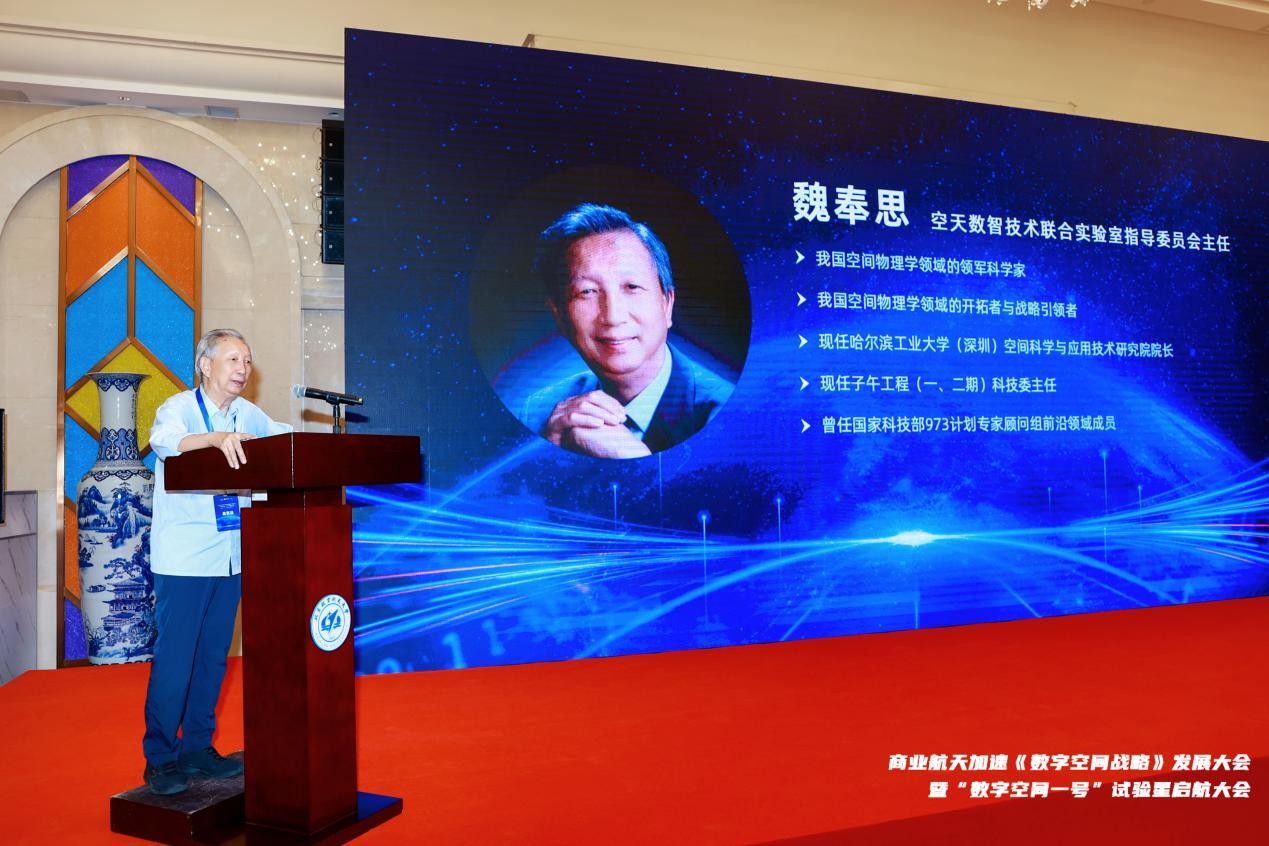
Academician Wei Fengsi of the Chinese Academy of Sciences
The so-called brain intelligence, in simple terms, means integrating the three links of space perception, space cognition, and space action all onto the satellite, forming a millisecond-level full-chain intelligent closed loop, allowing satellites to avoid collisions with each other and autonomously respond to environmental changes just like flocks of thousands of birds in nature.
The official launch of the "Digital Space-1" experimental satellite project is special not because of the specific tasks it will perform, but because it aims to verify one thing: whether satellites can have their own "brains".
Just as ocean navigation requires nautical charts, in the era of grand aerospace, humanity also needs to draw its own "aerospace map", which relies on the improvement of space digitalization and intelligentization capabilities.
And when satellites need "brains", an industrial breakthrough in the digital space has also kicked off in Beijing.
As the promoter of the implementation and practical application of Academician Wei Fengsi's "Digital Space Strategy", Digital Space was founded in 2019, with its core business focusing on space digitalization, intelligentization, and related applications. To accelerate the implementation of the "brain" in digital space, the company is currently speeding up the development of intelligent payloads and the research and development of digital space model algorithms.
Wang Shijin, Chairman and President of Digital Space, mentioned on site that focusing on the demands of large-scale constellation safe operation, space environment risk response, and satellite autonomous operation, Digital Space further proposed the "Satellite Intelligent Driving + Space Intelligent Management" solution: enhancing the autonomous operation capability of satellites through on-board perception payloads and intelligent driving payloads, and carrying out environmental monitoring, risk warning, constellation operation, twin deduction, and mission decision-making relying on the SpaceOmni ground platform.
Specifically, on the satellite side, satellite intelligent driving adds a perception layer and intelligent payloads to enable satellites to independently perceive and make decisions on the space environment, system status, and collision risks; on the ground side, the space intelligent management platform integrates environmental monitoring, risk warning, constellation operation, and digital twin deduction to build a satellite intelligent management and control closed loop with satellite-ground collaboration.
The mission of the "Digital Space-1" experimental satellite is to fully transport the "perception-cognition-action" brain intelligent architecture proposed by Academician Wei Fengsi into space for on-orbit verification. At the conference, Wang Shijin also emphasized the importance of speed — commercial aerospace cannot afford to wait, and it is necessary to advance on two fronts to obtain on-orbit data as soon as possible.
To further accelerate the process of technology verification, achievement transformation, and commercial application, Digital Space signed industrial cooperation agreements with 12 commercial aerospace enterprises including Spacety, CAS Xi Guang Aerospace, Taihu Nebula, Oriental Starlink, Juntian Aerospace, Star Mobility, and Micro-Nano Star on the conference site. In the next step, all parties will carry out cooperation in directions such as experimental satellite development, intelligent payload integration, platform collaborative adaptation, on-orbit experiments, and application scenario expansion.
In addition, Digital Space also put forward an initiative for industrial co-construction — "Building a Trustworthy Space Base and Co-constructing the Brain Intelligent Industrial Ecosystem", promoting universities, scientific research institutions, industrial chain enterprises, user units, and investment institutions to strengthen collaboration, and accelerate the verification and achievement transformation of key satellite intelligent technologies.
The reality is that the black box and hallucination problems of large language models still have many unsolvable issues when applied in current aerospace scenarios, while space is a purely objective physical world where causal laws are basic constraints. Therefore, Wang Shijin advocates using the physical world model as the base, embedding the standards, engineering experience, and physical laws accumulated over decades in the aerospace industry into the intelligent system, so that every deduction can achieve "visible rules, verifiable deduction, and controllable decisions".
In the future, if the satellite intelligent driving system can integrate commercial remote sensing and communication satellites from different sources into a perception and decision-making network, it will be possible to achieve the leap from single data delivery to decision-making delivery, truly making satellite data "come alive", and promoting China's aerospace industry to realize the transition from "effective management" to "efficient utilization".