Now that Opus 5 has topped the list, do we still need Fable 5?
The model community was buzzing with activity in July.
In the early hours of the 25th, Anthropic officially launched its new model, Claude Opus 5.
This time, Anthropic did not emphasize "the most powerful model," but instead presented a more pragmatic positioning: Opus 5 skips fewer steps in complex tasks, tends to proactively verify intermediate results, balances performance and cost across multiple evaluations, and is suitable for high-frequency daily use.
This shift in positioning is directly reflected in the product. Currently, Opus 5 has become the default model for Claude Max and is the most powerful model available to individual subscribers (Max/Pro); the higher-capability Fable 5 is primarily targeted at API and enterprise customers. While individual subscribers can access it, their quota is quite limited.
According to the officially released results, Opus 5 has focused on improving the efficiency of programming, knowledge work, and agent task execution, ranking high in multiple software engineering, business process, and computer operation evaluations. At the highest thinking level, some of its scores have approached or even surpassed those of Fable 5. However, in high-risk scenarios such as offensive network exploitation and long-cycle autonomous biological research, the restricted Mythos 5 remains more powerful.
Opus 5 offers an adjustable "effort" (thinking level), allowing users to allocate reasoning resources based on task difficulty. The higher the level, the stronger the ability to handle complex problems, but the slower the speed and the higher the Token consumption; lowering the level saves time and cost.
Currently, Opus 5 has been launched across all platforms. The API pricing is $5 per million input Tokens and $25 per million output Tokens, which is on par with Opus 4.8 and about half the price of Fable 5. For users prioritizing speed, the Fast mode can be enabled to deliver 2.5 times the speed at roughly double the cost.
Anthropic has also launched two Beta features: Dynamic Tool Adjustment and Automatic Fallback, designed to reduce the risk of increased costs from cache invalidation or task interruption due to safety blocks during Agent operations.
With performance approaching Fable 5 at half the price, can Opus 5 replace Fable 5?
01. Topping the charts, but not with an unassailable lead
Let's first look at the official scorecard.
To highlight the model's leading edge, Opus 5 was compared against several of the most powerful current models: the previous-generation Opus 4.8, the public flagship Fable 5, and OpenAI's recently released flagship model GPT-5.6 Sol.
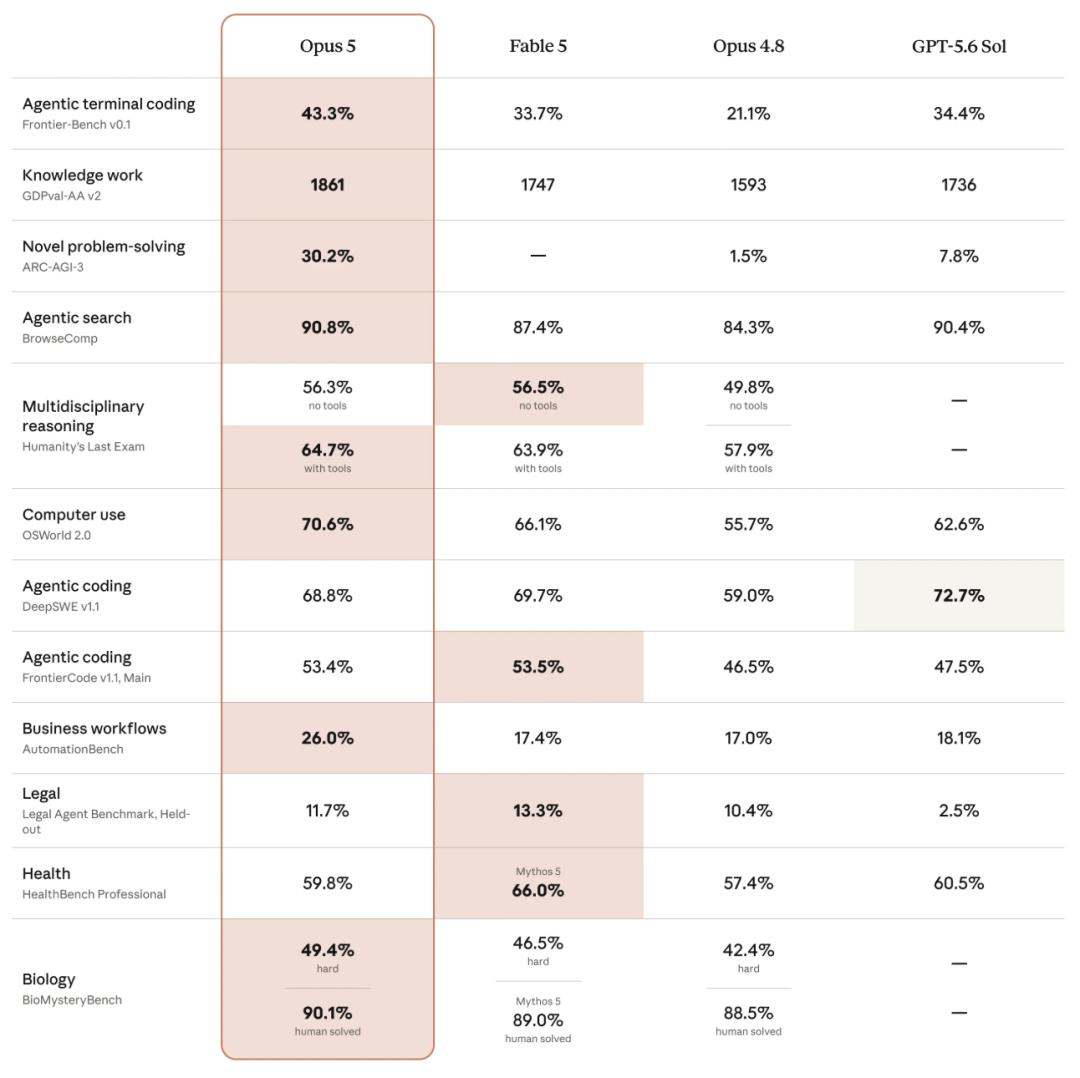
Software engineering is the most prominent area. In the Frontier-Bench v0.1 test, Opus 5 outperformed all participating models, with scores more than doubling those of Opus 4.8 while the cost per individual task was even lower. In the CursorBench 3.2 test, with max effort enabled, the performance gap between the two was less than 0.5%, and the cost per task was about half that of the latter.
Similar advantages appear in tasks requiring continuous model operations. In the Zapier AutomationBench test, at the same cost per task, Opus 5 achieved a pass rate approximately 1.5 times that of the second-place Fable 5. In the OSWorld 2.0 test, it surpassed Fable 5's best performance by using just over one-third of Fable 5's per-task cost.
The common thread across these projects is that they don't just test whether a model can answer a question correctly, but also whether it can call tools, go through multiple steps, detect errors, and keep moving forward.
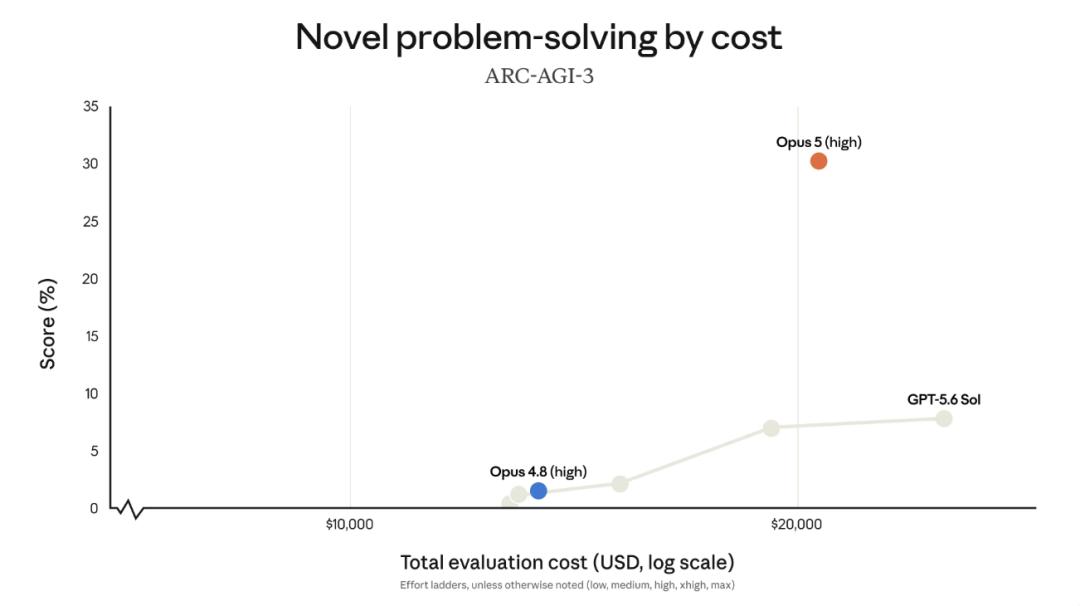
ARC-AGI 3 mainly evaluates the model's ability to handle unfamiliar rules and new problems. Opus 5 scored 30.2%, while the previous top score was 7.8% from GPT-5.6 Sol. However, this score was achieved at the "high" level rather than the "max" level, and the max-level results have not yet been released. At least under this setting, Opus 5 demonstrates strong capabilities in rule induction, observation, and trial and error.
That said, Opus 5 does not lead in every category. Among the more than ten comparisons released by Anthropic, it lags behind other models in four.
In the Humanity’s Last Exam test, without tools enabled, Opus 5 scored 56.3%, slightly lower than Fable 5's 56.5%; after enabling tools, Opus 5's score rose to 64.7%, surpassing Fable 5's 63.9%. This better illustrates the difference between the two: Fable 5 still has stronger pure model capabilities, while Opus 5 excels at searching, calling tools, checking results, and continuously advancing tasks.
The cases disclosed by Anthropic align with this characteristic. Without an image viewing tool, Opus 5 independently wrote a computer vision program to extract data from the raw pixels of mechanical drawings; in the absence of real-time market data, it proactively built a test environment to verify the correctness of the exchange's data interface.
From this performance, it can be seen that the focus of Opus 5's upgrade this time is less about a leap in pure model capabilities, and more about more mature execution, verification, and error-correction capabilities.
Of course, official benchmark scores should be treated with caution. Taking the Frontier-Bench test as an example, the results are the average of five runs under a specific agent framework, and when the safety classifier is triggered, Opus 4.8 takes over. This shows that changes in tool configurations, prompts, and operating environments may lead to different results.
Let's now look at third-party rankings.
As of July 25, on Artificial Analysis's Agent Index, Opus 5 max ranks first with a score of 61, just one point ahead of the second-place Fable 5. This ranking synthesizes 9 evaluations, reflecting overall capabilities better than focusing on a single advantageous category.
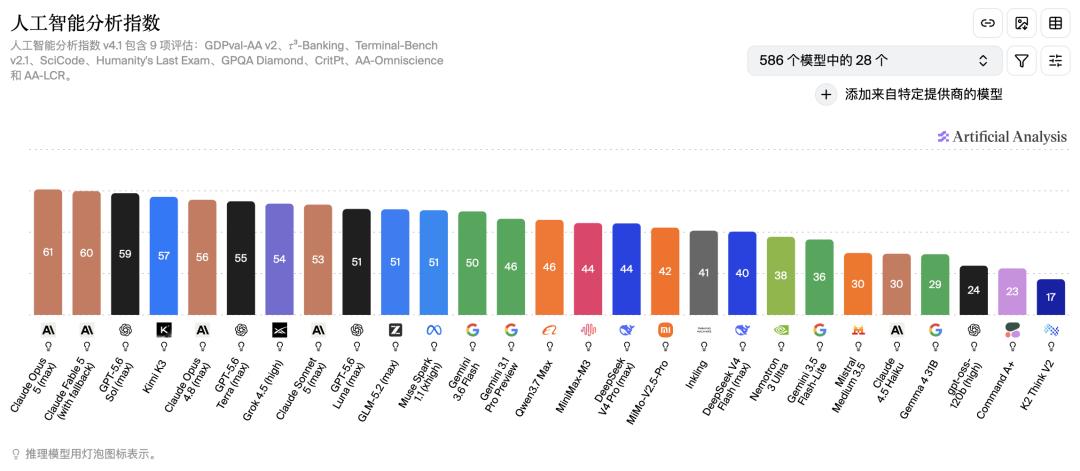
At this point, two conclusions can be drawn. First, Opus 5 has entered the current first tier, and temporarily ranks first at its maximum thinking level. Second, across all tests, Opus 5 has not opened a significant gap with other models, nor has it formed an unassailable advantage.
Therefore, Opus 5 is just the current leader on the rankings. Benchmarks define the upper limit of its capabilities, but the stability in real-world use, Token consumption, and final delivery quality are what determine whether its cost-effectiveness is truly high.
02. Higher benchmark scores do not mean better work output
After the model's launch, user evaluations quickly became polarized.
Positive feedback focuses on programming and interactive content generation. A user on X shared an interactive 3D black hole visualizer generated by Opus 5, which can even synthesize an electronic music track in real time. The code, visual effects, and audio are all integrated into one finished product, demonstrating its strong ability to rapidly create product prototypes.
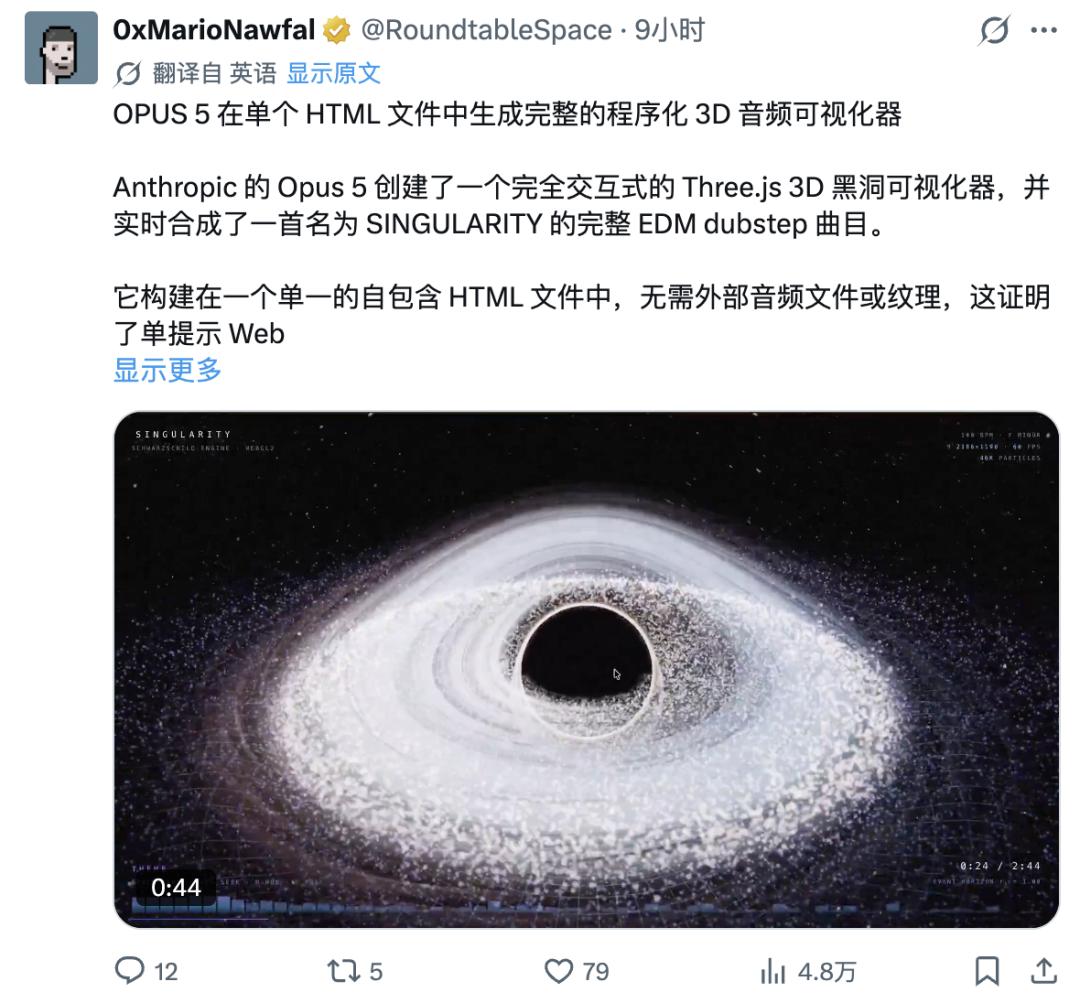
Some users also compared Opus 5 with Fable 5, GPT-5.6, and Kimi K3, arguing that it delivers better results in 3D creation.
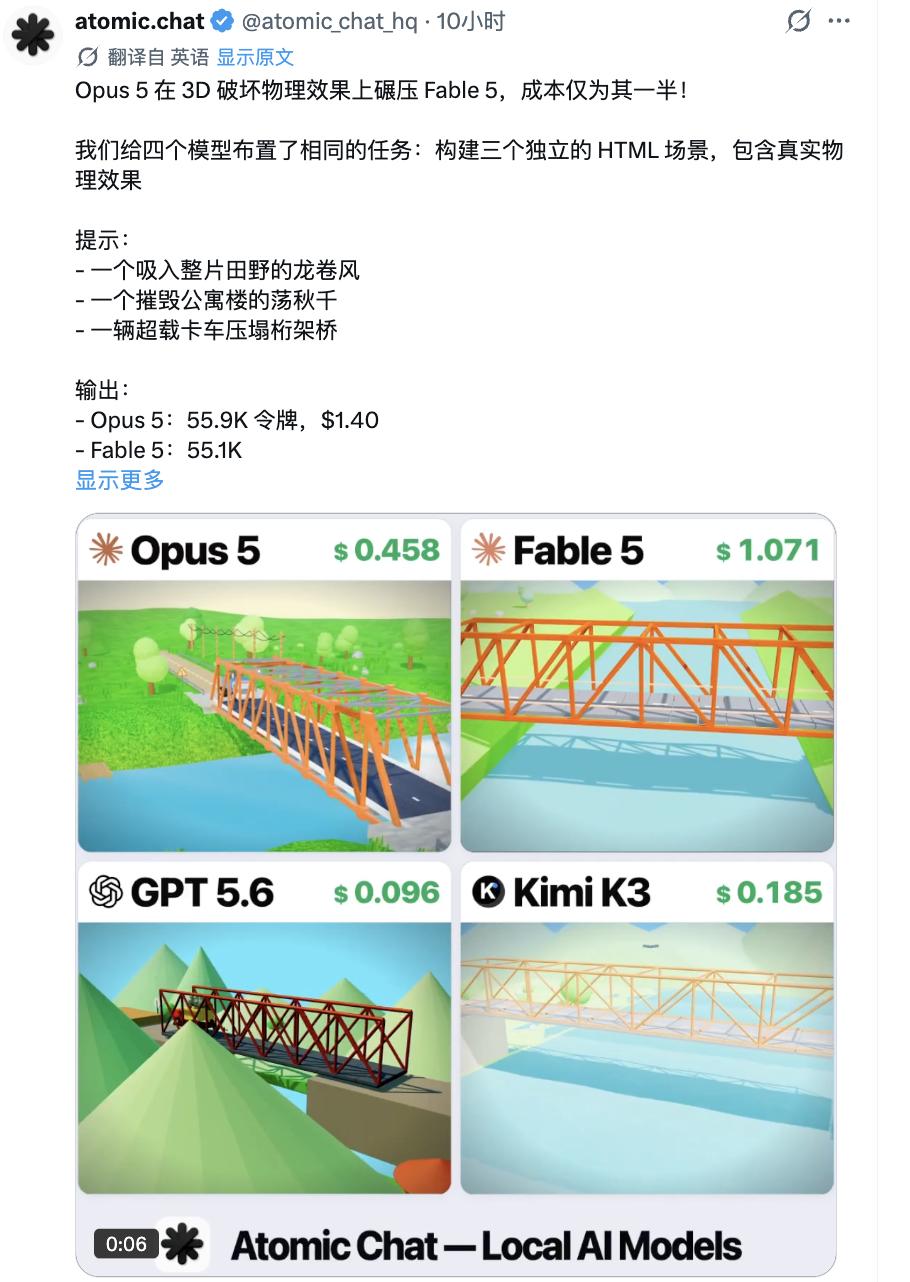
However, some developers believe that Opus 5 overthinks in some tasks, with extremely long reasoning processes, and even becomes "headstrong" as it goes on, deviating from the original goal. Some users reported that the model consumed a large number of Tokens and took up significant context space without strictly following requirements, showing that higher effort does not necessarily yield better results.

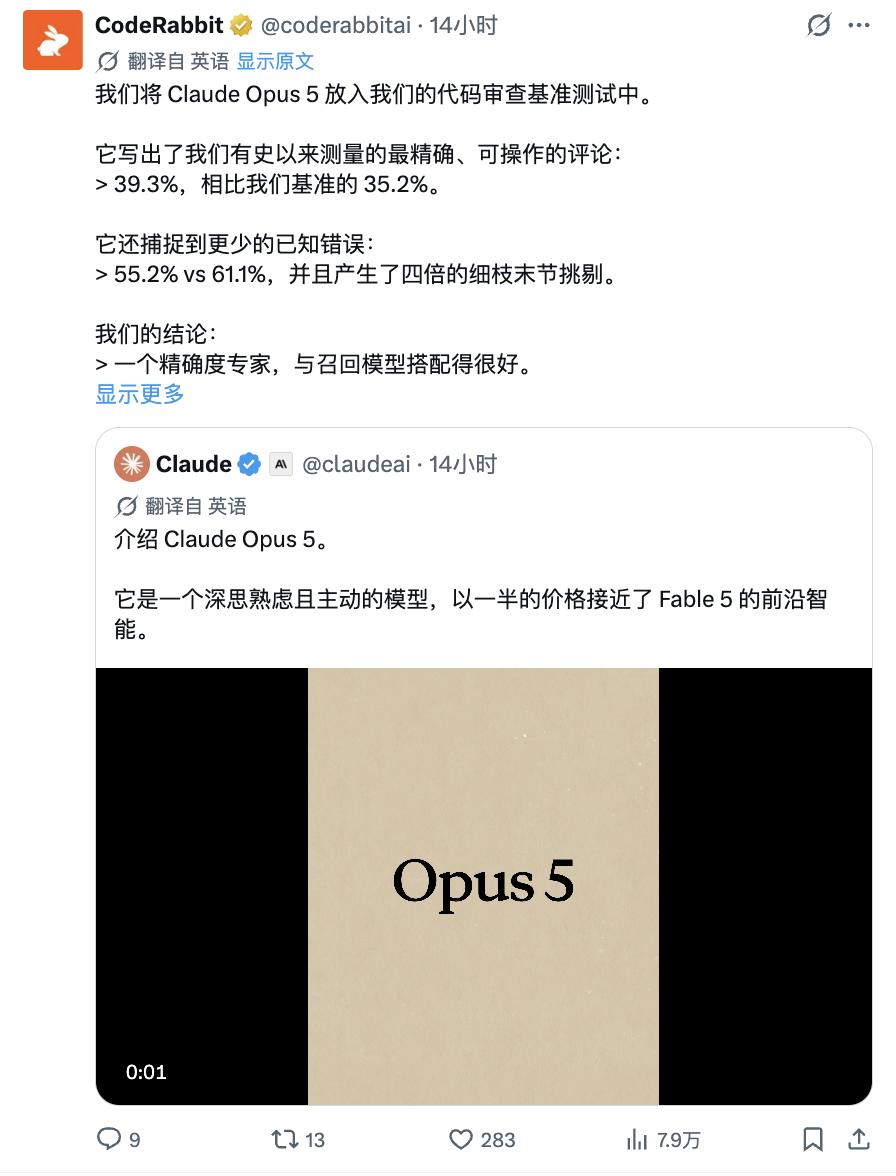
A more systematic test came from the code review platform CodeRabbit. Its conclusion was that Opus 5 is more suitable for writing code than for independently undertaking full code review work. It performs better on open-ended, design-oriented tasks, but may still miss issues such as logical errors, race conditions, and API misuse.
Independent developer Li Mo described Opus 5 as a "reliable colleague with a slight personality." In practical use, its debugging capabilities are very strong, far exceeding Opus 4.8 overall, making it a suitable substitute when Fable 5's quota is exhausted. However, the workflows and prompts formed in the Opus 4 era cannot be directly migrated to Opus 5. To achieve significant improvements, users need to understand the new model's habits and adjust task decomposition, effort levels, and verification methods.
Li Mo mentioned that two practical Beta features directly improved the Agent development experience: previously, modifying the tool list would invalidate the entire cache, but now changing tools mid-conversation no longer causes this issue; the API can also enable automatic fallback, where requests blocked by the safety classifier are automatically forwarded to other models.
Overall, Opus5 currently acts more like a colleague with strong execution skills and a willingness to self-check, but who still needs time to get fully accustomed to. It is suitable for generating code, fixing issues, and completing clearly defined tasks, but Fable 5 still has advantages in complex planning, long-cycle autonomous tasks, and some text expression scenarios.
03. Anthropic needs a daily-use flagship model
Anthropic has recently been accelerating its model update pace.
On May 29, it released Opus 4.8; on June 10, Fable 5 and Mythos 5; on July 1, Sonnet 5; and on July 25, Opus 5. In less than two months, almost Claude's entire main product line was updated.
Amid this dense wave of model releases, industry disagreements over how models should be made available have been widening. On July 16, Moonshot AI released the open-weight model Kimi K3, whose performance is considered to be close to the cutting edge. A few days later, OpenAI's Head of Strategy predicted on X that Washington would create "regulatory risks" around Chinese open-weight models, a remark widely interpreted as pressure on the open-source camp.
On the day Opus 5 was released, 25 companies and institutions including NVIDIA, Meta, and Microsoft jointly signed an open letter calling on the U.S. government not to prematurely restrict open-weight models. OpenAI, Anthropic, and Google were not on the signatory list.
Absence does not mean explicit opposition to open-weight models, but compared to open-weight approaches, Anthropic indeed emphasizes closed-source, tiered access, and risk control more. On June 12, the U.S. government imposed restrictions on Fable 5 and Mythos 5, and both models were temporarily taken offline entirely. After the restrictions were lifted, Fable 5 resumed public services, while Mythos 5, with fewer safety constraints, remains accessible only to some approved institutions.
Opus 5's positioning fits perfectly into Anthropic's strategy of "how models should be made available." Its ability to detect source code vulnerabilities is close to that of Mythos 5, but its ability to convert vulnerabilities into actual exploit tools is significantly weaker. For Anthropic, it is not just a cheaper alternative to Fable 5, but also an option that can more easily be opened to ordinary users and enterprises within a compliance framework.
Meanwhile, Anthropic is expanding its computing power. Two days before Opus 5's release, the company announced that it would deploy up to 2 GW of AMD Instinct MI450 series GPUs and Helios rack-level systems, with the first 1 GW planned for deployment in the first half of 2027. AMD also committed to making a strategic equity investment of up to $5 billion in Anthropic in the future.
From dense model releases and expanded chip supply to streamlined system prompts, what Anthropic is doing is not just improving benchmark scores, but splitting model capabilities into different price points, risk levels, and usage scenarios: Fable 5 handles more complex, longer-cycle tasks; Sonnet 5 meets widespread cost-sensitive demands; Opus 5 aims to become the daily default choice for developers and knowledge workers.
As a result, Opus 5 has not made Fable 5 obsolete. The latter still represents the upper limit of Anthropic's publicly available model capabilities, while Opus 5 solves the problem of delivering near-flagship capabilities to more users at lower cost. Its competitiveness lies in whether it can truly complete tasks with more stable performance, less manual intervention, and controllable costs.
* As requested by the interviewee, Li Mo is a pseudonym.
This article is from WeChat Official Account "AIX Finance", author: Lei Jing,