Celebrities are no longer investing in hot pot restaurants, and have shifted their investment focus to hard technology.
Recently, an online rumor claiming "Actor Huang Xiaoming's investment in Changxin yielded 10 billion yuan" went viral, pushing Huang Xiaoming to the top of trending searches.
The online rumor states that the fund under actor Huang Xiaoming entered the market when Changxin Technology was valued at 20 billion yuan, investing approximately 100 million yuan. Now, Changxin Technology's corresponding valuation for its IPO is around 579.2 billion yuan, delivering a return of nearly 29 times. If the valuation further surges to 3 trillion yuan after listing, the theoretical value of this investment will reach 15 billion yuan.
As of now, neither Changxin Technology nor Huang Xiaoming's side has responded. However, according to a report by Blue Whale News, an insider stated that the rumor is untrue and the person in question shares the same name as the actor.
After verification by AlphaRank, there is no direct investment relationship between actor Huang Xiaoming and his established Mingjia Capital and Changxin Technology in the public financing records. However, a person named Huang Xiaoming does appear on the shareholder list of Changxin Technology, but he is a former executive of Midea, and is currently one of the partners of Zhaoyin Yunting, the ninth largest shareholder of Changxin Technology.
The rumor may have been a false alarm, but it once again pushed the topic of entertainment celebrities' investments to the top of trending searches. We found that an obvious trend in entertainment celebrities' investments in recent years is that their investment focus is shifting away from hot pot restaurants and toward hard technologies such as robotics and AI.
Once upon a time, the most popular investment targets for celebrities were hot pot restaurants. Huang Xiaoming's Spicy No.1, Huang Lei's "Huangliang Yimeng", Xue Zhiqian's Shangshangqian, Zheng Kai's Huofengxiang... opened one after another, each more grand than the last. On the opening day, the celebrity would stand on the stage, fans would flock from all directions, and social media was flooded with check-in photos.
Looking back now, the era of celebrity hot pot restaurants has long receded collectively.
After the wave of catering investments ebbed, celebrities turned around and left, betting on new battlefields. AI, semiconductors, embodied intelligence, these hard technologies are replacing hot pot and catering as the latest investment buzzwords in the entertainment industry, and entertainment celebrities are increasingly appearing in the shareholder lists of hard technology companies in the capacity of investors.
A
It remains doubtful whether Huang Xiaoming invested in Changxin Technology, but he did invest in robotics.
Many people still remember the "Spicy No.1" hot pot restaurant he co-founded with Li Bingbing and Ren Quan. Founded in 2013, it was extremely popular when it first opened, opening eight chain stores in Beijing within a year, and even expanding overseas to Saipan, USA. However, good times did not last long. Later, the stores closed one after another, and the celebrity hot pot myth came to an end.
Huang Xiaoming has long since stopped focusing on the hot pot business, and has instead turned to hard technologies.
Before 2025, Mingjia Capital founded by Huang Xiaoming had an investment style that leaned toward catering and cultural entertainment. Since 2026, he has started investing in robotics companies, for example, making two consecutive investments in a robotics company called "Tianzu Zu".
This is a robotics leasing platform established in December 2025, incubated by Agibot Robotics. The latter was founded in 2023, and its co-founder is Peng Zhihui, a Huawei "Genius Boy". It has now completed financing up to Round B+++ with a valuation of 15 billion yuan, and is in the first echelon of embodied intelligence in China.
Tianzu Zu is exactly the leasing platform incubated by Agibot. At present, robotics manufacturers such as Unitree and Agibot have settled in. In March this year, Tianzu Zu completed its angel round of financing, with a financing amount exceeding 100 million yuan, and Huang Xiaoming's Mingjia Capital appeared in the list of investors. One month later, in the Pre-A round of financing, Mingjia Capital followed up with another investment. Now, Tianzu Zu is valued at 7 billion yuan.
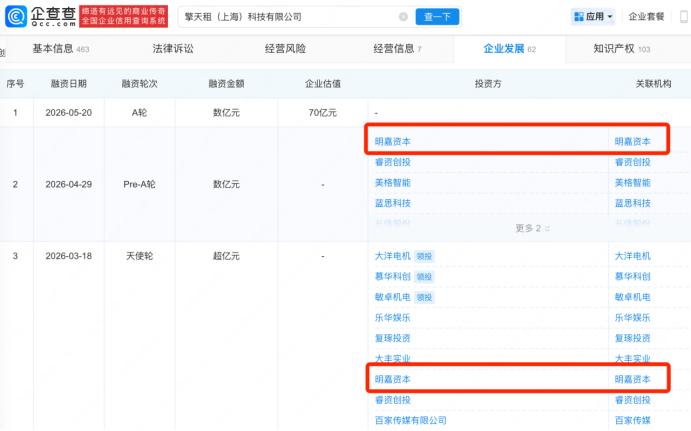
The connection between Huang Xiaoming and this investment began during a variety show recording.
Last year, in the Mango TV variety show *Chinese Restaurant: Africa Startup Season*, a robot named "Xiao Jiu" greeted guests and served dishes on the show. This robot was jointly developed by Agibot and Mango Super Media, with the main body being Agibot's Expedition A2. As a resident guest, Huang Xiaoming thus formed a bond with Agibot.
Last December, when Agibot's 5000th robot rolled off the production line, Huang Xiaoming personally supported Agibot at the event and took home a Lingxi X2 robot on the spot.
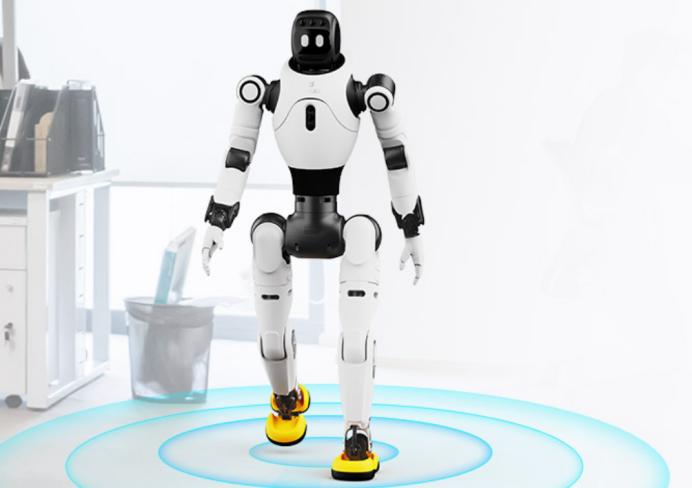
Caption: Agibot Lingxi X2
Huang Xiaoming himself takes this investment very seriously. He not only invested money, but also supported Agibot on multiple occasions. In February this year, at Agibot's robot gala *Robot Wonder Night*, Huang Xiaoming also came to the scene to cheer and watch the robots perform magic tricks. At Agibot's partner conference in April, Huang Xiaoming appeared in the capacity of an investor, and together with Jiang Qingsong, Chairman of Agibot, jointly launched the Tianzu Zu SHAREBOT global network.
In addition to Tianzu Zu, Huang Xiaoming also invested in another company under Agibot called Critical Point.
Critical Point is the dexterous hand business split out from within Agibot, and began independent operation under the "Critical Point" brand in January this year. Its legal representative is Wang Chuang, Partner of Agibot and President of the General Business Division. This company has completed three consecutive financings within half a year, and its current valuation is as high as 1 billion US dollars.
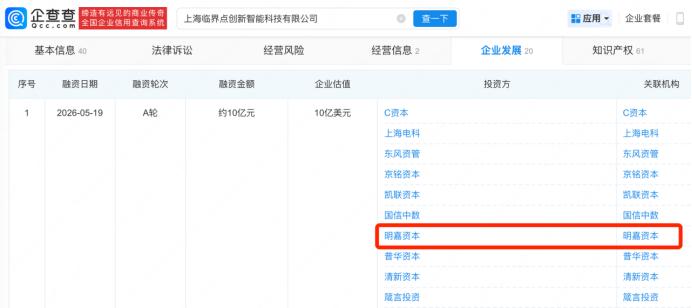
In May this year, Critical Point completed its Series A financing of about 1 billion yuan, with Mingjia Capital participating in the investment.
From Tianzu Zu to Critical Point, Huang Xiaoming's Mingjia Capital has made consecutive moves, deeply binding itself to Agibot Robotics by investing in its subsidiaries. With just a few rounds of layout, Huang Xiaoming has already held two robotics companies, one of which has a valuation as high as 10 billion yuan.
B
Huang Xiaoming is not fighting alone. At present, robotics has become one of the hottest battlefields for celebrities' cross-border investments.
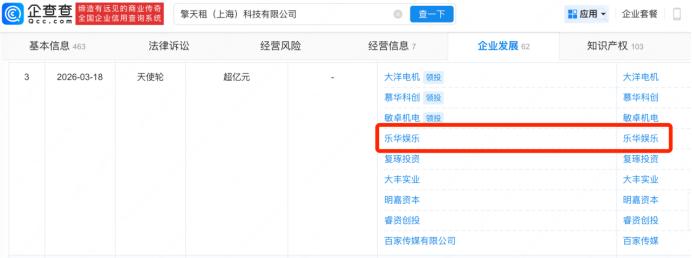
Wang Yibo's agency, Yuehua Entertainment, has also entered the game and participated in Tianzu Zu's angel round of financing last March. Du Hua, the founder, said that relying on the artist matrix and fan ecosystem, they will cooperate with Tianzu Zu to explore "robot + entertainment" services.
Yuehua Entertainment holds top-tier artists such as Wang Yibo. If robots can be combined with concerts and fan meetings, there is indeed huge room for imagination.
Superstar Legend, a concept stock associated with Jay Chou, has taken even bigger steps.
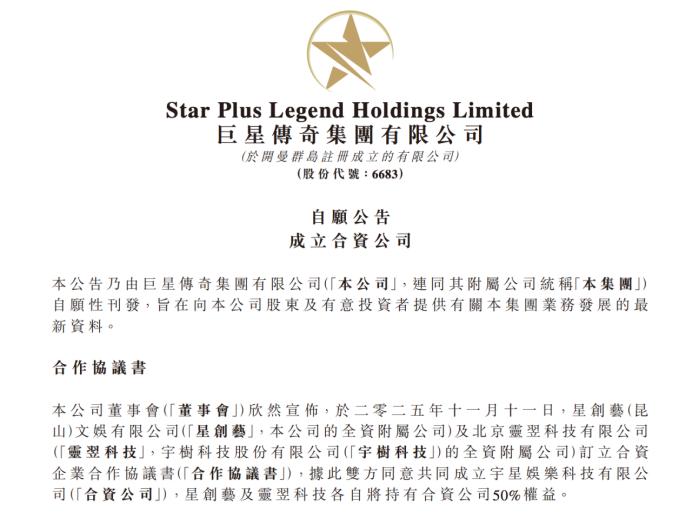
This entertainment company, co-founded by Jay Chou's agent and mother, announced in July 2025 that it would cooperate with Unitree Technology on the development of quadruped robotic dogs and robots, to jointly create consumer robotics products with IP attributes. In November of the same year, Superstar Legend issued another announcement stating that its subsidiary Xingchuangyi will form a joint venture with a subsidiary of Unitree Technology called "Yuxing Entertainment", with each party holding 50% of the shares.
Unitree Technology was founded in 2016, with Wang Xingxing as its founder. Its behind investors include Meituan, Tencent, and Alibaba. In July this year, the registration for Unitree Technology's IPO on the STAR Market took effect. Based on its estimated fundraising amount of about 4.2 billion yuan, its target valuation is about 42 billion yuan.
One is an entertainment company with a market value of 3.9 billion Hong Kong dollars, and the other is a technology company with a target valuation of about 42 billion yuan. What do the two want to do through the joint venture?
The announcement shows three parts: consumer-grade IP robots, performing humanoid robots, and IP derivatives.
There are already real achievements for consumer-grade IP robots. Last November, the robots jointly developed by the two parties received two orders totaling 6,000 units, with an amount of about 120 million yuan. Unitree Technology also has experience in performing humanoid robots. Last December, the Unitree G1 robot took the stage to dance at Wang Leehom's concert.
In short, this is a cross-border combination of "Jay Chou IP" and "Unitree Technology". This means that the "Jay Chou Companion Robot" may not be far from reality.
Actor Huang Lei is also quietly investing in hard technologies, and got in touch with robotics companies like these very early.
According to a report by ChinaVenture, in 2017, when cloud intelligent robot company CloudMinds completed its 100 million US dollar Series A financing, Huang Lei appeared at the press conference and served as the "Cloud Intelligent Robot Experience Officer". This company, founded by Huang Xiaoqing, former president of the China Mobile Research Institute, received hundreds of millions of dollars in investments from institutions such as SoftBank, and its valuation once exceeded 1 billion US dollars.
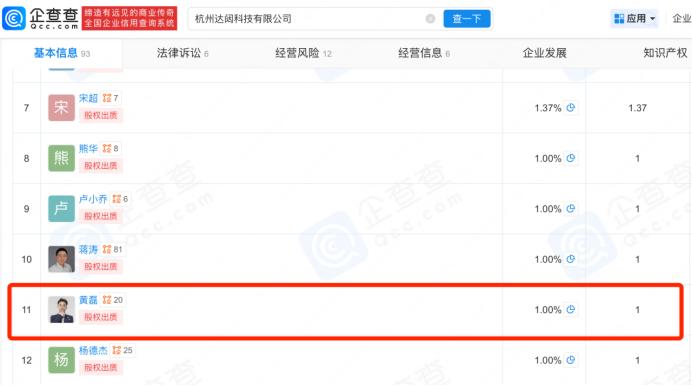
Qichacha shows that in 2019, Huang Lei invested in Hangzhou CloudMinds Technology, holding 1% of the shares and ranking as the 11th largest shareholder.
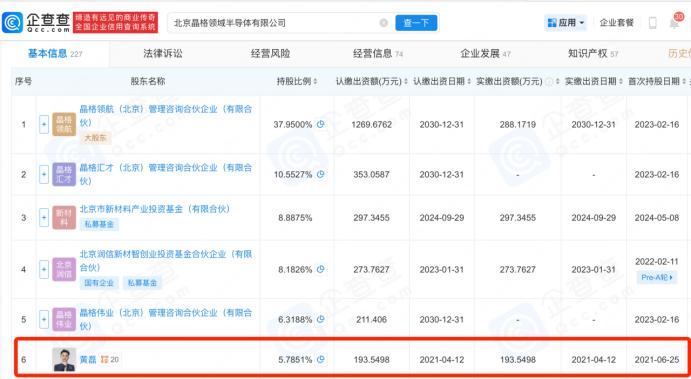
In addition, Huang Lei has also invested in an academician project for silicon carbide substrates. In June 2021, Huang Lei invested in Beijing Lattice Semiconductor Co., Ltd., holding a 11% stake.
Lattice was founded in 2020, focusing on silicon carbide substrates, the core material of third-generation semiconductors. Its founder, Chen Xiaolong, is a researcher at the Institute of Physics of the Chinese Academy of Sciences, and was elected an academician in 2025.
This company completed four rounds of financing up to Round B between 2020 and 2024. In its Series A financing, Hongtai Fund founded by Yu Minhong also appeared as an investor.
However, in recent years, Huang Lei has successively reduced his shareholding, from 11% to 5.79%, and is currently the sixth largest shareholder. From a time perspective, Huang Lei's share reduction periods correspond to the Pre-A, A, and B rounds of financing respectively, which means that as the valuation rises, he has achieved partial exit by reducing his old shares, and may have obtained floating profits.
If Huang Lei belongs to the type of long-term layout, then some celebrity investors have already tasted the sweetness of returns.
In August 2025, singer G.E.M. Deng revealed on a podcast that she invested in an AI company as early as 2019, and entered the market before ChatGPT became a global hit. According to her, this investment has already achieved a 10x return, and the three technology companies she invested in "all made money".
Among celebrity investors, the one who made earlier layouts and achieved a more thorough transformation is undoubtedly the actor Ren Quan. In 2014, he co-founded Star VC with Li Bingbing and Huang Xiaoming. In the early days, they invested in Internet projects such as Miaopai and Handu Clothing, and also invested in companies such as SenseTime and Li Auto.
In 2016, Star VC participated in the A+ round of financing of the digital twin platform 51World, and followed up with the B round of financing in the following year. According to its prospectus, the fund under Star VC holds a 5.4% stake. In December 2025, 51World was listed on the Hong Kong Stock Exchange. As one of the investors, Ren Quan also appeared at the bell-ringing ceremony.
C
Why did celebrities' investment focus shift from catering such as hot pot restaurants to hard technologies?
First of all, the business logic of celebrities investing in hot pot restaurants has collapsed.
The business model of celebrity hot pot restaurants is very simple to explain: use the celebrity's traffic to attract people, and rely on the fan economy to create early prosperity. However, the foundation of the catering industry lies in product strength, supply chain, and continuous operational capabilities. Celebrities are usually only responsible for showing up to endorse the brand, and do not delve into or are not good at management and operation. Once the celebrity's popularity declines or negative public opinions arise, the collapse of the brand is only a matter of time.
Secondly, hard technologies such as AI and robotics are simply too hot.
According to data from IT Juzi, in the first half of 2026, the total financing amount of China's embodied intelligence track reached 93.5 billion yuan, a 5-fold increase compared to the first half of 2025; the number of financing events increased by 137% year-on-year; there are at least 22 unicorn enterprises with a valuation of 10 billion yuan. Hot money is frantically pouring into hard technology fields such as robotics, AI, and semiconductors.
The investment logic of celebrities is very simple: where the money flows, people will go. In the past, when the catering industry exploded, they invested in hot pot and other catering businesses; now that money is flowing into the hard technology industry, they naturally turn to robotics and AI.
But the