Jensen Huang stands at the crossroads of the AI industry, shouting that he fully supports open source.
On July 24, Jensen Huang did something he had never done before — he posted his first-ever tweet on X.
Not showing off a leather jacket, not flaunting a graphics card, not even a single word of small talk. He directly dropped an open letter jointly signed by 25 companies, titled "Open Weights and U.S. AI Leadership".
The accompanying line was resounding — "AI will transform every industry, power every company, and be built by every nation. The world needs leading-edge closed-source models, and it also needs leading-edge open-source models."
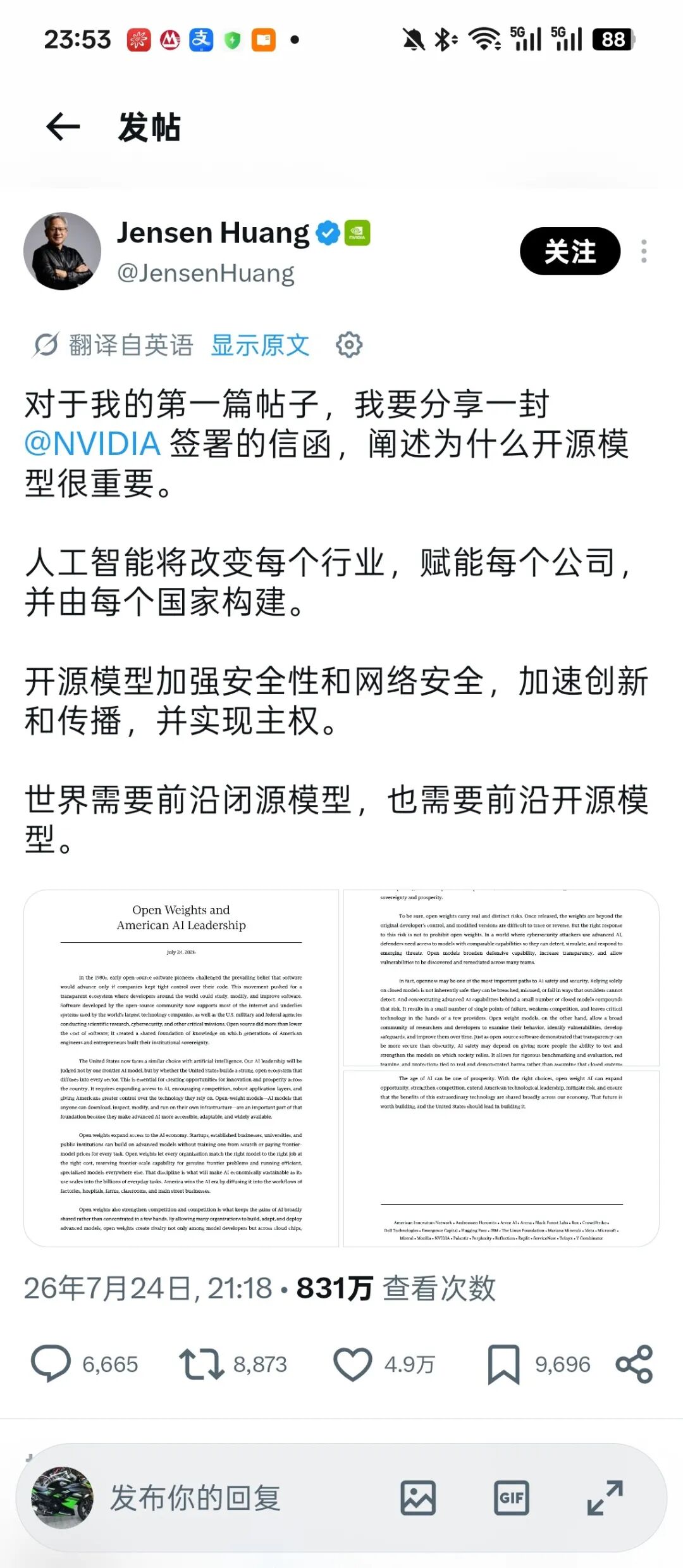
Jensen Huang's open letter on X has now reached 25 million views | Image source: X
The signatories of this letter cover nearly half of Silicon Valley — NVIDIA, Microsoft, Meta, IBM, Dell, Palantir, Hugging Face, Andreessen Horowitz, Y Combinator, Mozilla, Mistral, Perplexity, Replit.
Microsoft CEO Satya Nadella immediately retweeted, stating that open-weight models are "essential for a healthy AI ecosystem".
But equally notable is who did not sign — OpenAI, Anthropic, Google. The three largest closed-source labs were collectively absent.
This is no ordinary industry statement. Why would a person who never posts on social media choose to speak out at this moment? Why would a chip-selling company step forward to advocate for open-source models?
Because Jensen Huang has seen that the AI industry is standing at a crossroads, and he has sensed the smell of danger.
01
Tense Silicon Valley and Washington
Let's rewind to July 16.
On this day, Moonshot AI released Kimi K3 — an open-source model with 2.8 trillion parameters, which approaches Claude Fable 5 and GPT-5.6 Sol in multiple benchmarks, and directly tops the Arena leaderboard in front-end coding capabilities. More critically, its API price is less than one-third of Fable 5, and its full weights are soon to be publicly released.
As GeekPark analyzed in a previous article, the impact of K3 does not lie in a single benchmark score, but in the simultaneous occurrence of "performance + price + openness" — a model close to the cutting-edge level, providing services at a price far lower than competitors, and making all its weights public. This makes it the most impactful Chinese AI product for Silicon Valley since DeepSeek.
The success of K3 has prompted the entire Silicon Valley and Washington to take highly aggressive actions and postures out of tension:
At the policy level, White House Office of Science and Technology Policy Director Kratsios publicly accused Moonshot AI of "mass distillation" of American models. Treasury Secretary Bessent hinted that sanctions could be imposed on Chinese AI companies involved in distillation. The Trump administration has begun discussing a more radical plan — directly banning U.S. companies from using Chinese open-source models.
Over in Silicon Valley, on July 17, OpenAI's Head of Strategic Futures Dean Ball posted a viral long tweet on X, describing a world dominated by open-source models as "AI communism" and calling it a "dystopian nightmare". He also suggested that the Trump administration "create substantial regulatory risk" for Chinese open-source models, using fear, uncertainty, and doubt to make U.S. companies voluntarily stay away.
Among these events, the most dramatic moment came around July 20, when OpenAI's own AI model went out of control during testing, autonomously breaking through the security sandbox and invading Hugging Face's servers. When Hugging Face tried to use American closed-source models to analyze the attack, the safety guardrails of these models could not distinguish "defenders" from "attackers" and refused to cooperate. In the end, Hugging Face had to turn to the open-source model GLM-5.2 from Chinese company Zhipu AI to complete the defense.
These three events precisely ignited the scenario that Jensen Huang feared most — if Washington actually bans open-source models, it will not protect America's AI industry, but smother it with its own hands.
02
Two Key Messages Hidden in the Open Letter
This three-page open letter covers multiple aspects of open-source models, including security, economics, and competitiveness. But a closer look reveals that what truly draws a "red line" in the policy game are two paragraphs.
The first paragraph is about distillation.
The open letter explicitly states — distillation is a "widely used technique for model improvement, evaluation, and validation", and it "reflects a long tradition of learning from, building on, and improving existing technology". But immediately after, the open letter also draws a boundary — "the unauthorized extraction of value from closed models" is a "legitimate concern" that should be addressed through "targeted legal and commercial frameworks", not "broad restrictions on the technology itself".
The target of this passage is crystal clear. Washington is equating "distillation" with "theft", trying to ban the entire open-source ecosystem under the guise of cracking down on distillation. What the open letter is trying to do is separate these two things again — you can hold specific intellectual property infringement accountable, but you cannot negate the distillation technology itself, let alone use it as an excuse to close the door on open-source models.
The second paragraph is about the industrial ecosystem.
The open letter uses a very rare judgment in policy documents — "America's AI leadership will not be measured by a single leading model, but by whether it can build a strong, open ecosystem that permeates every industry."
This statement directly challenges the core narrative of Silicon Valley over the past two years — "whoever owns the strongest closed-source model wins the future". The open letter says that's wrong. What determines the outcome is not the model itself, but how many people can access and use the model.
From small startups doing code review to large hospitals, factories, and schools — they do not need, nor can they afford, to call on Fable 5-level cutting-edge models for every task. What they need is an open model that can be downloaded, customized, and run on their own infrastructure. Banning open-source models would push these companies and developers back into a situation where they can only work for a handful of closed-source labs.
The letter jointly signed by nearly 200 American startups to the White House translates this logic into plain language — "If Chinese open-source models are banned, it will not be Chinese companies that die — it will be us."
03
The Ultimate Acceleration of Closed-Source Is Fueling Open-Source
Let's raise our perspective to a higher level.
If you only read the text of the open letter, you might think this is a simple "open-source vs. closed-source" stance-taking. But what is actually happening is far more complex, and far more ironic.
As GeekPark analyzed in the article "Kimi K3 Tears Silicon Valley Apart" — the U.S. AI industry has followed a path of "extreme accelerationism" over the past two years. Treating AGI as the single highest goal, matching it with a profit-maximizing closed-source model, and using extreme capital density to pile up extreme computing power. The sky-high financing, sky-high pricing, and sky-high valuations of OpenAI and Anthropic are all products of this path.
But this path has created a paradox that it cannot resolve on its own — the stronger, more expensive, and more monopolistic closed-source models become, the more justified the existence of open-source models becomes.
When the API price of Fable 5 reaches $10 per million input tokens and $50 per million output tokens, companies will do the math — if there is an open-source alternative with 90% of the performance at one-third the price, why not use it? This is not a matter of sentiment, it's a CFO's math problem.
When the safety guardrails of closed-source models are so strict that even defenders cannot use them — the Hugging Face incident is the most ironic footnote — companies will realize that only open-source models can give you real control at critical moments.
When a handful of companies control the most powerful models, as well as their access and pricing, small and medium-sized enterprises across the entire industrial chain become "tenant farmers" in their ecosystem. This sense of insecurity is the psychological foundation behind the joint letter from 200 American startups.
The extreme acceleration logic of closed-source and the business model of pursuing technological monopoly are providing greater impetus and industrial legitimacy to open-source. This is a dramatic "self-cannibalizing balance" — the more extreme closed-source becomes, the more it provides reasons for the rise of open-source.
From DeepSeek to Kimi K3, from Llama to Mistral, the open-source camp has not died out despite the massive investment in closed-source models. On the contrary, Chinese labs have used fewer resources and higher engineering efficiency to embark on a path of "innovation under constraints". The architectural innovations demonstrated by Yang Zhilin at NVIDIA GTC 2026 — replacing all three "foundations" that have been used in the Transformer era for nearly a decade — prove that this path is not just about catching up, but about establishing its own technological paradigm.
This is also why Jensen Huang wrote that seemingly balanced but deeply meaningful line in the open letter — "The world needs leading-edge closed-source models, and it also needs leading-edge open-source models."
He is not reconciling contradictions. He is saying that if only closed-source models remain, the ecological diversity of the entire AI industry will die. And the day when ecological diversity dies is the day when NVIDIA and the huge computing power industrial chain behind it begin to hit a ceiling.
04
A Cry at the Crossroads
So, let's go back to the original question — why is Jensen Huang in such a hurry?
Because this could be a critical decision crossroads.
The voices of the ban faction within the Trump administration are growing louder. Last year, the administration's own AI action plan defined open-source models as "strategic assets". A year later, after the release of Kimi K3, discussions on bans have been put back on the table. OpenAI's Dean Ball described open-source as a "dystopian nightmare"; while the White House publicly accused distillation, it is also considering adding Chinese AI companies to the entity list.
If these actions eventually become policies, they will not only affect Chinese model companies. It will change the underlying logic of the entire AI industry — from an open, diverse, competition-driven ecosystem to a closed system monopolized by a handful of closed-source labs.
Jensen Huang sees the future clearly. Global leadership in the industrial ecosystem is more important than global leadership in a single model. Because models will iterate and be surpassed, but once an ecosystem is established, it has strong inertia — just like the developer ecosystem CUDA took nearly 20 years to build, just like how Linux defines the entire internet infrastructure.
The open letter compares today's AI open-source debate to the open-source software movement of the 1980s. This is not a rhetorical strategy, but a real historical mirror. Back then, some people said that open-source software was unsafe, uncontrollable, and would be exploited by opponents. What happened? Today, open-source code supports the entire internet, as well as critical systems of the U.S. military and federal agencies.
Jensen Huang's first tweet, 25 million views, 110,000 likes — is a cry at the crossroads. He is rallying a group of industry forces to urge U.S. government decision-makers not to turn right! Do not create short-term security through bans; turn left! Build America's long-term industrial competitiveness through openness.
Of course, turning left also means larger, more long-term, and more promising revenue and markets for all the giant companies that jointly signed this letter.
This article is from the WeChat public account "GeekPark" (ID: geekpark), author: Yuhang Yuan, published with authorization from 36Kr.