Claude Opus 5 is here, offering the performance of Fable 5 at half the price.
Zhexi News, early report on July 25, in the early hours of today, Anthropic's new generation flagship large model Claude Opus 5 was officially released and launched, which combines the characteristics of "deliberate consideration" and "active response", with performance extremely close to Claude Fable 5, but at half the price.
At this point, netizens offered a brilliant comment:
"If it's almost the same as Fable 5, then why pay twice as much to use Fable 5?"

Back to the model, in its strong suit of programming, Claude Opus 5 achieved SOTA in programming and knowledge work evaluations such as Frontier-Bench and GDPval-AA, but still lags behind Mythos 5 on cybersecurity tasks.
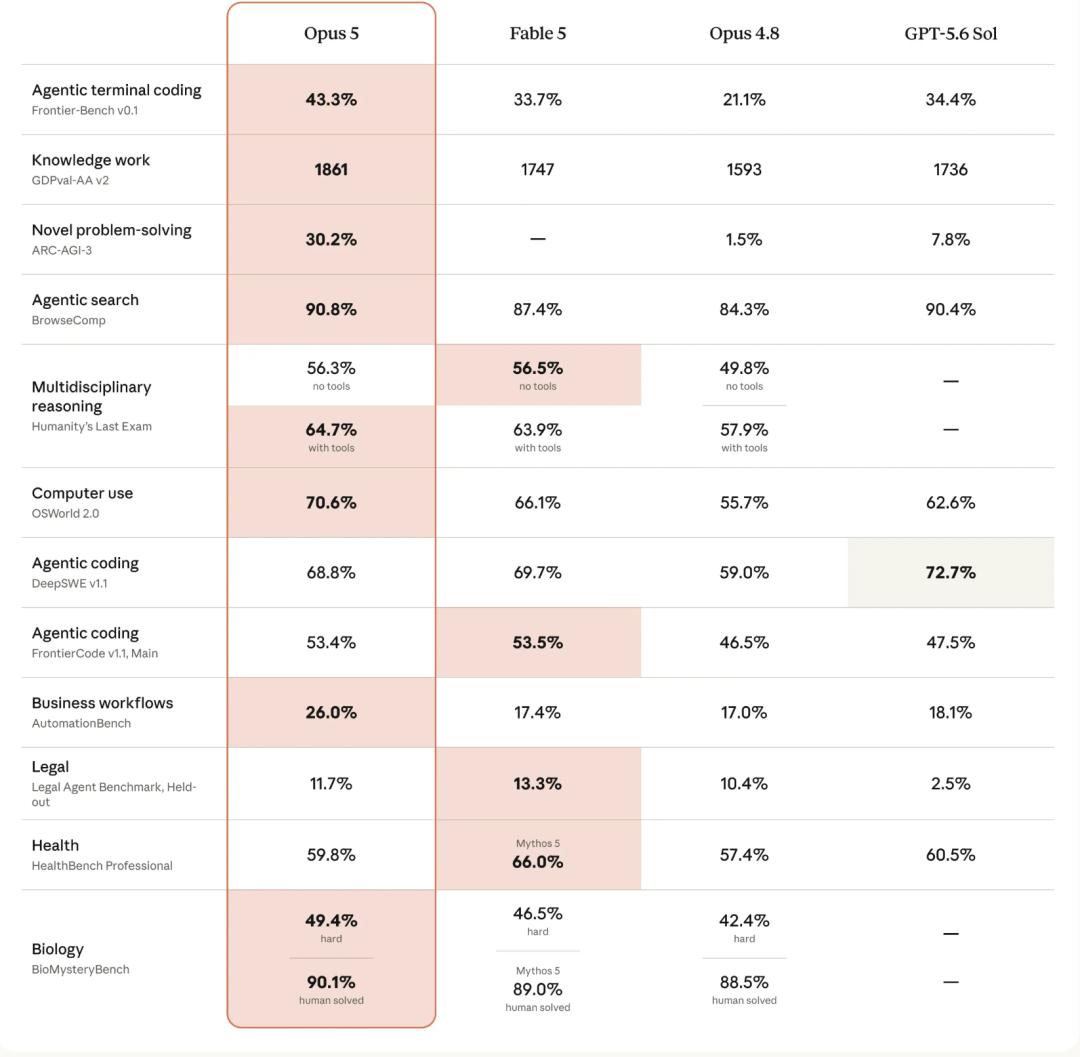
Anthropic really hyped up the new model this time, while also giving enough face to the previously popular Fable 5 and Mythos 5, which can be described as a "master of balancing all sides".
In terms of pricing, Claude Opus 5 is priced at $5 per million input tokens / $25 per million output tokens (on par with Opus 4.8). Developers can use claude-opus-5 in the API. Fast mode runs about 2.5 times the default speed and costs twice the base price.
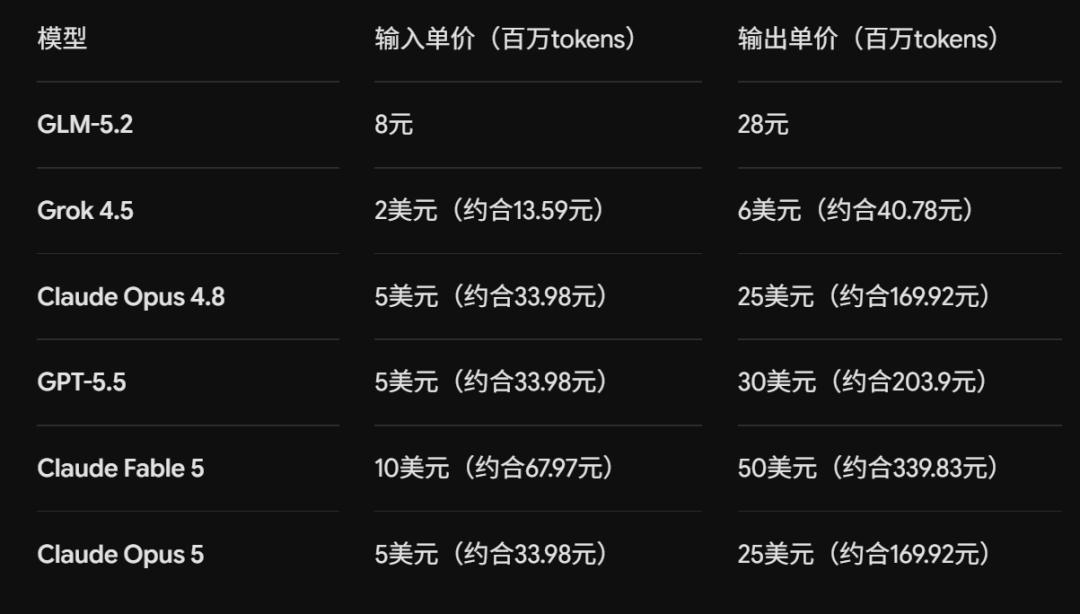
▲ Large model price comparison
This time Claude also updated two beta-stage features: prompt caching remains valid when switching tools mid-conversation, and automatic API degradation handling (when encountering requests flagged by the security classifier) to avoid direct request rejection.
Anthropic mentioned that Opus 5 is designed for high-frequency daily use, with higher work efficiency than previous models. It has become the new default model for Claude Max and is the highest-performance model in Claude Pro.
The release of Opus 5 has sparked extensive discussions among netizens, and some have pulled out that "old image":
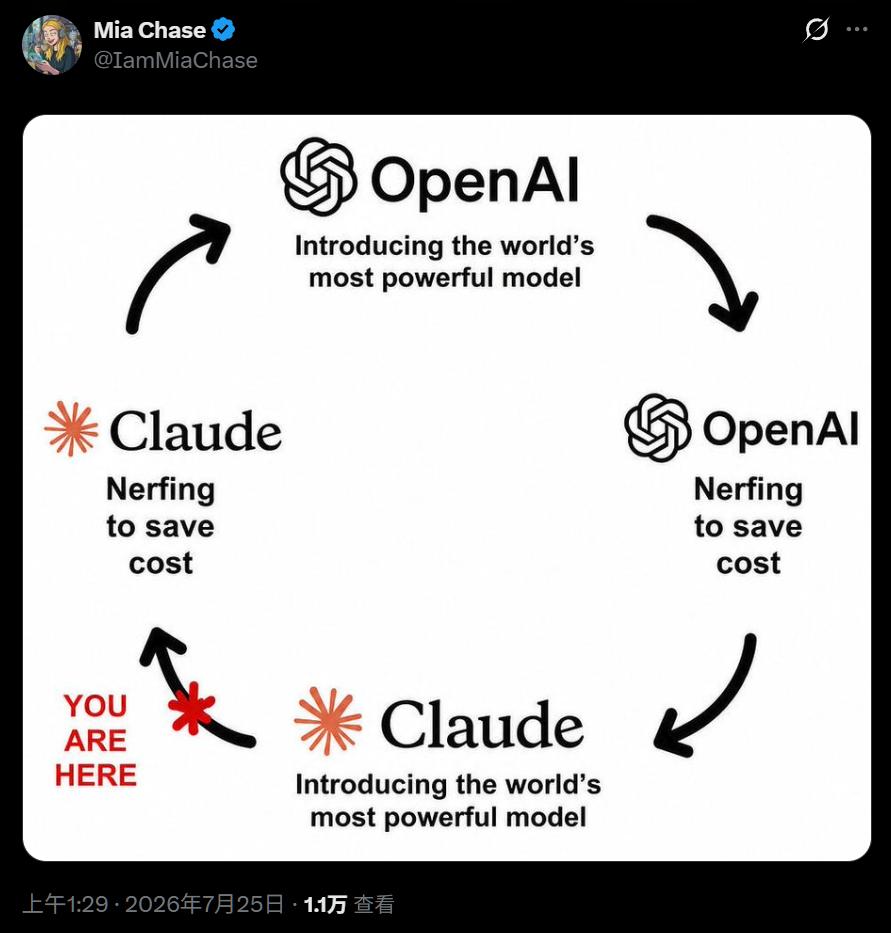
Some other netizens are teasing Anthropic's signature trick: resetting

Some users found after using it that Opus 5's writing style is very similar to 4.8, completely different from Fable 5, especially in word choice:
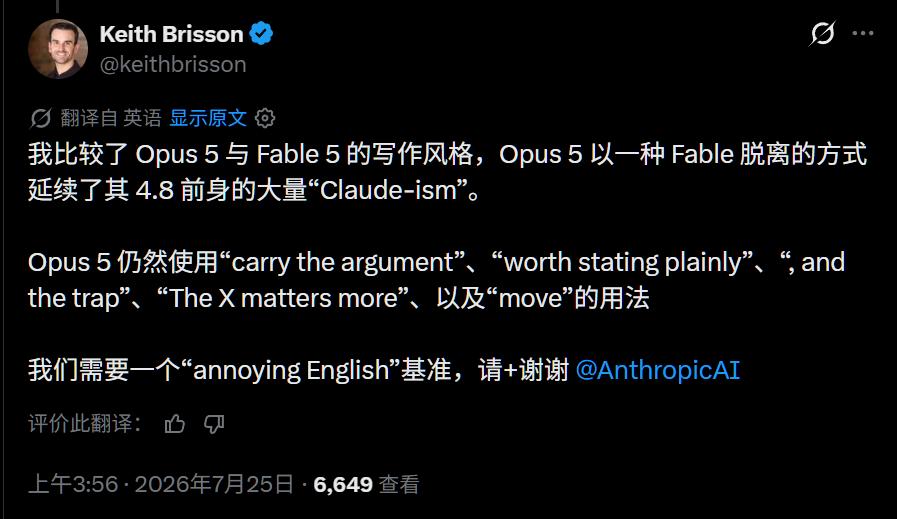
Some people think that calling it Opus 5 is more like calling it Fable 5.1:
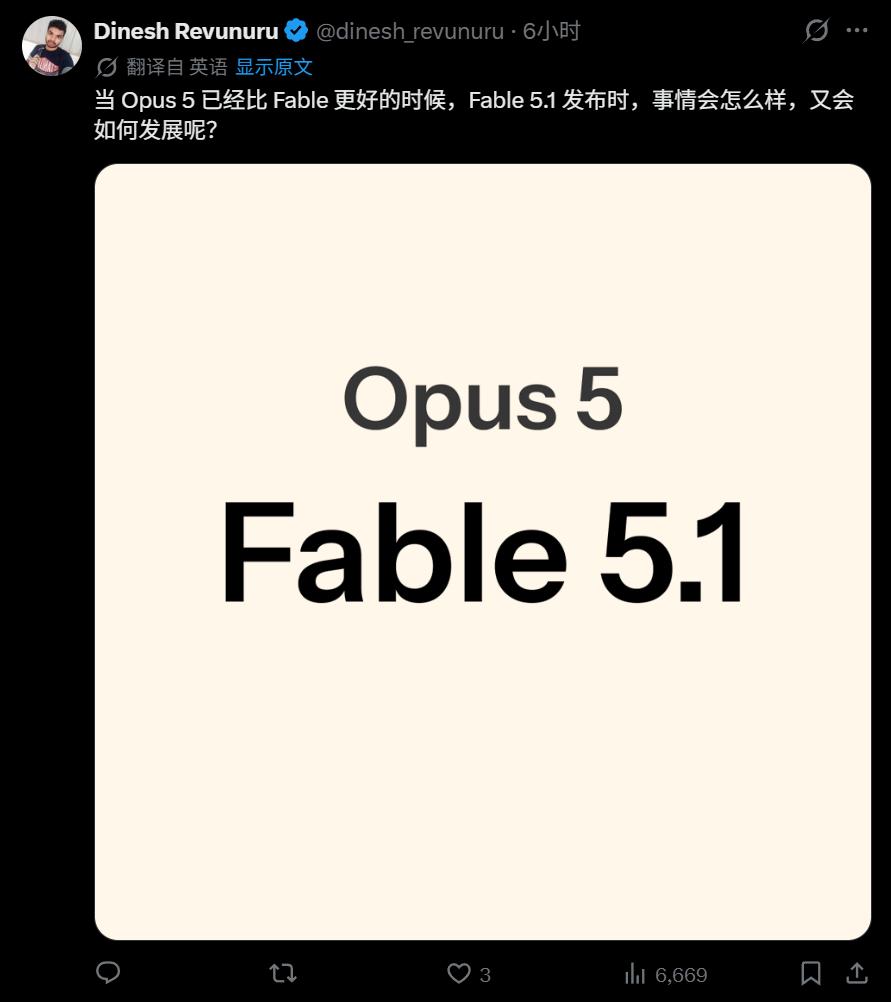
Netizens also thoughtfully predicted that various articles will soon be "teaching you how to use Opus 5", and this post has received high attention:

01.
From High-Value Software Engineering to Scientific Research and Visual Output
Performance and Cost-Effectiveness Stand Out as Key Advantages
The most common complaint people have about Claude is that it's "expensive".
This time, while maintaining the same cost as its predecessor Opus 4.8, Claude Opus 5 has achieved a significant performance leap.
The model's "Effort" setting allows users to flexibly adjust — they can either pursue maximum intelligence, or save tokens to get faster and cheaper results.
Opus 5 performs excellently in high-value software engineering tasks:
Frontier-Bench v0.1: Opus 5 surpasses all other models, reducing the cost of individual tasks while delivering more than twice the performance of Opus 4.8.
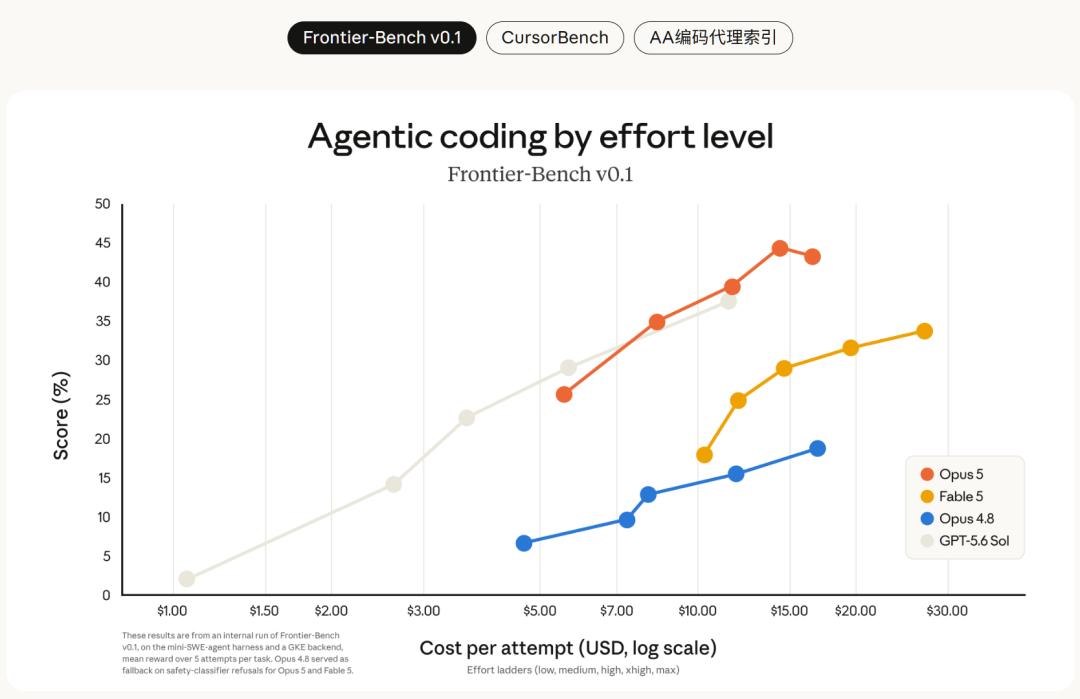
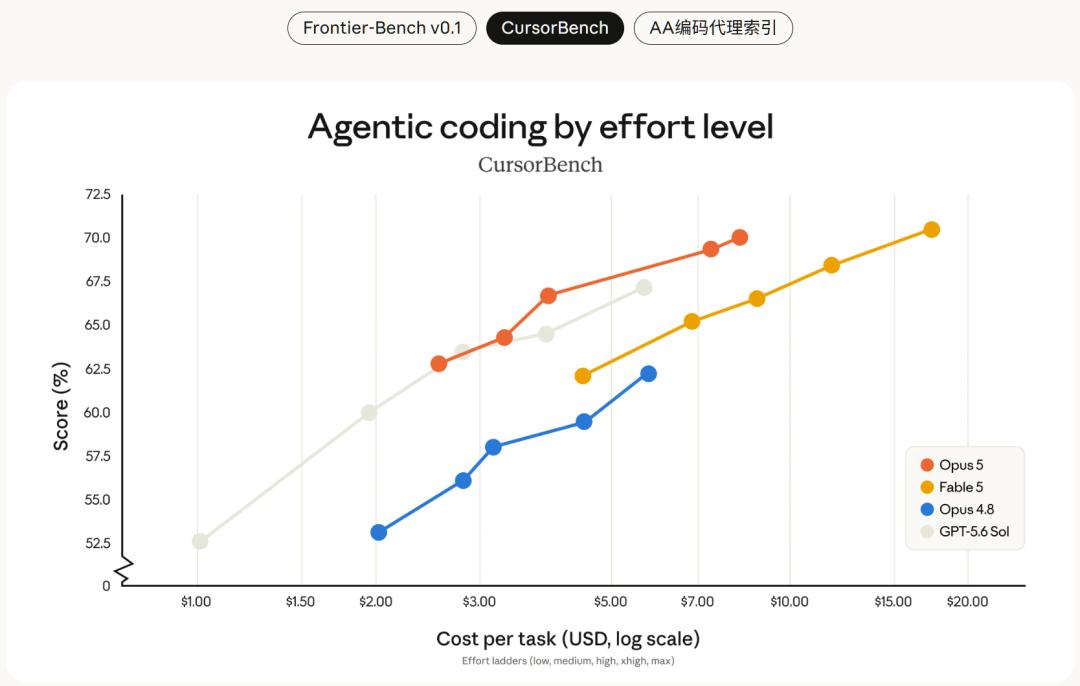
CursorBench 3.2: Under Max Effort mode, its performance is only 0.5% below Fable 5's peak score, but the per-task cost is only half of the latter; under High, Xhigh, and Max effort modes, Opus 5 outperforms all other models at the same cost.
Opus 5 also performs impressively in knowledge work and complex problem-solving tasks:
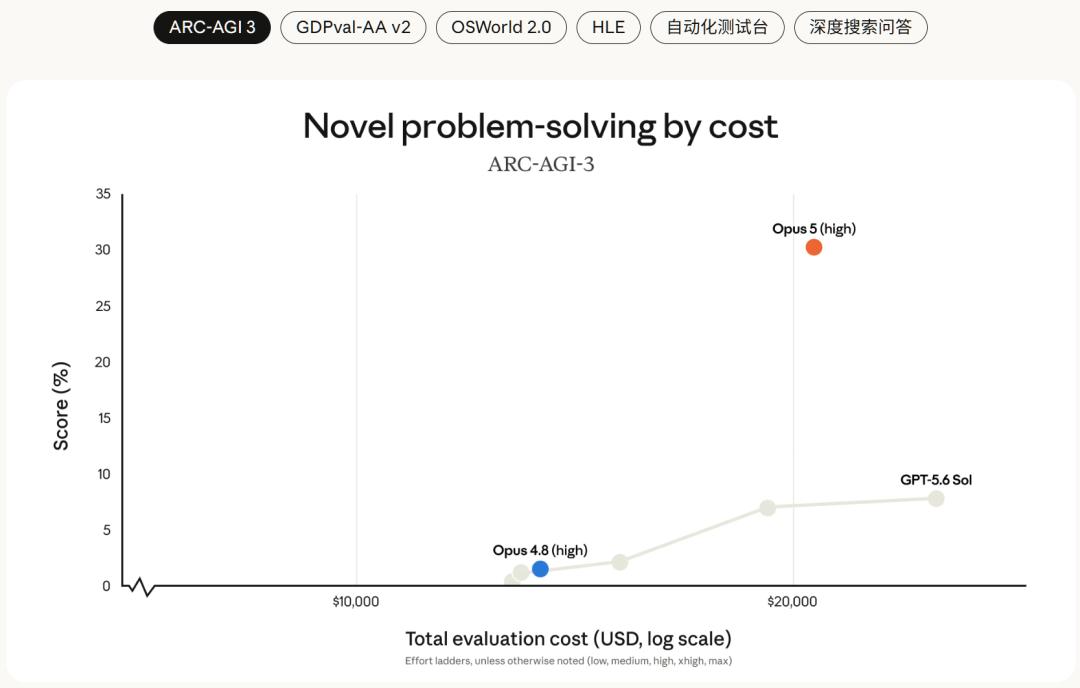
ARC-AGI 3 (an evaluation testing the model's ability to solve completely new, unknown problems): Opus 5's score is 3 times that of the second-place model.
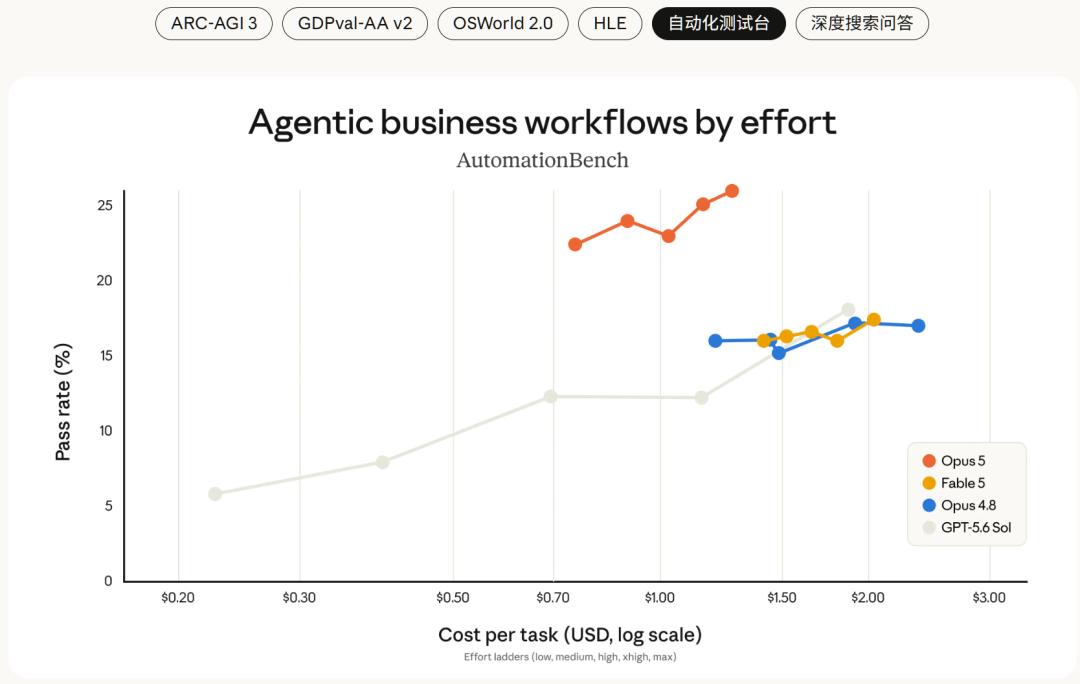
Zapier AutomationBench (measures the model's ability to complete end-to-end business automation processes): At the same per-task cost, Opus 5's pass rate is approximately 1.5 times that of the second-place model. Even at the minimum effort setting, Opus 5 passes more tasks than any other model.
OSWorld 2.0 (computer operation usage benchmark): At any given cost, Opus 5 outperforms all other models, and only needs slightly more than one-third of the cost to exceed Fable 5's best score.
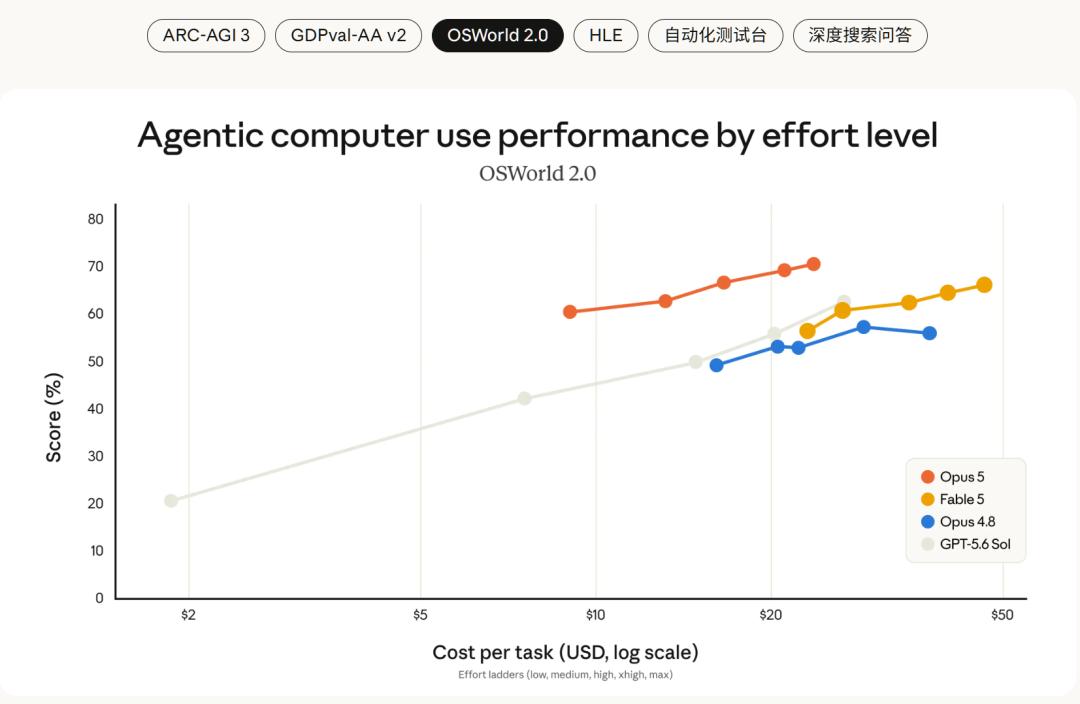
In addition, it has become the highest-performance and most cost-effective model across multiple related evaluations, including tests such as HLE, AutomationBench, and DeepSearchQA.
For scientific research, Opus 5 brings significant improvements over Opus 4.8. Opus 5 outperforms Opus 4.8 in all life science evaluations covering structural biology, organic chemistry, and bioinformatics. Its most notable breakthroughs are reflected in:
Organic chemistry tasks (such as inferring molecular structures from spectral data): Scored 10.2 percentage points higher than Opus 4.8 in internal benchmarks.
Protein-related tasks (such as predicting the impact of protein sequence variations on their functions): The score increased by 7.7 percentage points.
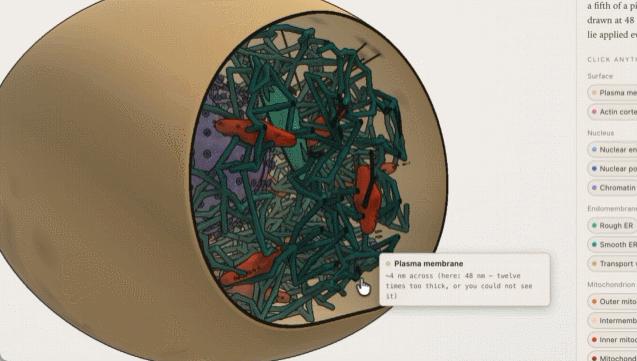
Finally, Opus 5 is equipped with substantially enhanced visual output generation capabilities.
Generating aerodynamic wind tunnel airflow diagrams:

Cell structure interaction diagram:
02.
Improved Self-Verification and Iteration Capabilities
More "Thinking Carefully" Before Writing Code
Lovable Co-Founder: The Biggest Leap Since 4.5
Claude Opus 5 has significantly improved its capabilities in self-verification and careful iteration, and can continuously optimize until the task succeeds. This is also one of the model capabilities that the industry is currently very concerned about.
In evaluations and early testing, we and test users have found many typical cases that demonstrate Opus 5's agency and rigor:
Independently building a visual pipeline: In a task from Frontier-Bench, the model received a drawing of a mechanical part and was required to write code to reconstruct a 3D model in FreeCAD, but the task deliberately did not provide the model with an interface to directly view the drawing. Opus 5's approach was to independently write a set of computer vision processing pipelines, extract geometric features from the original pixels, and then complete the reconstruction of the full mechanical part, with repeated successful experiments. Under the same setup, other competing models tried 5 times without a single success.
Rooting out deep bugs: Facing a real bug in a popular open-source package manager, Opus 5 found the root cause and fixed the edge cases missed by community patches; while competing models only fixed the superficial symptoms rather than the underlying root cause, and reported that the problem was resolved.
Building its own test suite: Engineers at a trading company used Opus 5 in a single session to build a market data access source for a new exchange. Previously, even with detailed solutions provided by engineers, older models could not complete this task at all. Since there was no real-time data source available for verification at the time, Opus 5 even built its own test suite to check whether the code accurately parsed the exchange data.
Anthropic also released some comments from well-known industry figures about Opus 5, for example:
Cognition CEO Scott Wu mentioned that Opus 5 performs excellently in debugging and root cause analysis of difficult problems in the company's Devin software.
Zapier CEO Wade Foster mentioned that Claude Opus 5 took the top spot in Zapier AutomationBench without increasing token consumption. It read an original customer health spreadsheet and executed the entire end-to-end customer churn prevention process (flagging at-risk accounts, notifying responsible persons, organizing retention reports). The old model couldn't finish it, but Opus 5 achieved 100% completion.
Lovable co-founder Fabian Hedin believes that Claude Opus 5 is the biggest leap in the Opus family since version 4.5.
According to Denis Shiryaev, Head of JetBrains IDE AI, what impresses him most about Claude Opus 5 is its judgment and decision-making ability. It thinks more deeply before writing code, and can catch its own logical flaws during the planning phase, which represents a major leap in problem-solving capabilities.
03.
Higher Security, Less Susceptible to Being Tricked
Focused Restrictions on Exploitation Capabilities
In pre-deployment testing, Anthropic's automated behavioral audit showed that Opus 5 is the most aligned model it has ever built.
It is more compliant with "Claude's Constitution" than Opus 4.8, Sonnet 5, or Fable 5, has the lowest incidence of deceptive behavior, and is the least susceptible to being misled or induced into misuse. It is currently Anthropic's safest model in avoiding reckless actions that could lead to irreversible side effects.
