Your next interviewer might not be a human.
Who Can Guarantee That Super Digital Employees Won't Be the Next Breakthrough for AI Implementation

Written by | Li Jiaxing
Edited by | Zhang Wei
Cover Source | MetaEnterprise AI
At the start of July, the autumn recruitment season began to warm up. The next resume you submit might not be seen by an HR first, but read by an AI employee beforehand.
Using machines to screen resumes is nothing new. What's truly interesting is: what if this AI doesn't just help HR filter resumes, but acts like a newly joined colleague, who can independently source candidates, communicate with them, score their suitability, and report results after being assigned a clear objective?
Recently, MetaEnterprise AI launched its first product, "Super HR". It is not a tool that only solves a single isolated step, but attempts to take on full tasks like a real employee: breaking down job requirements, sourcing candidates on recruitment platforms, reviewing their project experiences, assigning a matching score, and finally presenting the reasoning on "whether further communication is worthwhile" to human HR teams.
At the end of March this year, Chen Meng, a Tsinghua University PhD graduate, and his college roommate Yang Yibo, a Peking University PhD graduate, officially launched their startup for MetaEnterprise AI.
This is not Chen Meng's first entrepreneurial attempt.
Before founding MetaEnterprise AI, he had consecutively worked on multiple projects across sectors including educational SaaS, sodium-ion batteries, and in-vehicle photovoltaics.
Thanks to his long-term interactions with enterprises, Chen Meng is highly sensitive to cost-related pain points in corporate operations.
"When chatting with entrepreneurs in recent years, the most frequent topic we discuss is cost reduction and efficiency improvement. Meanwhile, many roles face inherent human-related uncertainties: employees may take leave or resign unexpectedly. The sudden departure of a key position holder can severely disrupt business operations." This is the problem Chen Meng identified through extensive exchanges with business leaders. He then raised a question: can enterprises adopt a more stable role model to ensure operational stability at lower costs?
Chen Meng put forward his answer. To build a human-like digital employee platform.
The team decided to start with recruitment scenarios.
Chen Meng told "Future Human Lab" that during their research, they found that headhunters and HR service companies spend a huge proportion of their time on initial candidate sourcing and outreach. For both HR specialists and headhunters, the large volume of early-stage recruitment work is far from rewarding: searching for resumes, sorting through applications, conducting initial screenings, following up with candidates, scheduling interviews, and organizing candidate profiles are all time-consuming, repetitive tasks that do not necessarily generate the highest value.
If this portion of work can be delegated to AI, human employees can free up their time to focus on tasks that require more critical judgment and relationship management: understanding business demands, aligning job profiles with clients, assessing a candidate's organizational fit, and driving final hiring decisions.
A crucial point is that the AI must behave like a real person. Users do not need to instruct it to "help me screen resumes"; instead, they can simply assign a task like "I need to hire an electronics engineer". The AI will then break down the task independently, source candidates on platforms, filter resumes, review project experiences, rank candidates by scores, report results, and wait for human confirmation on next steps. In other words, it is not a tool embedded passively in a platform, but actively pushes forward toward the goal of "hiring the right person".
However, a new hire cannot fully understand a company's operations on their first day, and MetaEnterprise AI holds the same philosophy for its Super HR product. It cannot become a perfect, top-performing employee right from launch; instead, it needs to gradually learn what kind of talent the company truly wants through continuous interaction with the enterprise. For example, when recruiting product managers, some companies prioritize experience at large tech firms, while others value hands-on experience building a business from 0 to 1 at a startup. For some roles, academic credentials are a hard threshold, while for others, practical project experience carries more weight.
AI Employee Market
It is far from a perfect employee as of today.
"Currently the industry holds two extreme views on digital employees: one is overly pessimistic, and the other is overly optimistic," Chen Meng told "Future Human Lab". He believes that in the short term, Agents will primarily handle localized, repetitive, and standardized tasks, before gradually expanding to cover more complete business workflows. We cannot dismiss the entire direction just because the technology still has limitations, nor can we claim full immediate implementation just because the technology is evolving rapidly.
Chen Meng also acknowledged that clients are most concerned about two core issues: AI hallucinations and data leakage. The AI cannot fabricate non-existent employee benefits that the company does not actually offer; if the company operates on a single-day weekend schedule, the AI cannot claim it provides two-day weekends. The accounts and recruitment data entrusted to digital employees by enterprises must not be leaked or misused.
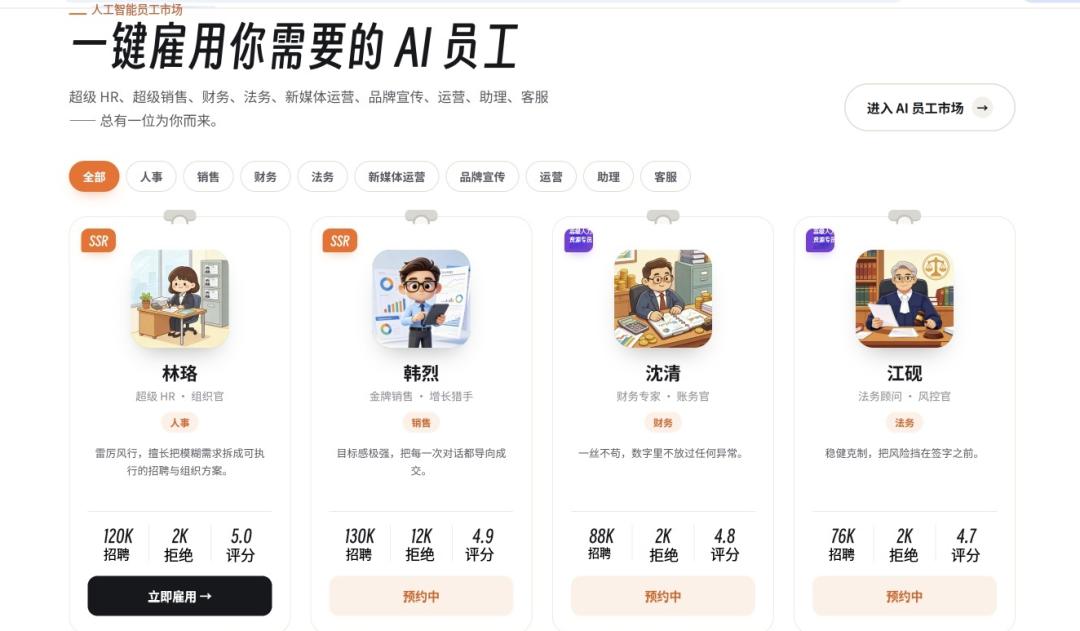
Super HR is only the starting point. MetaEnterprise AI plans to replicate this capability to cover other basic corporate roles in finance, legal affairs, sales, and other departments. The company has completed a seed funding round of several million RMB, and is currently advancing its angel round financing.
Its long-term vision is to allow enterprises to generate customized digital employees for different roles using natural language. For an AI system integrated into an organization, whether it can be properly managed, restricted, evaluated, and traced when errors occur, is the key factor determining its successful implementation in corporate business workflows.
The following is the edited conversation between "Future Human Lab" and Chen Meng, Founder of MetaEnterprise AI —

Tools Solve Individual Steps, Employees Solve Full Tasks
Future: Why do you insist on calling it a digital employee, rather than an AI recruitment tool?
MetaEnterprise AI: Tools solve isolated steps, while employees solve end-to-end tasks.
Ordinary tools may help you complete a single step, such as filtering resumes, drafting a paragraph, or generating a report. But digital employees are task-oriented. You do not instruct it to "help me screen resumes"; instead, you tell it "I need to hire an electronics engineer". It must work around this objective, independently break down the task, source candidates, filter profiles, communicate with candidates, assign scores, summarize results, and finally deliver the outcomes to human users.
It is more like an online employee. Users do not need to monitor every step of its work; it can advance tasks autonomously and report to humans only at critical milestones.
Future: What capabilities must an AI have to evolve from a tool into a real employee?
MetaEnterprise AI: We hope it can complete full closed-loop workflows just like a human being.
Many companies currently developing so-called super digital employees on the market are actually only building workflow systems that can handle partial steps. For example, RPA systems and Taobao customer service bots still require frequent human intervention at many stages, and cannot independently complete a full work cycle end-to-end.
If a task contains five steps A, B, C, D, and E, such systems may only handle A, C, and D, leaving other steps requiring human input. This means the efficiency improvement is far from significant.
We want our digital employees to independently complete a full closed-loop task just like a human. For example, if I assign a human HR to hire a finance specialist or administrative coordinator, their ultimate goal will definitely be to successfully recruit that person. If they misunderstand the requirements in the process, they can confirm with me and make timely corrections, but their final deliverable should be a fully vetted candidate, instead of pestering me for instructions at every single step.
If it interrupts me every step of the way, it will not save much of my time, and may even cause unnecessary delays.
Future: In what aspects must it behave like a human, and in what aspects should it not be too human-like?
MetaEnterprise AI: The human-like part refers to its ability to complete closed-loop workflows, acting as a smart, self-motivated high-performing employee.
Aspects that should not be human-like: first, humans need to rest, but AI can respond in real time 24/7 without interruption. The second aspect is cost. Large-scale commercial adoption requires significant cost reduction.
For example, a senior recruitment HR may earn 500,000 to 700,000 RMB per year in salary. Our goal is to cover the equivalent workload with a cost ranging from 50,000 to 100,000 RMB per year. The AI can deliver 80% of the output of a senior HR, but only cost 20% of that HR's salary. Only in this way can it truly deliver tangible value to enterprises, instead of being nothing more than a vanity project.
Future: If we integrate Super HR into a real recruitment workflow, what specific tasks will it perform?
MetaEnterprise AI: It mainly handles the repetitive, inefficient, and time-consuming work in the early stage of recruitment.
For example, looking at a recruitment funnel: you may start with 10,000 candidates, among whom around 200 are interested in the company; out of these 200, roughly 30 may be of interest to the company; after several rounds of communication, only 5 to 6 candidates are confirmed as suitable by both sides.
Our product handles the work from the candidate pool of 1,000-2,000 people down to the shortlist of 30 candidates. This includes searching for resumes, screening applications, assessing matching degrees, conducting initial communications, and organizing results. The final decision on whether a candidate accepts the offer still depends on how HR communicates with them, promotes the company's value proposition, and evaluates their value alignment with the organization.
Therefore, we focus on the matching work, while human HR teams still handle high-level communication, judgment, and relationship management tasks.
Future: What can't it do at the current stage? Which steps must be confirmed by humans?
MetaEnterprise AI: The very start and the very end of the recruitment process still require human involvement for now.
The starting point refers to defining recruitment requirements. HR teams do not generate these requirements on their own; most of the demands come from business leaders or hiring departments. Therefore, authentic, clearly defined recruitment requirements must still be input by business teams or company executives.
The ending point refers to the final interview assessment. AI can help you match information listed on resumes, but the final personal chemistry check, as well as evaluating soft skills such as a salesperson's communication EQ and organizational fit, still require human judgment.
Currently, AI can help you establish a baseline standard through resume reviews and initial communications, but the final judgment on high-level suitability still depends on humans. For example, if you prefer a salesperson to be rigorous and data-driven, or more empathetic and relationship-focused, this kind of subjective preference requires human final decision-making.

The Only Sign That Reminds You It Is AI May Be Its Blazing-Fast Response Speed
Future: Many AI products on the market today support chat functions. How do you determine if a digital employee has truly landed in real business scenarios?
MetaEnterprise AI: I believe we should not only evaluate if it can hold a conversation, but focus on whether it can integrate into real business workflows.
For recruitment scenarios, a real business workflow does not mean simply answering several recruitment-related questions; it means starting from the job requirements, then sourcing candidates, filtering them, communicating with them, assigning scores, and reporting results. It must be able to connect all these steps seamlessly.
Our current focus is product development, rather than building our own underlying large language model. We call on mature large models available on the market at the model layer, and concentrate our efforts on the application layer, context awareness, long-term memory, and cost control optimization.
If a senior HR tried to build a custom AI recruitment tool manually using a large model, the product performance might be close to ours. However, directly using raw large models consumes a huge number of tokens, and the system cannot permanently remember your unique preferences, requiring repeated re-alignment every time you use it.
Our goal is to make the AI memorize the company's specific preferences, reduce invocation costs, and turn it into a truly long-term usable product.
Future: Why did you choose to serve headhunters and recruitment teams in the first step, instead of directly targeting all small and medium-sized enterprises?
MetaEnterprise AI: Because headhunters and recruitment teams have high volumes of repetitive demands, and they demonstrate stronger willingness to pay.
A small or medium-sized enterprise with 10 to 20 employees may only hire 6 to 7 people in a normal year. Paying over 10,000 or even 30,000 RMB for a professional version of the product may not be cost-effective for them. The business owner can handle the recruitment work themselves when they have spare time.
But headhunters are different: the more candidates they successfully place, the more revenue they generate. They have massive recruitment demands and strong motivation to improve efficiency. Dedicated recruitment teams at large corporations, and recruitment teams at fast-growing startups, share similar demands.
Our ultimate goal is to serve small and medium-sized enterprises, but these businesses will not purchase AI recruitment tools from Company A, AI legal tools from Company B, and AI sales tools from Company C. We hope to integrate AI-powered HR