OpenAI has fully opened the ChatGPT Health feature, general-purpose AI assistants are entering the medical and healthcare track, do vertical apps still have opportunities to achieve breakthroughs?
According to media reports, OpenAI has officially fully rolled out the ChatGPT Health feature to users in the United States today, with support for integration with personal health data services such as Apple Health, Function Health, and MyFitnessPal. This is no ordinary feature update, as it sends a critical industry signal: general-purpose AI assistants are continuously penetrating into sectors with high trust thresholds, highly sensitive data authorization requirements, and stricter standards for product accountability and user commitments, such as healthcare.
Monitoring data from Qimai Data shows that at 10:00 on July 24, ChatGPT ranked first on three U.S. iPhone charts: the Free Apps Chart, the Overall Top-Grossing Chart, and the Productivity Top-Grossing Chart. It is clear that leading AI assistants are not only competing for new download traffic, but have also secured a stable position in the App Store's paid access ecosystem.
For iOS developers, the key issue to focus on now is no longer "whether to build AI features into your app". As general-purpose AI begins to deeply penetrate high-trust scenarios including healthcare, productivity, finance, and education, what can vertical apps rely on to build their own differentiated competitive advantages?
Full Launch of ChatGPT Health: General-Purpose AI Assistants Double Down on Healthcare Scenarios
According to industry media reports, ChatGPT Health is available to users aged 18 and above in the United States. Users can directly obtain AI-powered health advice through conversations, covering core areas such as common medical conditions, medication guidance, test result interpretation, and mental health. The feature is now fully accessible on both the ChatGPT web platform and iOS app, and all users (including Free, Go, Plus, and Pro tiers) can directly enable and experience it via the sidebar entry.
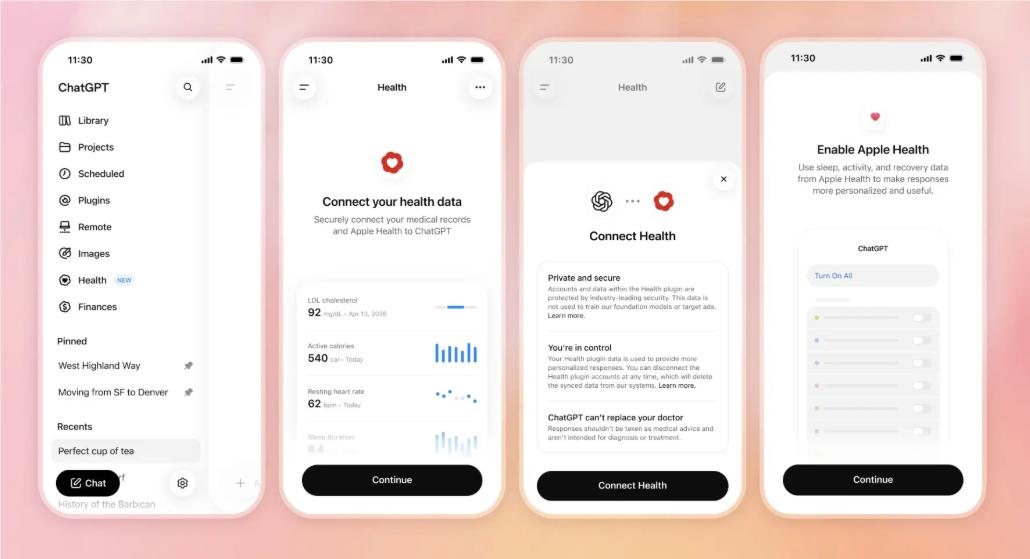
This announcement signals a deeper shift in scenario migration. In the past, the main usage scenarios for AI assistants were concentrated in areas such as content creation, search, translation, code editing, and office work; the full launch of ChatGPT Health drives AI assistants to migrate to high-trust scenarios including health record management, personal health data interpretation, and long-term health tracking. The competitive barriers in these scenarios are not limited to large model capabilities, but also include transparency in data authorization, clarity of privacy policy explanations, clear boundaries for output results, user retention rates, and users' tolerance for incorrect AI conclusions.
Leading AI Assistants Raise User Expectations, But Small and Medium Teams Still Have Opportunities to Stand Out
At 10:00 on July 24, Qimai Data's monitoring found that the top ranks of the U.S. iPhone Productivity Top-Grossing Chart are occupied by multiple AI assistants: ChatGPT ranks 1st, Claude 2nd, Grok AI 3rd, and Perplexity also firmly holds a top spot on the chart. The Free Apps Chart reflects traffic changes, while the Overall Top-Grossing Chart demonstrates a product's paid conversion capability; when products of the same category occupy both charts simultaneously, it means that competition in the AI assistant track has moved past the novelty trial phase and entered a new stage focused on competing for sustained payment capabilities.
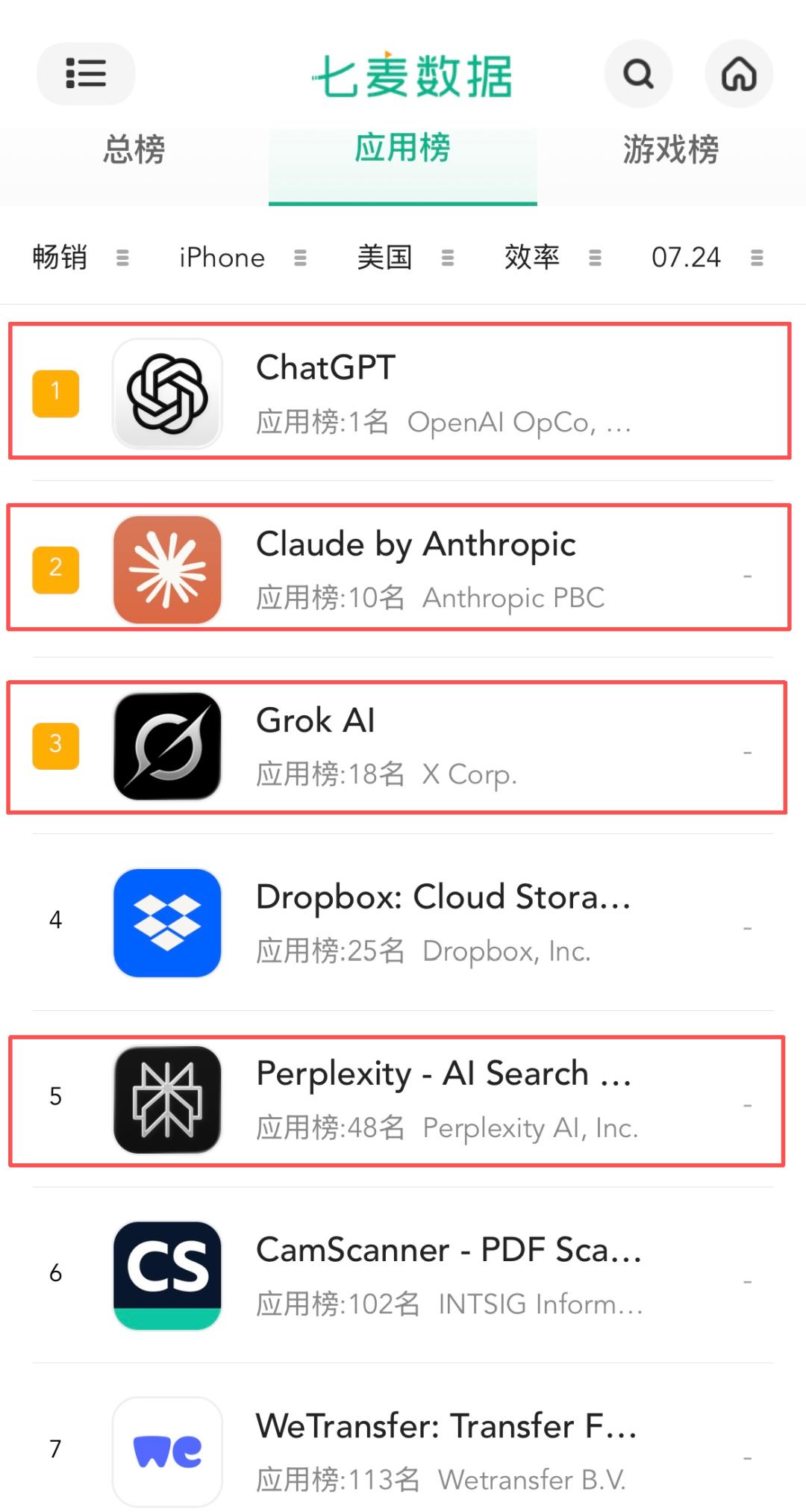
U.S. iPhone Productivity Top-Grossing Chart rankings at 10:00 on July 24
The key takeaway of ChatGPT Health for developers is that industry competition is shifting from a contest of "who has faster response speeds" to a battle of "who can better gain user trust and convince users to hand over highly sensitive personal data". Sectors including healthcare, personal finance, education planning, job hunting, and household asset management share the same characteristics: users not only demand accurate answers, but also require verifiable supporting evidence for content, traceable operation records, clear risk boundaries, and long-term continuous service delivery.
This actually creates opportunities for developers in vertical tracks. While general-purpose AI assistants have raised user expectations, they often struggle to dig deep into vertical industry workflows, compliance requirements, professional content moderation, offline supporting services, data error correction, and performance review processes. Small and medium teams that only build a superficial AI conversation shell will face continuous competitive pressure from leading products, but those that focus on a single track to build a complete business closed loop still have a chance to break through.
Three Key Checkpoints for Developers to Implement AI Features
For apps in high-trust categories such as healthcare, finance, and education, and vertical scenario apps that aim to further build their own competitive moats, you can prioritize checking the following three aspects and make corresponding optimizations:
First, rework your product page description. For high-trust categories like healthcare, you cannot make vague claims on your product page that "AI can help you analyze everything". In your creative assets and copy, you should clearly list the types of data that support integration, explicitly state that AI cannot replace professional personnel to make medical judgments, and inform users how to independently manage data authorization, as well as the rules for data storage and deletion. Product page screenshots, privacy statements, and above-the-fold copy all need to reduce user doubts and anxiety.
Second, design features as complete workflows rather than a single conversation window. In scenarios such as health record management, budget management, study planning, and career planning, users' core demands are for continuous tasks: smart reminders, information logging, content interpretation, periodic reviews, and generation of next-step action plans. AI is well-suited to serve as the interactive carrier, but the core value of the product needs to be embedded in reusable, complete workflows.
Third, growth teams need to distinguish between general AI demands and precise vertical demands, and test and verify them separately. You can leverage custom product pages to segment different user groups for scenarios such as health tracking, diet management, sports recovery, and office productivity; then combine Apple Ads and App Analytics to observe which product page descriptions deliver higher conversion and retention rates, avoiding investing all your budget in broad, generic AI-related keywords.
Conclusion
The significance of ChatGPT Health's full launch is not about the "AI healthcare" concept, but that leading AI assistants have begun to compete for the entry point of high-trust scenarios. Based on a comprehensive analysis of today's U.S. App Store charts, ChatGPT app metadata, the rankings of leading AI assistants on top-grossing charts, and public information, the next phase of AI assistant competition will place greater emphasis on user data governance, complete task closed loops, and trust system construction.
This also points out a viable direction for developers in vertical tracks: there is no need to compete with general-purpose AI assistants on being "all-powerful", but instead to thoroughly master the business risks, standard workflows, and user motivations for sustained payment within a single specific scenario. Especially for health, finance, education, and household utility apps, future product pages, permission pop-ups, subscription page introductions, and review section operations all need to treat "trustworthiness" as a core product capability, rather than a simple marketing slogan.
Competition for traffic entry points in the AI assistant space is gradually tightening, and high-trust scenarios will become the critical arena for testing a product's sustained payment capability.
Does your product already have clear data authorization instructions and comprehensive risk warnings? Can you convert a single AI conversation into a complete product workflow that users will continue to use in the long term?
*This article is sourced from Mint, and the copyright of the article belongs to the original author. The content is for exchange and reference only, and does not constitute professional advice.
This article is from the WeChat Official Account "Qimai Research Institute", author: Mint, published with authorization from 36Kr.