Wang Hong and Deng Yu won the Fields Medal: Mathematics is not a game for loners
Chinese mathematicians Hong Wang and Yu Deng have both been awarded the Fields Medal, sparking nationwide enthusiasm for mathematics and reshaping public perceptions of the discipline. Fundamental research, which demands extreme focus and long-term dedication, is by no means a game for loners.
In many popular stereotypes, mathematics is often seen as a somewhat "arduous" subject that requires relentless contemplation among piles of books and in front of blackboards. Past publicity about Chinese mathematicians in the last century frequently centered on the unimaginable perseverance and hardships they endured.
Diligence and hard work are indispensable for fundamental disciplines, but outstanding mathematicians are far from being "bookworms."
After Hong Wang won the award, the public has been abuzz with discussions about this Guangxi native's passion and talent for mathematics, while also taking a casual interest in her relatively unremarkable undergraduate days at Peking University and various small details from her daily life.
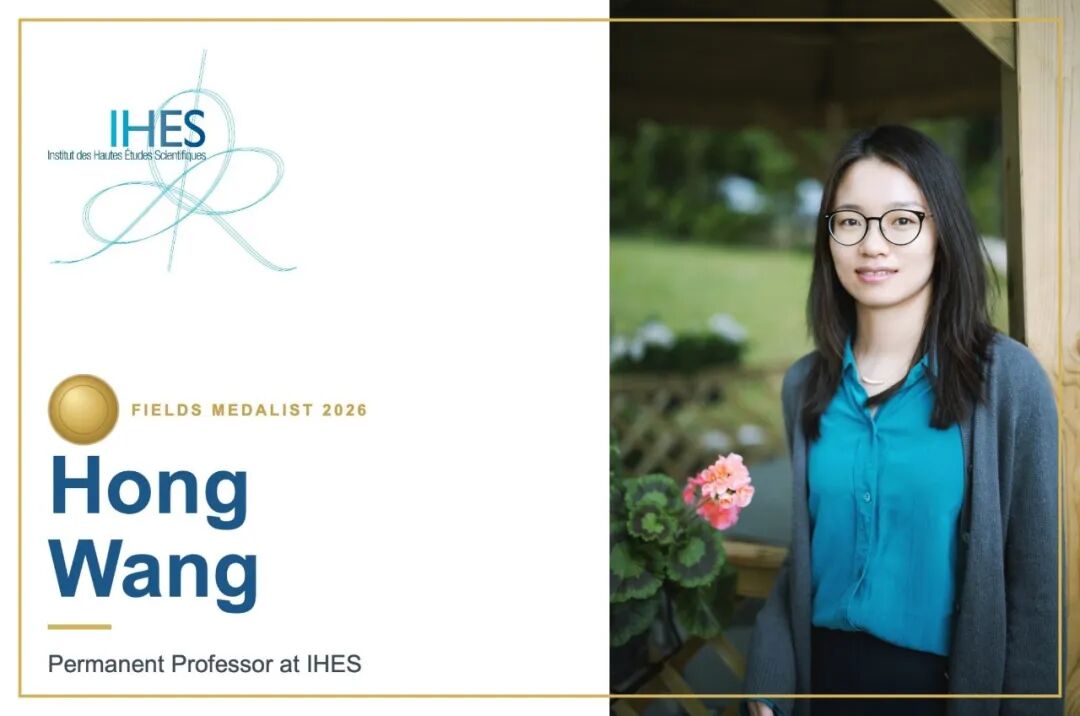
(Award announcement poster for Hong Wang at the Institut des Hautes Études Scientifiques (IHES) | Source: IHES official website)
Hong Wang mentioned in an interview with China Science Daily that during her graduate studies at École Polytechnique in Paris, France, she once considered switching careers, even interning at an architecture firm for a month before realizing mathematics was still her true calling. After starting her postdoctoral research at the Massachusetts Institute of Technology, she no longer doubted her aptitude for the subject. Her advisor, Larry Guth, was patient and empathetic, presenting her with unique problems while giving her ample time to think through solutions on her own.
The process of thinking through problems independently, rather than rushing to find answers, is of great importance. Hong Wang stated, "When you figure out for yourself that an idea is flawed instead of being told by others, you accumulate far more experience, learning to recognize what makes a solid idea rather than simply taking others' words at face value."
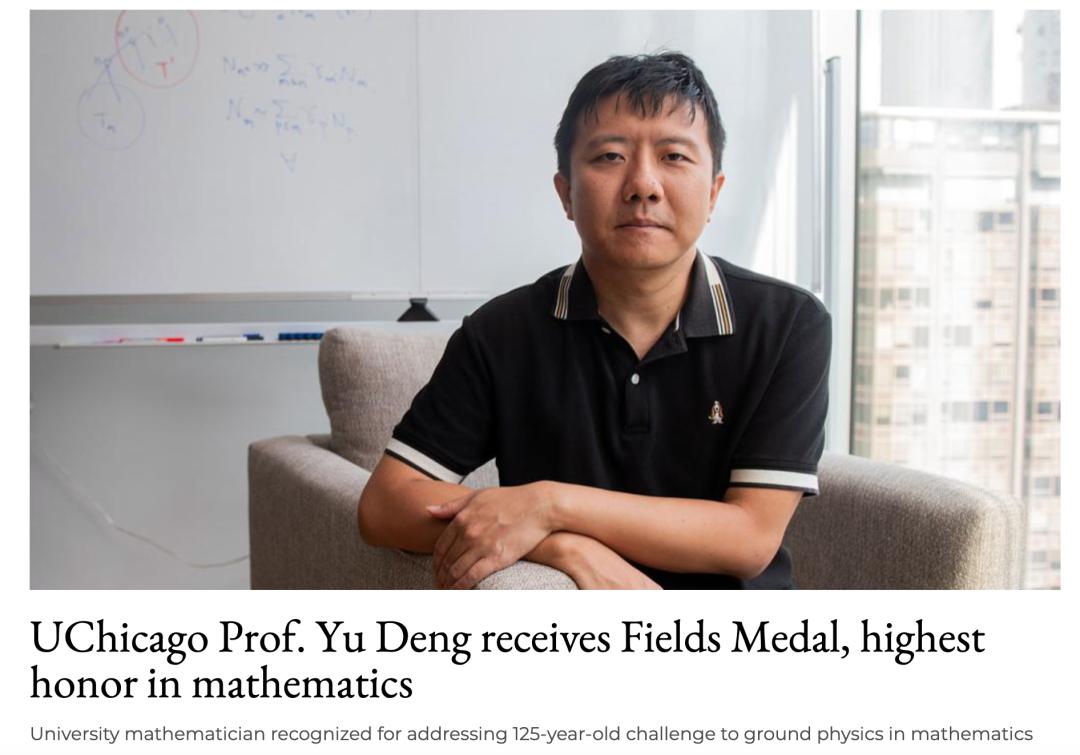
(University of Chicago official website coverage of Yu Deng's award | Source: Official website screenshot)
The life journey of Shenzhen native Yu Deng has also drawn widespread attention. He maintains broad curiosity and enthusiasm for the world, enjoys anime and classical poetry, loves discussing ideas with others, and even frequently engages with the public on Zhihu to explore mathematical problems. Zheng Guoyou, Yu Deng's high school history teacher, recalled to Shenzhen Special Zone Daily that Yu Deng possessed exceptional powers of concentration. He also excelled in history class, and whenever he encountered a famous quote, he would ask: "Teacher, who first said this?" "What was the original text?" "What was the context in which it was spoken?"
Yu Deng remarked, "I dislike repetitive work, but as a famous quote puts it, 'the essence of mathematics lies in its freedom.' Mathematics offers infinite possibilities waiting for you to explore, bringing new and exciting challenges every single day."
Both Hong Wang and Yu Deng received their primary and secondary education in China, and earned their bachelor's degrees at Peking University. This is a source of great pride for China, and it demonstrates the strength of China's education system in cultivating top mathematical talent. Yu Deng now serves as a professor at the University of Chicago, while Hong Wang is a permanent professor at the Institut des Hautes Études Scientifiques (IHES) in France, and also holds a concurrent professorship at the Courant Institute of Mathematical Sciences at New York University (NYU Courant). Their achievements prove that outstanding Chinese talents have the capability to lead global research and contribute cutting-edge strength to the advancement of humanity.
This kind of global mobility and collaboration fosters talent development, forming the foundation of a thriving academic ecosystem. In an era of receding globalization, we should cherish and encourage such global academic network collaborations.
Geniuses always appear in clusters. The process of thinking requires independent exploration rather than blind adherence to external opinions, but academic research often thrives on mutual inspiration, where achievements are made through collaboration.
Hong Wang shared during an interview at the International Congress of Chinese Mathematicians (ICCM2025) that during her postdoctoral research at the Institute for Advanced Study (IAS), she was stuck on a single research problem for a year and a half. Eventually, she decided to launch several small-scale projects with her collaborators. These discussions led to highly productive partnerships, which ultimately shaped her current research focus on harmonic analysis and geometric measure theory.
Professor Xuhua He from the University of Hong Kong, who was elected Vice President of the International Mathematical Union (IMU) on July 21, commented on the two winners that this phenomenon is not an isolated academic highlight, but a remarkable sign that Chinese mathematical research has deeply integrated into the global innovation network, gradually evolving from a "frontier follower" to a "key contributor." The landmark research breakthroughs made by Hong Wang and Yu Deng not only solve long-standing unsolved international problems, but also represent that Chinese mathematicians are using original methods and techniques to reshape the landscape of contemporary mathematics.
At 47 years old, Xuhua He is the youngest Vice President of the IMU in nearly 20 years. The IMU not only coordinates the quadrennial International Congress of Mathematicians (ICM), but also oversees the selection of the Fields Medal, widely known as the "Nobel Prize of Mathematics."
Xuhua He believes that the Chinese mathematics community is transforming from a "participant" to a "co-builder," taking on the important exploratory responsibility when solving abstract scientific issues of shared concern to humanity. Hong Kong boasts a highly international and inclusive academic environment and institutional framework, as well as multiple world-leading universities and research institutions, which can provide these "pioneers" and "leaders" with a cutting-edge international dialogue platform, acting as a hub connecting the Chinese mathematics community to top global academic forces. Additionally, mathematics is a "long-cycle" fundamental science, where breakthroughs often rely on deep dedication and focus. Hong Kong's scientific research funding mechanisms and international talent introduction policies are well-positioned to provide long-term support for top young scholars, encouraging them to take a long-term perspective and strive for new heights.
In fact, the Guangdong-Hong Kong-Macao Greater Bay Area is rapidly emerging as a major hub for mathematical research. The University of Hong Kong recently successfully welcomed Fields Medalist Professor Ngô Bảo Châu to join its faculty.
Regarding this, Professor Yang Wang, Vice President of the University of Hong Kong and a renowned mathematician, stated that fundamental mathematics is on the eve of a profound paradigm shift. The landscape of future major mathematical breakthroughs will no longer be limited to "geniuses contemplating alone in front of a blackboard." We are rapidly advancing into a deep era of "Human-AI Partnership".
Recently, AI has demonstrated astonishing potential in assisting with solving the Erdős problem and disproving the Jacobian Conjecture. Yang Wang believes this clearly indicates that AI is no longer merely a computational tool for auxiliary verification; it is evolving into an "academic partner" capable of providing mathematical intuition and even opening up entirely new theoretical paths.
Yang Wang emphasized that the future positioning of the University of Hong Kong is not only to be a key hub for traditional mathematical research, but also to build a super academic ecosystem that seamlessly integrates "top human intelligence" and "cutting-edge AI technologies".
This should also be the positioning for academic research in the Greater Bay Area: showcasing Chinese ingenuity while integrating global wisdom, seizing the transformative opportunities brought by AI, enabling mathematicians to not only describe the world through mathematical language, but also powerfully shape the global future.
For ordinary people who are not mathematicians, what we can learn from them is their passion and perseverance when exploring the unknown, and to maintain a sense of curiosity about the world.
As Yu Deng noted, even in today's era swept by the AI wave, while derivation processes can be effectively simplified, core planning capabilities remain irreplaceable. Solid logical thinking and computational skills will always be the cornerstone of exploring the unknown. The more we are in the AI era, the more we must "lay a solid foundation as much as possible, always maintain curiosity about the unknown world, and then find the direction you truly love through continuous exploration."
This article is from the WeChat official account "Workplace Anthropology", written by Workplace Anthropology Xiaowen, and published with authorization from 36Kr.