The world's first 2nm GPU is here. Lisa Su has launched the "most powerful AI rack", whose CPU performance outclasses NVIDIA's.
Reporting from San Jose, July 23 by Zhidx, just now at the annual AMD Advancing AI Conference, Dr. Lisa Su, AMD Chairperson and CEO, made a series of major announcements, unveiling AMD's most powerful AI chip the Instinct MI455X GPU, the "most powerful agent CPU" Venice, the "most powerful rack-scale AI infrastructure" Helios, as well as a new Ryzen chip designed specifically for robots.
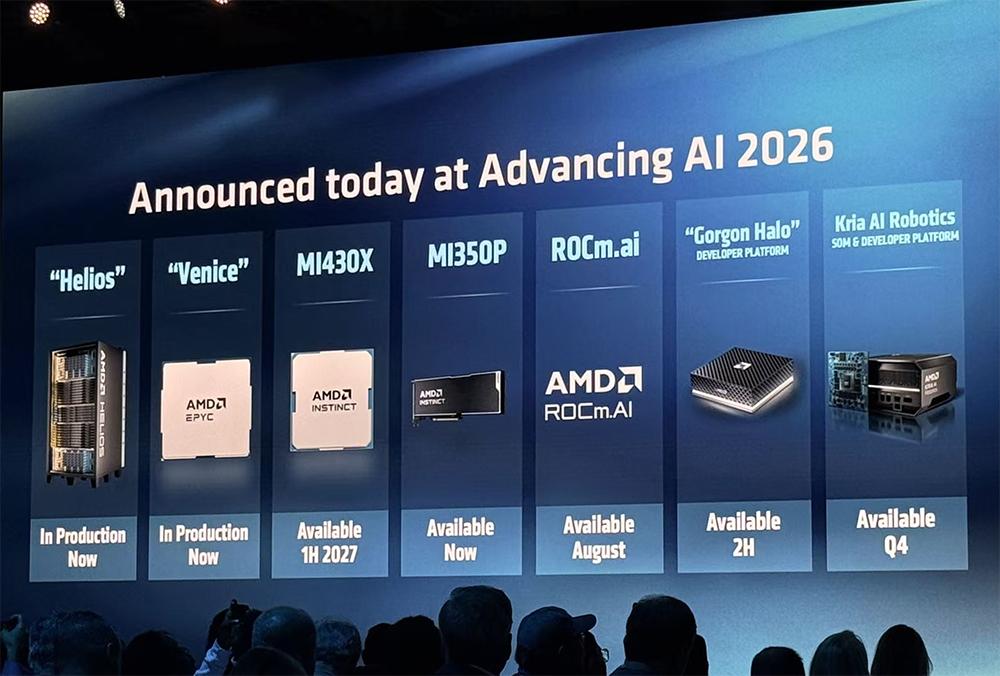
Today AMD announced 7 major releases:
- Most powerful rack-scale AI infrastructure Helios
- Most powerful agent server CPU "Venice"
- Data center AI chip MI430
- Air-cooled PCIe GPU MI350P
- AI software stack ROCm.ai
- On-premise AI developer platform "Gorgon Halo"
- Kria AI robot system module & developer platform
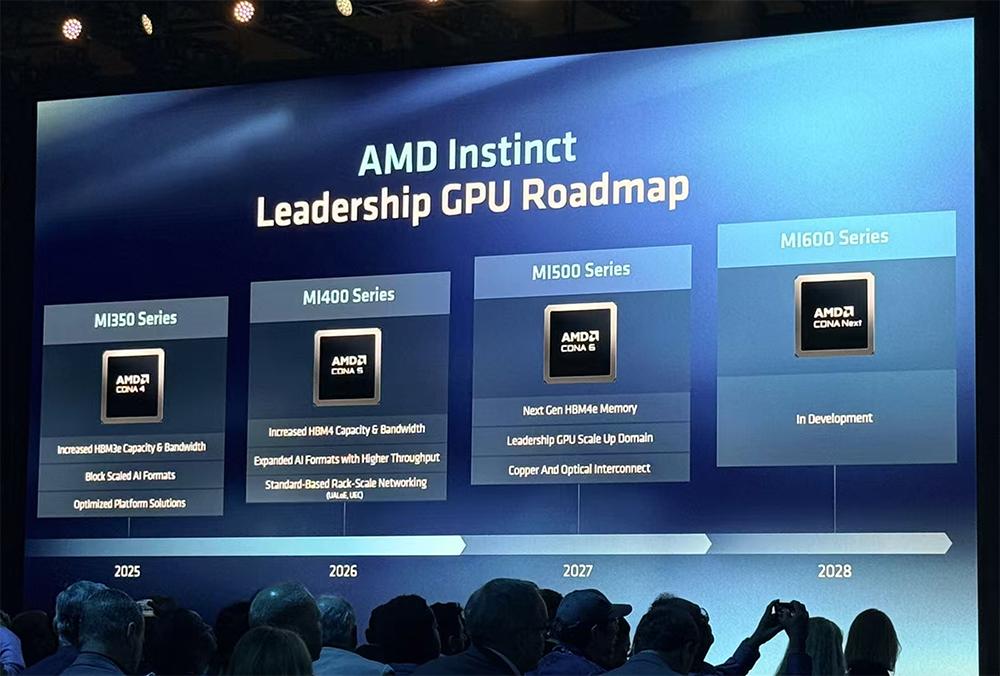
At the same time, Lisa Su unveiled the latest roadmaps for AMD GPUs, CPUs, and rack-scale AI infrastructure.
For GPU products, the MI500 series is expected to launch next year, featuring next-generation HBM, support for larger scale-up networks, and the introduction of new copper interconnect and optical interconnect technologies; the MI600 series is currently in development and will launch in 2028.
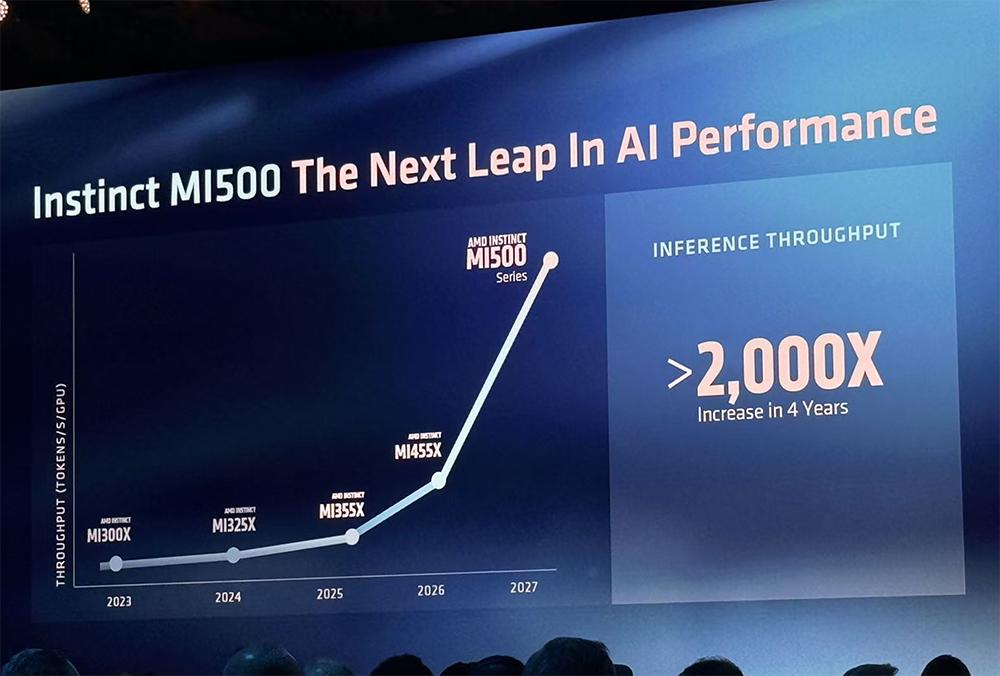
The inference throughput of the next-generation MI500 will surge to over 2000 times that of the MI300X.
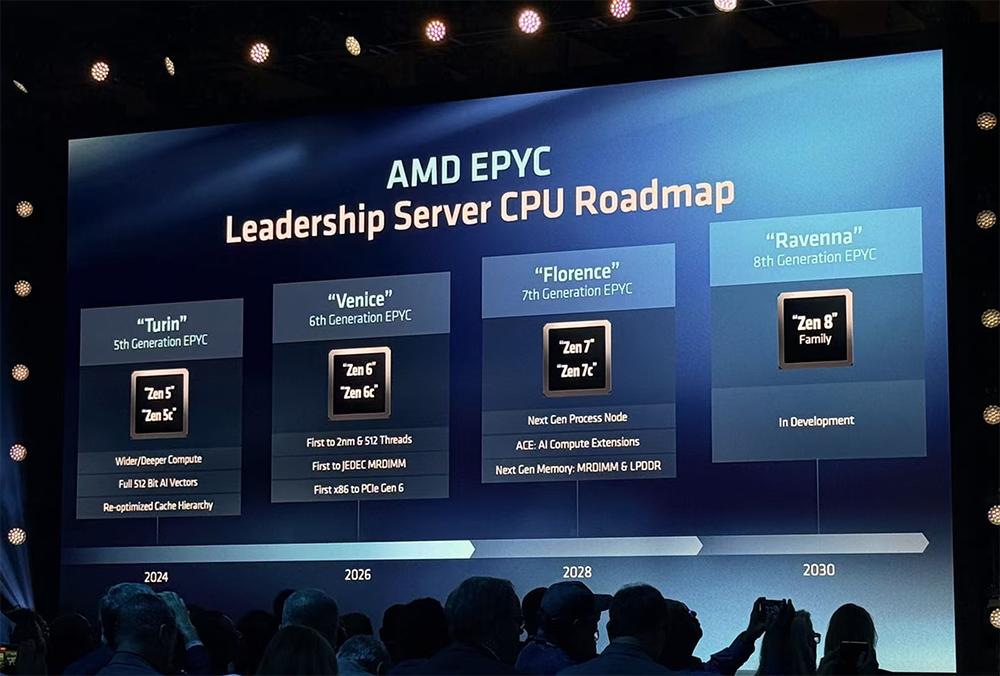
Among server CPUs, the sixth-generation "Venice" launched today is AMD's first 2nm server CPU, marking the first use of 512 threads and PCIe 6.0; the seventh-generation server CPU "Florence" will adopt a new generation of process nodes and memory, and is expected to ship in 2028; the eighth-generation "Ravenna" is in development and expected to ship in 2030.
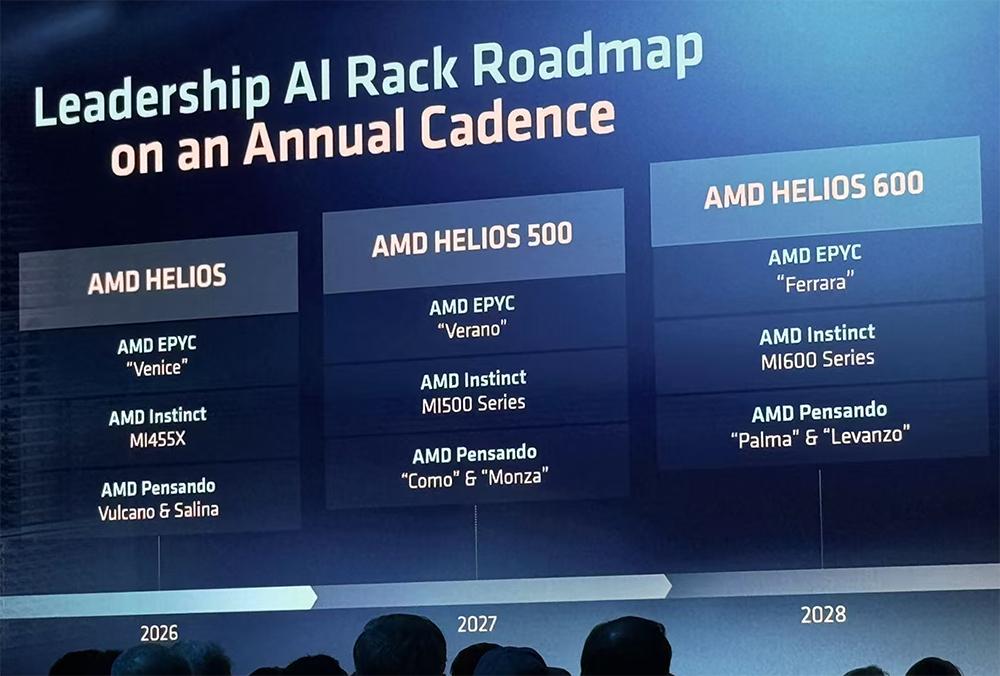
For rack-scale AI infrastructure, the three-year roadmap is as follows:
- Helios is launched today, featuring "Venice" CPUs, MI455X series GPUs, Pensando "Vulcano" AI NICs and "Salina" DPUs.
- Helios 500 will arrive next year, featuring "Verano" CPUs, MI500 series GPUs, Pensando "Como" AI NICs and "Monza" DPUs.
- Helios 600 is scheduled to ship in 2028, featuring "Ferrara" CPUs, MI600 series GPUs, Pensando "Palma" AI NICs and "Levanzo" DPUs.
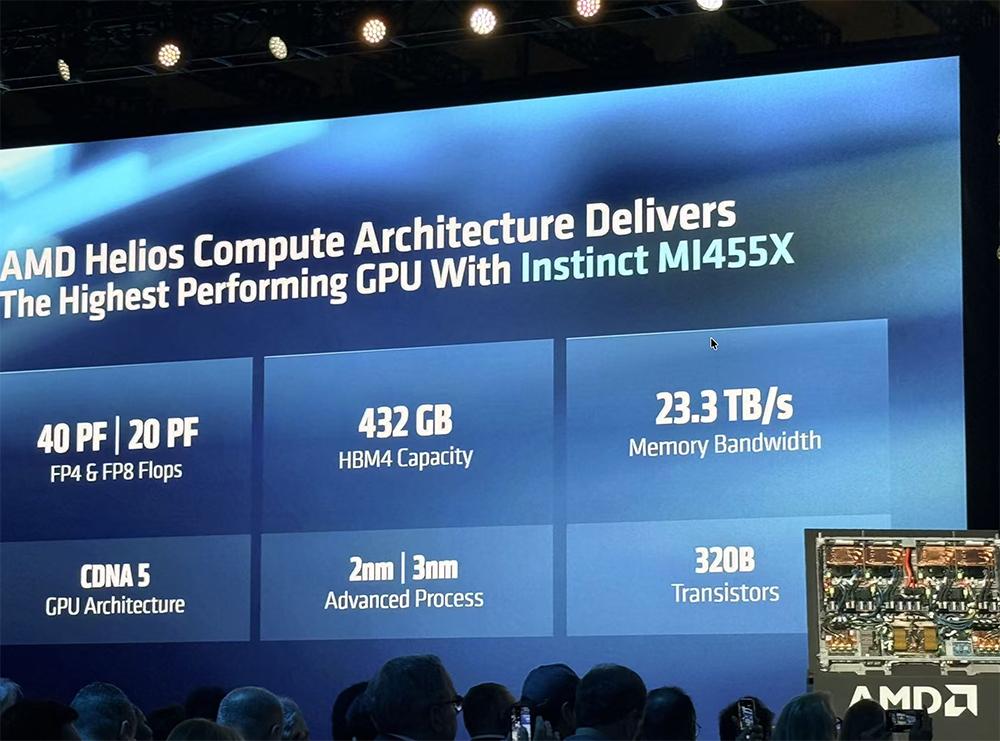
For the MI455X GPU, it is manufactured using TSMC's 2nm and 3nm process technologies, based on the CDNA 5 architecture, packs 320 billion transistors, leverages innovative Chiplet design, combining 12 compute chiplets and an I/O chiplet with 432GB of HBM4, and uses advanced 3D stacked packaging technology.
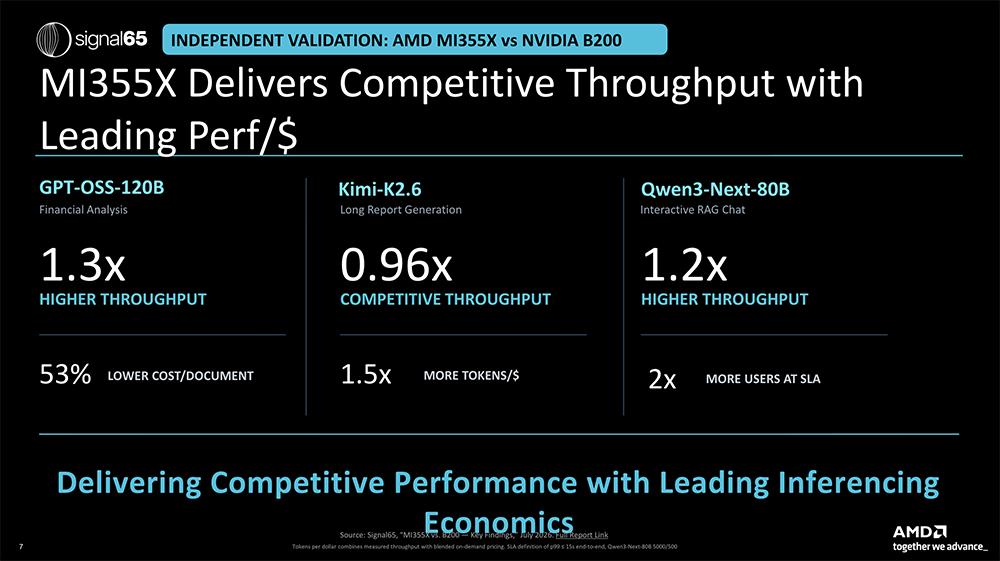
An independent report recently released by Signal65 shows that when testing real-world workloads with multiple mainstream open-source models, the throughput of the previous-generation AMD MI355X GPU approaches or even exceeds that of NVIDIA's B200, while offering higher cost-performance.
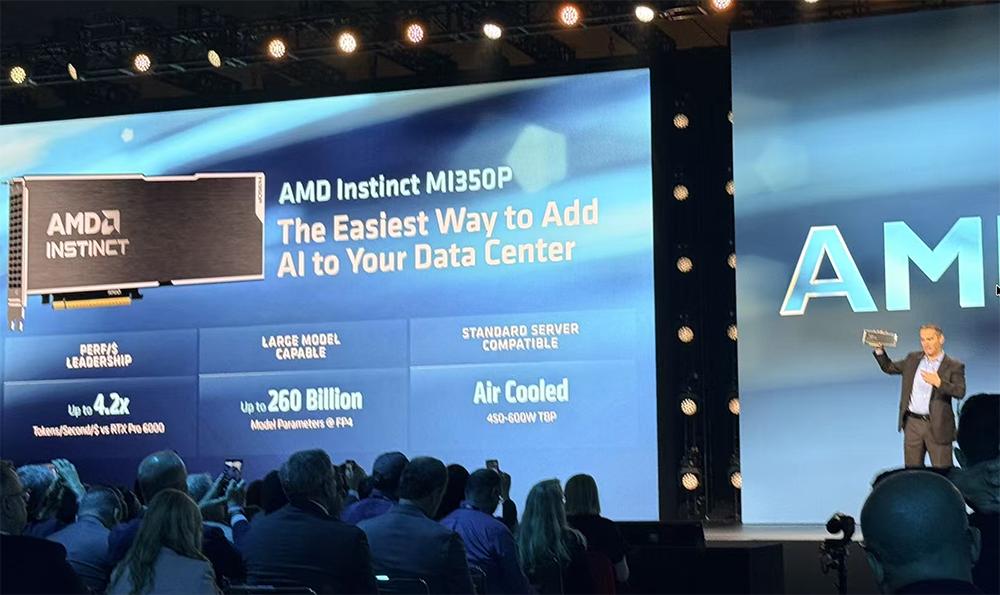
AMD also launched an air-cooled PCIe GPU for enterprise servers — the Instinct MI350P, which features 144GB HBM3E, approximately 4TB/s of memory bandwidth, PCIe 5.0 x16, a maximum power draw of around 600W, and can also be configured to around 450W. A single card can support models with up to approximately 260 billion parameters.
The number of tokens generated per dollar per second for the MI350P is 4.2 times that of the NVIDIA RTX Pro 4000.
AMD internally conducted key tests on two scenarios: autonomous threat detection and running personal agents. Through token routing, part of requests are sent to cutting-edge cloud models, while the other part are routed to open-weight models running on EPYC and MI350P. Ultimately, token costs are reduced by approximately 43%, and the response speed of on-premise workloads is increased by up to 3 times.
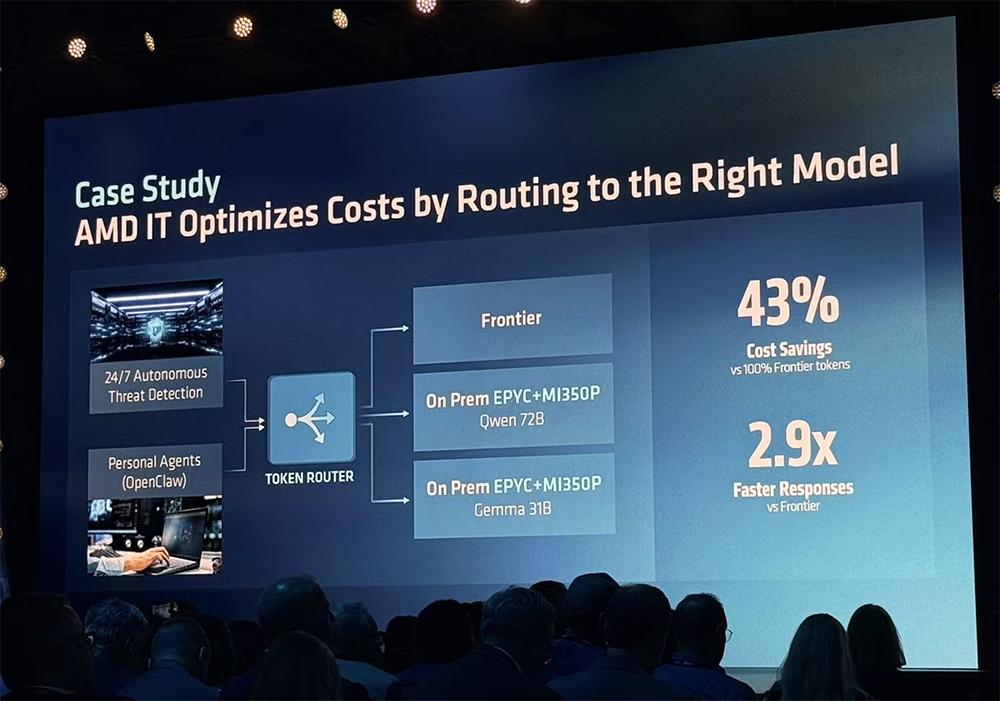
This hybrid architecture combining cutting-edge cloud models and enterprise on-premise models will become an important deployment method for enterprise AI.
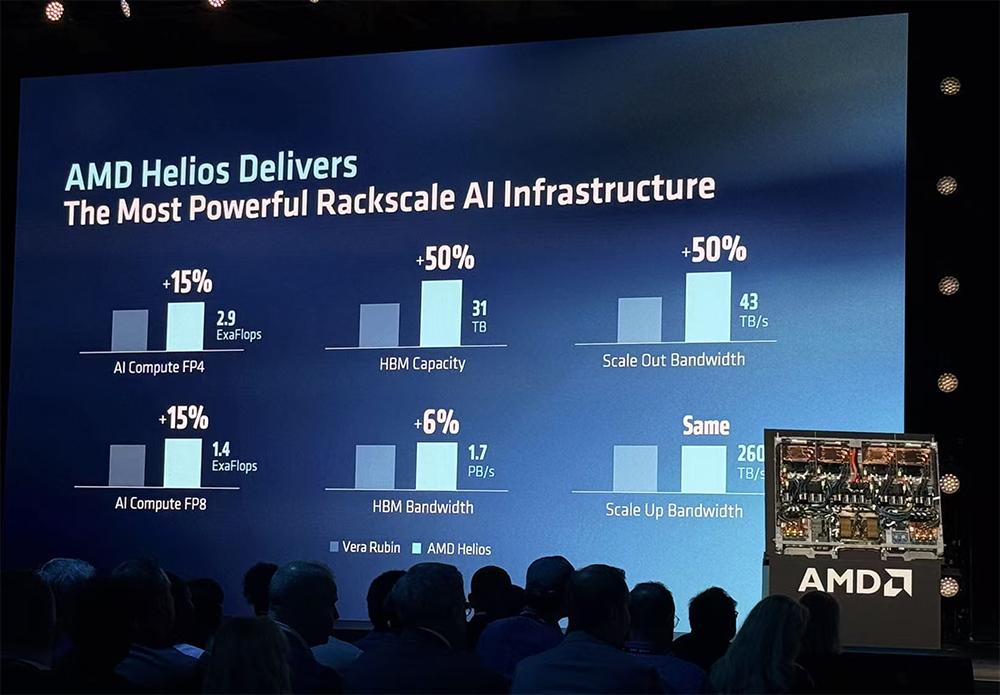
In terms of rack-scale AI infrastructure, AMD conducted a detailed comparison between Helios and NVIDIA's Vera Rubin rack. Helios outperforms in FP4 performance, FP8 performance, HBM capacity and bandwidth, and scale-out bandwidth.
These are the measured performance figures of Helios obtained by AMD: HBM bandwidth reaches 20TB/s, FP4 computing power reaches 20 PFLOPS, single-GPU scale-up bandwidth is 3.2TB/s, and scale-out bandwidth is 190GB/s.
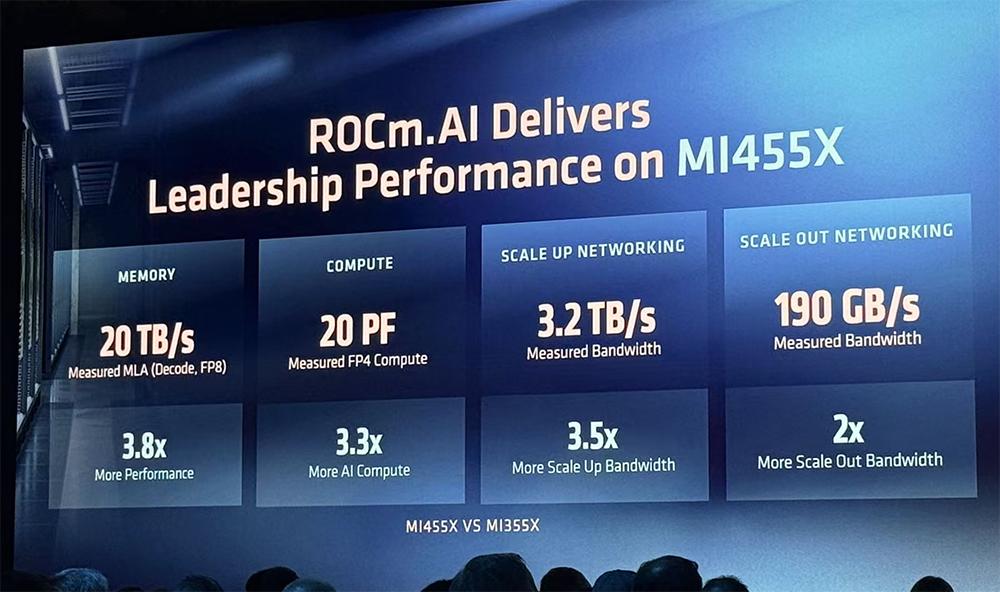
AMD executives stated that these are "the highest measured performance numbers ever publicly released by a GPU manufacturer."
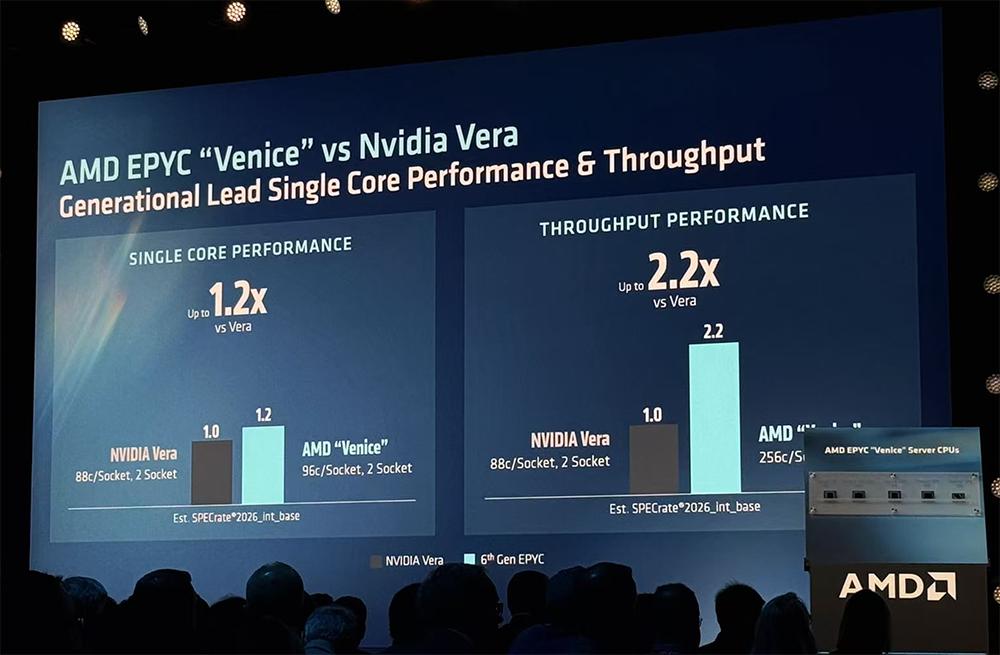
On the CPU side, AMD compared the performance data of "Venice" with NVIDIA's Vera CPU, which was just disclosed this week: the throughput performance of "Venice" is 2.2 times that of Vera, and per-core performance leads by 20% out of the box, without any performance tuning.
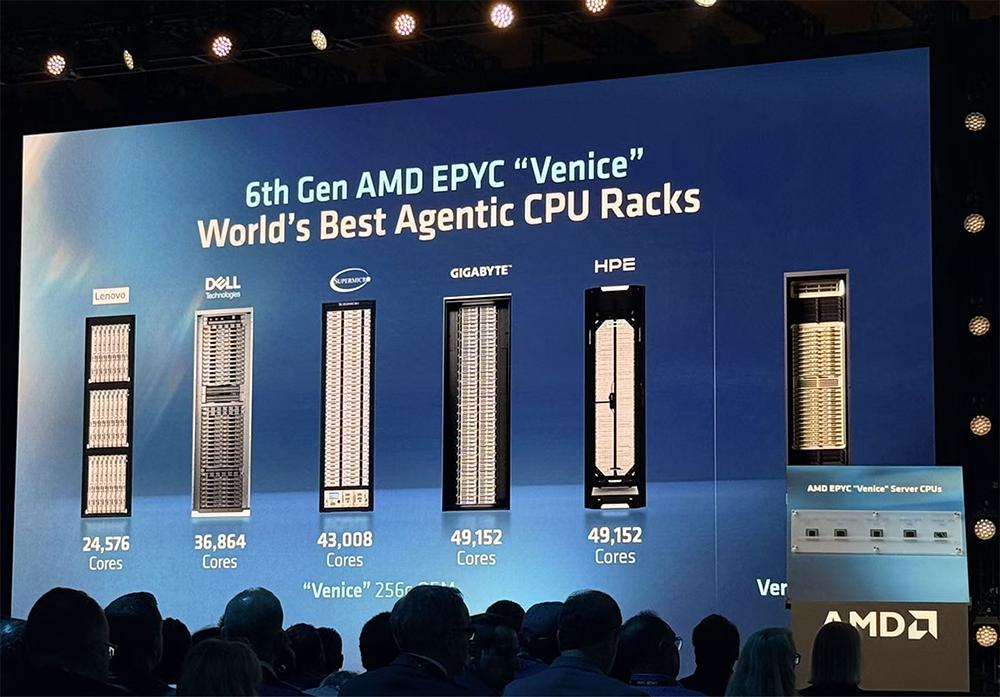
A rack equipped with the "world's most powerful agent CPU" is naturally the "world's most powerful agent CPU rack".
For on-premise local AI, "Gorgon Halo", the high-end upgrade of the AMD Ryzen AI Max 400 series, features 192GB of unified memory and can run 300-billion-parameter large models locally.
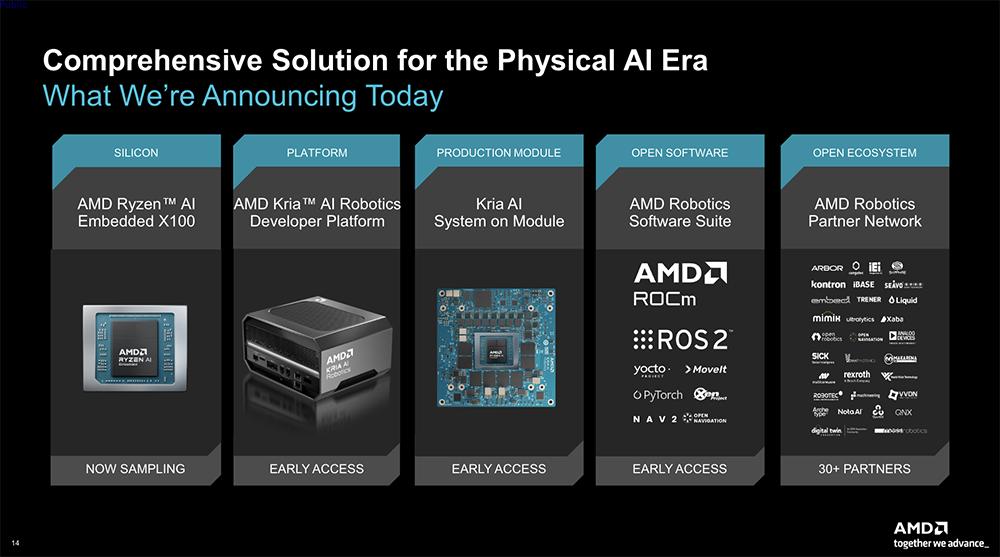
For physical AI, AMD launched the Ryzen AI Embedded X100 series processors, the Kira AI robot developer platform, Kria AI system computing modules, the Kria AI robot software suite, and showcased its robot partner ecosystem.
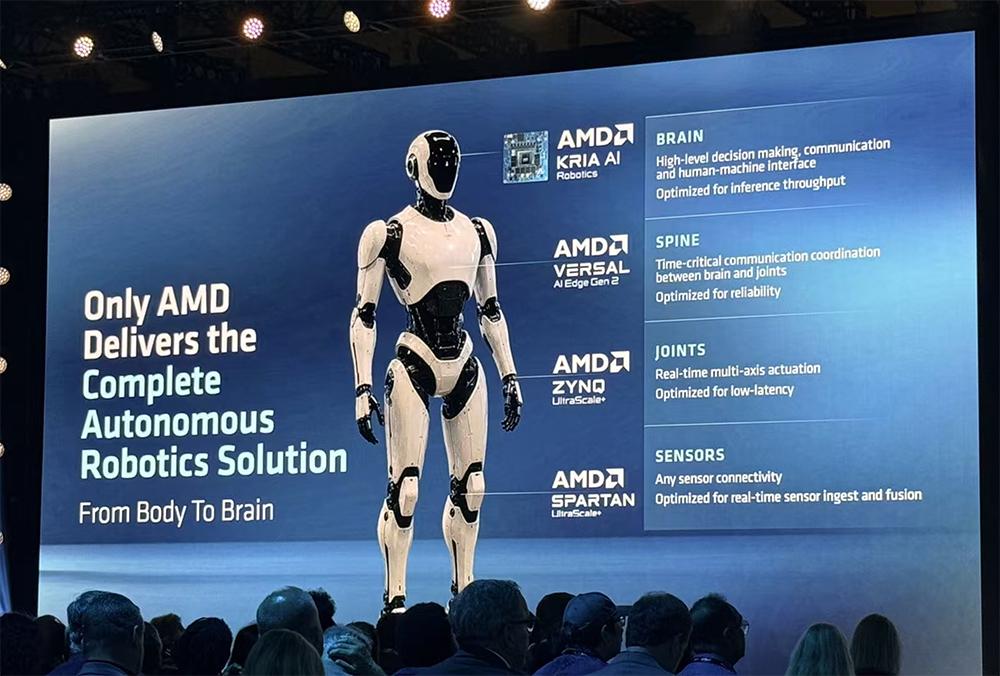
AMD also emphasized that its product portfolio can cover the entire stack of autonomous robots, from body to brain:
- Kira AI: the "brain" of the robot, responsible for advanced perception and reasoning.
- Versal AI Edge: the "spine" of the robot, responsible for high-speed data processing and adaptive computing.
- Zynq UltraScale+: the "joints" of the robot, responsible for real-time control.
- Spartan UltraScale+: handles sensor connectivity and low-level interfaces.
On the software side, AMD launched the ROCm.ai software stack, and released demo videos of it running MiniMax M3 and DeepSeek-V4 Pro.
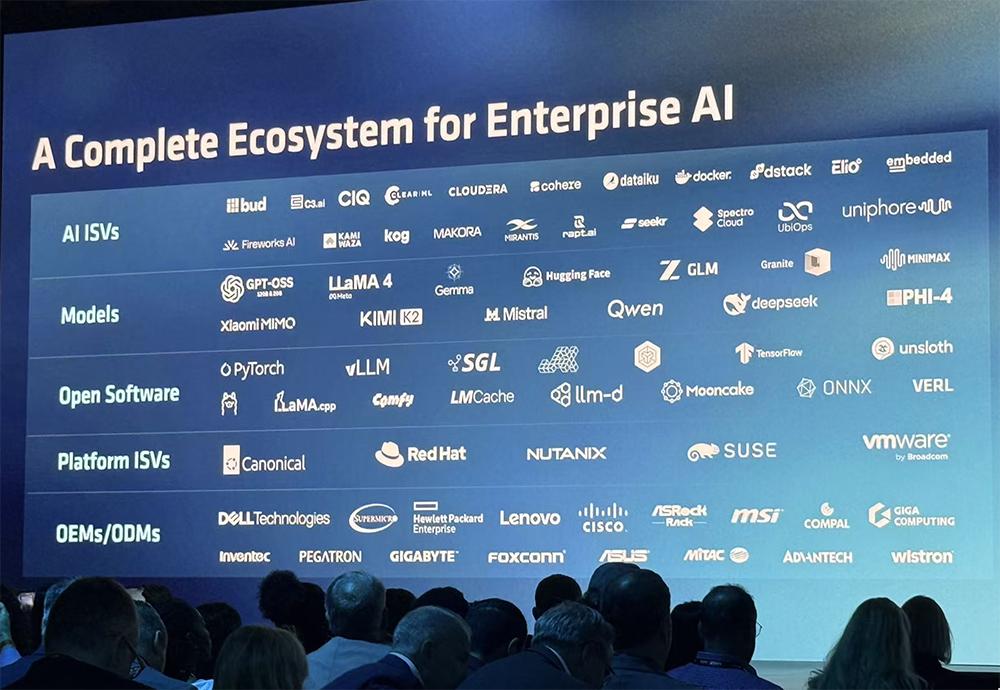
During this conference, we saw the names of many Chinese partners and models. For example, enterprises such as ByteDance, Tencent, Alibaba, Moonshot AI, and models such as MiniMax, DeepSeek, Kimi, Xiaomi MiMo, GLM, Qwen.
Interestingly, in addition to launching its own AI chips, AMD also announced at the conference that it has established a technical partnership with US AI chip company Cerebras Systems, to jointly launch a brand-new decoupled AI inference solution that combines AMD's Helios rack-scale solution with Cerebras' wafer-level engine. It is expected that when the two computing engines work together, tokens per watt per second will increase by 5 times.
Cerebras plans to deploy AMD Hel